
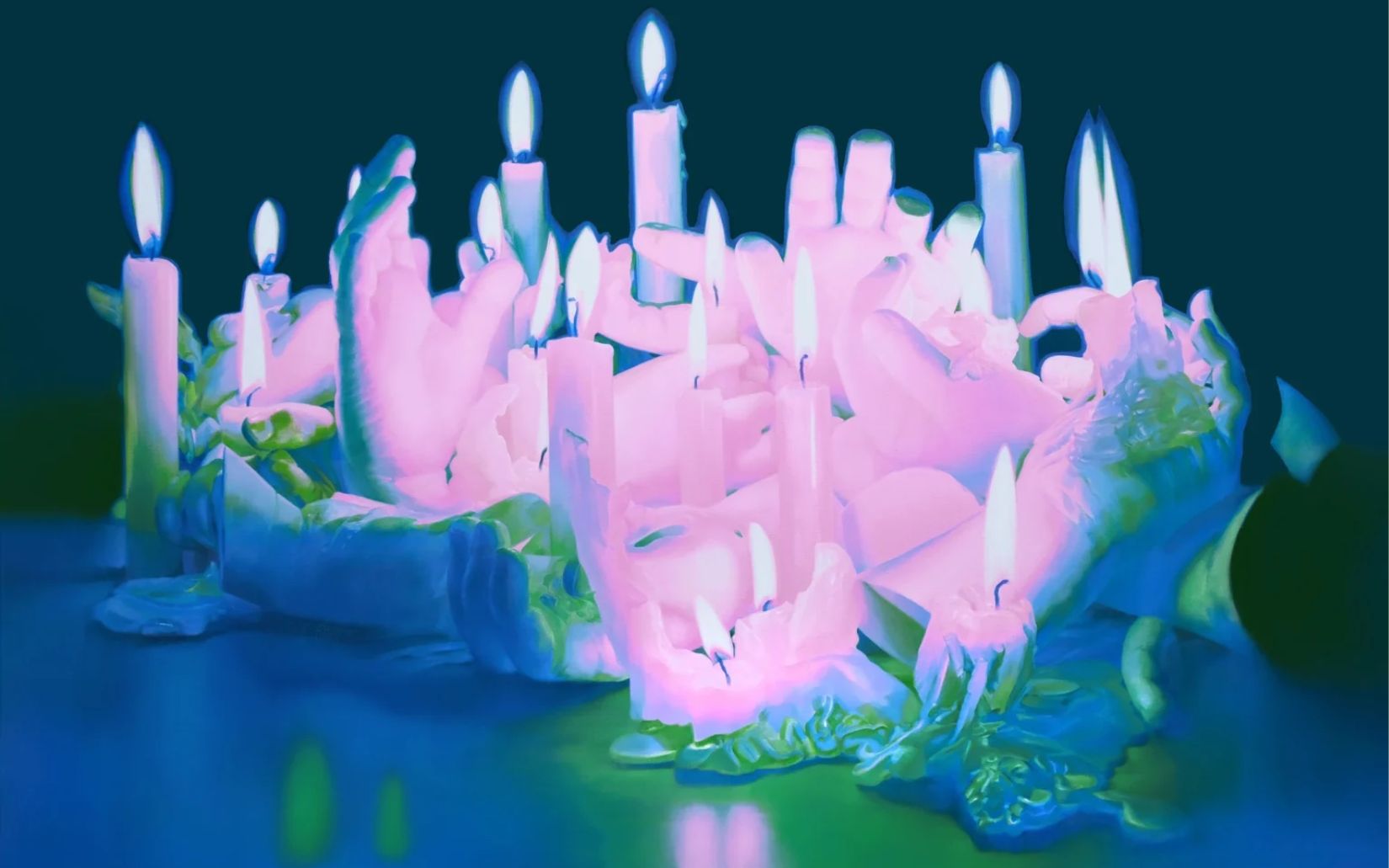
Jin Pul began by painting the inner world: dreams, memories, and stage-like spaces inhabited by incomplete figures and birds unable to fly. Over the years the gaze turned outward, toward figures resting back to back, rugged mountains and forests, and finally the fragile, ordinary things that now carry the work: candles, dried flowers, plants. Oil on gesso-primed linen, built in thin layers and wiped away as often as it is added, becomes a way of holding time. Even when no figure appears, the subject remains people, the relationships between them, and the ways we live. Perhaps the same questions have been painted for many years, simply through different landscapes.
✧✧✧
How has your artistic style evolved over time? Were there any particular influences, experiments, or moments that marked a turning point in your practice?
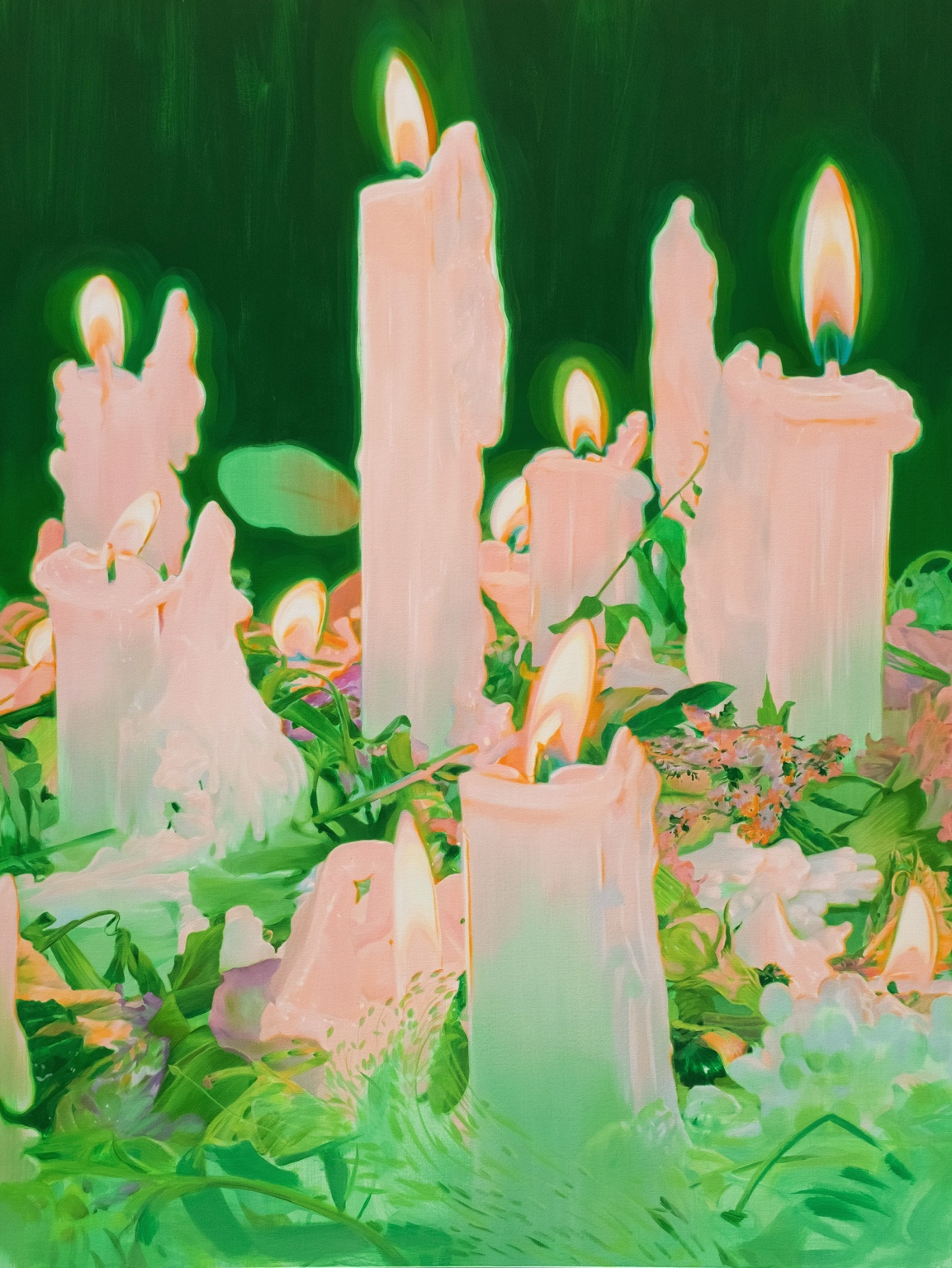
My work began as an exploration of my inner world and has gradually expanded toward an interest in others and the world around me. In my early work, I was drawn to dreams, memories, and the unconscious. I created stage-like spaces inhabited by incomplete figures and birds unable to fly, expressing feelings of anxiety and absence that exist somewhere between reality and unreality. Painting was a way of confronting aspects of myself that I could not fully understand. Over time, my gaze gradually turned outward. Through figures leaning back-to-back or resting on one another’s shoulders, and landscapes of rugged mountains and forests, I began exploring how imperfect beings support one another as they make their way through life. More recently, fragile and seemingly ordinary things, such as candles, dried flowers, and plants, have become central to my paintings. While I previously focused on constructing symbolic scenes, I am now more interested in closely observing my subjects and translating the forms, transformations, and traces of time I discover into a painterly language. Looking back, I don’t think there was a single event that dramatically changed the direction of my work. Rather, the things I pay attention to, and the way I look at them, have gradually shifted as I have moved through life. Yet one thing has remained unchanged. Even when human figures are no longer directly present in my paintings, what I am ultimately depicting is still people, the relationships between them, and the ways we live. Perhaps I have been painting the same questions for many years, simply through different landscapes.
Art is often chosen as a means of free expression. Why did you choose visual art over other forms of expression?
When I was in first grade, I was given the task of illustrating poems written by my classmates. I remember dipping a large brush into watercolor paint and watching the colors spread and blend across the white paper, gradually forming the scenes I had imagined. It was such an exciting and joyful experience that I can still remember the feeling vividly. I have continued drawing and painting ever since. Of course, a blank canvas no longer fills me with nothing but excitement. These days, it often brings a sense of pressure and even anxiety. No matter how long I have been painting, there are still moments when I struggle with what to paint and how to approach it. And yet, what continues to draw me to painting is the possibility of discovering something unexpected in the process. I may begin with a clear idea, only to find myself encountering an entirely different landscape as I adjust forms or wipe away colors. Painting is also unique in the way it holds time. A single painting contains not only the original intention but also layers of hesitation, revision, and accidental discoveries. Even when paint is added or removed, traces of what came before never disappear completely. In many ways, this resembles how memories remain with us and how we experience life. For me, painting is not only a way of expressing what I already know, but also a process of discovering what I have yet to understand. The pure excitement I felt as a child is quite different from how I approach painting today. Still, the joy of encountering something unexpected after working through uncertainty and difficulty remains. Perhaps that joy is what has kept me painting all these years.
How does your work engage with or respond to the social, political, or environmental issues of our time?
Rather than directly depicting social events, I am more interested in the attitudes and emotions of the people who witness them. My 2014 painting Each One’s Night (각자의 밤) grew out of questions about our position as observers of other people’s suffering and tragedy. Even when witnessing the same event, people respond differently. Some feel profound grief, some turn away, and others simply watch. I wanted to understand where these differences come from. Later, during a period when our society experienced a great tragedy, I found myself particularly moved by people who responded deeply to the suffering of others. There were people who, despite having no personal connection to those affected, took their pain to heart, remembered it, and grieved alongside them. I began to wonder how I could express that kind of compassion through painting. That question led me to begin painting candles. My earliest candle painting depicted an island made entirely of candles, where many small, fragile flames came together to form a single landscape. A candle gives light by slowly consuming itself. To me, this resembles people who willingly give something of themselves for the sake of others. I don’t believe my paintings can offer direct solutions to social problems. But I do believe there are feelings and acts of compassion that should not be forgotten, even after the events that gave rise to them have passed. I hope my paintings can offer a moment to reflect on where we stand in relation to the suffering of others, and what it truly means to care for someone beyond ourselves.
Could you tell us about a work that holds particularly deep emotional significance for you? What makes it special?
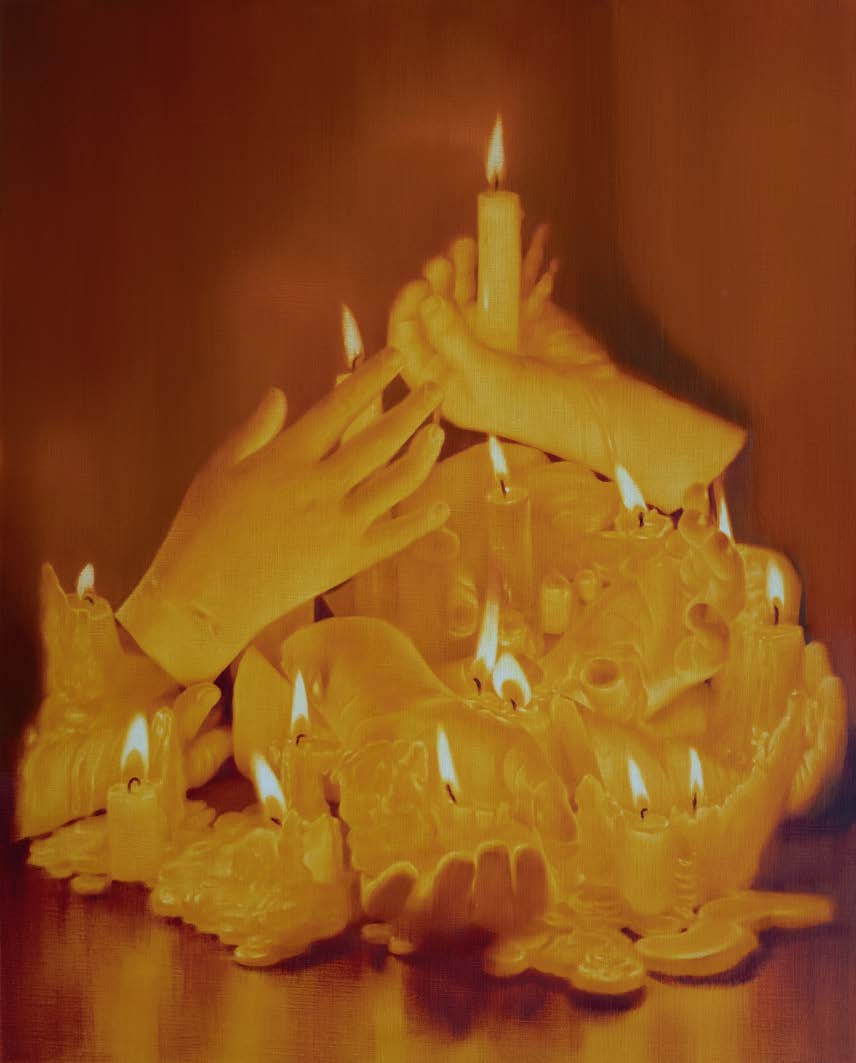
I would like to talk about one of my recent works, HEART AND HEARTS. The hand depicted in this painting originated from a plaster cast I made of my son’s hand when he was about five years old. My son has grown so much since then, but the small hand preserved in plaster remains exactly as it was. Whenever I look at it, I feel as though a moment that has long since passed is right there in front of me. I began painting candles resting on that hand. While the plaster preserves a form from years ago, a candle is constantly melting and changing shape as it burns. Two objects that hold time in very different ways come together within the same painting. As I worked, I found myself thinking about how nothing can be held onto forever. Children grow, we grow older, and even those who are beside us now will one day be gone. But disappearance does not necessarily mean that everything is lost. The feelings we have shared and the time we have spent together can remain in different forms. More recently, I have also incorporated dried flowers that I received as gifts during a previous exhibition. The hand, the candles, and the dried flowers each carry a different sense of time, yet they all remind me of someone’s presence and the feelings they have left behind. For me, this painting is about the sadness of things passing away, but also about how we continue to live, leaving something of ourselves with one another.
Could you walk us through your creative process, from the first moment of inspiration to the completion of a work?
My work often begins with something small that unexpectedly catches my attention. The dried flowers I have been painting recently are one example. After an exhibition, I kept the flowers I had received as gifts and allowed them to dry rather than throwing them away. Over time, the once-upright stems began to bend, and the soft petals became wrinkled, taking on entirely different forms. At first, I simply saw them as flowers that were withering. But the longer I observed them, the more I began to discover a different kind of beauty. They seemed like small beings that had lived through their time fully, each revealing its own quiet light as it approached the end of its existence. I began rearranging the dried flowers into new compositions, creating landscapes from their forms. I usually work with oil paint on gesso-primed linen, building up thin layers of color. Along with brushes, I sometimes use rollers, and I often wipe away paint before it dries. In my practice, removing paint is just as important as applying it. As I wipe away the surface, underlying colors or the natural texture of the linen begin to emerge. When painting the delicate thinness of dried petals or the lines of bent stems, I am less concerned with reproducing their exact appearance than with capturing the tension and rhythm I find within them. My initial idea rarely remains unchanged throughout the process. The lines, colors, and movement of the paint often lead me in directions I had not anticipated. As I continue adding and removing paint, there comes a moment when the elements within the painting seem to have found their own places. That is when I finally step back.
When you experience creative doubt or periods of stagnation, how do you find the strength to begin working again?
Doubt and creative stagnation tend to come and go like changes in the weather. I used to become impatient during those periods, but I have come to see them differently. Just as the weather never stays the same forever, I have learned through experience that failure and stagnation do not last forever either. My RePot series, which began in 2017, grew out of such an experience. At the time, I was struggling to continue my practice and had to leave my studio. While sorting through my paintings, I removed the painted canvases from their stretcher frames. I had no idea that those paintings would ever become artworks again. Then one day, a thought suddenly occurred to me: What if I cut up those discarded paintings and reassembled them into the forms of plants? I acted on the idea immediately. The paintings I had taken apart came back to life in entirely different forms. That experience taught me that something I believed had ended could become an unexpected beginning. Time that seemed meaningless, or experiences I had considered failures, might one day take on a value I could never have imagined. Since then, whenever I feel stuck, I try not to force myself to produce something. Instead, I look around or go for a walk. Sometimes, an ordinary scene I would normally overlook offers an unexpected clue. So perhaps the most important thing is simply to put on a comfortable pair of shoes, step outside, and eventually find my way back to the studio.
How important is it for viewers to understand your original intentions? Do you see ambiguity as something that enriches a work, or do you strive for clarity?
When I begin a painting, I usually have a particular thought or feeling in mind. But I don’t believe viewers need to understand it in exactly the same way I do. After all, even my own feelings toward a painting can change before, during, and after making it. One person might find hope in my work, while another might be reminded of a distant memory or a personal sadness. I find those differences fascinating. At the same time, I don’t pursue ambiguity for its own sake. Even when the meaning of a painting is not fully explained, I believe the relationships between form, color, light, and darkness should be compelling in themselves. Sometimes, the experience of simply spending time with a painting before reading anything about it can be more meaningful than an explanation. If a viewer discovers something I never intended or feels something entirely different from what I had imagined, I see that as another possibility the work can offer. Rather than remaining fixed to a single interpretation, I hope my paintings can hold different stories for different people.
Do you believe art is created for the artist, for the audience, or somewhere in between?
I don’t think art necessarily changes someone’s life all at once. But I do believe that, at certain moments, it can help someone find the strength to stand up again. And when such moments accumulate, they can eventually have a profound influence on a person’s life. I have experienced this myself. During difficult periods, I have found the strength to carry on through the work of other artists and through learning about the lives they have led. Some works have stayed with me for years, gradually changing the way I see the world. These experiences have led me to believe that art may begin with the artist, but it takes on new meanings when it encounters other people’s lives. Of course, I don’t begin painting with the specific intention of comforting someone. I simply try to look closely and honestly at what I have discovered and felt, and to express it as truthfully as I can. If that work happens to reach someone at an unexpected moment and offers even a small sense of comfort or support, I would be deeply grateful. At the same time, making art is not always beautiful or fulfilling. The desire to create something truly meaningful can lead to constant self-doubt, and sometimes requires enduring long periods of difficulty and frustration. Still, I think I continue painting because of everything art has given me. For me, art begins with a deeply personal experience, but becomes richer and more meaningful when that experience meets the lives of others.
How do you envision your artistic practice developing over the next few years?
Recently, I have been thinking about the direction from which we look at the world. We often consider things that are upright, balanced, and orderly to be stable or ideal. But life itself is rarely so neatly arranged. Some things lean to one side, others are out of place, and still others exist alongside one another without quite fitting together. I don’t believe these conditions necessarily mean that something is wrong or incomplete. Sometimes, looking at the world from a slightly oblique angle reveals relationships and forms of order that we might otherwise overlook. What once seemed familiar becomes strange, and an ordinary scene can suddenly appear in an entirely different light. I would like to explore these shifts in perspective more deeply through painting. Rather than focusing primarily on faithfully depicting my subjects, I am becoming increasingly interested in the structure of the pictorial space, the use of negative space, the tension and balance between forms, and the relationships created through the physical qualities of paint. I also hope to continue exploring the possibilities that emerge between painting and small-scale sculptural work. Until now, I have used ordinary things encountered in everyday life to reflect on different aspects of human existence. Moving forward, I want to explore more deeply the relationships these forms create within a painting and the new kinds of order that may emerge between them. To look at the familiar world from a slightly oblique angle. I hope that small shift in perspective will lead me to landscapes I have not yet discovered.
✦ ✦ ✦
Jin Pul treats stagnation like weather: it comes and it passes. The RePot series, born in 2017 from discarded canvases cut up and reassembled into plants, showed that what seemed finished could become a beginning. A plaster cast of a child’s hand with candles melting upon it, dried flowers kept from an exhibition, a candle island made of many small flames: each holds a different sense of time and a different form of care. The work ahead looks at the familiar from a slightly oblique angle, attending to negative space, tension between forms, and the meeting of painting and small sculpture. A comfortable pair of shoes, a walk, and the way back to the studio remain the method.