
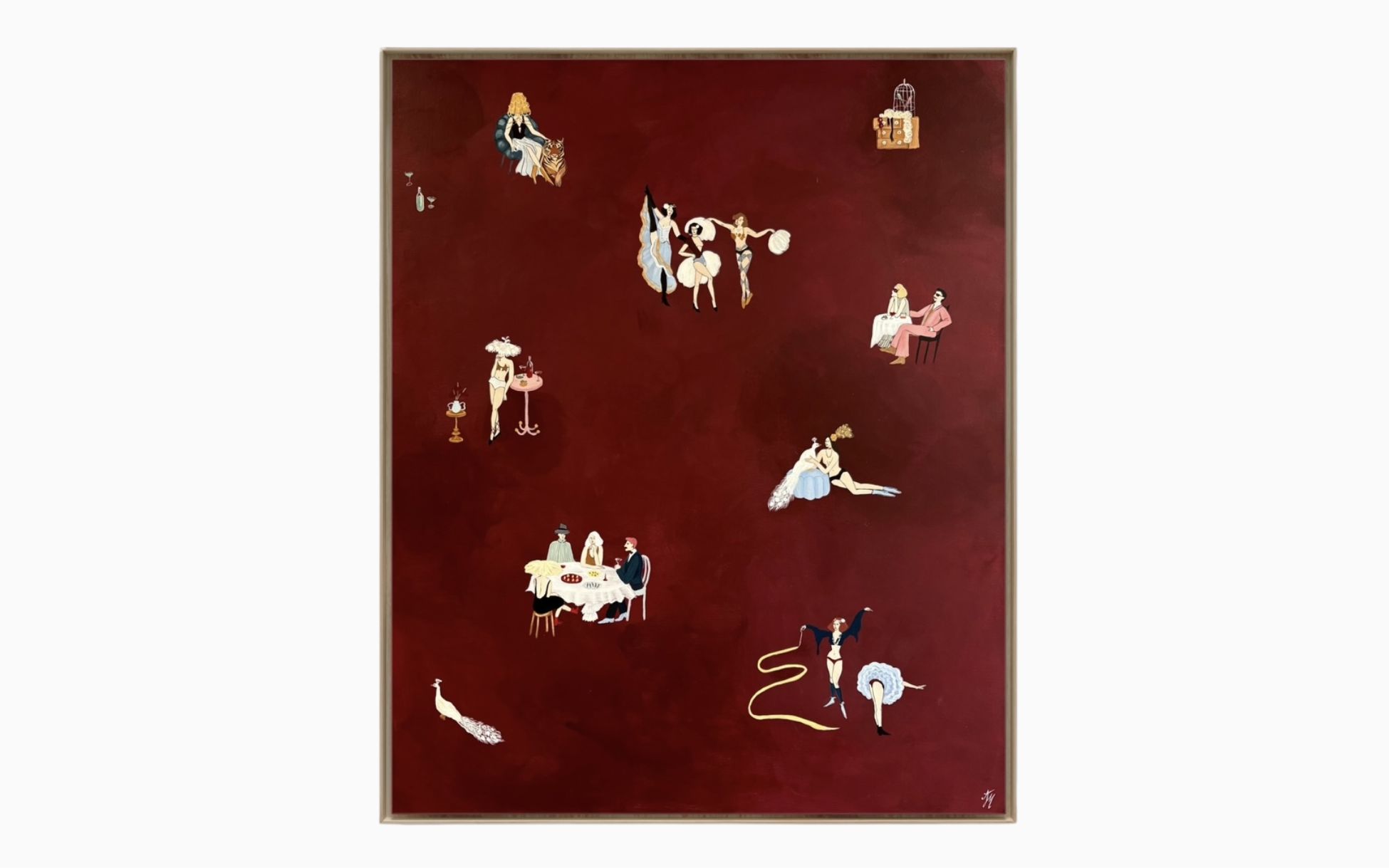
Agata Malec walks into the studio every morning and sits down in front of the easel, whether the first move is clear or the mind is completely blank. Painting began in early childhood, was set aside for a more secure path in mathematics and textile design, and returned through a commission that arrived almost out of nowhere. From there came a decision to follow the work alone. The paintings that have grown from that choice are populated by fairytale characters, dreamlike visions, women, and flowers, spread across canvases covered in colour, with stories that unfold as the work is made. The Tulip Queen, now part of the logo, marks the moment of finding an own style: simplified forms, mixed media, and permission to play.
✧✧✧
How do you reignite creativity during those inevitable periods of self-doubt or stagnation?
Every morning, I walk into my studio and sit down in front of my easel. Sometimes, I know exactly what to do the moment I arrive, and other times, my mind is completely blank. Even so, I almost always start a new painting or continue working on one. I often make mistakes along the way, paint over what I’ve done several times, and keep trying. And then, quite often, a little spark of inspiration suddenly appears. What seemed like a mistake ends up leading me in a completely new direction. Sometimes, the paintings I really have to struggle with turn out to be my favourites. Maybe it’s because I manage to surprise myself. When I’m lacking inspiration for a painting, I love going somewhere and simply observing people. It could be a restaurant, a park, a forest, a shopping mall, or a party. I take in the scenes around me, people’s behaviour, and all the little details. I like imagining their stories, what makes them sad, what makes them happy, what their fantasies might be. To me, every person is unique and full of mystery. This is a huge source of inspiration for me. Simple everyday activities can also be a lifeline, things like cleaning, for example. Maybe these periods of creative stagnation are actually a good thing, because otherwise, I might never get around to clearing up the mess I create when I’m completely immersed in an artistic frenzy... My mind also slows down when I cook, play with modelling clay, or draw with my daughter. And usually, after these moments, my creativity finds its way back to me.
Do you believe an artist's passion is something destined or a conscious choice?
I feel that an artist’s passion is something written in their destiny, although our choices can sometimes keep us from listening to that inner voice for a long time. I’ve been painting since early childhood, and even then, it was a great passion of mine. My parents supported my interest, and I attended classes with different teachers to develop my skills. I’ve always loved learning new things, especially anything involving hands-on activities or sports. So, alongside painting, I also rode horses and practised synchronised swimming. When it was time to choose a secondary school, I felt the pressure to think about my future and choose a path that would lead to a secure profession. Although my family recognised my artistic talent, becoming an artist was considered too risky, so I chose a school specialising in mathematics and technical subjects. I remember filling the margins of all my notebooks with drawings. Later, I studied textile design at university, combining my artistic interests with more technical subjects. I was fascinated by textiles and sewing, but I was quite lost when it came to deciding what I really wanted to do with my life. I didn’t see painting as my future, although I occasionally painted portraits, landscapes and animals on commission. A lot changed when I became pregnant. I was in my final year of university and working as a lifeguard at a swimming pool. It made me start thinking seriously about my future. Then, almost as if out of nowhere, a woman came into my life and commissioned me to paint four large canvases. She also offered me the possibility of working with her after I graduated, which would involve setting up my own business. I had my daughter and graduated, but it turned out that the promised collaboration had simply disappeared. And this is where I think destiny and personal choice came together. Perhaps fate, or perhaps God, brought this woman into my life to plant a seed and give me hope that I could make a living from painting. But it was my decision to pursue that path on my own, despite everything. I gave myself a tremendous opportunity and rediscovered the joy that painting had brought me as a child. I wouldn’t trade it for anything. Over time, I found my own style and learned to be authentic, both to myself and to others. I stopped trying to meet other people’s expectations or create in ways that didn’t come naturally to me. Instead, I allowed myself to follow what was genuinely coming from within. I think many of us face this kind of choice in life: whether to follow our hearts and take a risk, or to remain held back by the fear that we won’t achieve anything if we dare to pursue what we truly love.
How has your artistic style transformed over the years? Are there specific influences, experiments, or moments that marked a turning point?
A lot changed in 2025. By then, I had already become a full-time artist, painting fairytale characters, dreamlike visions, women, and flowers. However, everything still had a fairly realistic look. Things changed when I painted „The Tulip Queen”, which is now also part of my logo, symbolising the moment I found myself and discovered my own style. It was a turning point for me. For the first time, I simplified forms, gave things new shapes, combined different media, and simply allowed myself to play and experiment. I wasn’t sure what would come out of it. I gave myself the freedom to create without chasing realism or worrying too much about the final result. When I looked at the finished painting, I felt that this was it. I had finally found something that truly felt like me. The painting sold shortly afterwards, for more than any of my previous works. From there, I continued along this path. I moved away from depicting a single scene within a defined frame or setting, such as a landscape. Instead, I began covering my canvases with colour and placing figures across the entire surface, wherever I felt they belonged. I no longer felt restricted by any particular composition or setting. I started creating these stories as I painted, allowing them to unfold naturally in the process. And that’s still how I work today. I don’t always know what the final painting will look like when I begin. I let the characters, colours, and shapes guide me, and the story gradually reveals itself along the way. Another significant step in my career was combining my painting style with the idea of live painting. During an event, I observe people and capture little scenes, gestures, and details that create its unique atmosphere. I then translate these moments onto the canvas, creating a kind of artistic reportage, a record of the event as seen through my eyes and interpreted through my own sensibility. This way of painting allows me to capture the atmosphere of the entire gathering rather than just a single scene. Guests can watch the painting evolve, with new scenes appearing as the event unfolds. And quite often, they find themselves in the painting, becoming characters in the story I’m creating. I’m excited to see where this journey will take me next.
How important is it for viewers to understand the intended message of your work? Does ambiguity add value, or do you seek clarity in your expression?
I think I like to leave my viewers free to interpret my work in their own way. My only mission is to bring warmth into someone’s home. If one of my paintings makes someone smile, then I’ve achieved my goal. Many people tell me that my work reminds them of their childhood and brings them a sense of peace. I paint little scenes that everyone can interpret in their own way. Of course, if someone asks me what is happening between the people in a painting, I’m happy to share the story I had in mind. But that doesn’t mean they can’t create their own stories around it. I believe that’s part of the beauty of art, everyone brings their own experiences, memories, and emotions to what they see.
Are there any upcoming projects or dreams that you’re particularly excited about?
Oh, yes! I’m incredibly excited about my first solo exhibition, which will take place this December. Although it’s also quite stressful, I know it’s a big step forward for me. I still have quite a few paintings to finish for the occasion, so I guess my biggest dream right now is to actually paint everything I’ve planned...hahaa. As for new projects, I’m slowly starting to explore my love for textiles again. My university studies introduced me to their possibilities, and I feel they could become another medium through which I can express myself. I’m dreaming of creating jacquard and printed fabrics featuring motifs from my paintings. Some of these designs could be turned into bed linen, tablecloths, or curtains. I think there’s also something quite personal behind this idea. I want to surround myself with the world I create in my paintings. And textiles make this possible in a very special way, you can wrap yourself in them, snuggle up under them, and quite literally feel close to that world.
Artificial Intelligence is increasingly infiltrating creative fields. Do you see artificial intelligence as a threat, a tool, or a collaborator in the art world?
I personally don't see AI as a threat, as it hasn't affected the interest in or sales of my paintings so far. In fact, I believe that its growing presence has made people appreciate handmade art even more. I travel to different art fairs with my paintings, where I meet many people. Many of them talk about feeling overwhelmed by AI generated images and appreciate the opportunity to meet the person behind the artwork. I believe AI can be a useful tool, and there are artists who know how to use it wisely and responsibly. I think it all depends on how it is used and what role it plays in the creative process.
Identify five habits or concerns you are actively trying to let go of in your practice.
✧ Sometimes I compare myself to other artists, especially when I spend too much time on Instagram or Pinterest... I start wondering then if my work is good enough. ✧ I feel nervous when showing my work to curators and other artists because their opinions matter in the art world. ✧ I'm trying to overcome my fear of public speaking. ✧ Leaving my paints all over the studio and then struggling to find them. ✧ Sometimes I get so caught up in painting that I don't spend enough time with my family.
✦ ✦ ✦
Agata Malec describes a mission that is modest and complete: to bring warmth into someone’s home. If a painting makes someone smile, the goal has been reached. Live painting at events turns guests into characters in an ongoing story, a kind of artistic reportage seen through a personal sensibility. A first solo exhibition arrives this December, with textiles waiting beyond it: jacquard and printed fabrics carrying motifs from the paintings, so that the world on the canvas can be wrapped around a body and brought into daily life. Mistakes lead to new directions, struggle produces favourites, and the work keeps surprising its maker. That capacity to be surprised is where the practice stays alive.