
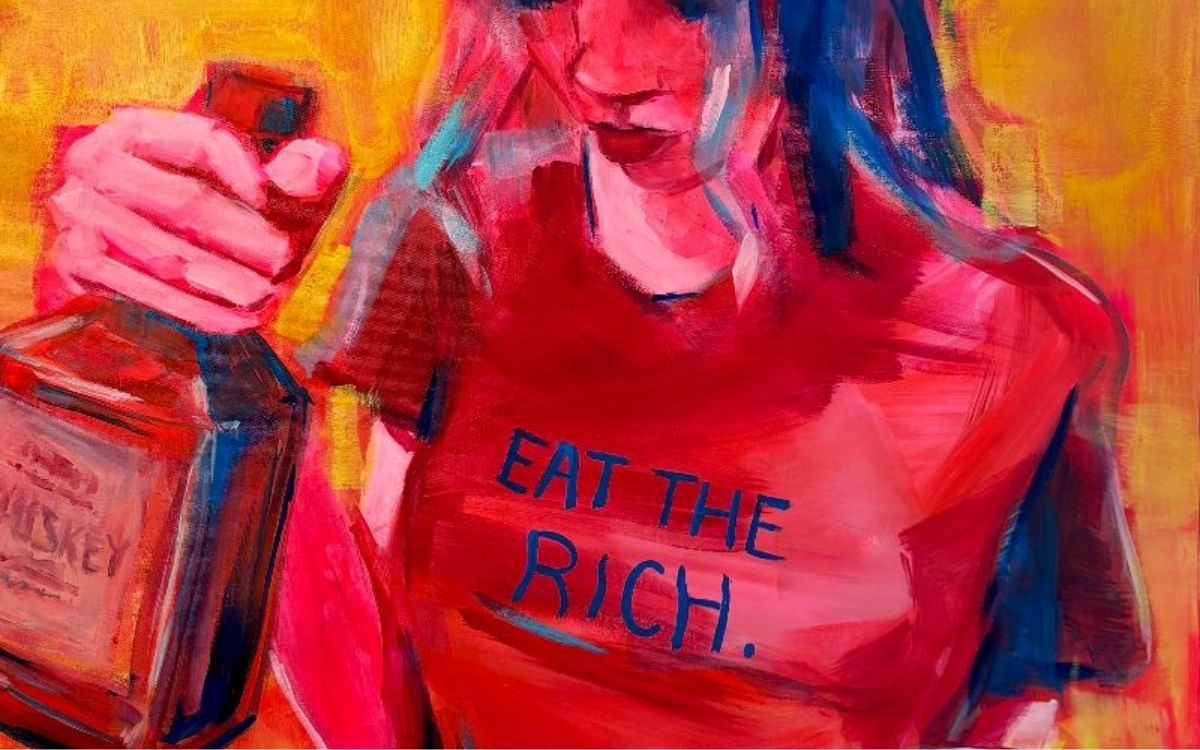
Bree Chapin spent 15 years keeping two lives separate, a corporate career in tech by day, painting and showing work with the ConArtist collective on the Lower East Side whenever time and energy allowed. The leap, when it finally came, arrived as a layoff around a birthday in 2023: the push needed to commit fully. What had always been there, underneath the desk job and the careful compartmentalization, was a practice rooted in a vertiginous sense that the world is not as it should be. Capitalism, surveillance, inequality, the betrayal of technology's promise: these are not incidental themes but the persistent undercurrent of a body of work that understands, with Nina Simone, that an artist's duty is to reflect the times.
✧✧✧
Have you ever felt drawn toward a conventional career path? What made you take the "creative leap" despite the risks?
I had always wanted to pursue art, it always felt like the thing I was supposed to do. However, the risks of going to an expensive art school then try to make a living from something like painting worried my parents too much. My mom really wanted me to study something safer that would help me “get a real job.” You can’t really blame them, given the economic realities of our times and the relentless devaluing of art in our society. I put in about 15 years working at a desk and built a reasonably respectable career in the corporate/tech world, but I never stopped painting. Around 2013, I joined an art collective called ConArtist on the Lower East Side of NYC and spent whatever time and energy I could eke out in between the 40-60 hours on the clock. Being in that environment, surrounded by so many weird and inspiring artists was absolutely transformative for me. In many ways it was a DIY art school program and I am forever grateful that I found a place there. I think it was the first serious step I took toward taking my own artwork seriously. I started showing my work in galleries, selling paintings, and even doing curation. All while doing the “normal job” thing and doing everything I could to keep my two lives separate. I literally hid my art life from my day job because I didn’t want my creative sphere to be “tainted”. The more of the artist world I was exposed to, however, the more it felt I needed to drop the other. I speak from a lot of privilege here, though, and I realize how much good fortune played into me even being able to think about leaving my “stable career path.” For too many people it’s just not possible, unfortunately. I started making plans to take the leap around 2022 or so and was lucky enough to be laid off around my birthday in 2023. It was the push I needed to commit to this path fully. Sometimes it’s scary as hell, but you only get one ride on this rock, so you might as well take the leap if you can.
How does your art engage with or comment on pressing contemporary issues—social, political, or environmental?
Political and social themes have always been a constant undercurrent in my work—often explicitly and sometimes more subtly. I think I’ve always had this sense of the injustices and inequalities of modern society… a certain vertiginous sense that the world isn’t as it should be or how it could be. My artwork is a way for me to channel that vertigo, engage with it, and communicate it to others. Some consistent themes that appear in my artwork revolve around capitalism, social inequalities, mass surveillance, feminism, and abolition. I also have a background in technology, so that definitely bubbles through in my work. I’ve always had a deep sense that we betray the promise of technology by using it for harm rather than to improve peoples’ lives wholesale. I do believe all art is fundamentally political, whether the artist intends to make a specific political statement or not. Who gets to make artwork, under what circumstances, who gets to decide what’s seen and not seen, what’s funded or not, whom does art benefit, whose voices are consistently heard or unheard… all of this is political at its foundation. Some artists simply choose to try to make these systems more visible.
What do you think is the most meaningful role an artist plays in society today?
As the late great Nina Simone said, “An artist’s duty, as far as I’m concerned, is to reflect the times. I think that is true of painters, sculptors, poets, musicians…” As I wrote in another response, I believe art has always been inherently political and I’ve always had a strong drive to reflect, as a witness, what I see happening in my reality. In the same way, artistic expression has always posed a threat for authority, not just for its tendency to highlight the problems in society but also for the unique ability for artists to imagine something better. There will always be those who would perceive creativity of this kind as dangerous and do what they can to dampen it. It feels especially urgent right now. At a time when artists are fighting censorship, defunding, and even physical danger in expressing themselves all while simultaneously big tech companies are feverishly trying to flatten human-made creativity into a bland toothless commodity… even if all you paint is pretty flowers, it ends up being a political act.
What unusual or unexpected sources of inspiration have deeply influenced your work?
I don’t know if this would be unexpected, but music has always played a big role in my process. Some of my earliest memories are of watching MTV in the middle of the night (I have always been a bit of an insomniac). I was blown away by the sounds and the visuals beaming out of the screen… I fell in love with music from the beginning and I fell hard. When I’m painting, I almost always have music playing. Music also makes its way into the themes and symbols of my work. In 2023 I had a solo exhibition of 21 of the same painting of a police officer borrowing the title “Some Of Those That Work Forces” from Rage Against the Machine. I’m currently working on a series of paintings in part inspired by Laurie Anderson’s “O Superman,” each with a line from the lyrics as a title. I also have a mild obsession with magnetic tape. You know, the kind used in audio cassettes, VHS tapes, and reel-to-reel recordings. I’m fascinated by the physical properties of it as a medium: a layer of magnetic dust that clings to a ribbon. Each time you view/listen to it, the player pulls some of that dust off in a way that alters it forever. In a way, you can never play the same song/tape twice. If I had any talent or discipline, I would love to be a musician or make music. I still have this blue Danelectro guitar I got when I was 15. I enjoy playing sometimes even if I never practice enough to be any good at it.
How has your artistic style transformed over the years? Are there specific influences, experiments, or moments that marked a turning point?
In many ways, just having more time and space to imagine and create has been transformative for my work. Suddenly I have more time to experiment and any mistakes I make feel less catastrophic and more crucial to the evolutionary process. I look at the artwork I made when I had to squeeze it in between office hours and the work I make now…. There’s more depth both visually and spiritually. I have more time to explore a theme or a technique in a satisfying way rather than rushing to get things out of my head and onto canvas. Going back farther in time I do believe my time with ConArtist collective was a turning point. I was able to work alongside some really incredible and interesting people, I exposed myself to artistic critique and feedback, and I began showing my artwork to the public. I made close friends and collaborators for life. The collective is now defunct, but that period in my growth was lightning in a bottle.
Do you believe the ‘mad artist’ stereotype still holds weight, or is creativity more grounded than we think?
I think this depends on the artist, but it is strange how much society fetishizes mental anguish and “madness” in art. Plenty of amazing artists struggle with their mental health, some to extreme levels. Plenty of amazing artists don’t, or at least not in an intense way. This notion that it’s somehow necessary for an artist to suffer through “madness” in order to make great art is bizarre and probably dangerous. I do often say that when I’m making art that I am channeling what I perceive as an “ambient anxiety” through my work. For many—myself included—creative expression and working with your hands has a therapeutic benefit. There are studies that show being around artwork has psychological and physical benefits. That’s another reason I believe that access to art (and actual therapy!) should be a right for everyone.
In what ways has viewer feedback surprised you or shifted your perspective on your own work?
One of the most intimidating but valuable piece of feedback is when someone asks you a question about your work that you genuinely hadn’t considered—or at least hadn’t thought to put into words. I can’t tell you the number of times that someone has come up to me and thrown me a bit when asking me about my choices in subject, tone, color, symbolism… it opens my eyes more to my own work and I often take that with me when I go back to the studio. For a solo exhibition in 2024 I did an artist talk with this amazing multidisciplinary artist Jennie West who asked me some really thought-provoking questions about my work—many of which still bounce around in my head while I’m painting. It’s also a bit scary, right? Because some part of you feels a little like you were supposed to have understood everything about it before. I think there can be an unconscious pressure we put on ourselves to have answers for our work when sometimes there are just more questions…
Artificial Intelligence is increasingly infiltrating creative fields. Do you see artificial intelligence as a threat, a tool, or a collaborator in the art world?
I used to be a lot more optimistic about technology. Technology has been an interest of mine since I was a kid teaching myself enough HTML to make a silly angelfire website about my favorite bands. The Internet seemed like this thrilling place that would make us all smarter, kinder, and more equal. Maybe if it had been made a public utility from the beginning, rather than a profit-making machine for a scary bunch of dudes with a frightening worldview… So I had worked in tech for years and to me artificial intelligence looks like a series of fancy interconnected algorithms making statistically sound guesses about things based on scraping heaps and heaps of existing data. “Artificial Intelligence” is a marketing term to get starry-eyed investors to bet the farm on a few tech companies promising magic from some language models. Somehow these tech companies have convinced us to allow them to do unimaginable harm at break-neck speed such as: mowing down acres of land for data centers that endanger ecosystems and human communities alike, establishing oppressive surveillance networks with zero oversight or public accountability, and strip-mining all of human thought, creativity, and discourse without even the pretense of consent to generate nauseating slop at scale. They’re stealing and hoarding human expression just to sell it back to you. We’re witnessing an historic flattening of human expression, critical thinking, and intelligence and plenty of people seem to be confused about the road we’re taking. None of these technologies are meant to make life better for ordinary people, irrespective of what their PR is telling you. So, when I see an artist using A.I. to generate “art,” a part of my heart breaks. It feels like they’re abdicating the very gift of creativity that makes them special and human...all to make some misanthrope in Silicon Valley a little richer and the rest of us so much poorer.
What would the theme song of your artistic journey be, and how does it reflect your story?
Two songs leap to mind: ✧ Lust for Life by Iggy Pop. I heard this song as a kid and fucking loved it. Musically, it’s a driving, energetic banger of a song. Obviously I’ve never been a heroin addict in the 1970s, but there’s a euphoric embrace of living in the lyrics. Despite my anxieties about the world I think I’ve always had a natural lust for life, and I’m just thrilled to be here. ✧ L.E.S. Artistes by Santigold also resonates with me looking at my own artistic journey. Musically, it’s a beautiful song that dips and swells… Lyrically this line that really hits home is “I can say I hope it will be worth what I give up. If I could stand up mean for the things that I believe.” As artists, there’s a lot we choose to give up to do what we’re doing whether it’s financial stability, leisure, travel, relationships, time with family, answering that same “but what do you really do?” question over and over…. And then there’s this final bit: “change-change, change, change, I want to get up out of my skin. Tell you what, if I can shake it I'm 'a make this something worth dreaming of”
How do you envision the evolution of your work in the coming years?
I never try to look too far ahead, because I’ve learned that life and art are unpredictable. There are themes and concepts I hope to explore more deeply, and I hope to find more venues and galleries to show my work. I would love to work at ever-larger scale, and I really also enjoy doing murals. Trying to sustain a career as a full time artist can be a bit scary at times, but I realized long ago that I would rather take the risk of pursuing my passions rather than always wondering. I hope I can find some kind of stability and a way to keep my focus on my work. But no matter what happens I don’t plan to stop creating, and I hope I never end up standing too still.
Are there any upcoming projects or dreams that you’re particularly excited about?
I’m currently working on a series of paintings (and possibly some 3D or interactive work) partially inspired by Laurie Anderson’s “O Superman” called “Here Come the Planes.” Each piece bears a lyric from the song as a title. The series is a symbolic exploration of themes of danger and anxiety, technology, and the fragility of memory… there’s a feeling of nostalgia developing as I am working on the paintings, along with grief. I have a few other series in mind for the future, but it’s challenging when there are more ideas you want to explore than there are hours in the day. Sometimes I think I need five concurrent lifetimes to accomplish half of what I want to do.
✦ ✦ ✦
Bree Chapin is an artist with more ideas than hours, more series in mind than concurrent lifetimes to pursue them. The current work, inspired by Laurie Anderson's "O Superman" and carrying grief, nostalgia, and anxiety through each lyric-titled canvas, is already pointing toward something deeper and more spacious than what came before. Having more time has meant more depth, both visually and spiritually, and that expansion is only beginning. The plan, stated without hesitation, is to keep going regardless of what stability looks like. You only get one ride on this rock. The leap has already been taken, and standing still was never really an option.