
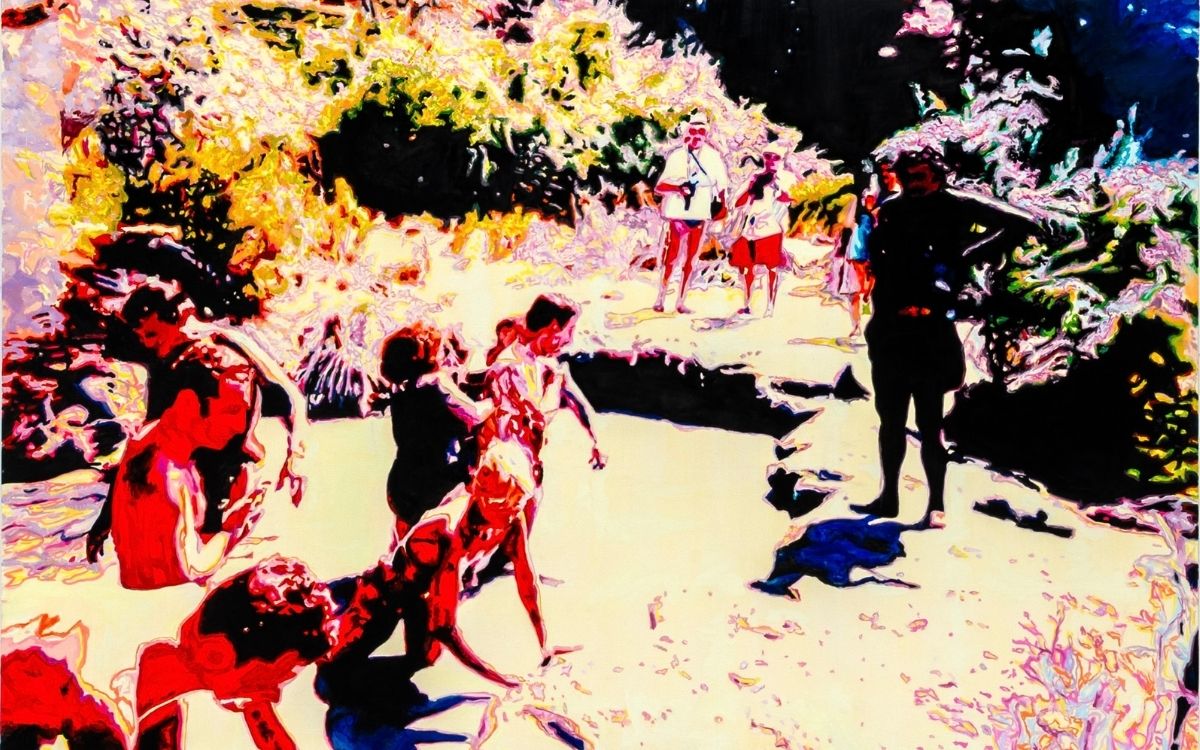
Calder MacKay makes paintings about a feeling that has no exact name. Working from archival photographs, some from family albums, others from complete strangers, the work that has developed over the past year circles around a particular condition of contemporary life: the serene tension that sits underneath everything, the collective numbness, the way a generation finds itself suspended between cynicism and hope. Through distortion, over-saturation, and the deliberate collision of past imagery with a present-day emotional lens, Calder MacKay asks what it means to live now, and uses fragments of a world that did not yet know this future to try to understand it.
✧✧✧
How does your art engage with or comment on pressing contemporary issues—social, political, or environmental?
I think a lot of the work I’ve made in the past year has been very much centred around contemporary issues. In a broad sense what it means to live today in 2026 and all the strange collective feelings that are associated with that. I find that we live in a highly saturated and splintered world. We as a species are the most connected, we’ve ever been while yet all the while we re consciously choosing to spend less and less time with each other. We are beginning to feel more and more comfortable being alone. The world we live in now is bombarding us with imagery trying to colonise every second of our time awake. Leading to this collective feeling of and underlying angst in our general day to day. It’s an almost serene tension that I feel sits underneath everything we do now. Not enough to stop us in our tracks but enough that we’re all aware of it but can’t seem to put a name to it. In allowing us everything we cannot find anyone. We are stranded in a generation suspended between cynicism and hope. In the past this dread came from real world struggles and hardships now it comes from artificial envy and fabricated catastrophe. It’s causing us to forget how to engage with each other, we forget how to be truly alone, so we never long for anyone else. You can sit on a bus today and see a sea of people hiding under this collective blanket, tucked away in their little corners as they breathe in this unified numbing agent taking them away from what is real. I don’t in anyway however long for a time before this. Any part of our past is flawed in countless ways. But I find in using the archive and peering through these windows to the past you can see a world before this pseudo-angst, a time when the future that we live in now, seemed collective and hopeful. Before everything was reproduced and recycled, before our future was put on hold. I like to use these pockets of a time gone and see them through a contemporary lens. Find what draws me to them and mould in to fit my own means. I want the work to feel somewhat off-kilter, like something is looming just outside of our periphery. Using techniques of distortion and saturation to capture these feelings of today while projecting them onto these fragments of our past. There is a feeling of collective nostalgia that I think we can all share in. But I no longer think it is strictly this homesickness for the past. It instead can help us understand the impossibility of the present. I want to try and begin to understand it all and in turn understand myself. Growing up in the time that I did, I can’t help being sculpted by this, so much of how we’ve learned to engage with the world around us has been a product of their product. It has impacted all of us, but with specific lasting effects on the younger generation. While their minds are still finding their footing, they had no choice but be swept up in it. And for myself I’m trying to decipher its affects and propose more hopeful ways of looking forward.
In a world flooded with imagery, what responsibility do artists have to standout and say something authentic?
I think artists have a lot of power and responsibility to make use of some of the last spaces that people can truly pause. I think it is a shame how our image economy and the circulation of images has caused so much of the art we see, and digest is presented outside of its original context. So many great works of art are now seen through a screen no bigger than your hand. This in a lot of ways is great and allows for people to see and experience more work, and more varied work than ever. But I think for the means of detaching from this bombardment of imagery, seeing work in gallery context or in a real-world scenario, is one of few instances in which an artist can get a clear message across to someone, without any third party interfering with that sharing of ideas. It allows for someone to take a breath give themselves some time to reflect and hopefully feel something near to what the artist was trying to convey. It’s not an exact art, but as long as they come away feeling something, they’ve manage to carve out space in the real world to find reflection and think for themselves.
Can you take us through the evolution of an artwork, from that first spark of inspiration to the finished piece?
I think for me it always starts with archival imagery, I sift through hundreds of photos, some from my own family archive some from complete strangers. I like to play around digitally with cropping the image, finding compositions that would work on a painting. Again playing around with scale and what feels right for the work itself. Then once I decide on something I’m happy with, I begin to decide on if I feel I can justify painting it. Sometimes this has come long before I’ve altered the image, something sticks out so strongly to me within the context of why I’m making work, and I feel like it can tell a clear story. Other times I have to sit with an image for a while, and often times these instances where I allow myself the time to think of how this imagery can link to a wider context is where I can really learn more about my practice and the themes I’m trying to explore. Now with these notions of what the painting is for still swimming around, I again play with the image further, trying to illicit a similar response or allude to my thinking, through visual means. By often times playing around with saturation, over exposure, shifting layers I can begin to create something that feels new to me and also speaks to the thinking surrounding my practice.
Describe a piece you’ve created that has held the most emotional weight for you? What makes it significant?
I found that one of my more recent pieces ‘a sun that blisters the back of your eyes’ was one that I found very significant. I found that this piece felt like a culmination of a lot of what I’d been trying to do over the past year. Throughout the year I’ve been playing around with a lot of these techniques and visual tropes to convey certain feelings to the viewer. Over saturating the figures to the point in which they turn bright red, almost boiling and bubbling with the weight of our contemporary lens looming over them, like a blistering sun. The composition of the work I felt also helped add to this underlying angst, the figures all looking off into the distance to, this dark void. What are they looking at? Why can’t they look away? Are they looking at us? Then this moment of relief. The sprawling pool that sits below, inviting you in, as a break from this blinding heat. The one solitary figure, the one that looks the other way. Not yet saturated, not yet influenced. He swims alone. This image was taken by my grandparents. On a holiday somewhere in Spain or Portugal in the 70s, I imagine. This insignificant photo of them just enjoying their holiday has allowed me to try and understand and express the feelings I now experience as a young person living 50 years on from when the image was taken. It’s my grandad that’s alone in the pool. And this isn’t anything that anyone else will get from the work. But for me, in a lot of ways he has been an anchor in my life. A solid base in which I can count on to calm the noise and shake me awake at times. He is everything that today is not, not trying to buy your attention, not trying to be someone he’s not. He’s taught me that it’s all a façade. None of it is real and in realising that, you can find your own moment of relief.
How has your artistic style transformed over the years? Are there specific influences, experiments, or moments that marked a turning point?
I think over the last year things have changed a lot. I think the time on my masters felt like a bit of a pressure cooker at times. But this did have its advantages, I think coming into that space, talking with my peers learning from such a varied group that are all coming from such different starting points. Allowed you to see how different people worked. And as much as my tutors etc were great, I think I learned the same if not more from the people in the studios. I think starting the course I felt a bit trepidatious about what to do. I think when you are given a year to make anything you want. I found I really wanted to figure out a way of working, that felt like I was challenging myself. Something that was going to allow me to think on things that were genuine interests and things I felt I wanted to explore. I think in giving myself enough time to figure that out and fail a lot at the start, really pushed me to where I am now. Having made a body of work I was very happy with and felt like a truer expression of me, and my own view on the world than anything I’d made previously. Now I find myself at a similar place post graduating, deciding if this is something I still feel has much left to explore and more interest to be derived from. Or if I should go somewhere else entirely. That is something that is in equal parts terrifying and exciting.
Do you feel a personal connection to your subject matter is essential? How has this connection shaped your work?
I think in general I do, I think for me at least if I feel no sort of connection to the work I’m making then, I wouldn’t really know why I’m making it. I’m not sure if I fully subscribe to making art being a form of therapy, but I do think I use it to make sense of things. I think in the past I used to rely on my own personal connection a lot heavier than I do currently. When working with your family archive as source material you can help but feel as though you are personally linked to it, because you are. I would often try and tell my own familial stories through the work. In many ways, this was very effective and allowed people to share their own stories. But I found that over time I began to rely on this connection too heavily. I found that using material, that I myself don’t recognise allows me to meet the image in the same way the viewer would. I can’t be swayed by any sort of established context that I bring to the image. I found that I can still project that onto these images and find my own way of connecting with them, but it allows for readings of the work to be much more varied, which is something I would always strive for.
Do academic institutions still play a vital role in shaping artists today, or has self-taught creativity disrupted this tradition?
I think so, I really do think they still have a vital role. Not that it is the only avenue by any means, but I think there is still so much value to be had in these institutions. I’m saying this after spending 6 years in art school so I’m probably trying to convince myself here a little bit. But I’ve found that there is a reason these institutions have been around for as long as they have and have helped shape the number of artists that they have. The people in these schools if they have your best interest at heart, are there to push you to think deeper, engage more closely and try and push you to improve your work in any way they can. Sometimes all that means is having a different perspective from someone that has seen a lot of work. Because at the end of the day although all that I said previously is true, these are just people giving you their opinions on things. I think there can be an issue sometimes in art schools where a tutor can say something to a student and because of this pre-existing power hierarchy the student can fall into taking every word they say as gospel. Completely changing what they do, before they check in with themselves to ask if they really want to change. I think as with anything in life you have to take everything with a pinch of salt and that goes for criticism too. Because although every reading of your work is valid and just as justified as any other. You can come in the next day and speak to someone that can give you the polar opposite view, for good or bad. So, I think over the 6 years what I’ve learnt is you must always be open to criticism and praise, but don’t allow it to change everything you do, if you truly believe and can justify that you feel you’re on the right path. Because all work isn’t finished, there is no perfect painting or final piece. You make something, you learn from it and you do something different. As long as you keep doing that, whether that be as part of an institution or as a completely self-taught artist with no formal training, if you’re consistently having some sort of external critique, you’ll be fine.
✦ ✦ ✦
What makes this conversation worth reading carefully is the honesty running through it, about the pressure cooker of the masters year, about learning as much from peers in the studios as from tutors, about the terrifying and exciting question of where to go next. Calder MacKay has arrived at a body of work that feels like a genuine self, hard-won and grounded in real thinking. The grandfather swimming alone in the pool, unsaturated, unbothered, pointing toward something quieter and more solid than everything the contemporary world is selling: that image, private and precise, is the kind of anchor that holds a whole practice together. The work around it, and the work still to come, earns that weight.