
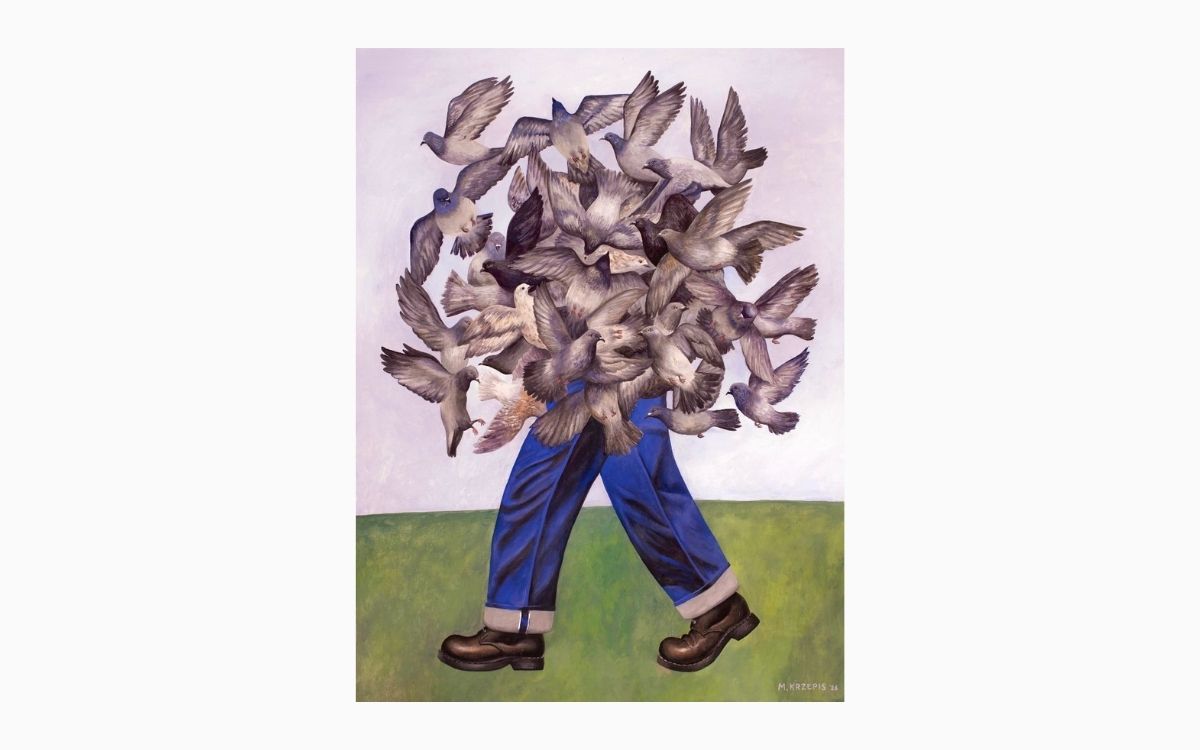
Ten thousand bad drawings live inside every artist, and Mark Krzepis believes the only way through them is to draw them out, embracing the rough 3AM napkin sketch as the true foundation of discipline. What began as strict photorealism in graphite, reinforced early on by praise for accuracy, cracked open at university through encounters with abstractionists, inkers, and life painters, and a professor's gentle reminder that seeing color differently is no failure at all. Working now mostly in paint on wood panel, a preference sharpened by a pandemic spent experimenting with whatever materials were on hand, the practice draws heavily on illustration's instinct for narrative, using figures and objects as props within a clear emotional register.
How do you reconcile the tension between raw, innate creativity and the discipline required to master your craft?
Raw creativity in its natural state is rough, impulsive, and ugly. Creativity does not turn on and off at convenience, it exists behind every action. The artist’s mind is constantly at work as you gather information to be resolved. Bolts of creative ideas are fired off from the recesses of the mind and it is up to you to find a pencil in time to capture the moment. The unflattering sketches you draw on the nearest napkin at 3:00AM have the potential to become your next masterpiece. Behind every final work of art is a messy array of sketches, whether on paper or in the mind's eye. Discipline towards mastery is built on a foundation of these rough sketches — they work in tandem. I am a believer in the idea that every artist has ten thousand bad drawings in them and the only way to get rid of them is to draw them out. Meaningful and masterful artworks come from taking these bad drawings and revising, editing, and recomposing them to solve a problem; embracing the bad sketches shortens the distance between rough idea and finished art.
How important is it for viewers to understand the intended message of your work? Does ambiguity add value, or do you seek clarity in your expression?
My background is in illustration and as illustrators we make art to solve problems and communicate ideas in understandable ways for the viewer. This bleeds into my fine art practice as I try to use figures and objects as props to create a narrative within the picture plane. There are levels to understanding: as a baseline, the emotional tone should be read clearly as we as human beings can recognize the expressions on the figures and the nature of their body compositions. What are they doing/ how are they feeling? These are the initial questions. Next are the cultural and historical contexts to understand the work further: what is the artwork referencing? I play with a lot of art historical references in my work and people who can recognize the references can connect the work to the broader web of culture. The deepest level is the personal connection to the work: what happened in the artist’s life that influenced them to make this artwork? A lot of my artworks were spawned out of emotional chapters in my life; only my journal and I will know the full motivations behind a piece and who certain figures represent in my life. There is always a deeper ambiguity and further clarity does not necessarily add value. Artworks are not puzzles to be solved — I believe that there should be something for everybody to take away when looking at a work of art. Someone who looks at Van Gogh’s The Starry Night, may know that he painted it while at the Saint-Paul-de-Mausole asylum after self mutilation and mental strife. Others may just look at it and enjoy the stars in the night sky illuminating the quaint village. Both readings are valid.
How has your artistic style transformed over the years? Are there specific influences, experiments, or moments that marked a turning point?
When I started to take art a little more seriously as a pre-teen, I mostly drew with graphite and copied images from my computer. I drew in black and white because I have protanopia colourblindness and struggle with matching colours. I was reinforced by classmates, my parents, and internet forums to believe that good art was how accurately you could replicate photographs. It wasn’t until I started to interact with other artists in my first year of university that I broke out of this cage of photorealism. I met abstractionists who encouraged me to draw from my stream of consciousness, inkers who taught me to draw with no underdrawing, and life painters who taught me to trust the evidence of my eyes. I had a wonderful old professor in my observational painting class who noticed me painting a brown vase green. Instead of chastisement he said to me “I saw it as green once too.” He proceeded to show me how to lay out my paints in order of complementary colours to better understand how to mix colours convincingly. When the COVID-19 pandemic closed down the university, I spent the following months experimenting with all these different skills, mediums, and approaches I learned until I whittled it down to the things I enjoy. I never paint on canvas, I think the texture sucks and it doesn’t lend itself to mixed media as well as wood panels do. And during the pandemic, the dollar store was the only place that I could pick up art supplies and they sold decent wood panels, compared to their crappy canvases. I originally worked with more mixed media as I wanted my style to combine elements of painting and drawing but nowadays I mostly paint.
How do you feel social media is shaping the way art is created, consumed, and valued today?
Social media introduced a way to numerically measure social success; artists can measure their success quotient by tallying their likes, follows, saves, etc. Competition is intensified by social media as artists can compare their success quotient to other artists — whether consciously or not. On platforms like Instagram or Tiktok, artists are encouraged to produce content that is congruent to current microtrends. Consumption of artwork becomes a parasocial and passive activity as art 'content' compacts to fit the same mold as news, memes, comedy skits, soft-core pornography, commentary, and aesthetic videos. On a cellphone, all art is the same size whether you're looking at Picasso's Guernica or Blake's The Ghost of a Flea. When the consumption of art loses its tactility it also loses the excitement of acquisition from the viewer. The passive viewer does not seek to discover new art at local openings and devour its presence for minutes or hours. To the passive viewer, a ten second digital interaction is satisfactory and equivalent.
Artificial Intelligence is increasingly infiltrating creative fields. Do you see artificial intelligence as a threat, a tool, or a collaborator in the art world?
The potential clients that use AI imagery for their branding would have paid peanuts anyway. Good illustration will stand the test of time: when AI imagery becomes increasingly ubiquitous, human made illustration will outshine. The pendulum will swing back towards the romantic, in the way impressionism emerged as a response to the camera. People who care about art will not be swayed by artificial intelligence's quantization of visual imagery. Intimate elements of human art such as shaky lines, charcoal fingerprints, whiteout, and hairs stuck to varnish will be celebrated as something radical. People who care about gizmos will play with their gizmos.
List five moments or achievements in your career that fill you with gratitude.
Organizing my first ever exhibition after my house fire in 2022. I had been gutted by the loss of my home and the damage to my artworks but found the energy to transform this traumatic moment into an amazing exhibition which showcased the damaged works and newer paintings. The exhibition documented the journey of rebuilding the lives of myself, my family, and neighbours.
Having Andy Warhol's nephew view and compliment one of my paintings on exhibition in Pittsburgh.
Having the opportunity to interview and tour Wolfgang Tillmans around my university. It was a pleasure to pick his brain about his creative outlook before his big Toronto Retrospective.
Doing my first LP sleeve. It was a magical experience to see my artwork displayed in the window and stocked on shelves at the record shop where I bought my first turntable.
Getting the opportunity to work at my alma mater, OCAD University, as a teaching assistant and tutorial leader. It was a privilege to run labs with students and be the one to aid them on their drawing goals.
If you had the chance to sit down with any creative mind from history, who would it be and what would you ask?
Andy Warhol and I would ask him to take my picture.
What are your long-term aspirations as an artist, both personally and professionally?
I don't wish to be Damien Hirst or Banksy, I just want to be able to support myself and my future family by making pretty pictures. Career wise I wish to have illustrations in all areas: record sleeves, book covers, children's books, editorials, posters, magazines, etc. I would like to be exhibited by a handful of the neighbourhood blue chip galleries, have a piece in the Art Gallery of Ontario, and also have a picture or two hanging in your grandmother’s rumpus room.
For Mark Krzepis, meaning in a piece operates on layers, an emotional tone anyone can read, historical and cultural references for those who recognize them, and a private, journal-deep truth that belongs to the artist alone. Ambiguity is not something to resolve but something to protect, since a finished work should offer different things to different viewers rather than a single correct answer. What remains constant through fire, loss, and rebuilding is a plain, unpretentious ambition: to make pictures worth living with, on record sleeves, book covers, gallery walls, and eventually, somewhere unassuming, a grandmother's rumpus room.