
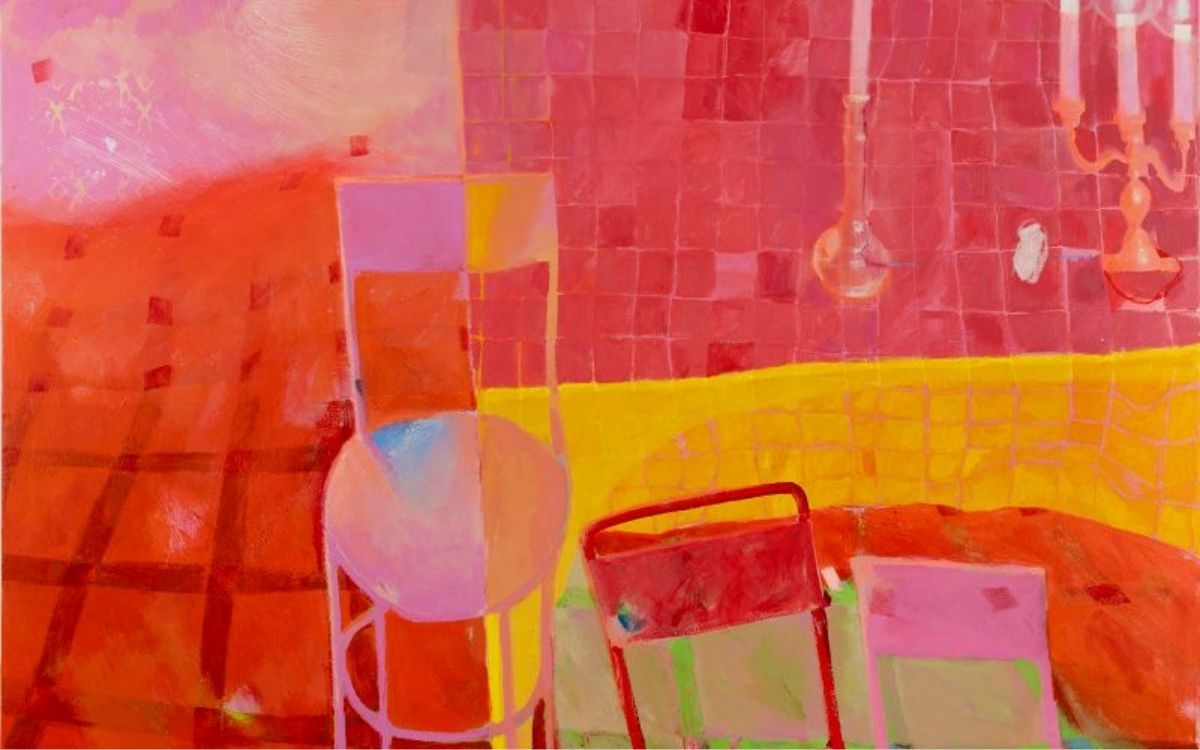
A grandmother's kitchen and a mother's table shaped the earliest sense of intimacy that now runs through the work of Miriam Dema, colors carrying the air and flavor of a Catalan childhood into every canvas. Painting becomes a place to unlearn control, oil sticks and rough fabrics like jacquard and lace making precision impossible and inviting mistake as a form of play. Working from memory rather than reference, the practice builds in layers that settle, correct, and cover each other until a familiar cast of objects, glasses, chairs, fruit, skies, reveals itself, reaching not for likeness but for the idea of a thing.
How has your upbringing or cultural heritage shaped the themes and techniques you explore in your art today?
My way of relating and caring is deeply influenced by my grandmother and my mother: the emotional weight the kitchen and the table hold for me, the attraction to the domestic, a way of looking that values intimacy and the beauty of the everyday. The colors carry the air and the flavor of the places I grew up in Catalonia. Painting is also where I unlearn things: the need for control, the self-protective habits. Working with oil sticks and on rough fabrics helps; it makes precision impossible.
Can you take us through the evolution of an artwork, from that first spark of inspiration to the finished piece?
At first, I just begin painting. The first layers are the loosest, following the first impulse without overthinking where I'm heading. Something always suggests a path, a shape, a pattern to follow, and the piece builds up in layers that settle, correct, and cover each other until it reveals itself. I work from memory, so the focus stays on feeling, color and on the dialogue with the piece. I skip sketching and paint directly on canvas. I enjoy the mistakes that redirect the piece, a chance to be surprised and stay playful.
How has your artistic style transformed over the years? Are there specific influences, experiments, or moments that marked a turning point?
Over the years, my work has grown more painterly and abstract, less linear. References have fallen away, leaving a recurring cast drawn from my own imagery: glasses, chairs, fruit, skies, that I reinterpret again and again, reaching for the idea of a thing rather than its likeness. The real turning point was working on rougher supports: jacquard, lace, printed fabrics. Each surface pushed me to loosen my grip, let go, and embrace the mistake, and that sharpened everything else.
Describe a piece you've created that has held the most emotional weight for you. What makes it significant?
That would be 'Pastís de poma al cel', the last piece of a series about my relationship with my grandmother, works that held deep love for the childhood I had around her. I painted them from nostalgia, then reached this big canvas and painted with such focus and emotion. It took shape of a cloudy sky with a round table floating at its center, like an encounter with her, in the present, sharing the cake she always made for us. It was a very moving process, and I hold it close to my heart.
How important is it for viewers to understand the intended message of your work? Does ambiguity add value, or do you seek clarity in your expression?
I work from emotions, sensations, memories of my own. My paintings reflect my inner world. What I find most beautiful is when the viewer connects with their own lived experience through the piece: a moment, an idea, a sensation, as if a collective intimacy became visible. I love that the work leaves room for whoever looks at it to make it their own, because their gaze is also part of what constitutes it; it adds meaning and depth, giving the piece new dimensions.
List five core themes or messages you aim to convey through your art.
Love, presence, lightness, care, and connection.
Has social media democratized art or diluted its value? How do you feel platforms like Instagram influence modern creativity?
Social media is a double-edged sword. It lets us reach more people, creates opportunities, and helps discover emerging artists we'd otherwise never encounter. At the same time, overexposure and overstimulation trivialize the piece, reducing it to just another image, which can lead to a superficial relationship with the work. I suppose the point is to be grateful for these opportunities while going deep into our practice, not letting its pace rush us, and still experiencing art in person.
Have you considered teaching your artistic skills to others? What excites or challenges you about that?
I've been thinking about it lately. For a long time I felt I lacked the authority to teach. I've realized everyone has their own process; a teacher can act as guide, offering paths and letting the student choose which to take, and how. Over the years I've found tools that help me unblock, let go of control, and approach painting more playfully. That's what I'd want to pass on, more than technique. Communicating such an intuitive process is a challenge, but it can help you understand yourself better and approach your own practice from a different place.
How do you challenge yourself to continually grow as an artist while remaining true to your voice?
I try to live with more love, presence, and appreciation every day, developing my intuition and my capacity for both critical and magical thinking. I don't really separate growing as an artist from growing as a person, since I paint from what I feel. The work can only go as far as I do. So I keep working on myself and keep exploring ways to reflect that truth on the canvas. I think staying true to your voice happens naturally as long as you create from an honest place.
What kind of legacy do you hope to leave in the art world?
To make people feel, to move them. That my work could enrich enrich someone's life, even one person's, already seems like a superpower to me.
At the center of Miriam Dema's work sits a quiet devotion to love, presence, lightness, care, and connection, themes lived as much as painted. Ambiguity is embraced rather than resolved, each piece left open enough for a viewer's own memory to settle into it, adding a layer of meaning the canvas alone could never hold. Growth as an artist and growth as a person remain inseparable here, since the work can only go as far as its maker does, and the hope, modest and sincere, is simply to make someone feel a little more moved, a little more met.