
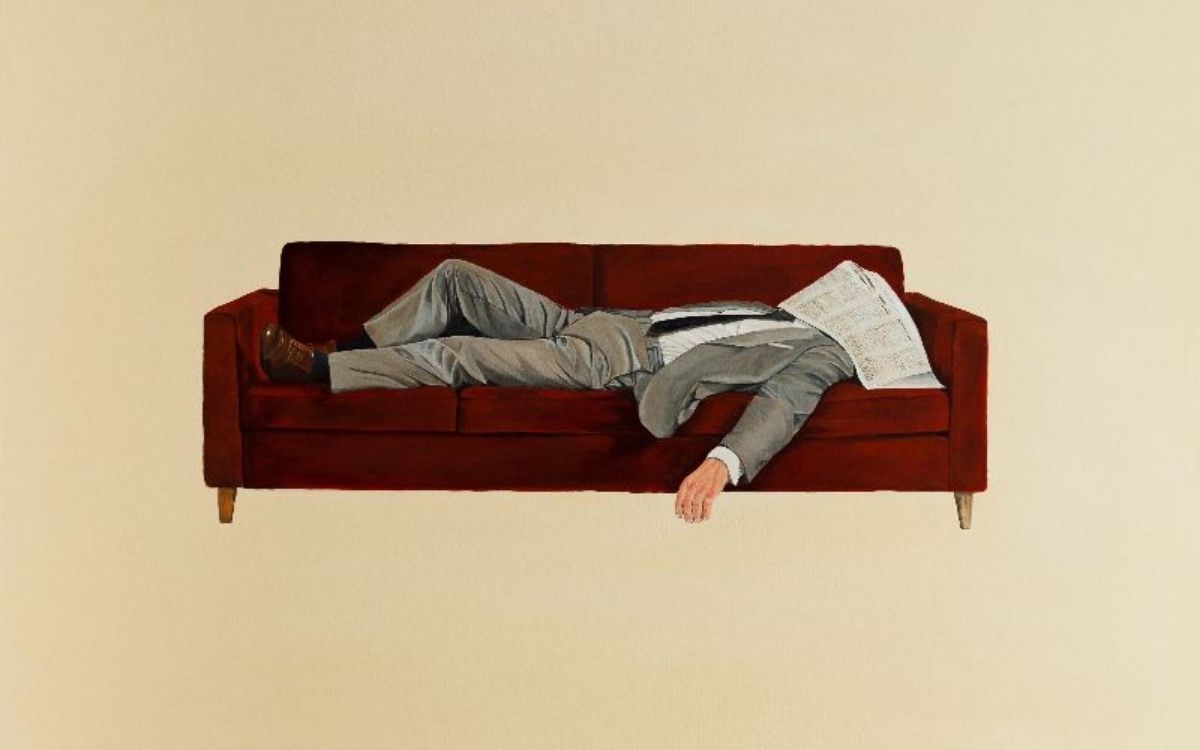
Seven years in growth equity gave Niamh Barry a front-row seat to the paradox at the heart of corporate life, ambition and busyness coexisting with quiet isolation. That observation became the foundation of a practice built on transitional moments, a fridge opened after a long day, an empty office, someone eating lunch alone, scenes ordinary enough to be overlooked yet honest enough to reveal something real. Realism grounds the work, but each canvas carries one deliberate interruption, an object that doesn't quite belong, inviting a second look and a quieter kind of attention.
What unusual or unexpected sources of inspiration have deeply influenced your work?
Before becoming a full-time artist, I spent seven years working in growth equity. That experience gave me a front-row seat to the routines of corporate life. Everyone is ambitious, everyone is busy and everyone is moving towards something, yet it's still possible to feel incredibly isolated. In identical clothes, offices, and routines, there's a strange comfort in the predictability, but also a deep sense of anonymity. Being surrounded by people all day while feeling completely detached is a paradox that lies at the heart of my work.
Many of my paintings begin with moments that most people might overlook: looking in the fridge after a long day at work, an office after everyone else has gone home, or someone eating lunch alone. They're transitional moments that rarely become part of the story we tell about our lives, but I think they often reveal us most honestly.
I'm interested in depicting figures who exist within the world but somehow feel separate from it. That's one reason I often leave large areas of the canvas intentionally sparse. The empty space reinforces that feeling of distance and leaves room for the viewer to step into the scene.
Although my paintings are grounded in realism, I like introducing one element that doesn't quite belong. It might be a bathtub, a child's sand shovel or another unexpected object. I like creating a small interruption in an otherwise ordinary scene that encourages people to pause, look again and ask themselves why it's there.
How do you reconcile the tension between raw, innate creativity and the discipline required to master your craft?
I don't necessarily think creativity and discipline compete with one another.
Most of my ideas begin as something very loose. I'll notice a scene, or an image will get stuck in my head, and I'll usually sketch it, photograph it or mock it up digitally to see if there's something there.
Because I paint in a mostly realistic style, bringing an idea to life can take weeks. Some days you're making exciting progress, and other days you're simply trying to get the angle of a hand or the fold of a shirt to feel believable. Both are equally important.
I also think my previous career shaped the way I work. In finance you learn to solve problems methodically, and although painting is very different, I still enjoy the process of gradually refining an idea until it feels right.
Usually the first idea isn't the best one. The painting becomes interesting somewhere in the middle, once I've lived with it for a while and started asking better questions. That's where discipline comes in. It gives an initial idea the time it needs to become something more.
How important is it for viewers to understand the intended message of your work? Does ambiguity add value, or do you seek clarity in your expression?
I don't think people need to understand my work in exactly the same way I do.
Every painting starts with something specific that I've been thinking about, but once it's finished it belongs just as much to the viewer as it does to me.
That's one of the reasons my figures are often anonymous. They're not portraits of specific people. I want viewers to be able to see themselves, or someone they know, within the painting rather than feeling like they're looking into somebody else's story.
I've had people tell me that a painting reminded them of a family member, a relationship or a particular period in their own life. I love hearing those interpretations because it means the work has taken on a life beyond my own experience.
Can you take us through the evolution of an artwork, from that first spark of inspiration to the finished piece?
Most of my paintings begin with something I notice that I can't stop thinking about.
Sometimes it's a place, a person or an unexpected combination of objects. I don't usually sit down and paint it straight away. I'll often think about it for weeks before I understand why it has stayed with me.
From there I'll sketch ideas, collect reference photos and start working through the composition. I usually spend more time taking things away than adding them. I'm constantly asking what can be removed without losing the feeling I'm trying to create.
Once I start painting, I usually block out the composition and values in acrylic because it's much easier to make changes (vs oil) at that stage.
Once the composition feels resolved, I move into oils and spend the next few weeks gradually building the painting.
How do you envision the evolution of your work in the coming years?
Lately I've become increasingly interested in larger spaces and more complex compositions. Instead of focusing on one person, I want to create paintings where multiple stories are unfolding at once. I like the idea that someone could stand in front of a painting for ten minutes and keep noticing new details or making new connections.
I'd also like to push the balance between realism and subtle absurdity a little further. My paintings will probably always feel grounded in everyday life, but I enjoy introducing one unexpected element that changes the way the whole scene is read.
Beyond that, I hope the work becomes more ambitious without becoming more complicated. I want the paintings to remain visually simple, but emotionally richer.
What would be the one core message through your entire body of work?
If there's one thing I hope my work does, it's encourage people to look at everyday life a little differently.
A lot of my paintings are set in offices, hotels or apartments, but they aren't really about those places. They're about the people inside them and the lives they're trying to build.
I think we spend so much of our lives chasing the next milestone that we overlook the moments in between.
I don't think my paintings are arguing that work is good or bad. Work can give us purpose, challenge and community. But I'm interested in what happens when it becomes the only way we define ourselves. What gets squeezed out? Relationships, hobbies, rest, curiosity, connection—those parts of life deserve just as much attention.
I want my work to inspire people to pay a little more attention to the rhythms of their own life, reach out to someone they've been meaning to call, or simply starts asking themselves where they find meaning beyond achievement, then I'd feel like the paintings have done what I hoped they would.
How does your art engage with or comment on pressing contemporary issues—social, political, or environmental?
We're living through a time where loneliness and disconnection have become major social conversations, despite us being more digitally connected than ever. At the same time, professional success has become something we're constantly encouraged to pursue, and for many people work has become one of the primary ways we define ourselves. I'm interested in what happens when ambition begins to crowd out other parts of our identity.
This current body of work focuses primarily on men because that's the environment I spent seven years working in. I watched many of the men around me carry an enormous amount of pressure—to succeed professionally, provide financially and appear completely in control. Those expectations can be incredibly isolating, even if they're rarely spoken about.
At the same time, I experienced what it was like to build a career as a young woman in a predominantly male industry. Those experiences made me think about the roles we
perform at work, the pressure to fit in and the emotional cost that can come with constantly trying to succeed.
I'm not trying to offer answers or make a judgement about modern work. For many people, work is deeply meaningful. I'm more interested in the balance. When does ambition enrich our lives, and when does it begin to replace the parts of ourselves that exist outside our careers? Those are the questions I hope my paintings encourage people to reflect on.
For Niamh Barry, discipline and creativity have never been in conflict, each idea given the time it needs to become something more than its first version. Figures remain anonymous by design, less portraits than open spaces where viewers can recognize themselves, a relationship, or a version of their own life. Beneath paintings of offices, hotels, and apartments lies a steadier question: what gets crowded out when ambition becomes the only measure of who we are, and what might it look like to notice the rhythms of life happening quietly in between.