
A shoe factory apprenticeship, years as a scenic artist and art director touring sets across the UK, Ireland and Europe, and finally, unexpectedly, a heart attack at forty-nine: the path to painting for David Hamilton was anything but direct. It took illness to prompt the leap back toward a long-held but doubted ambition, resulting first in a small portrait of a goddaughter and later in a practice built on psychology, climate anxiety, economic strain, and the liminal spaces between waking and dream. Doors, mist, and threshold light recur throughout the work, each one standing in for the quiet, uncertain passage between one state of being and the next.
Have you ever felt drawn towards a conventional career path? What made you take the “creative leap” despite the risks?How do you measure the impact of your work – by its perception, its personal meaning, or something else?
I was never interested in a conventional career path really. I did start work at seventeen, leaving school and A level examinations to embark on a career as an apprentice shoe designer in a local shoe factory, however, a few short few years later, I realised the errors of my ways and eventually made it to where I had originally intended to go, namely, art college in Belfast.
I think this foray into the world of factory work and routine at an early age left a lasting impression on me and I have been a bit of a free spirit ever since. I did have a career, as such, as a scenic artist and subsequently art director for an international theming company making sets for the entertainment industry but even this was a nomadic lifestyle travelling from one job to the next across the UK, Ireland and Europe. All I ever aspired to really though was my own painting practice but I never thought I was a capable enough painter to be able to, and it was only the catalyst of an illness that emboldened me to try.
I actually made a painting based on this personal journey titled “Don’t Fear the Leap” inspired by a quote I read from a review of the James Joyce short story Eveline. The reviewer stated that Eveline was “fearing the leap” meaning how she was torn between leaving her familiar but abusive family life in Argentina for a better and more rewarding life in Argentina. The words not only struck a- cord with me personally but also how many of us hold ourselves back from pursuing our dreams and aspirations through a lack of self - belief or confidence in one’s abilities.
I keep being drawn back to this piece not only because its narrative reflects my personal journey but also, I hope the positive theme of the painting will encourage others to pursue their dreams too.
I think within my practice I am trying to touch people mainly on a personal level. My work often incorporates psychological and scientific concepts using metaphors from nature and human behaviours to explore themes of mental health, emotional expression and social interaction. Also, I have paintings which deal with subjects I believe are pertinent to us all in these changing and confusing times such as climate change as in the painting titled, “I = P x A x T” and the – cost – of - living - crisis as depicted in “The Family Bowles and the Fiscal Black Hole”.
One of my most challenging paintings to make and which were inspired by the poetry of Julia Kardas is called “Cognitive Distortion” in which I tried to depict how habitual, inaccurate or exaggerated thought patterns twist reality often leading to negative emotions and a biased view of oneself or the world. Another is titled “Camouflaging” where I tried to portray how humans choose to show and conceal their emotions depending on social context and perceived safety
I think these are the two pieces I found that touched people particularly on both an emotional and personal level and it was humbling to see the heartfelt emotions they stirred within the viewers.
Can art be truly therapeutic, have you seen its healing power personally or seen it impact others?Describe the piece that created the most emotional weight for you and what makes it significant.
The most important painting I created and one which had the most impact on my art career was of my goddaughter Fin. This was the painting I made after recovering from a life - threatening illness and not only did it help in my recovery but also encouraged me to believe that I could produce a piece I could be proud of and perhaps be able to find a new career path through.
Having gone through life without suffering any ill health up until the age of 49 except for scraping my knee when I was eleven, having a heart attack was really the last thing I expected to happen but it did happen. Subsequently, during recovery, I came to the realisation that I was not going to be able to return to the rigorous and stressful career I had before and pondered on what exactly I could do next.
I have always been mono passionate about art so I thought about taking up painting seriously again after a very long hiatus from it. I had no idea where it was going to lead but I knew the challenge of it was a welcome distraction from the melee of emotions I was going through at the time. I had actually been so long away from the practice of painting I didn’t know exactly where to even begin again. I knew the basics but to say I was a tad rusty would have been an understatement. The internet also wasn't as it is today where you can find out everything you want to know and order anything you need to order at the tap of a keyboard so it was a lot of trial and error before I even got a suitable canvas and some equally suitable painting materials together, to start.
Subject matter too was an aspect I really didn’t have to think about much previously. In my former career the work was already usually designed beforehand and it was up to us to bring character and life to it. In this new art world creative ideas had to be formed and then life breathed into them through the stroke of a brush.
I remembered a quote from Picasso when choosing the subject matter where he said “Painting is another way of keeping a dairy” and I thought capturing an image of a loved one would perhaps allow me to document different chapters of their lives, preserving a moment in time that a photograph on its own would might not fully capture, in the same soulful and subjective way.
So duly I set about painting the piece and I choose my young goddaughter Fin as the subject. Through much trial and error, I managed to produce a piece I was content with. Was it perfect, no, was it technically accomplished, no, was it going to take the art world by storm certainly not but it was a start. I had proved to myself that there was another productive path I could take and through this painting I had found the key to a new door in my life, one which I opened and embraced. I have this joyous art life today because of that one small painting and one of the best days ever was when I gifted it to Fin.
How important is it for viewers to understand the intended message of your work? Does ambiguity add value or do you seek clarity in your expression?
For me it is important for the viewers to understand the intended message of my work as some of my pieces serve as visual essays moving beyond simple representations to explore the liminal space between different states of being.
What I mean by this is that they operate like a slow deep observation of the world capturing, at times, “in – between mental states and feelings (such as stillness, memory or the transition between sleep and waking) to invite personal reflection.
Rather than a straightforward, realistic representation of a landscape or interior my paintings tend to tell an abstract narrative like story. They act as a written essay does – exploring a specific concept, mood, or thought. Instead of focusing on the strict, physical details as in my recent door series, I have stripped away the superfluous (like unnecessary visual clutter to deliver serene, calming, and atmospheric images.
When I speak of liminal space, I mean the “in – between zone” I refer to the threshold between order and chaos, physical reality and the abstract world of plans, or the boundary of the “self”. My work tends to explore these psychological twilight zones to help viewers experience a “mental reset” or a deep connection to their own past and emotions.
My landscape works tend to act at times as visual metaphors for the human subconscious, capturing again as in my Door series, the literal definition of a threshold. I sometimes employ soft focus, mist and blending techniques to obscure sharp horizons. This blurs the physical boundary between earth and sky, mimicking the mental state of daydreaming or fading memories. When I strip away modern distractions at times in my work (like roads or powerlines) I challenge the viewer to confront a vast solitary space, attempting to prompt internal quietness.
For my interior paintings I shift the focus from wide - open nature to intimate psychological thresholds, portals that look from a dark room towards a light source outside. This visual set up physically represents a “state of transition” or looking forward into an unknown future. Using subtle desaturated tones allows the environment to feel still and frozen in time. The room ceases to be a functional space and instead becomes a container for human emotion or absence referencing the emotional weight that physical spaces accumulate.
List five core themes or messages you wish to convey through your art.
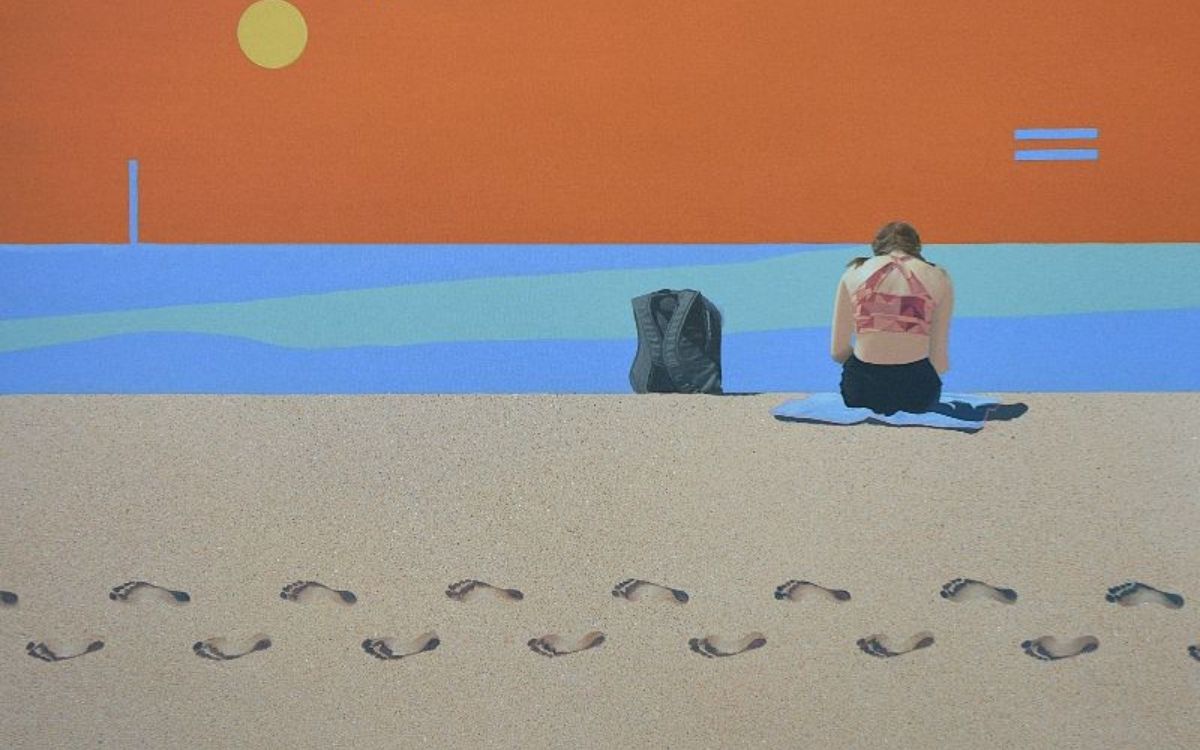
Environmental degradation would be the first of five core themes I would like to convey through my art specifically in relation to the climate crisis. In my work I try to explore the emotional and atmospheric consequences of a warming planet, abstracting environmental threats into symbolic imagery, framing change as an unnatural alteration of our daily lived environments as illustrated in the piece, I = P x A x T.
This is a painting representing a mathematical notation of a formula put forward to describe the impact of human activity on the environment and I titled it after the notation. The expression equates human impact on the environment to a function of three factors population (P), affluence (C) and technology (T)
Impact may be measured in using global hectares (GHA). Ecological footprint per capita is a measure of the quantity of Earth's biological productive surface that is needed to regenerate resources consumed per capita. This ecological footprint was one of the various aspects of the notation I incorporated in the composition, illustrated by the footprints in the sand.
The Human Condition and Psychology
I try at times in my work to visualise complex inner realities, such as how cognitive distortions for example can warp our perception of reality, by turning these invisible mental struggles into art.
Cognitive distortions are habitual, inaccurate or exaggerated thought patterns that twist reality, often leading to negative emotions and a biased view of oneself or the world. Examples include all-or-nothing-thinking, overgeneralization and catastrophizing and they are often a factor in conditions like depression and anxiety. The idea behind the painting of the same name was to illustrate how cognitive distortions are likened to fun house mirrors because of how they both twist and distort your perception of reality - instead of altering your appearance, cognitive distortions warp your thoughts, making you see situations in a biased or inaccurate way.
Just as a fun house mirror might make you wider or thinner than you are, cognitive distortions can magnify small problems and minimise your strengths leading to emotional distress and a skewed view of yourself, others and your circumstances. As the mirror changes the physical image these distorted thoughts change the way you interpret events, often amplifying positive ones. What you see in the mirror is not an accurate reflection of yourself similarly with cognitive distortions you believe the distorted thoughts are the truth when they are not based on fact.
I collaborated on this painting with the poet Julia Kardas and it is part of a broader body of work on reflection and emotions inspired in part by her affecting poems.
An extract from her poem Cicada reads:
I wish I could stop this maddening distortion
The fallacious prophecy whispered to my ear
And repeated like a prayer
Until it becomes the lullaby I welcome each night.
The Cost – of - Living – Crisis and Macroeconomics
My painting titled “The Family Bowles and the Fiscal Black Hole” is my attempt to visually translate abstract macroeconomic geopolitics into a domestic struggle. I try to represent economic debt as a terrifying “celestial body” – a black hole – that devours economic energy and directly causes the cost – of – living crisis
In celestial terms a black hole draws energy (light and matter) into its vortex and a fiscal black hole draws economic energy (GDP) into its vortex due to the deadweight of massive debt. This huge and terrifying new celestial body resulted in an attack on public services and economic prosperity. The cost – of - living - crisis that followed left families struggling to put food on the table and to pay the bills, and little meat on the bone for anything else.
In this painting I tried to tie this macroeconomic phenomenon to the personal reality of working and struggling families. I suggest it questions the narrative used by politicians and the media who blame a “black hole” in public finances for cutbacks and austerity, while ordinary families are left with little else to pay the bills and survive.
Decadence & Technology
In my series of paintings titled” Contemporary Decadents” I tried to juxtapose 19th – century aesthetic philosophies – such as escaping into inner realms – with modern technology and the digital age.
Decadents expressed the notion of the person who disdains the world around them and retreats in a self - created inner world. Abstractionism also indicates a departure from reality, in terms of the depiction of imagery in art. Be it slight, partial or a complete departure from accurate representation. In one of my paintings from this series titled, “Monitor”, I tried to incorporate this aspect of decadent philosophy by assimilating it into today’s technology, in an allegorical manner, combining their views with an abstract piece I visualised as the screenshot on a monitor.
Nineteenth century decadents were also inspired by a disgust at the corruption and rampant materialism of the modern world and partly by a desire to escape it into the realms of the aesthetic and the fantastic. New York Times columnist Ross Douthat characterises todays decadence as a state of economic stagnation, institutional decay and cultural and intellectual exhaustion at a high level of material prosperity and technological development.
Mythology and Cosmic Cycles
I like to explore folklore indigenous stories and portals to represent the interconnectedness of all things, trying to weave together cultural myths and liminal spaces. In bridging different planes of reality, I attempt to showcase how humanity, nature and the spiritual world are bound together trying to make a profound sense of unity through several core conceptual methods.
I also like to intentionally integrate physical and symbolic portals to visually merge our conscious waking state with the subconscious. These portals such as illustrated in my “Door” series act as conceptual thresholds where separate dimensions collapse into one another, illustrating that nothing exists in a vacuum.
Whether I paint celestial ideas or earthly settings these portals serve as reminders that the smallest individual elements are fundamentally linked to macroscopic, universal energies.
Name five pivotal lessons that you have learned that has shaped your artistic journey.
I think the first of these for me personally is self-belief. Although I am grateful for the artistic journey I am now on, I believe I could have paved this path for myself sooner if I had had more faith in my own abilities. It took a fortunate/un fortunate piece of luck in the form of an illness to have me reevaluate what this second chance at life had really given me.
Self- belief is the foundation for achieving your goals. It provides the courage to take the first steps, fuels the resistance needed to push through inevitable obstacles and silences the self-doubt. I found all of these traits in myself by accident, eventually, but not all of us are given a second chance.
Sacrifice
Making art requires sacrificing time, energy and comfort. It means choosing vulnerability over certainty – giving up stability and instant gratification to master a craft. Ultimately, it is the exchange of personal resources in pursuit of a vision that is greater than oneself.
The most fundamental sacrifice is time. Building up an audience and mastering technical skills often require spending countless hours isolated from family, friends and social lives. This draining mental and physical effort demands that other interests and hobbies take a back seat.
The concept of the “starving artists” exists for a reason. It can be a low – income and unpredictable. It might mean living in smaller places, giving up luxuries or working part time jobs just to fund materials or pay rent while working on a project.
True art requires digging into deep emotions – including pain, grief and conflict. This demands sacrificing emotional equilibrium, as creators constantly push past their comfort zones, wrestle, as described before, with self – doubt and confront their deepest fears to bring an idea to life.
Rejection
I have had many more rejections than I have ever had selections and it is how you deal with those rejections which is the most important thing. At the beginning of my art journey, when my work was routinely rejected for exhibitions, to say I was disappointed would have been an understatement as I deeply wanted my work to be accepted into these shows. Over time though I came to realise that I could use these rejections to improve my practice and rather than making me feel inadequate they incentified me to work harder at making my art better.
I would go to the exhibitions I was rejected from to learn from the work of the artists who were selected. I found through this that to become a good artist you have to learn from a greater one and always endeavour to view as many greater artists as you can. On a side note, too, always remember it is not only the quality of the work that is being judged but the calibre of the judges.
Nowadays I live quite happily with rejection probably because over a long period of time you become quite desensitised to the volume of it. However, I take it now as part of the process rather than some stinging critique of who I am. In reality gatekeepers make decisions based on subjective tastes, space constraints, or whether your work fits a specific exhibition theme. Remember that every successful artist has a long history of rejections.
Patience
Creativity is much like being a gardener, it needs time space, care and room to grow. In my work it was only when I started allowing myself to slow down, to sit with an idea and let it evolve, to stop throwing the kitchen sink at it, that my work began to reflect the connection and authenticity I was striving for.
One lesson to learn is that not every moment in the studio needs to be productive. There will be days when the ideas are just not there when the work is just not flowing. It is important to learn to step away in those moments and do something completely different. It is often during these times of reflection that inspiration strikes again and you can approach the work with new energy and perspective. Slowing down doesn’t mean giving up, it means creating space for creativity to breathe.
Patience doesn’t come naturally to everyone . I seem to have endless patience when I am painting but in other aspects in my life, I am totally the opposite. The trick I found is to let go of the arbitrary pressure I put upon myself and create at a pace that suits me.
Slowing down and working at a pace that suits me has definitely made me a better artist and taking that pressure of myself has definitely made me a happier artist too. I actually work less than I did before but I seem to produce more paintings and better work. In giving myself this extra time to engage with my work I have definitely found more joy in the process.
Rewards
For me, especially when I first ventured out on this journey, art provided me with a therapeutic emotional release from my health issues which I was very grateful for. Engaging in the creative process quiets your inner monologue and lowers tension, offering a mental escape similar to meditation. Scientific studies also show that visual expression directly stimulates the brain reward centres which naturally make you feel happier.
As a means of safe self – expression art provides a unique channel to communicate complex emotions and fragments of memory that are difficult to put into words and the creative process also allows for endless trial and error letting you learn from your mistakes and develop new technical skills.
I believe art is profoundly rewarding, I have experienced how beautiful a practice it is, I have met the most beautiful humans through it, I have travelled to the most amazing places because of it, and it has it served me well as a powerful tool for self – discovery, with every finished painting representing a tangible reminder of my growth and capabilities.
List five moments or achievements in your career that fill you with gratitude.
I touched on the first of these five moments when I was describing earlier the piece which carried the most emotional weight for me. This was how the first painting I made after recovering from an illness not only helped in my recovery but guided me on a new path of discovery. I will always be grateful to that small work and it shall always hold a special place in my heart. It not only restored my confidence but instilled in me the self – assurance I was searching for. Most of all though it gave me a new future I could look forward to and for that I shall always be grateful.
The next piece of work I felt gave me a great sense of gratitude and achievement was the first time I had a painting selected for exhibition at the National Gallery of Ireland, in The Hennessey Portrait Prize.
Again, it is a piece I painted after surgery and a period of time in hospital (sorry, I am genuinely not ill all the time). The piece was actually of a fellow hospital patient who resided in the bed opposite mine and whose blinding red fleece I would awake to first thing in the morning. I found his character interesting and during the day I would make sketches of him to pass the time (with his permission of course) and took reference photographs also with the intention of making a portrait of him later. When I returned home, I made the portrait and duly submitted it for consideration in the exhibition. I never actually believed that my work would ever be selected for such a highly esteemed national gallery and I was both shocked and delighted when it was.
I shall never forget the train ride to Dublin to deliver the painting for this exhibition and how proud I was of myself as I walked through the streets of the city with it clutched tightly in my hand, having to pinch myself on occasion that this extraordinary day I was in, wasn’t really a simulation.
The icing on the cake for this whole scenario was when at the launch of the exhibition evening a few weeks later, I was awarded a highly commended prize for the piece. Again, I was a tad shocked, so much so in fact that I just stood there, frozen in disbelief instead of going up to the stage to receive the prize. In the end I had to be prompted to move and eventually did. So, I am very grateful to that piece and my sitter for those lovely memories and proud of myself too for turning what was a negative experience in the hospital into what was eventually a very positive one.
Another exhibition I was selected for which gave me a lot of pride and pleasure to be a part of was The Royal Academy Summer exhibition in London. It is a difficult exhibition to get selected for because of the sheer volume of entrants the judges have to sift through, I think I read somewhere that they have only about seven seconds to see a piece as it is being whizzed past them. But I did actually make it through all the submission stages and I felt very proud that I was selected for it. I also got to share the traditional Varnishing Day celebrations with the other artists which was a lovely experience.
My selected painting was titled Mr and Mrs Bowles and it was after a Gainsborough piece called Mr and Mrs Andrews. I reversed the roles of the sitters in this piece and Mrs Bowles now held the gun that Mr Andrews was holding in the original and sat Mr Bowles on the bench where Mrs Andrews was originally sitting. The gun dog was also replaced by the Bowles' favourite chicken and the landscape was a combination of the original Gainsborough landscape and the view from the Bowles home.
After the exhibition it was really amazing to visit The National Gallery and see the original Gainsborough. I cannot remember how long I stared at it for but it was hard to get prised away from it!
When I look back at other achievements in my art career, one that always stands out too, is the first time I ever had a painting selected for a major exhibition. I mentioned beforehand how rejection plays a major role in every artist's life and how many artists give up after years of trying to progress with their aspirations and it was no different for me. It is very deflating especially at the start of your career to be constantly knocked back with submission rejections but the excitement I felt at getting into one at last was a very profound moment personally and I was on cloud nine for days afterwards.
The painting was a portrait commissioned by a friend for his wife as a surprise anniversary gift. I referenced the piece from a photograph and it was selected for The Royal Ulster Academy Annual Exhibition. It was really uplifting and fulfilling to finally get selected for this prestigious show after years of trying and failing and it was also very special to me personally that it was this show in particular, as being from this province made the selection even more poignant.
The lovely end story to the piece is that the family all came over for the weekend from Scotland and apart from my patron none of them knew that the painting was actually in the exhibition. So, when we all went to the show it was a beautiful unforgettable moment when she saw her piece and her gift was explained, and to top it all off her painting also appeared full page in the beautiful brochure made for the exhibition! Truly it was a gorgeous art moment and one that I will always remember very fondly.
I think the fifth thing I feel a lot of gratitude in my career for really is social media. The reason being is, I could actually not be more grateful to all the artists, especially on Instagram, who encourage me on a daily basis by liking or commenting on my work. It is so touching and encouraging to me that friends and complete strangers alike would actually take the time just to simply like a painting or say something positive concerning the narrative or the rendering of it. It really means a lot to me and really helps my confidence. Also, I would not have had half of the wonderful art experiences I have been blessed with over the years if it wasn’t for fellow artists posting about exhibitions or suggesting shows for me to enter my work into. And following on from this meeting these artists in person and becoming firm friends. My practice has also improved immensely too just being able to view and learn from other artists' work from all over the world, finding new styles and new ways to approach the art of painting.
Yes, I have a lot to thank social media for in my practice, indeed without it I would never even have been afforded the opportunity to write this special spotlight project for Artit about my work and my practice, something which I have been proud to have been invited to do. Thank you.
For David Hamilton, painting has become both diary and reckoning, a way of translating cognitive distortion, fiscal anxiety, and ecological grief into images that ask viewers to slow down and sit with discomfort rather than resolve it. Rejection, sacrifice, and patience shaped the practice as much as any single success, teaching a hard-won trust in timing and in the value of stepping away when the work refuses to come. What remains is a body of work built on second chances, some medical, some artistic, and a quiet gratitude for every painting that marked the start of something new.