
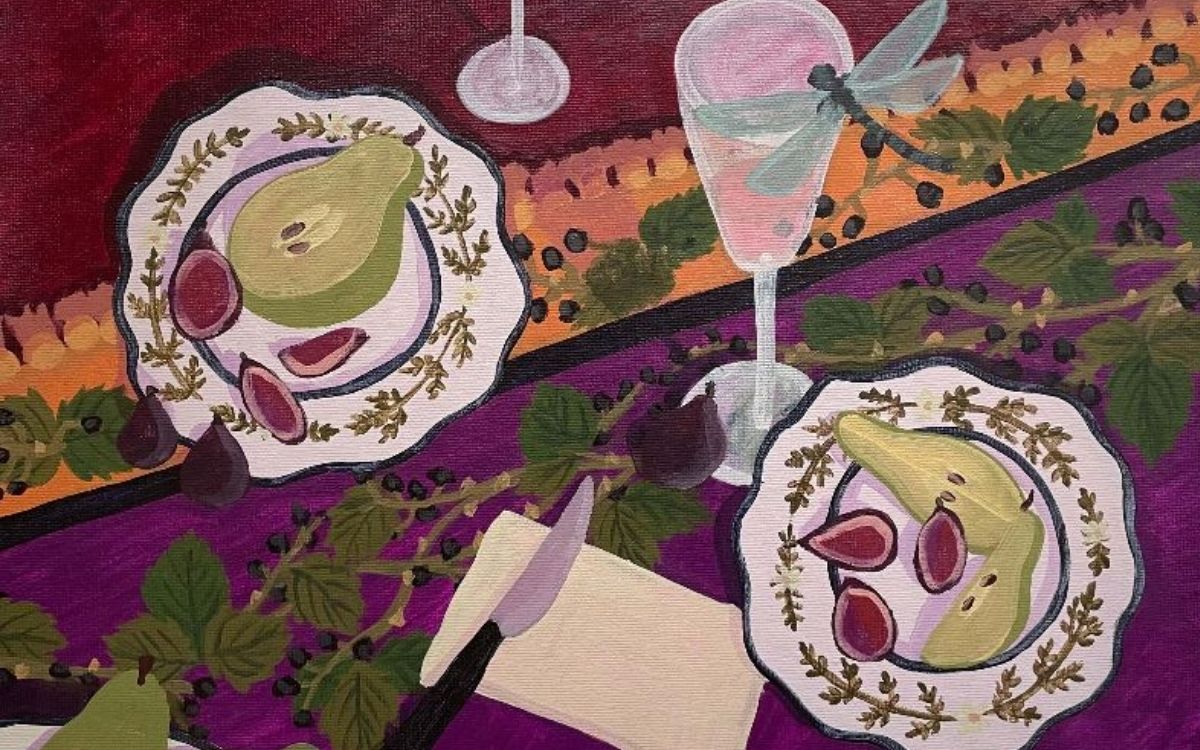
Nostalgia and still life anchor the practice of Madeleine Landaker, a body of work built from morning coffee, corners of an apartment, and the quiet architecture of everyday routine. What began with disciplined realism gradually loosened into bolder color and looser brushwork, memory allowed to warp and shift the way it naturally does, rather than forced back into precision. Painting becomes a way of holding onto both past and present selves, documenting change while making room for it to keep happening.
Do you believe an artist's passion is something destined or a conscious choice?
I think an artist’s passion is both a destined and conscious choice to pursue, speaking from personal experience. Starting from a young age, I’ve always been considered the artist of the family. When in daycare, I gravitated towards the arts and crafts corner, in grade school art was always my favorite class, and later I decided to go to college for painting. Once I started showing my interest in drawing and painting, my family was very supportive of me and encouraged me to continue that exploration and experimentation of those practices.
Going to school and making a career from my art practice wasn’t always my Plan A, or even my Plan B and I never considered it an option as a career path until high school, and even then I was still hesitant and unsure. Both of my parents went to school in scientific based fields; my mom marine biology and English, my dad medical school. A lot of my extended family pursued careers in the education system, either as counselors or teachers, however, none of them taught art. My grandpa did photography and charcoal drawing as a hobby and my great-grandmother was an oil painter, but they saw those enjoyments as hobbies. Observing the jobs my family had around me in addition to the stereotypical comments made about artists (“starving artist”, “struggle”, “competition”), it deterred me away from taking my practice seriously for a while. I had the idea that I couldn't be an artist but I wasn’t sure what else I was passionate about in the same way to turn into a career until my uncle brought up graphic design.
I am a very practical thinker, I like to plan things out, know what my next three steps are going to be, and to accommodate for any bumps in the road. Graphic design seemed like the smartest artistic career path I could go because I was told it guaranteed a job after graduation. It wasn’t what I was drawn to but financially it made the most sense at the time of college applications. After going through my foundation courses in undergrad, I realized I wouldn’t be happy in that study so I declared Communication Arts as my major, went through one semester and didn’t enjoy it either, so I finally switched over to painting. Painting was what I wanted to do from the start of building my application portfolio, through the foundations program, and what I was wishing each assignment was in that first semester of Comm Arts.
There was a conscious choice made to pursue art as a career on my end. Growing up, I was drawn to art and creating without the understanding of why other than because I loved doing it. And even though I tried pushing against it and went back and forth between pros and cons, I ended up giving in and pursued the medium that I love working with the most.
It is a challenge to keep up the motivation to keep showing up, especially after graduating and not having deadlines and having a consistent creative schedule. There has always been a tug for me towards creating and I don’t plan on steering away from it. I plan to lean more and more into that tug, one of the next big steps being grad school.
How has your artistic style transformed over the years? Are there specific influences, experiments, or moments that marked a turning point?
Over the years, I feel like my work has gone in odd directions that have circled back to where I started while carrying small characteristics from each experimentation of style, developing it into what it is today.
When starting to take my practice more seriously, I focused on developing my technical skills and aiming for realism made the most sense to me. In high school, I worked a lot from reference photos and aimed to get every last detail down because technical skill was emphasized so much for college application portfolios. Once in college, the first two years also focused on technical skills, building up the understanding of shading, rendering, understanding materials, and building technical foundations as an artist. By the time I got to my third year of undergrad, I was burnt out from realism and rendering objects to look exactly to their real form, so I decided to loosen up on restrictions and perfectionism in my paintings. Precision had followed me from high school to undergrad, the expectation placed on me by both myself and professors, and I was getting bored of it. This is when I started exploring the implications of objects and scenes rather than copying and pasting. I completely disregarded reference photos and went back to drawing and painting things from memory, just like I would when I was a kid. This phase of style and approach to creating a piece brought back an excitement and wonder to my process that I didn’t realize I had lost and missed.
After graduation, I experienced a period of burnout and I started to gravitate back to realism and having a photo to reference from. Having a color palette and composition already laid out for me took away some of the daunting pressure I was feeling before even starting a piece. At that time, I made a three piece series, “Sunday Brunch”, at my first artist residency. Being in that creative space helped me out of the slump I had fallen into and started making work for my personal enjoyment and documentation of what was going on in my life at the time. I was also working on a bold, almost pop-art style fish painting for my mom that was similar in process to what I had done my last year of undergrad. Between that painting and “Sunday Brunch”, I wanted to figure out how to combine those styles into one. In fall 2026, I attended my second artist residency in France, and unintentionally achieved that goal. I combined the color experimentation and bold style with memories through another three piece series; “Breakfast Plums and Afternoon Walks”, “Evening Conversations in Violet Hues”, and “Anemones, Asters, and Alcoves”.
My style started with the focus on realism and building up technical skills, took a completely different turn to bold, blocky shapes and colors, back to a small shift of realism but with a looser hand, and finally merged bold colors with real spaces I have photographed. My style is still progressing and developing and I expect it to continue to develop and shift with me throughout my career.
Do you feel a personal connection to your subject matter is essential? How has this connection shaped your work?
My work falls under the theme of nostalgia and memory, so I do think it’s very important for me to be connected to my subject matter. I use my work as an exploration of self, both in the past and present. I tend to lean towards painting still lifes, and usually the references for said paintings are from photos I took myself, a collage of sketches I’ve done, or images from memory of what I remember something looking like.
I have gone through a lot of change and development as a person over the past few years. From moving out of my parents house and to college, living with roommates to living with partners, and navigating being a young adult now living on my own, there’s a lot I have discovered and am still discovering about myself in relation to habits, routines, and way of living. Documenting mundane moments in my everyday life acts as a reminder of how far I have come as an individual and how much I still have yet to grow. Taking the time to paint my morning coffee, the way a chair sits in the corner, and other snippets of my life aids in deepening my appreciation for what I have in a way other forms of expression don't fully reach.
Over the past few years, I have found that if I don’t have a personal connection to what I’m painting, whether it’s the subject matter, style, or even color palette, I don’t enjoy painting it and I will rarely return to it once I’ve stopped working on it for a period of time. There are pieces that I have started that I had a strong connection with at the beginning stages but lost interest over time and I felt myself move on from that subject matter, that memory, and feeling associated with that moment in time. There is always the possibility of returning to an unfinished piece with the understanding that it will be warped from what it was intended to be because I have changed from when I first started.
I have also explored my past self and want to lean into that exploration, mainly focusing on childhood memories under the age of ten. Around the age of five, I went through a big shift of moving cities and away from friends and family, then went through another move at the age of nine. There are snippets from those chapters that I want to explore and bring to life through paintings and mixed media projects. I think a big reason why I want to dive deeper into these specific memories is because of how pivotal those moments were for me and I am experiencing another pivotal moment in my life. There is a sense of comfort for my present self to bring forth those memories, making it feel like I am comforting my past self by materializing those experiences.
The idea of memory in my work has also helped me let go of the need for precision and perfection in my work. I used to be very particular with my process, having to get every color correct, every last detail in, and make the image as realistic as possible. Over time and under exploration of memory, I have loosened up with my brush strokes, allowing paint to sit in places it isn’t in the reference photo. Memories are never going to be exact and precise to when they played out in their original moment. They warp and shift every time we return to them and replay them in our heads and I allow that shift to happen in my process.
What are five steps you’re taking to ensure your continual growth as an artist?
Five practices I’m working on instilling into my routine to continue my growth as an artist are being more mindful and intentional, building up weekly habits of sketching, as well as being more experimental. I’m also working on staying active and up-to-date in the contemporary art scene and I’m picking up more opportunities as they come up.
One of the most valuable ways I have learned and developed as an artist has been through trial and error with my work. I have found styles and techniques through experimenting with my work, but with experimentation there’s also the fear of it not being good or coming out the way I envisioned it in the beginning. In high school and undergrad, professors encouraged us to make mistakes and learn from them, giving me that push from another person to try new things, but now that I’m out of school I have to be that person to encourage those pushes. Experimenting and letting go of the fear of making “ugly” work is a mindset I’m working on instilling into my practice and allowing myself to roll and work with the “mistakes”. Working more often in my sketchbook will also help with experimentation and loosening up with materials, gestures, and colors. Building up the habit of putting ideas on paper, no matter how elaborate, will also encourage me to develop a more regular studio routine. It’s difficult to set aside time and just start working on my art in between my everyday jobs but once I get started it’s easier to want to continue the next day. Building up a routine and habit of weekly sketching will motivate me to set aside more time for my practice, as well as provide a space for me to make mistakes and experiment.
In relation to sketching, I would like to sketch more of my references from life and utilize those sketches as my reference photo, rather than rely solely on a photograph. Working from a sketch brings in more mindfulness and intention behind my work, especially with it being related to personal memories and experiences. Characteristics change up slightly and that reference morphs into a more accurate memory; there is muscle memory for my brain and hand because they’ve drawn it before, I have to rely on what I remember that subject matter looking like when I was observing it to sketch it which takes away the safety net of a photo which I personally feel like I’ve relied on too much at times. There is also the habit of going to that space and sketching it out from different angles, studying the space or object in different light, taking the time to fully absorb the space and appreciate it even more. I’ve done this process for a few pieces and I’ve really enjoyed it because there’s an added appreciation for the process of building up to developing the piece of art.
Keeping up with the contemporary art scene, going to galleries, and exposing myself to current things happening with art movements and artists is another habit I am growing to develop my practice. I like to listen to podcasts and interviews with artists while cleaning, making dinner, or working in the studio and I would like to start reading more articles when I have down time. I follow other artists, galleries, and art platforms across social media to have exposure even when I’m not actively looking for it.
The final step I am taking to ensure my growth is taking opportunities when they are presented. It’s very easy for me to say no and come up with excuses on why I shouldn't do something which has led to lots of missed chances for growth as an artist and person in general. I’ve been saying “yes” to more invitations that have led to some of the best experiences I’ve had as an artist. I went to France for three weeks because of it, I’ve had my work up in galleries, I’ve gained more inspiration, and I’ve met some amazing and talented people because I said yes to an opportunity. I am always seeking to continue to grow and learn.
If you could live anywhere in the world to further inspire your creativity, where would it be?
If I could live anywhere to further inspire my creativity, I would choose Edinburgh, Scotland. I have always wanted to travel, to broaden my knowledge on culture and arts. To live in Europe, there would be easier access and more reliable transportation to new cities and different countries that would inspire new work. My work aims to capture personal moments in my life, usually passing moments, and being able to travel more would provide more reference material for future pieces.
Edinburgh would essentially be home base for me, but I would love to travel to new countries. I’m constantly on the hunt for new patterns, textures, color combinations, and experiences. When I was in France for three weeks this past fall, there was a constant flow of inspiration for me, to the point I felt a little overwhelmed (in a good way) with all of the ideas and the urge to create. I filled my camera roll and sketchbook with material to use in future work that I still return back to. With my work mainly being still-life centered, occasionally incorporating figures, traveling to cities and exploring new spaces would give me unlimited access to inspirational material. Big cities are constantly moving, changing, and developing. There are always events going on, annually, monthly, and weekly. It’s easy to observe people going about their day, capturing candid moments, because there is so much happening, usually no one notices others observing them. And then there are smaller, quieter towns that take things at a slower pace, making it easier to absorb every last detail. Something I would like to incorporate into my practice more would be more on-site sketching and painting. Instead of taking photos of references, I would love to sketch something and use that sketch as my reference piece. During my residency in France, I was able to take my time sketching flora around the town and looking back at those to incorporate into the pieces I made there. There was a mindfulness that I appreciated in that moment.
Even though I have mentioned traveling and exploring new spaces, I would like to live in Edinburgh because I think I would work best there. As much as I love the vibrancy of other countries across Europe, there is a quiet, almost moody charm that Scotland carries that I am attracted to. Personally, I love the rain, cloudy days, and cooler weather which contrasts with what my work displays. It would be ideal to have my studio and living space in a calmer place to motivate me to stay in the studio and produce work that reminisces on those busier, vibrant places. However, there are also places for me to explore in Scotland that I can use as inspiration. I have never been there so naturally I would want to explore that new space, those experiences forming memories and creating inspiration.
No matter where I end up moving, I want to find a place that balances chaos and constant motion with stillness and calm that satisfies both parts of me that enjoys each of those aspects.
Have you considered teaching your artistic skills to others? What excites or challenges you about that?
I would love to carry my practice into a classroom setting and teach my own skills and techniques. As a kid, I was always eager to learn new skills, try new art mediums and techniques. I loved learning and experimenting while having someone with experience there to encourage and guide me through that learning process. I still have that urge to learn and experiment, but I also want to share what I have learned in my own practice, and contribute to the art community with new processes and ideas.
Currently, I am working a few different jobs, two of them being a Group Fitness Instructor and working at an indoor tropical houseplant store. With both of these jobs, a major part of them is sharing knowledge and guiding clients through classes. As a fitness instructor, I love leading a class and seeing progress made among participants. I am able to see their progress over time, their strength, and confidence grow. For me, it’s fulfilling to see that growth and know I helped guide them to that point. Nurturing that growth and helping guide other artists to that point of confidence in their own practice would be equally fulfilling because I get to share something I truly love with others. I enjoy sharing knowledge with clients and being able to collaborate in these learning settings I’m already a part of. To be in a teaching setting as an artist, not only would I introduce new skills, techniques, and ideas to students, but students (and staff) would expose me to new ideas and skills.
While in undergrad, I didn’t take full advantage of the tools and resources provided to me. There are things I wish I had learned, especially in building the foundation of my practice, and those are things I am still learning today. Even in undergrad, I thought about what I would have done differently if I was the professor for a particular class, how I would have changed up the curriculum so that I as the student would have gotten the most out of that course and the program as a whole. Strong foundational skills, such as, how to build a canvas and wooden panels, color theory, photographing work, are all things I would like to incorporate into a classroom setting, no matter what level the class is at. Discipline is another strong foundational skill needed as an artist that I am still working on instilling into myself as an artist. It is easy to not show up when you don’t feel like it, but it’s important that you show up anyway, even if it’s the bare minimum for the day. Learning that practice earlier would have saved me a lot of time and is something I would emphasize to any artist.
As an instructor, I want to bring forth what I have learned through my own trial and errors with the hope that it makes it a little easier for someone to build and develop their practice as an artist.
Are there any upcoming projects or dreams that you’re particularly excited about?
As far as current projects go, I decided to take the next big step forward in my practice and apply for grad school. I am in the process of getting my portfolio built up and looking at schools to attend.
When I graduated from my undergrad program in 2024, I had no intention or desire to go to grad school. I was burnt out and frustrated with my practice by the time I graduated and was not thinking about continuing my education. Between graduating and my decision to go to grad school, I attended two artist residencies. It wasn’t until the second residency in fall 2025 that I made the decision to go back to school and look at grad programs. In the two weeks of being at the residency, surrounded by other artists and in my own studio space, I realized I had missed the community built in those kinds of environments. Workshops were hosted, we had studio visits, a gallery show, we bounced ideas off of one another, and helped each other with projects and overcoming blocks in our work which is the kind of environment and support system created in undergrad and grad school. I want to continue experimenting and exploring my practice with others around me doing the same with their practice. My goal with grad school is to be pushed in new ways, to be challenged, and to see my practice from different angles.
Other current projects and upcoming work I am excited about are paintings connected to personal memories and nostalgia from childhood and moments experienced in everyday life. The current painting in my studio is of my coffee bar and coffee set up from when I was making my coffee one morning and capturing my morning routine I have developed. The references and paintings I have planned out are like an homage to the space I have created in my first apartment on my own. I have always known I won’t stay in this space forever; I will move to a new city and to a new state, but there is something special about my apartment that makes me want to capture its everyday being in a permanent, yet personal manner.
There are projects I have in mind that also involve mixed media and creating/building my own reference images to create an imaginary space. I am currently playing around with paper mache and sculptures with the goal of making props for photoshoots to later use as photo reference for my paintings. The coffee bar painting mentioned above is also on a larger canvas than what I have been working on over the past few years. I have slowly been scaling up in surface area with my pieces and getting over the fear of working large. Overcoming this fear of working large has been exciting and motivating in my studio.
I am excited to see the progress and development with this series and experiences in grad school and how they will shape me as an artist.
For Madeleine Landaker, growth means saying yes more often, showing up even on the days motivation runs thin, and trusting that style will keep circling back on itself, carrying pieces of every earlier phase forward. Grounded in personal memory yet increasingly open to travel, new spaces, and shared studio environments, the work continues to search for a balance between stillness and motion, precision and looseness. What stays constant is the instinct to document the mundane with care, coffee cups, quiet chairs, ordinary mornings, trusting that these small, specific moments carry more truth than any staged or polished version ever could.