
Growing up on an island shaped the earliest sense of scale for Rodrigo Costa, a horizon drawn early by the ocean, softened only through play, drawing, painting, singing, and the intricate plays staged for family, friends, or simply a video camera left running. That whimsical childhood, carefully preserved through photo albums, home videos, and folders of early drawings, became the wellspring for a practice built on reviving wonder, warmth, and eternal questioning. What began as instinct grew into a guiding philosophy of play, brightness, hope, happiness, and understanding, five pillars that continue to shape work meant to feel less like instruction and more like invitation.
How has your upbringing or cultural heritage shaped the themes and techniques you explore in your art today?
I was born and grew up on an island; that will always be the greatest portion of my identity. It’s nearly impossible not to be shaped by such experience. People born in islands might just be quicker to realise the intrinsic human need to grow metaphorical wings, as their understanding of the world often has its limits almost immediately drawn by the ocean, the horizon.
I had a magical childhood; I was a whimsical child. Back then, I couldn’t see the limits of the island, probably because I travelled a lot through play, drawing, painting, dancing, singing. I don’t remember the finitude of the ocean, but I do remember the songs, the books, the drawings made on the paper towels in restaurants, the kids’ TV shows, the cassette tapes (and later the DVDs). I remember living inside these worlds, inside their colours, shapes, lines and warm sounds, far away from (but still very much on) land. In my living room, I was putting on intricate original plays, dance shows, festivals, book readings, sometimes just for me, sometimes for family and friends, and even sometimes only for the video camera we had for decades.
Getting older, however, meant gradually starting to feel the tightness of the island and slowly acquiring a much more reduced colour palette for life in general. I would argue that is one of the main reasons I found an interest in reviving childhood and this sense of wonder and possibility that becomes lost amid the hardships of adulthood. Resorting to and being tremendously inspired by my parents’ almost obsessive documentation of my time as a child – our collection of photo albums, home videos, folders of drawings, paintings and other works from school –, I saw no other path to express my creativity but to delve deep into researching how my practice could possibly work towards recreating, multiplying and expanding these feelings of eternal questioning, happiness, easiness and caring warmth.
This is essentially why I keep striving to come up with ways to invite the audience into my experience of our early years, while also encouraging them to find something in it that might just reignite anything from their own. We haven’t all had the perfect childhood, but I’m confident we all share the importance of keeping our sense of curiosity and openness to possibility active, of not problematizing every single inconvenience or setback. I feel I am only trying to keep the younger me alive, thriving; he’s done all the work, alongside supporting parents, teachers and friends; he is the eternal beating heart behind everything I’ll ever make. My goal will always be to make him proud and happy.
What do you think is the most meaningful role an artist plays in society today?
For centuries, art and culture have been continuously “refined” and redesigned to fit and serve certain elitist narratives. They went from honest, raw expressions, intrinsic and basal to the human condition, to overly complicated “concepts” and academicisms – this is a fact, this is history. Schools with their strict programmes and small number of hours dedicated to creativity, teach us how to draw and paint and sculpt “properly”, claiming that everything else outside that properness is wrong or ill-made (and how many prospective artists we have lost due to this). Galleries and museums in all their pompousness and white walls and intricate entries tell us that only highly educated, extremely well-read people can truly appreciate “art” and that only a three-page (front and back!) synopsis grants artistic value to an object, even if that is a simple rock inside an empty room (which, don’t get me wrong, might bear a terrific amount of philosophical thoughts to it, but is no better or worse than other more expansive and genuine, even amateur, artistic languages).
We who work in these areas – and in this I am including artists –, have been actively propagating baren spaces where very few people feel comfortable to enjoy, hate, ponder about, look at or appreciate culture for what it is or might be. Throughout my life, I have met a plethora of people who fear entering cultural spaces, either because they can’t even figure out how to do it or because they feel they might be harshly judged by who or what’s inside for their lack of knowledge of the subject.
Hence, the most meaningful role to be played by contemporary artists nowadays should be one of deconstruction and mediation, of reconciliation, reconnection with the other, the audience. This is something that, I believe, is already happening, with artists progressively shifting their efforts towards community-focused projects and workshops, interactive works, active conversations between artist-audience-galleries/museums, and many other kinds of events that include everyone in the global cultural narrative.
How important is it for viewers to understand the intended message of your work? Does ambiguity add value, or do you seek clarity in your expression?
I would classify most of my work to date as partially ambiguous and abstract, with a pinch of recognisable shapes, sounds, characters or themes. Even when I make something I think will be extremely easy to identify and comprehend, I am always pleasantly surprised by and excited for other people’s interpretations and strongly believe that the work grows immensely from that.
I understand that what I create might carry many messages, most of which I’m oblivious to. This is something that both thrills and terrifies me. I consider myself an extremely organised and studious person who struggles with an irritating need to fully understand and immerse myself in everything I watch, write, read, draw, make, which can be exhausting and, most of the time, denies me the pleasure of experiencing things for what they are and how they might feel to me. It’s hard for me to lead with feeling in my practice. It always begins there, with a concern, a curiosity, an annoyance, but it quickly grows into planning and prioritising and explaining. This is where I start losing sight of the various meanings, as I am deciding to pursue only one (and any ramifications that come from it). At this point, I’m writing profusely about what I’m doing and why, feeling the need to present all of this to the audience, more so to take them on my journey than to indoctrinate them on what to take from what they are seeing (which accidentally ends up happening).
I speak a lot during openings, like a child eagerly trying to clarify their drawing of apparently random shapes and lines. Something in me seems to be constantly pushing for every thought behind every stroke to come out and be extensively described – I believe because creating is a very lonely (and lonesome) activity. Nonetheless, I absolutely love openings because they are often the first time I am receiving fresh feedback from people who haven’t been in the studio with me, looking at the pieces for hours on end until they become uninteresting or not good enough. There was not one time when these comments didn’t add something new to my work and my way of perceiving it.
So, yes, ambiguity is essential to my practice, because it forces me to be less serious and to invite all kinds of ways of seeing, opinions, ideas to what I have already created and will create in the near future. Also, I always hope that every synopsis or more theoretical presentation of my practice acts as a means for discussion and sharing – nothing is ever set in stone nor is it absolute.
How has your artistic style transformed over the years? Are there specific influences, experiments, or moments that marked a turning point?
When I was younger, I was fed this idea that an artist MUST have a style, a language or a common theme imprinted throughout everything they make. Since my years at university, I have been internally theorising about this and how boring it might become to see a creative keep to the same images, techniques, worries, concepts.
I believe it’s in our nature to look for order in chaos, for patterns amidst what seems disorganised. An artist’s mind is usually a very chaotic and unpredictable space/reality, and it can often become quite an ordeal to manage this. The default (mine, at least) is to repeatedly return to the “artist statement” – what moves/guides the creative process and why. But transformation is inevitable. We change, our moods change, the world changes, and subsequently so does the work we choose to make. My sketchbooks are a perfect example of this, ranging from serious collages and realistic drawings to silly, pointless abstract compositions and colour spots, with some scattered funny notes that contrast with heavier texts and ideas that rarely leave these pages sprinkled across this heterogeneous mix of themes, colours and feelings.
For the last six years, I have been fortunate enough to experience two particular ways of producing artwork that have undoubtedly shaped and almost divided my practice.
The first is preparing a proposal for a personal project to be financed by a public or private organisation or partner (or even for an open call). This entails planning, budgets, calendars, sketches; it brings order and purpose to the creative process, but it also allows for a more focused, sustainable and profitable way to investigate and express whatever is piquing my interest, as well as then showing it to a larger audience. This specific kind of work, although with deadline and budget obligations, always ends up portraying a better, clearer version of my language and ways of creating.
The second is quite similar to the first, but it adds more responsibility to what’s being made. I’m talking about public art commissions based on specific themes and community events. These opened a subdivision in my practice that I never could have predicted, one that is more commercial, but nonetheless still my expression. This sort of work sometimes might mean less freedom to create, as the biggest worries are scale and sturdiness/longevity, as well as responding to prompts that might not fully align with my personal interests. However, it became imperial to find a balance between the “artist statement” and the goal of these sorts of invitations.
Both these situations have showed me that it is possible, in fact, to be consistent with what you make and how, without necessarily having a certain way to do things, a style, a language. It’s much more a thing of spirit and delivery that keeps happening organically, with no extensive planning or consideration.
Is art created for the artist, the audience, or somewhere in between?
“Art” has a complicated, intricate way of “becoming” art. I am partially against the idea that just because an artist is producing something, it can automatically be considered art. The artistic object is born from a group effort, it demands interaction and attention from outsiders, way beyond the moment of its making.
Creating is an act available to anyone. Therefore, everyone is able to make art. However, it’s unfair and even castrating for any creative process to set out to “make art”. In a somewhat selfish manner, all artists (or creatives of any kind) should be mainly focused on making, as we have almost no responsibility in the process of considering and defining what is or isn’t art. What we are doing is expressing, finding outlets to state what troubles us and those around us; it is honestly a privilege to call this a job. So, it is arguable that art is created for the artist in the sense that it can be an extremely personal activity that regularly begins with self-reflection and evaluation.
The audience, on the other hand, can only reap benefits from being eager to interact with and identify what they consider “art”. This age-old matter might not have an all-encompassing and clear, clean answer (nor does it need to), but it’s indispensable for the production and classification of culture and cultural acts. The perfect context is always that which allows for the combination of both artist (or their work) and audience in this discussion. This way, an object or action that spurred from an individual point of view and is now being put in front of viewers from diverse backgrounds, can then hopefully become art.
I wholeheartedly believe that the tag of “art” isn’t created, it’s achieved. It shouldn’t be a worry, and it varies from person to person, depending on the physical and social circumstances in which it’s being presented, as well as on personal likes and beliefs; it’s based on debate. Anytime an artist creates something, it’s only beneficial to try to look outside their own convictions and motifs, so as to produce something greater than themselves, and henceforth possibly more appealing to a greater number of people and a propeller to broader dialogue.
List five core themes or messages you aim to convey through your art.
There are many messages that I would like my art to convey, most of which I don’t yet know how to put into words. However, I can pinpoint five essential pillars that usually guide me through what I create and the impact I wish it to have on a larger audience.
PLAY. This is essential and a constant reminder for me. We need safe spaces where we can make and enjoy art (the artistic object) as an appendage of our own body and intrinsic human need for expression and experimentation. Having fun is always at the core of any of my creative processes and pieces. If I’m not having fun building, painting, cutting, interacting with the work, I can’t find it in me to pursue it further. This is where change and growth usually happen.
BRIGHTNESS. In thoughts and in actions. I’m making art to open bright, positive spaces, to pursue what still makes us smile and feel safe and understood in a fast, ever-changing world where colour and light are sometimes lacking. This is also true of any collaboration, workshop or public event that I might take part in. The goal will always be to slow down, talk face-to-face and look for what might still be shiny and shining through us.
HOPE. To believe in the possibilities of tomorrow without disregarding today’s prospects. This sounds a bit cliché, but it’s something that most of us struggle to keep present in our day-to-day memory, as we are often living ahead of each moment. Hoping inevitably leads to action and reaction, to transformation. However, we can’t simply hope for the future, we must hope for the present as well. We must believe that our expression and experience are as valid and valuable as any other.
HAPPINESS. Setting up moments which remind us that being happy is a journey of ups and downs, not a straightforward path.
UNDERSTANDING. Listening to and regarding others’ narratives and backgrounds. It’s impossible to make something that will appeal to and/or please everyone, but I’m always eager to step outside my ideals and concepts to learn about how other people might view the world. This then translates into an exhaustive search to create art that invites conversation and shared experience, the construction of blown-up playgrounds where the audience might feel free to be themselves fully.
If you could become one of your creations for a day, which would it be and why?
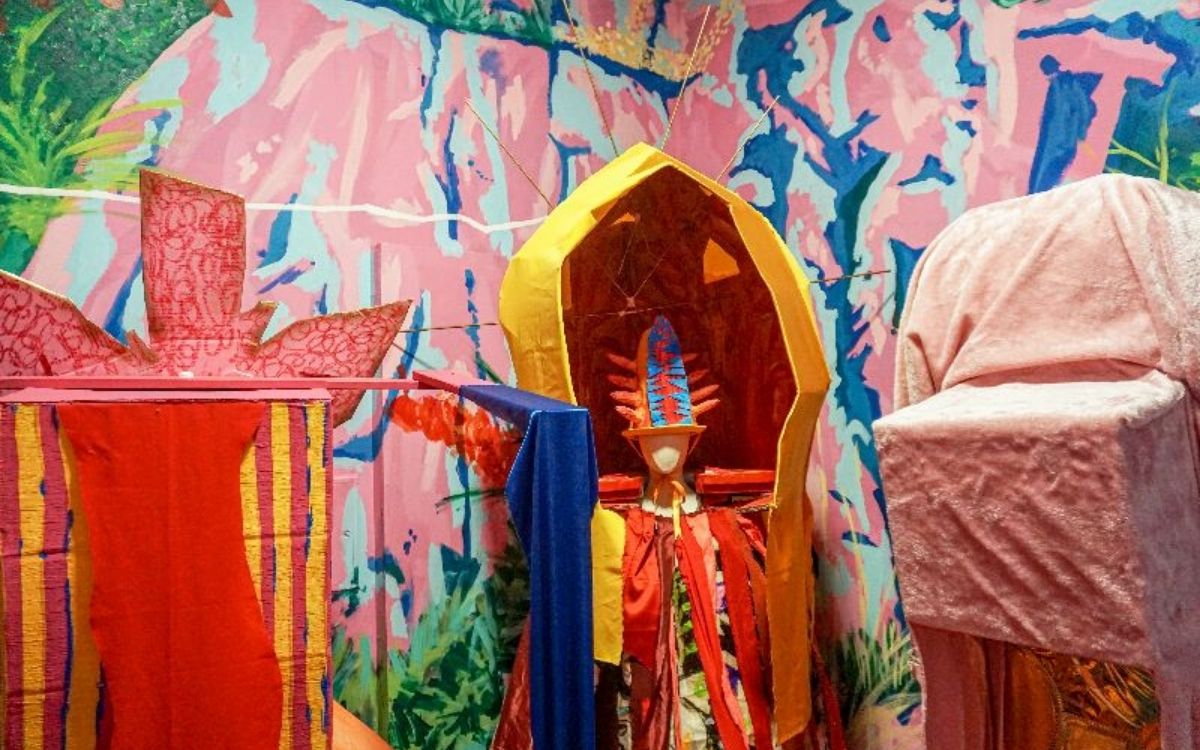
I can confidently say that I would absolutely love to become “The Host” (2020) for a full day. This was a costume I made for my BA Degree Show, which was cancelled due to the COVID-19 pandemic, meaning I never had the chance to truly experience this piece’s full potential. I like to think of it as an exploded self-portrait that, six years later, still resonates with me. There is an inexplicable kindness and sweetness to its image that I love to revisit from time to time, something magical and almost ethereal that always makes me grin.
I can’t say I’m a particularly shy person, since I enjoy speaking in public, during openings, talking to people, and discussing ideas. However, with this costume on, my confidence grows exponentially and the energy in any room immediately shifts. People are laughing, touching/caressing, hugging; they’re staring, smiling and suddenly it becomes a lot easier to be in a space. Even facing its large dimensions, the audience usually reacts with excitement and curiosity and, although there’s a certain creepy element to it, I think I wouldn’t mind spending 24 hours walking around as this lovable watermelon-headed character, with people kindly staring and smiling, their eyes hopefully glimmering with glimpses of childhoods long gone.
“The Host” also has the possibility of alternating between being a silent and a speaking presence. It can quickly morph from exaggerated person to cute teddy bear and that dynamic would be equally fascinating to try out. All in all, I believe this would be a great social experiment, perhaps a way of spreading happiness and striving for togetherness in a reality that is consistently becoming more divided.
What are your long-term aspirations as an artist, both personally and professionally?
I have been clearer about this than I am now. After the pandemic, I have struggled to envision great plans for the future, as it became scarily obvious at that time that we are not in control of practically anything, except of how we choose to respond to adversity. Since then, in fact, I have done numerous things that were never part of my expectations or dreams (including a forced return home) and that made me grow and better myself.
Nonetheless, in very broad strokes, I would say a long-term professional aspiration is to insist on a creative career, not necessarily as a visual artist, but as someone who can make an honest living from expressing ideas, feelings, worries. I say this because I have recently returned to one of my greatest loves, theatre, and I feel that I am not yet ready to close that door once again. Also, having created, run and curated a gallery and other projects that supported emerging artists (when I myself was one) presented me with the dream of someday, in the far-away future, opening a space for creatives to make and exhibit work, with regular events, concerts, workshops, artist talks and group conversations.
Personally, my biggest aspiration is to find fulfilment with everything I do, whatever and wherever that might be; to be happy and grounded, always aware of my privilege and open to chance and new places, people, ideas and encounters.
For Rodrigo Costa, ambiguity is not a retreat from meaning but a doorway toward it, a way of keeping every piece open to interpretation, conversation, and the unpredictable feedback of an opening night crowd. Style, in the traditional sense, matters less than spirit and delivery, consistency found not in repetition but in honesty across form. What remains constant is the belief that art is achieved rather than declared, built through the meeting of maker and audience, and that somewhere beneath every finished piece still lives the eternal beating heart of the child who first learned to travel through colour, sound, and story.