
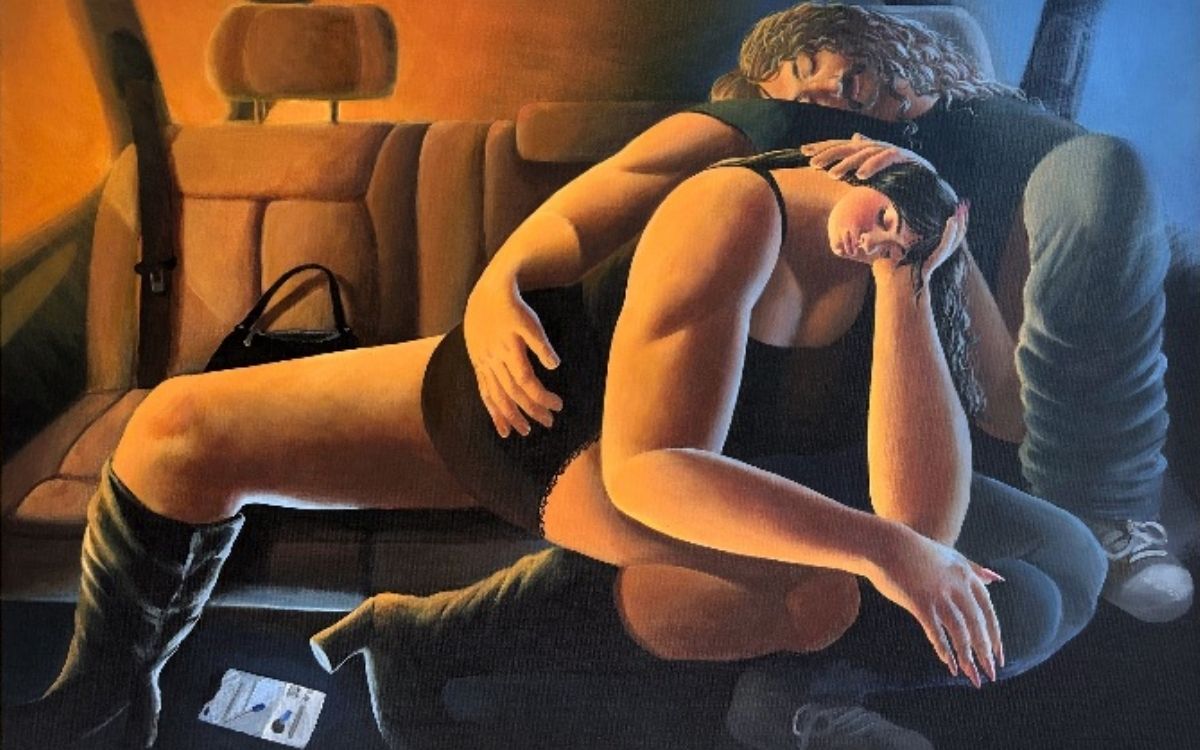
Thirty years of backlogged ideas live inside Ariel Posh, stored quietly until they surface as full, hearty bodies on canvas. Working entirely from autobiography, nights out, mornings alone, the specific slant of light, Ariel Posh builds figures that refuse to be chopped up or made small, choosing instead scale, presence, and unapologetic occupation of space. Cubist instincts meet a diarist's eye, condensing three-dimensional life into single images that insist on being witnessed rather than explained.
How do you reconcile the tension between raw, innate creativity and the discipline required to master your craft?
I feel the raw creativity part of it is the part that is inherent to my existence and the way I move through my life. I have always been an obsessive maker. I observe and the muses visit and it all comes together on the inside, whether I like it or not. Even when I’m not outputting anything I am always storing inspiration, ideas, and moments. I have 30 years of backlogged ideas.
The discipline required is the part that sets it up- pre party planning. If you’re having a party at your house, you have to make some snacks, vacuum the rug, stock up on toilet paper, and have the place in some sort of an order so that people can move about freely and have the best time possible. I see hosting the same way I see studio time. Getting in the studio and spending the time necessary is allowing myself to have the best time possible when in the throes of it all. It pays off. I am playing host for myself. Making time and putting in some effort is the least I can do.
There is a spoken excerpt on a Harry Chapin album where he talks about the difference between good tired and bad tired. Bad tiredness is described by him as when you “won other people's battles, you lived other people's days, other people's agendas, other people's dreams… very little you in there”. Alternatively, good tiredness is in pursuit of your battles, dreams, and goals. You sleep easy after a day of becoming Good Tired even if the day wasn’t very successful. Being Good Tired is worth every drop of discipline I can spare. It’s the best feeling in the world and it only comes from discipline. It’s the only way to bring the innate creative to the surface and manifest it into the tangible.
How does your art engage with or comment on pressing contemporary issues—social, political, or environmental?
I believe there’s something very radical about a woman living a full, hearty life. A life full of consumption, community, presence, and mistakes. When I make my paintings, I try not to segment up the body. I try to make them robust, large, lived in and occupied bodies in a direct rejection of the chopped up way we tend to depict women in a world that more and more wants women to be small and quiet. People look down upon the life of a woman having fun and experiencing excess, as if a life without marriage or a baby is frivolous and simply passing days until those things arrive.
Someone said to me recently that my work is irrelevant as it isn’t solving any major current issues. All I could think about was, is it irrelevant to keep a diary? My work centers around the real life of a real 30 year old woman in 2026. It will be dated one day and hopefully, when looked back on in hindsight, it will capture something unique about this era. Knowing how it all plays out is for the historians of the future to worry about.
How do you reignite creativity during those inevitable periods of self-doubt or Stagnation?
For me, the best way to reignite creativity in moments of staleness is to do as much stuff as possible. I find myself going out more, seeing all my friends, having an insane social life, and making stories. I’ll go visit my favorite painting at the PMA and then go sing some karaoke. I believe fulfilling that part of myself will bleed into my practice, giving me more content, inspiration, and simply more focused energy. I need to get the fun in so I can be devoted in the studio.
Especially with figurative work, spending time around people will always ultimately spark something new for me to explore. How can you stay stagnant when you are always trying new things and meeting new people? It’s impossible. I am fed by new people that I meet for the first time and those I’ve known and loved for a long time. When the cup is filled is usually when I will have a several week long burst of productive, exciting working time. When it slows down, it’s time to get back out there and go dancing.
Can you take us through the evolution of an artwork, from that first spark of inspiration to the finished piece?
All my current work is completely autobiographical, so sometimes inspiration could just be a night out with a friend, or in the morning after- curled up by myself at home. Sometimes the spark comes from the way our bodies move or how the light hits. Sometimes my spark is simply thinking, oh my god, what a gift it is to be alive!
Later on I’ll try to remember that moment, usually starting by scribbling out a quick figure to capture the essence of the moment and the memory. From there I keep redrawing it, sometimes filling pages, until I capture the note that sparked it all. I try to solve how to make it all work out; How can you see everything going on in one image when the scene is so three-dimensional as you’re living it? I currently have one rule in place for myself (that of course I break occasionally) which is that I’d like to depict every hand, foot, and face of every figure depicted. I work on condensing it all into a single image by drawing from a lot of cubist ideas. Seeing the same thing from multiple perspectives simultaneously is the only way I have found to capture these moments.
Some works stay drawings, usually the quieter moments. For the louder or more involved scenes I make paintings. That process is easy. I go into the painting and I keep working until every moment on the canvas feels loved enough and the colors feel right. I usually have a color palette in mind before I ever start painting but rarely does it not evolve as the painting does.The figure drawing aspect being figured out ahead of time helps me flow and focus on touch, color, and specific details and building the scene around them.
Do you feel a personal connection to your subject matter is essential? How has this connection shaped your work?
Oh, absolutely. I paint mostly myself and my friends, all moments from my life. Since what I am trying to capture is a moment, having it rooted in reality sets an energetic goal I can work towards. I know how the work must feel intuitively. The most fun part for me is when I get to build up the clothes the person I’m painting is wearing to further paint a story. What type of beverage they’re drinking and what neon light is shining on them tells us so much atmospherically and story wise. It’s sort of an act of love, capturing these moments.
Years ago as a younger artist I was chasing more abstract academic goals. I suppose I thought some sort of academic base would be the only way to make interesting, defensible work. I figured the creative could grow out of that strong research foundation as it did for so many artists who I admired. For me, I found trying to force the creative link into the academic world where it was not natural for me slowed me down and frustrated me. In the past few years as I have transitioned into painting my life I have expanded creatively in ways I never thought possible. I follow the threads of what speaks to me authentically and find literature, media, and work from there.
How do you feel social media is shaping the way art is created, consumed, and valued today?
Social media is the only reason I’m doing this interview today and the only reason anybody knows who I am. I can’t say if that’s good or bad. For me, it definitely changes the way I work. I make work in sizes that I feel will translate well to the Internet. I also find myself taking photos while painting and seeing how it translates on camera. I like to post painting updates on my long studio days and post on instagram stories. Sometimes that alone motivates me to keep going for a few more hours so I can post another progress pic and make the few people who respond to them happy.
I think chasing social media success as a way to find value in your work will kill you, though. That’s a quick descent into boring, predictable work for most people. Playing the game has become necessary but you shouldn’t let the game own you. I do love those videos where people hold a painting and slowly turn around for a “reveal”. The painting is usually so uninteresting but those videos are so funny. I always watch them. They get more views than anything I’ve ever made and I think I’m ok with that.
Social media is also amazing because you could be exposed to 1 million different painters in the span of an afternoon. You can see who those artists then follow and who they’re reposting. I've found and connected with so many artists via DMs, them being pushed by the algorithm, or popping up because an artist I admire commented on a new work or reshared. I feel gluttonous eating it all up.
What are five things you do to overcome creative blocks or feelings of discouragement?
The first move is that I’ll go out and have a beer with some friends. If I'm in the studio all day beating myself up, that’s my go to, and it almost always knocks me right. They fight the discouragement on my behalf by being proud of me for going to the studio at all.
Two, I will rewatch all of Sex and the City. Carrie is out there writing articles out of crumbs. The girls persist. If that doesn’t work, I move on to three, which is where I pick up and start reading the book I’ve been neglecting. Usually I’ll find an answer there. Or at least a new thread to explore. The worst that happens is I’ve read another book.
Four, instead of sitting and staring at my painting that’s not working, I’ll do all the things I’ve been neglecting in my house like organizing my closet and cleaning. It’s boring, but I figure if you’re going to be in your head, you might as well be doing the shit you’re supposed to be doing. I usually neglect that stuff when the juices are flowing, so I see it as a cosmic balance. Sometimes, doing my dishes is all it takes to de-stress me enough so I can get back to making. If it’s been more than an hour of me sitting in the studio frustrated, I frequently opt to go home and be mad while I do chores.
Five, I’ll find a friend who is an artist and complain to them. They set your ass right really quickly. Nothing whips me in shape like a friend saying, “so you have a creative block? Who cares! Get back to work girl cause nobody is making it but you!”. Sometimes all you can do is lock in despite it all and get to work anyway. It is a privilege to be able to create and I don’t want to take it for granted.
Identify five habits or concerns you are actively trying to let go of in your practice.
I’m trying to let go of thinking that my work isn’t important enough to be making. I’m definitely insecure in that regard, which I don’t believe is unique to me. I very much try to ignore those thoughts. I’ve never gone to a museum and seen a tiny painted cup from 200 years ago and thought- oh god, why did they make that unimportant thing?
I’m trying to stop defending my work before anyone’s even said anything contrary- it’s definitely a mental game that I’m stuck in. The inner harsh art critic comes after me more than any real one. It used to prevent me from working as I’d be so caught up in the what-ifs. My new mantra to replace the thought is, “hey, I’m making SOMETHING!”. If the inner critic is right and I’m making absolute garbage, maybe it’s ok to make garbage. Why should I only show the successes? I reframe it as Brave Artist Shares Even The Ugly Side.
I’m trying to stop being afraid of being rejected as frivolous, even though that’s what the work is about at times. As my work became more about my life, the more critique of it feels like a critique of me. Funny how that works. I work on rejecting that notion for my sanity. Funnily enough I feel very secure in my life, choices, community, all of it, which is why I am working on removing this doubt. Most of what I am trying to let go of is completely mental roadblocks serving no one, especially not me.
I’m also trying to stop worrying about the outcome as I paint and I’m trying to be looser. I’m trying to give up the constant rendering into oblivion. I am trying to let the painting lead me as it moves along. For most of 2024 I spent my time making small, quick, one or two hour paintings. Most of the paintings were only ok, some were good! What I gained from that was the ability to just throw paint down and see what sticks quickly. This has fortified my defenses against the overworking habit as I fight it every day.
I’m also trying to stop dehydrating while painting. Sometimes I’ll paint for 6-7 hours and I won’t have a drop of water. It all leans back to being a good host- you need to make sure you offer up a drink! Setting myself up physically for success while working all weekend or all night after my full-time job is essential for any success. I need food and water!
For Ariel Posh, discipline is simply the act of playing host to a creativity that never stops arriving, structured, tended, and shown up for, even on the hardest studio days. The work stays rooted in real life, real friendships, real rooms lit by neon, treated with the seriousness of a diary that might one day speak for its era. What remains constant is the refusal to shrink: not the figures on canvas, not the appetite for living, and not the belief that a full, occupied life is worth every drop of good tiredness it takes to make.