
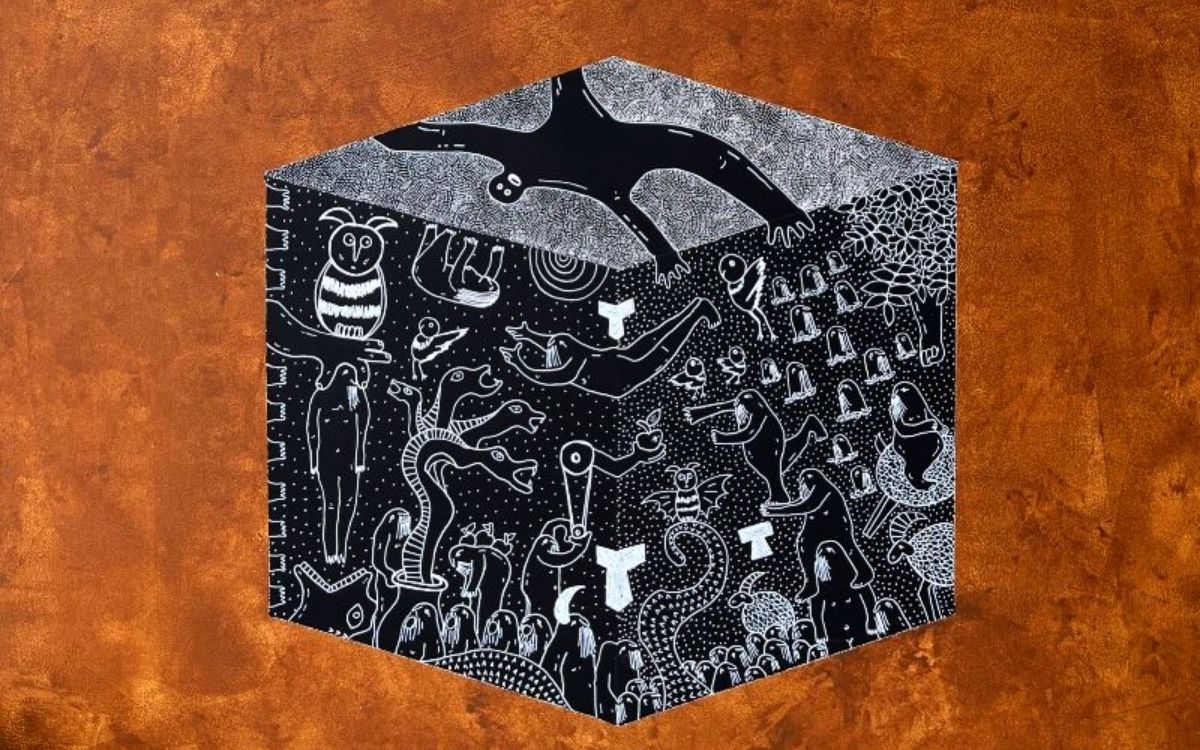
Istanbul shaped Dogukan Cigdem long before art became a practice, teaching that identity is never singular but layered, transforming, built on memories not always consciously carried. Drawn to what remains unseen, emotional landscapes, inherited memory, and the fragile ties between humans and nature, Dogukan Cigdem approaches contemporary issues not through direct statement but through their quiet emotional residue. The result is work that resists easy narrative, offering instead a space for reflection, where beauty often lives in imperfection and uncertainty.
How has your upbringing or cultural heritage shaped the themes and techniques you explore in your art today?
I grew up in a city where contradictions coexist naturally. Istanbul is a place where history and modern life constantly overlap, where silence can exist within chaos, and where every street carries traces of countless lives. Growing up in this environment taught me that identity is never singular; it is layered, constantly transforming, and often built upon memories we don’t even realize we carry.
My cultural background has never influenced me through symbols or traditions in a literal sense. Instead, it shaped the way I observe the world. I became interested in what remains unseen: emotional landscapes, inherited memories, and the invisible connections between humans and nature. These ideas eventually became the foundation of my artistic practice.
I don’t see technique as something separate from concept. Every material I choose, every surface I work on, and every layer I create serves the emotional weight of the work. My process often mirrors memory itself—fragmented, imperfect, and constantly evolving. Rather than presenting clear narratives, I prefer creating spaces where viewers can encounter their own emotions and experiences.
In many ways, my upbringing taught me that beauty often exists in imperfection and uncertainty. That perspective continues to shape both what I create and how I create it.
How does your art engage with or comment on pressing contemporary issues—social, political, or environmental?
I rarely approach contemporary issues through direct statements or explicit narratives. Instead, I am interested in the emotional consequences these realities leave on individuals. Political instability, environmental degradation, social polarization, and the accelerating pace of modern life all influence how we experience ourselves and one another. Those invisible effects are what I try to explore.
Rather than illustrating events, I create spaces for reflection. I believe art has the ability to slow us down in a world that constantly asks us to consume images as quickly as possible. Within that pause, questions emerge—about belonging, vulnerability, memory, and our relationship with the natural world.
Nature occupies an important place in my work, not merely as scenery but as a living presence that reflects human emotion. I see the relationship between humanity and nature as increasingly fragile, and this tension quietly appears throughout my practice.
Ultimately, I don’t aim to provide answers. I hope my work encourages viewers to become more aware of themselves and the world they inhabit. Sometimes, creating a moment of genuine reflection can be more powerful than making a definitive statement.
If you could communicate just one core message through your entire body of work, what would it be?
If there is one message that connects all of my work, it is that every human being carries an inner landscape worthy of being seen.
We often move through life trying to appear complete, certain, and strong, while hiding the parts of ourselves shaped by vulnerability, memory, loss, or longing. I believe those hidden places are where our humanity truly exists.
My work is an invitation to pause and reconnect with those forgotten parts of ourselves. It isn’t about offering certainty but about embracing complexity. I hope viewers leave my work feeling less alone in their own emotional experiences and more connected to the invisible threads that unite us all.
For me, art is not only about creating images. It is about creating encounters—with ourselves, with others, and with the quiet truths we often overlook.
Do you feel a personal connection to your subject matter is essential? How has this connection shaped your work?
For me, a genuine personal connection is essential. I don’t believe I could create meaningful work if I felt emotionally detached from what I was exploring. Every piece begins with a question, a memory, or a feeling that has already found a place within me before it appears on the canvas.
This doesn’t mean every artwork is autobiographical. Rather, my own experiences become a starting point for something more universal. Personal emotions—whether they involve belonging, uncertainty, loss, hope, or transformation—often reveal experiences that many people recognize in themselves. That is where I believe art becomes a shared language.
When I work, I rarely begin with the intention of illustrating a fixed idea. Instead, I allow the process itself to guide me. The emotional relationship I have with the subject evolves alongside the work, and sometimes the finished piece teaches me something I didn’t fully understand when I started.
That personal connection also demands honesty. It encourages me to resist creating images simply because they are visually appealing or easily understood. Instead, I try to remain faithful to the emotional truth that initiated the work. Even when the final result feels quiet or ambiguous, I hope that sincerity becomes visible.
In the end, I believe viewers instinctively recognize authenticity. They may interpret the work differently than I intended, but if the emotional core is genuine, a connection can still be established. That invisible dialogue between artist, artwork, and viewer is one of the reasons I continue creating.
How do you feel social media is shaping the way art is created, consumed, and valued today?
Social media has fundamentally transformed the way art circulates. It has made artists more visible than ever before and created opportunities that were once difficult to imagine. At the same time, it has accelerated the way we experience images.
Art is increasingly encountered through screens, often within seconds, surrounded by countless other visual stimuli. This speed can make it difficult for viewers to truly spend time with a work. I sometimes wonder how many artworks are remembered beyond the brief moment they appear while scrolling.
For artists, this creates a delicate balance. Visibility is important, but there is also the temptation to produce work that performs well within algorithms rather than work that reflects genuine artistic inquiry. I think that is one of the greatest challenges facing contemporary artists.
Personally, I see social media as a tool rather than a destination. It allows me to share my work, connect with people across different cultures, and discover inspiring artists from around the world. But the artwork itself must always exist beyond the screen. Texture, scale, silence, and physical presence cannot be fully translated into a digital image.
Ultimately, I hope people continue to seek real encounters with art. A photograph can introduce an artwork, but it can never replace the experience of standing in front of it.
How do you respond to debates about the accessibility of art—should it be exclusive, or is it for everyone?
I believe art belongs to everyone. While not everyone may choose to engage with it in the same way, everyone should have the opportunity to experience it.
Accessibility, however, does not mean simplifying art or removing complexity. Some works naturally ask for patience, reflection, or prior knowledge, and that is perfectly valid. What matters is that these works remain open to dialogue rather than creating unnecessary barriers.
Art has the unique ability to connect people regardless of language, nationality, or background. A viewer doesn’t need to understand every conceptual reference in order to feel something. Emotional recognition often comes before intellectual understanding.
At the same time, I appreciate that every viewer brings their own perspective. An artwork is never completed solely by the artist; it continues to evolve through the experiences of those who encounter it. That diversity of interpretation is one of art’s greatest strengths.
For me, art should invite curiosity rather than exclusion. It should encourage questions instead of demanding predetermined answers. Whether someone has spent years studying art history or is entering a gallery for the first time, both experiences have equal value because both are rooted in genuine human perception.
What kind of legacy do you hope to leave in the art world?
I don’t measure legacy by the number of exhibitions, awards, or works that survive after me. Those are meaningful milestones, but they are not the reason I create.
What I hope to leave behind is a body of work that continues to invite reflection long after I am gone. If someone stands in front of one of my works years from now and feels understood, challenged, comforted, or simply encouraged to pause for a moment, then I believe the work has fulfilled its purpose.
I also hope to contribute to a broader understanding of art as a space for empathy rather than certainty. We live in a time that often rewards quick opinions and immediate conclusions. Art offers something different: the possibility of remaining with a question, of accepting ambiguity, and of discovering meaning through contemplation.
If my work can encourage even a small number of people to reconnect with their inner world and with the fragile relationship between humanity and nature, I would consider that a meaningful legacy.
Ultimately, I hope people remember not only the images I created but the atmosphere they carried—one that invited silence, vulnerability, and honest reflection. If those qualities continue to resonate beyond my lifetime, then my work will have found its place.
At the center of this practice lies a simple conviction: every human being carries an inner landscape worth being seen. Rooted in personal honesty rather than autobiography, the work reaches toward something shared, a recognition that moves faster than explanation. Dogukan Cigdem creates not to offer answers but to open encounters, with the self, with others, and with the quiet truths too often left unexamined, hoping the atmosphere left behind, one of silence, vulnerability, and reflection, continues to resonate long after the image itself is gone.