
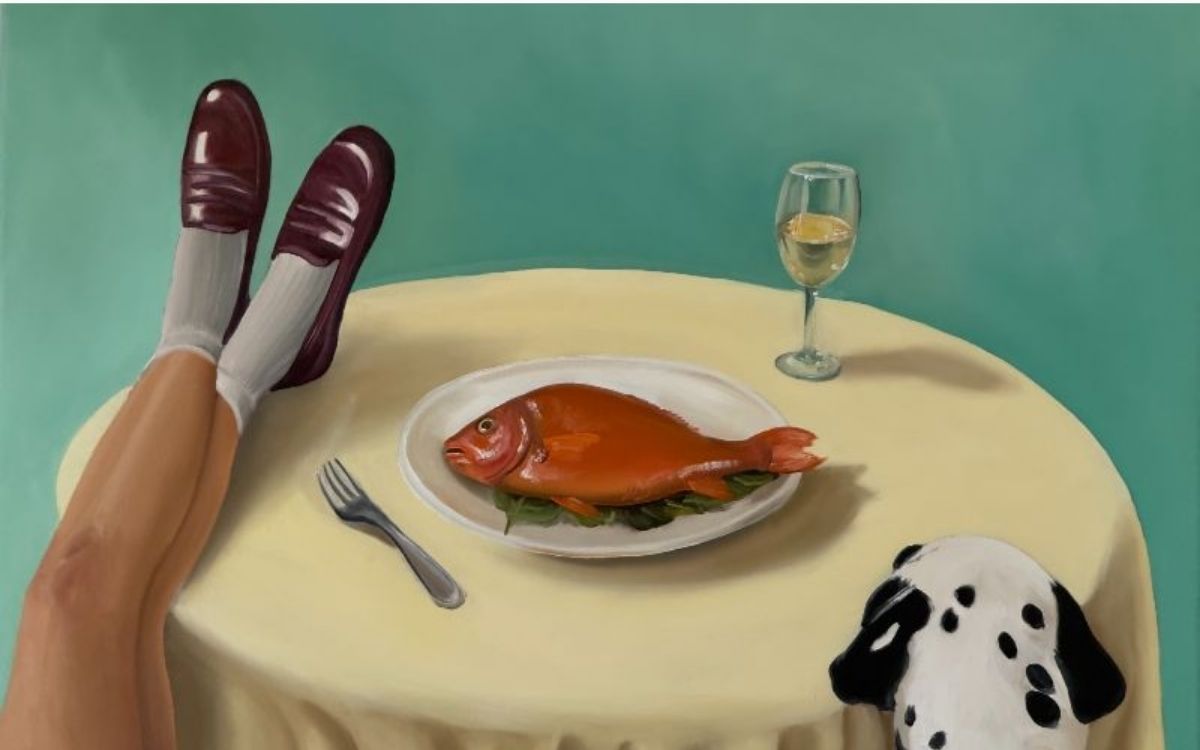
Long before understanding what art meant, Nerea Amondarain understood how to watch. A pair of shoes by the door, a dog staring at something on the table, the light on a tiled wall, ordinary moments that always seemed to hide a story beneath the surface. That instinct to observe, feel, and translate became the foundation of a practice built on oil painting, personal symbols, and a quiet insistence on the handmade in an increasingly artificial world. Recurring motifs like the dalmatian and the loafers, alongside titles rooted in Basque language, ground the work in something deeply personal, resisting the pull toward sameness that global visibility often demands.
Can you pinpoint a single moment in your life when you realized art was not just a passion but your purpose?
I've always been an observant person. Long before I understood what art was, I understood how to watch. Everything I saw, every everyday moment, no matter how absurd, I would draw it. A pair of shoes left by the door, a dog staring at something on the table, the particular color of a tiled wall in the afternoon light — none of it seemed significant to anyone else, but to me, it always felt like there was a story hiding just beneath the surface. I felt like there was a life behind every ordinary thing, and it would stir feelings in me, whether very negative or very positive, but never indifferent. I think that's the part of myself I've carried the longest: an inability to look at something plainly. Everything asked to be translated, reinterpreted, put down on paper.
For a long time, I didn't call it anything more than a hobby. I took painting classes as a child, the way most kids try out an instrument or a sport, without any real understanding of what it would come to mean. I quit due to lack of time, the way children's hobbies often get quietly phased out by school and everything else that starts to take priority. Later, I started drawing at home on my own, filling notebooks in the in-between hours, and again I quit due to lack of time, life pulling me in other directions, convincing me that this was something I could always come back to later, that it wasn't urgent, that it wasn't necessary. And then, at some point as an adult, I signed up for classes again. Not because I had a plan, not because I thought it would lead anywhere in particular, but because something in me kept insisting.
And it's there, oddly enough as an adult returning to something I'd first touched as a child, that I finally understood what it actually was. It isn't a hobby. It never really was. It's not just something I enjoy doing, in the way you enjoy a pastime you could easily live without. I can't conceive of life without creating. There's no version of my life, imagined in any direction, that doesn't include making something. It's part of my identity in the most literal sense: it's not an accessory to who I am, it's one of the materials I'm made of.
I think what took me so long to recognize this is that creating never felt like a decision. It felt more like a compulsion, or maybe closer to a language. When I see something ordinary, my instinct isn't to simply notice it, it's to ask what it would look like slightly exaggerated, slightly wrong, slightly funnier or sadder than it actually is. That's where the dalmatian comes from, and the loafers, and the everyday tables set with too much elegance for whatever chaos is happening on top of them. They're not random symbols. They're the closest thing I have to a signature, a way of saying: this is how I see things, even when things are simple.
I can't see life without art, and I mean that almost literally. I don't experience a walk with a dog, or a dinner, or a spilled glass on a pink tiled floor, without some part of my brain already composing it, deciding on a palette, wondering how it would feel rendered in oil. And I can't live without feeling, which might sound dramatic, but it's the most honest way I can put it. If something doesn't move me, even a little, even uncomfortably, I don't know what to do with it. Art has become the only place where I can hold both the negative and the positive at once, without needing to resolve them into something neat. A painting can be funny and melancholic. It can be elegant and absurd. It can be about freedom and about clumsiness in the same breath.
So when people ask why I paint, the honest answer isn't really about technique, or ambition, or even beauty. It's that I don't know another way to be fully present in my own life. Observing, feeling, and creating are the same motions for me. I can't separate them, and at this point, I don't want to.
What do you think is the most meaningful role an artist plays in society today?
I believe that in a world where technology plays such a fundamental role, and where it's increasingly hard to distinguish what's real from what isn't, returning to the primitive is being valued more and more. There's something almost instinctive about it, a kind of quiet resistance. The more our lives are filtered, edited, and mediated through screens, the more we seem to crave things that are unpolished, imperfect, made by hand rather than generated. It's as if, the more convincing the artificial becomes, the more desperately we need proof that something real still exists.
I think the newer generations have grown up in a fundamentally technological environment, immersed in it from the very beginning, without ever knowing a version of life without it. And yet, paradoxically, we're the ones who consume the most secondhand products, both in fashion and in home décor. We're the generation of vintage finds, of flea markets, of furniture with a history we didn't create but chose to inherit. Not so much out of necessity, though that plays a part too, especially now, but because we want to have our own identity. We want objects that carry a past, a texture, a flaw, something a factory line could never replicate. A secondhand chair has a story before it even enters our home. A mass-produced one has none.
I believe no one is looking for the beige, personality-less house that could belong to any catalog anymore, the kind of space that photographs beautifully but says nothing about the person living in it. Nor do we want the same clothes everyone else has, the same five silhouettes cycling endlessly through every storefront and every feed, until owning them starts to feel like disappearing into a crowd rather than expressing anything at all. There's exhaustion, I think, with sameness. With perfection that isn't earned. With spaces and wardrobes that feel curated by an algorithm rather than by a life actually lived.
I believe we live in a completely unsupported world, one that's been promised a future that doesn't exist. We were told certain things would be waiting for us if we followed the expected path, and many of those promises simply evaporated. Stability, permanence, a sense of a future stretching out in front of us in a predictable, comforting way. None of that arrived the way it was described. And in the absence of those larger structures, all that's left is to hold on to our own identity and stay true to ourselves. It's not a grand or dramatic decision. It's closer to a survival instinct. If the world outside isn't going to hand us meaning or belonging, we have to build it ourselves, object by object, choice by choice, out of whatever feels honest.
That's why craftsmanship is taking on a bigger role. A handmade object carries the trace of a person, of time spent, of decisions made by hand rather than by machine. It's imperfect in ways that feel human rather than flawed. There's a kind of intimacy in something made slowly, something that couldn't be replicated exactly twice, and I think that intimacy is exactly what so many of us are starving for. We don't just want to own things anymore, we want to feel connected to the things we own, understand where they came from, sense the presence of another person's hands in their making.
I see my own work as part of that same instinct. Painting, to me, is a way of insisting on the primitive in a world that keeps pulling us toward the artificial. Oil on canvas is slow, tactile, imperfect by nature, impossible to mass-produce or fake convincingly. Choosing that medium, in this particular moment, feels less like a stylistic decision and more like a quiet form of resistance, an insistence that some things should still be made the old way, with the hand, with the eye, with the time it actually takes. If technology keeps blurring the line between what's real and what isn't, I want my work to stay firmly, stubbornly, on the side of what's real.
Do you have any rituals or habits that help you enter a creative state of flow?
I like consuming art of all kinds to get into a state of inspiration. It doesn't have to be paintings. It can be a film, it can be music, it can be a photograph someone posted without much thought, or a scene in a show that lasts only a few seconds but stays with me for days. I've never felt like inspiration needs to come from a "serious" source to count. Sometimes the most unexpected things end up sparking the clearest ideas, precisely because I wasn't looking for them.
Listening to certain music, watching certain films, with certain aesthetics, inspires me in a way that's hard to fully explain. There's something about the atmosphere a song creates, or the color palette of a film, or the way a certain era or subculture presents itself visually, that seems to unlock a different part of my brain. It's not that I consciously sit down and think "this will inspire my next painting." It's more that I let myself be immersed in whatever I'm consuming, without any expectation, and somewhere in that immersion, something shifts.
But my ritual for inspiration is simply consuming art, and a spark appears. I don't have a fixed routine, no specific time of day, no particular setting I need to be in. It's less structured than that, and I think that's exactly why it works. If I forced it, sat down demanding an idea to arrive, I don't think it would come the same way. Instead, I try to stay open, almost passive, letting whatever I'm watching or listening wash over me, and trusting that if something is meant to spark an idea, it will do so on its own terms.
And when that spark does appear, it's usually sudden and a little inconvenient, the way good ideas often are. It rarely happens when I'm sitting with a sketchbook ready. It happens in the middle of a film, halfway through a song, while I'm doing something completely unrelated. So I quickly jot the idea down on whatever I have on hand, usually my phone, because if I don't, I know it will dissolve just as fast as it appeared. I save it, sometimes as a messy note, sometimes as a blurry photo of a screen, sometimes as just a few words that mean nothing to anyone else but instantly bring the whole idea back to me later. Those notes become a kind of archive of sparks, waiting for the moment I'm ready to turn them into something more permanent.
Can art be truly therapeutic? Have you experienced its healing power personally, or seen it impact others?
Yes, I believe art can be truly therapeutic, and it's not something I arrived at as a theory, it's something I've lived through my own process, painting after painting. For as long as I can remember, I've been an observant person, someone who couldn't look at even the most ordinary moment without feeling something about it, whether that feeling was negative or positive, but never indifferent. That intensity used to feel like a burden sometimes, carrying so much emotional charge around things other people barely noticed. Painting became the place where all of that had somewhere to go.
When I look back at pieces like "Sin querer," which is about clumsiness, about breaking something, spilling something, making a mess, I realize I wasn't just depicting an event. I was reprocessing a feeling I know intimately: the small shame of clumsiness, softened into something sweet and aesthetic instead of something purely negative. Painting it in pastel tones, with my dalmatian as the main character, wasn't a random stylistic choice, it was a way of proving to myself that even the moments that feel embarrassing or frustrating in real life can be looked at with tenderness once you give them enough distance and enough color. That transformation, taking something uncomfortable and finding the humor and beauty inside it, is, I think, one of the clearest examples of art functioning as therapy for me personally.
The same happened with "Todo al 7," where I was working through feelings of tension, risk, speed, and excitement, emotions that are inherently rough and destabilizing. Choosing a soft blue and pink palette for that piece wasn't about making the subject pretty for its own sake. It was about giving myself permission to hold something risky and something gentle at the same time, rather than letting the tension dominate completely. Painting has repeatedly given me that ability, to sit with two opposing emotions at once without needing to resolve them into a single, simpler feeling. I don't think I could process complexity like that nearly as well through words alone.
I also experience the therapeutic side of art before I even start painting, in the way I consume it. Watching films, listening to music, absorbing certain aesthetics, that's my ritual for reaching a state where inspiration surfaces, but it's also where a lot of quiet emotional processing happens without me even trying. A song or a scene will hit something in me, and suddenly a spark appears that I have to write down immediately, usually on my phone, because if I don't, it disappears. Looking back at those saved fragments later, I often realize they were less about the film or song itself and more about whatever I was feeling at that exact moment, something I didn't fully understand until it came out later as an idea for a painting.
As for seeing its impact on others, I notice it most in the reactions people have to pieces that mix humor with something a little uncomfortable or absurd, the raw fish on an elegant table, the dalmatian staring intently at something it shouldn't. People often laugh first, and then pause, and then tell me the piece reminds them of something specific in their own lives, a memory, a pet, an embarrassing dinner, a person. That reaction, the shift from amusement to recognition, feels like proof that the therapeutic function of art isn't limited to the person making it. If I can take something as ordinary and sometimes as awkward as everyday life and turn it into an image that makes someone else feel seen, or simply feel something instead of scrolling past indifferently, then the healing isn't only mine anymore, it becomes shared.
So yes, art has been genuinely healing for me, not in a dramatic, cathartic sense, but in the quieter, more constant way of giving form to feelings I might otherwise never fully understand.
How do you think art should be valued—emotionally, socially, or monetarily? Is there ever an objective measure?
I don't think art can ever be reduced to a single kind of value, and I'd argue that trying to force it into just one, especially the monetary one, is where most of the confusion around art comes from. For me, the emotional value has always come first, by a wide margin. A painting starts as a feeling I need to process, whether it's clumsiness, tension, freedom, or humor, and its first and most important value is simply that it existed as a release for something I was carrying. That value is completely detached from price. It would be exactly as real if the piece never sold at all.
But I don't think emotional value is only personal to the artist. I've seen it become social almost immediately, the moment someone else looks at the work and recognizes something in it, whether that's their own dog, their own clumsy Tuesday, their own contradictory feelings about risk or freedom. At that point the value multiplies rather than transfers, because it doesn't stop being meaningful to me just because it starts meaning something to someone else too. I think that's actually where art becomes genuinely valuable on a social level, not through institutions or critics, but through that small, direct moment of recognition between a stranger and a canvas.
Monetary value is the part I find hardest to justify with any real logic, and I say that as someone who does sell my work. Price ends up depending on so many things that have nothing to do with the emotional weight of a piece: market trends, an artist's visibility, the size of the canvas, how "collectible" a particular style happens to be at a given moment. A painting that took me the least emotional effort might sell for more than one that completely rearranged something inside me while I was making it. That disconnect used to bother me more than it does now. I've come to see monetary value as almost a separate, parallel system, one that exists alongside the emotional and social value without ever fully capturing it.
As for whether there's an objective measure, I honestly don't think there is, and I'm not sure I'd want there to be. Technical skill can be assessed with some degree of consistency, proportion, composition, control of a medium, but even that starts to break down the moment you consider how much powerful art deliberately breaks those rules on purpose. Some of the pieces that move me most aren't technically flawless, they're emotionally precise instead, and precision of feeling isn't something you can measure with a ruler or a rubric.
I think this connects to something bigger I believe about where we are right now, culturally. In a world so saturated with the artificial, where it's increasingly hard to tell what's real, people are craving objects and images that feel handmade, imperfect, personal, rather than optimized or algorithmically pleasing. That shift, the same one driving people toward secondhand fashion and furniture with a history instead of a beige, catalog-ready sameness, is also reshaping how art gets valued. I think authenticity is becoming its own kind of currency, maybe even more so than technical mastery. A piece that clearly carries a specific person's identity, humor, or wound tends to resonate more than something technically perfect but interchangeable.
So if I had to define how art should be valued, I'd say emotionally first, socially second, as an extension of that emotional resonance reaching other people, and monetarily last, almost as an afterthought that happens to keep the whole thing sustainable. There's no objective scale that can weigh those three against each other fairly, and I don't think there should be. The moment art becomes fully measurable, it stops asking anything of us, and asking something of the viewer is, to me, the entire point.
In an increasingly globalized world, how can artists preserve authenticity and cultural integrity in their work?
I think authenticity in a globalized world isn't really about resisting influence, because influence is everywhere and impossible to avoid completely. It's more about making sure that whatever you absorb from outside gets filtered through something distinctly yours before it reaches the canvas. For me, that filter has always been the everyday, the small, personal details that don't travel, the ones that come specifically from my own life rather than from whatever aesthetic happens to be circulating globally at a given moment.
A lot of my work carries titles in Basque, words like "Amama," "Zaldi," "Untxi," which aren't decorative choices, they're roots. They ground the piece in a very specific cultural and linguistic identity before a viewer even sees the image. I think that's one of the simplest but most effective ways artists can preserve cultural integrity: by refusing to translate everything into the most universally palatable version of itself. It would be easier, in some ways, to give every piece a generic English title that travels more smoothly across markets and audiences, but that would mean sanding down exactly the texture that makes the work mine rather than interchangeable with anyone else's.
I also think authenticity gets preserved through recurring personal symbols rather than trend-driven ones. My dalmatian and the loafers show up again and again across different pieces, not because they're currently fashionable motifs, but because they belong to my own visual vocabulary, built over time and rooted in things that are specifically mine, my own sense of humor, my own domestic references. In a globalized art world, where certain aesthetics spread instantly and get replicated everywhere, I think the artists who hold onto their own recurring symbols, their own specific references, are the ones who manage to stay recognizable as themselves rather than dissolving into whatever visual language is dominant that year.
This connects to something I feel strongly about the moment we're living in. The more globalized and technological everything becomes, the harder it gets to tell what's genuinely someone's own voice and what's simply an algorithmically optimized version of a trend. I think that's exactly why returning to something more primitive, more handmade, more specific to a person's actual life and background, is being valued more now, not less. People are tired of the beige, catalog-ready sameness that global markets tend to produce, whether in fashion, interiors, or art. Authenticity becomes almost a form of resistance in that context, a refusal to let your work get smoothed into something exportable and forgettable.
I also think preserving cultural integrity means being honest about scale. Not every piece needs to speak to a universal audience. Some of my paintings are deeply tied to very local, very personal references that won't mean the same thing to someone unfamiliar with where I come from, and I think that's fine. I'd rather make something that feels completely true to my own background, even if part of its meaning only fully lands with people who share that context, than dilute it into something more broadly legible but hollow.
Globalization will keep pushing artists toward a kind of visual homogenization, whether through algorithms favoring certain aesthetics or through markets rewarding whatever currently sells across borders. I think the responsibility falls on us to keep injecting our own specific, sometimes untranslatable details into the work anyway, our language, our humor, our own domestic symbols, so that even as art circulates globally, it still carries the fingerprint of exactly where and who it came from.
Can you imagine ever choosing to stop creating art? What might lead you to such a decision?
No, I can't really imagine that, and if I'm being honest, the question itself feels almost impossible to answer from the inside, because I've never conceived of life any other way. I've said before that I can't see life without art, that I can't live without feeling, and that isn't a poetic exaggeration I use for interviews, it's the most literal way I have of describing how I exist in the world. So when I try to imagine a version of myself who simply stops, who decides one day that this is over, I come up empty. There's no scenario I can construct where that person is still me.
I think part of why I can't imagine it is that creating has never functioned like a career choice or even a hobby, in the way I once mistakenly labeled it. It's closer to a way of processing existence itself. Every time something happens to me, good or bad, mundane or overwhelming, some part of my brain automatically starts translating it into color, composition, a possible painting. That's not a switch I turn on when I pick up a brush, it's constant, running quietly underneath everything else. Asking me to imagine stopping is a bit like asking me to imagine stopping feeling altogether, and I don't think that's something I could choose, even if I wanted to.
I also think about how many times in my life I've already tried, without realizing that's what I was doing, to walk away from it. I quit painting classes as a child due to lack of time. I stopped drawing at home due to lack of time again. Each time, I told myself it was temporary, practical, reasonable, that art would still be there whenever life settled down enough to make room for it. But it never actually stopped, not really. It just went quiet for a while and then pulled me back, eventually, into adult classes, into full pieces, into an identity I couldn't keep pretending was optional. If those attempts to step away, gentle as they were, never once succeeded in the past, I don't see any circumstance strong enough to succeed now.
What might lead someone to stop creating, I imagine, would have to be something that fundamentally changes their relationship to feeling itself, exhaustion so complete it erases curiosity, or a kind of numbness that makes the world stop asking anything of you. But that's exactly the opposite of how I move through life. I'm the person who can't look at an ordinary table setting without seeing a story in it, who can't watch a film or hear a song without a spark showing up uninvited and demanding to be written down before it disappears. As long as that instinct exists in me, and I have no evidence it's going anywhere, there will always be something pulling me back toward the canvas.
I think there's also something to be said about art being tied to identity rather than output. Even in periods where I create less, where life gets busy or heavy, I don't experience that as "not being an artist" anymore, the way I might have years ago. It's part of who I am regardless of how frequently it shows up in visible form. So even in the hardest, most depleted stretches I can imagine, I don't think I'd stop, I think I'd simply create less, or differently, or more privately for a while, the way I did as a child and young adult without ever fully letting go.
So no, I can't imagine choosing to stop. I've only ever conceived of life with art in it, in one form or another, and I don't believe that will change. It's not a promise I'm making because it sounds good in an interview, it's simply the truth of how I've lived every version of my life so far, and I don't see any reason that would be different going forward.
For Nerea Amondarain, painting has never been a decision so much as a compulsion, a way of holding contradictory feelings at once without needing to resolve them. Clumsiness becomes tenderness, tension becomes softness, and everyday absurdity becomes something worth pausing for. Rooted in specific, sometimes untranslatable references, the work resists dissolving into whatever aesthetic happens to be circulating at a given moment, choosing instead to stay recognizably, stubbornly its own.a