
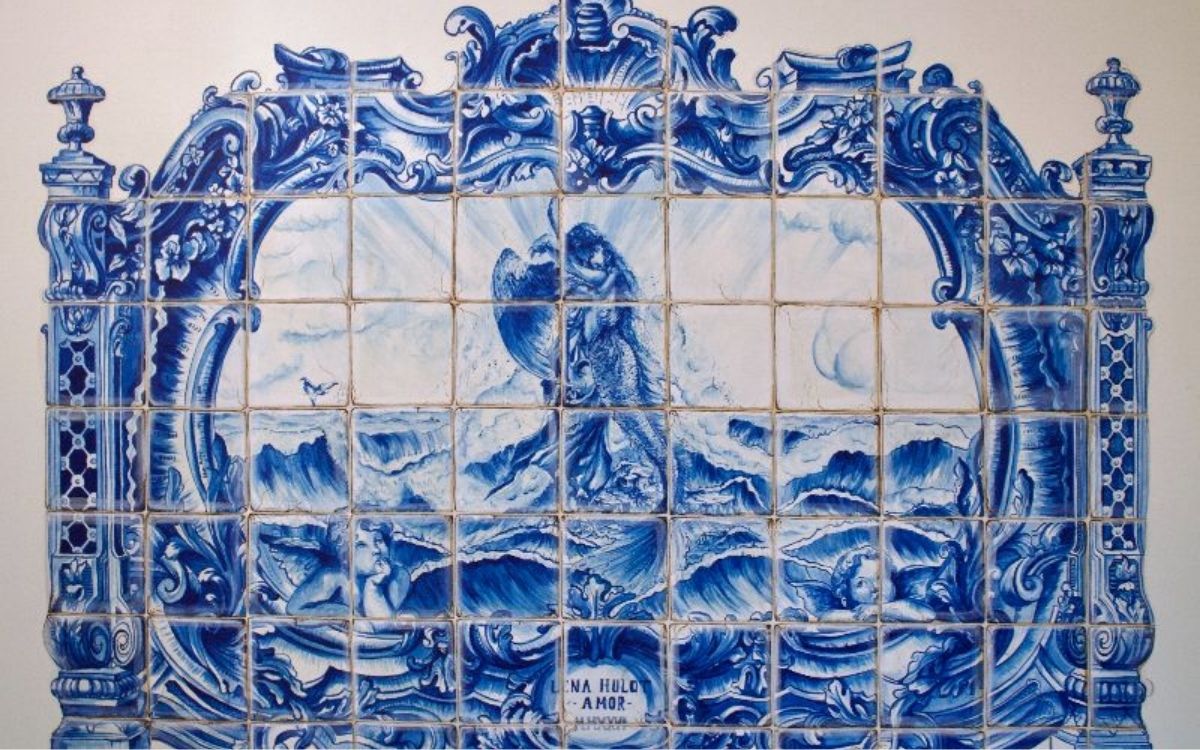
Paris shaped Lena Hulot long before the first brushstroke touched a wall. Raised amid museums, châteaux, and theatre stages, Lena Hulot developed an early fascination with ornamentation, rich colour, and the illusionist magic of trompe-l'œil. Self-taught and instinctive, Lena Hulot reinterprets 18th-century decorative traditions through murals that are theatrical, maximalist, and quietly whimsical, turning ordinary walls into spaces built for dreaming.
How has your upbringing or cultural heritage shaped the themes and techniques you explore in your art today?
I was born in Paris into a French family where art and culture have always been an important part of everyday life. From a very young age, I visited countless cities, museums, castles, and churches, and regularly attended theatre performances and musicals. That early exposure shaped my appreciation for decorative arts, architecture, and the painting techniques of the 18th century.I became fascinated by ornamentation, rich colour palettes, and trompe-l'œil—elements that continue to influence my work today. I’m constantly exploring the styles that inspire me: I combine them, reinterpret them, and experiment with them. As a self-taught artist, I’m always practicing, whether I’m painting on walls, canvas, or ceramics. Whenever I discover something beautiful, I want to understand how it was made and then reinterpret it in my own way.My goal is to bring these traditional art forms back into everyday life, while giving them my own signature: theatrical, maximalist, and infused with a sense of magic and whimsy.
Do you believe an artist's passion is something destined or a conscious choice?
I believe that when you're an artist—or when you have a true passion—it's almost impossible to ignore it. No matter what, you always find your way back to it.
For a long time, I thought my passion was fashion, but nothing really felt clear. I wasn't sure what motivated me or what I wanted to express. The day I painted on a wall, it may sound cliché, but I genuinely had a moment of clarity. I knew that this was what I wanted to do.
That said, I don't think it's only about destiny. It's also a conscious choice—and even a risk—to believe that your vision can become a career and a stable source of income. I'm still at the beginning of my journey, and there's a lot of uncertainty ahead, but I know this is the path I'm meant to follow, and I can't imagine doing anything else.
How do you measure the impact of your work—by its reception, its personal meaning, or something else?
I measure the impact of my work in several ways. As a mural artist, I’m no longer creating only to satisfy my own taste. I have to understand my clients, what they love, and the atmosphere they want to create in their space.
At the same time, people choose to work with me because of my artistic vision. My work draws inspiration from French decorative history, bringing craftsmanship, memory, and ornament into spaces that are meant to be lived in. I want my murals to add depth, character, and a stronger sense of place.
Ultimately, I measure the impact of my work through my clients' reactions. If they feel proud of having something created especially for them, and if the mural makes them dream, feel inspired, or simply feel happier every time they enter the room, then I know I've achieved what I set out to do.
Can you take us through the evolution of an artwork, from that first spark of inspiration to the finished piece?
Lately, I’ve been spending a lot of time exploring the styles and painting techniques that inspire me, especially trompe-l'œil. I’m lucky to live in Paris, where I’m surrounded by decorative arts. Trompe-l'œil, arabesques, acanthus leaves, and painted decorative details are everywhere. The more I observe them, the more my eye has become trained to notice their craftsmanship.
One day, while I was at the art supply store where I regularly buy my materials, I noticed a painted mural that I had never really paid attention to before. As I looked closer, I discovered a faux carved wooden panel that had been painted entirely by hand. I took a photo, studied the technique, and it immediately inspired me to repaint my own door.
I then gathered references of carved doors and reinterpreted them to create a design that felt true to my own style. I usually begin by sketching the composition in Procreate before transferring it onto the door and starting to paint.
One thing that defines my process is that I rarely make practice studies beforehand. I prefer taking the risk of learning directly on the final piece. My approach is very instinctive: I experiment, make mistakes, analyze them, and adapt my technique as I go. That’s how my work continues to evolve.
Of course, when I’m working on a commission, the process is very different and much more structured. I take the time to ensure that the concept, references, and artistic direction are all clearly defined. At the same time, I leave room to create, suggest alternatives, and broaden my clients’ perspective. Once the design has been approved, I can practice specific techniques beforehand if needed. This gives both my client and me confidence that the final result will meet our expectations.
Do academic institutions still play a vital role in shaping artists today, or has self-taught creativity disrupted this tradition?
I’m largely self-taught. Of course, I’ve taken painting classes, and during my fashion studies I had extensive training in observational drawing, life drawing, and garment studies. But no one really taught me how to paint the decorative murals I create today.
I’ve also been fortunate to grow up in a family with a strong artistic background. I’ve always loved drawing and painting, and I’ve always learned quickly. That gave me the confidence to develop my practice independently.
Before starting my own business, I seriously considered attending art school or pursuing formal training in decorative painting. In the end, I realized that this way of learning simply wasn’t for me. Going back to a system of grades, juries, imposed techniques, and constant comparison would probably have limited my creativity rather than encouraged it.
That doesn’t mean I’m against education. Quite the opposite—I’m always looking to learn new techniques because there’s still so much I don’t know. I simply prefer short, specialized workshops, often outside Paris. They allow me to learn from skilled craftspeople, travel, discover new environments, and meet people who share the same passion.
I believe art schools still play a vital role for many artists, but they’re no longer the only path. Being self-taught often requires more time, discipline, and curiosity, but it can also lead to a deeply personal artistic practice. It’s the path that suits me best, and I hope it encourages others to realize that there isn’t only one way to become an artist.
Has social media democratized art or diluted its value? How do you feel platforms like Instagram influence modern creativity?
I have a love-hate relationship with social media.
On one hand, it has undeniably democratized art. It has given thousands of artists a level of visibility they would never have had before. With just a few posts, an artwork can reach an international audience, attract clients, and create incredible professional opportunities.
But there’s also a downside. Today, the line between creating because you genuinely love your art and creating to succeed on social media has become incredibly thin.
I’ve experienced that myself. For a while, I believed the value of my work depended on the reactions it received online. I started producing pieces quickly just to keep posting content. It was a difficult period because I gradually drifted away from what had inspired me in the first place. I was no longer creating out of passion, but with the goal of performing.
To me, that’s where the real distinction lies. When you create only for social media, you inevitably start chasing trends, comparing yourself to others, producing work more quickly, and trying to satisfy an audience whose attention span is often fleeting. At that point, art risks losing some of its sincerity. It becomes content to consume rather than something meaningful to contemplate.
On the other hand, when you share work that you’re genuinely proud of, work you’ve taken the time to create with care, everything changes. The process becomes more authentic, more personal and, I believe, more lasting. To me, social media should be a way to share honest work that truly reflects what drives us as artists, without being afraid of other people's judgment if a post doesn't perform as expected. It's important to remember that social media is only a tool. It doesn't define who we are.
Today, I try to see art as the opposite of this culture of constant performance and consumption. Art invites us to slow down, to observe, to feel, and to create with intention. Perhaps that's exactly what our society needs most.
What would the theme song of your artistic journey be, and how does it reflect your story?
Music is an essential source of inspiration in my work. If I had to choose a soundtrack for my artistic journey, it would probably be the music from old French and Italian films. I’m especially inspired by La Gloire de mon père by Vladimir Cosma, Voice in Sight from La Svergognata, as well as the compositions of Piero Umiliani and the great Henry Mancini.
These pieces reflect the nostalgia and atmosphere that I try to bring into my work. To me, they evoke a time when elegance was part of everyday life, when objects were made to last, and when homes carried stories and the traces of the people who lived in them.
When I listen to this music, I imagine warm summer evenings, long meals shared over wine, dancing until late at night, or riding a bicycle through vineyards. It creates a world that feels peaceful and inspiring to me, and it is an atmosphere I try to bring back to life through my paintings.
Paris shaped Lena Hulot long before the first brushstroke touched a wall. Raised amid museums, châteaux, and theatre stages, Lena Hulot developed an early fascination with ornamentation, rich colour, and the illusionist magic of trompe-l'œil. Self-taught and instinctive, Lena Hulot reinterprets 18th-century decorative traditions through murals that are theatrical, maximalist, and quietly whimsical, turning ordinary walls into spaces built for dreaming.