
Nicholas Steinmetz builds paintings from images that keep coming back. Raised in Brazil between two large cities and shaped by graphic design, zine culture, anime forums, and the visual chaos of the early internet, Steinmetz developed a practice rooted in montage and the productive tension between things that do not obviously belong together. The work moves between drawing and painting, between rectangular canvases and cut MDF panels whose silhouettes come from the drawings themselves, creating objects that ask viewers to look back and forth between what something is and what it contains. What follows is a conversation about fragmentation, visual language, and the excitement of not knowing where a painting will lead.
Art is often chosen as a medium for its freedom. Why do you personally turn to art, rather than another form of expression?
I think images have a kind of power that is different from the power of words. I am an expressive person, I read often and although I'm not the best writer, I do express myself with words, but I feel that both creating and interpreting images allow me to access meanings that are less rigid and less clearly defined. Language often asks us to organise a thought into a sequence, but an image can hold several things at once, it can contain a tension without needing to resolve it, and it can continue producing new associations as it is placed beside other images or when encountered at another moment in time.
The meaning of what I paint does not always appear to me immediately, sometimes it develops while I am making the work, through the relationship between two figures, through a colour that changes the atmosphere of the composition, or through a form that begins to resemble something I had not consciously intended, and at other times, I only recognise something in an image months or years later. This is one of the reasons I keep returning to certain figures and compositions, their meanings are not exhausted by the first appearance in a work, they can be displaced, deformed or combined with something else, and that new context changes the way I (and others) understand them.
Of course, only creating images does not necessarily mean making art (specially in the age of AI), we are surrounded by images, and many of them are produced to communicate something very specific. What attracts me to art is the freedom it gives an image or an artwork not to function simply as an illustration of a thought that already exists. For me the act of drawing, combining images and painting are the best way to understand what I am looking at and what I am trying to say, even when I cannot yet explain it in words, it's kind of like therapy in a way.
This also means that I do not always know exactly what I want to express when I begin a work. I may know that a particular image affects me, or that I am interested in the tension between two forms, but I do not necessarily know where that relationship will lead, and that's really exciting. The work gradually develops its own internal logic and once it exists in the world, it can produce meanings that go beyond what I first thought, because it is encountered by people with memories and references that are different from mine.
I think art is the way I am most genuinely able to express myself in the world and it's the way that is also genuine for me to see the world through someone else’s eyes. It allows me to materialise something subjective without having to define it completely and I can create a structure for an experience, a thought or a feeling while leaving enough openness for it to continue changing.
How has your upbringing or cultural heritage shaped the themes and techniques you explore in your art today?
I think it's difficult to point to a single aspect of my upbringing and say that it explains my work, like most artists, I feel that the way I see images is really just the accumulation of everything I've been exposed to throughout my life.
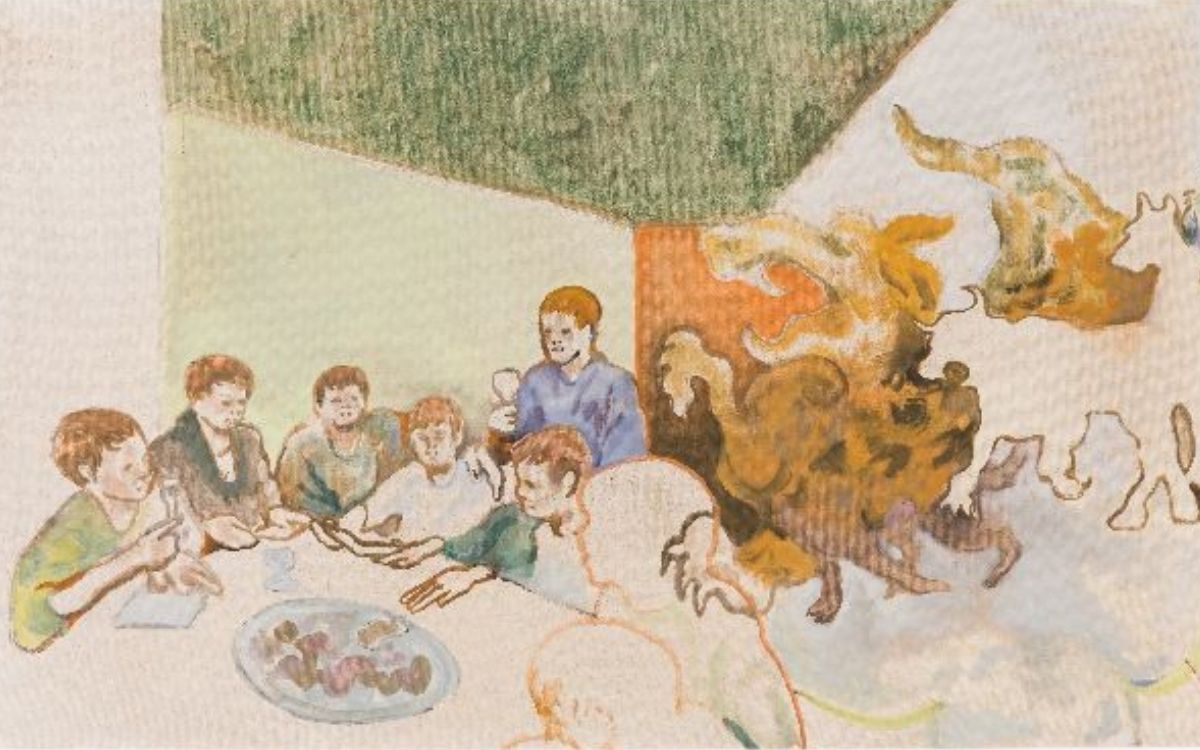
Growing up in Brazil, and especially between two large cities, definitely shaped the way I look at images. Cities are full of visual information, and I think this constant accumulation of images and information naturally led me to a practice based on montage. My Jewish upbringing is another important part of that background, although it's never something I try to illustrate directly. Looking back, I realise that the table has become a recurring image in my work, and I don't think that's a coincidence. The table is a place where people gather, eat, argue, negotiate, celebrate and perform rituals, it's also a compositional device where different bodies and objects can exist together and start building relationships.
I also think there's something in Jewish tradition that resonates with the way I make images. Meanings are rarely fixed, stories, symbols and rituals are constantly revisited and reinterpreted over time, and I guess my paintings work in a similar way. I don't usually think of an image as carrying one final meaning. I'm much more interested in how its meaning changes depending on what other images surround it.
At the same time, my background in graphic design still influences the way I compose a painting, and it made me very aware of rhythm, composition and how moving one element can completely change the way an image is read. I also grew up reading a lot of fanzines and comics/mangas, which probably explains why narrative is still so important to me, even if my paintings never tell a complete story. I like the feeling that you're looking at a fragment of something much larger that exists outside the frame.
I don't think any of these experiences appear literally in my work, they're just part of the way I've learned to look at the world.
Can you take us through the evolution of an artwork, from that first spark of inspiration to the finished piece?
My process almost always starts with drawing. Before painting, I collect images that somehow stay with me, they can come from the internet, magazines, comics, photographs that I've taken, or even drawings or paintings I made years ago. I don't really organise them, they just accumulate over time, and eventually I realise that some images keep coming back while others disappear for months or years before resurfacing again in some works.
Drawing is the moment when those images begin to change, I don't really think of it as illustrating an idea, it's more like taking images out of their original context and seeing what happens when I combine them, stretch proportions, repeat and put together things that probably shouldn't belong in the same image. In a certain way it's kind of a form of collage, except I'm not literally cutting and pasting photographs, but the collage happens through drawing and by redrawing something.
Once the composition of a drawing feels good enough, I start thinking which is the best surface to work on it, sometimes it works better on a traditional painting on a rectangular canvas, sometimes it's better if it's painted on one of my cut MDF panels. Those MDFs are silhouettes that also come from my drawings and I use it as a support, but the painting inside doesn't necessarily match that outer shape. I really like that tension that forms between the object you're looking at and the image painted inside it.
Moving from drawing to painting is never just about copying, something always changes. A composition that works on paper might completely fall apart once it's enlarged, or an irregular surface and its empty spaces forces me to rethink the whole image.
After that I redraw everything with the brush, almost as if I'm drawing all over again, so those first painted lines become a structure that I can either follow or completely ignore later. From there I like to say that the painting becomes a conversation or a puzzle. Sometimes a section needs to stay very graphic, while another needs to become softer or much more painterly. I also don't mind making mistakes, and actually think that most of the interesting parts happen because something didn't work the first time. Covering an image, painting over it or changing the composition halfway through often makes the work much more interesting than sticking to the original plan.
Colour is probably the most intuitive part of the whole process. I honestly don't always know where it comes from… sometimes I recognise a colour scheme from another painting I've seen, sometimes it comes from the materials that I have around me, and sometimes it just feels right without me being able to explain why.
What unusual or unexpected sources of inspiration have deeply influenced your work?
I don't think I arrived in contemporary art through the most conventional route… I studied graphic design, and before I was seriously thinking about painting, I spent a lot of time around people making comics, independent publications and zines. What I loved about that scene was how free it felt, people were making things because they genuinely wanted to make them.. Looking back, I think that had a huge impact on me, it taught me that a work doesn't need permission to exist, you can just make it, print it, exchange it, and see what happens.
I also really miss it in a way, zine fairs weren't just places where people sold publications, they were places where artists met each other, shared references and became friends. I think that environment shaped the way I still understand my artistic practice today.
Another huge influence surely was growing up on the internet! I'm somewhere between the Millennial and Gen Z generations, so a lot of my visual education happened online. I spent way too much time looking at anime forums, fan art, weird Tumblr pages, seeing furries on deviantart, watching Flash animations and all sorts of very specific internet communities. At the time it just felt like entertainment, but looking back I realise how much those spaces expanded my visual vocabulary. What interests me isn't internet culture itself, and I'm not trying to make paintings about it, I think it's more about the experience of growing up surrounded by thousands of completely different kinds of images. Online, there wasn't much hierarchy, a painting could appear next to a meme, a medical illustration next to fan art, or a photograph next to someone's strange little drawing. I think that's very close to the way I still collect images today.
The same thing happens with cinema and videogames. I'm usually drawn to works that don't explain everything straight away and I like entering a world and slowly understanding how it works through observation rather than exposition. That probably has a lot to do with the way I build paintings. I don't really want them to tell a complete story, I want them to feel like fragments of a much larger world, as if you're arriving in the middle of something that's been happening long before you got there.
How has your artistic style transformed over the years? Are there specific influences, experiments, or moments that marked a turning point?
Looking back, one of the biggest turning points happened during the pandemic, when I joined an online study group about the relationship between comics and contemporary art. That was probably the first time I felt like contemporary art could also be a place for me, until then it felt like this huge world that I admired from a distance, but wasn't really sure how to enter or if I would be able to fit in.
After that, I started painting much more consistently… At first, I was mostly trying to understand what painting could do that drawing couldn't, and what kind of images I actually wanted to make, back then I was very interested in masculinity, and I felt like every painting needed a very clear subject. I thought I had to justify why I was painting something, so the image usually came after the idea, and looking at them now, I think those works were much more illustrative than what I do today.Over time that changed quite naturally, so instead of starting with a theme and trying to represent it, I became much more interested in what happened when images were simply allowed to exist together. I stopped worrying so much about what a painting was "about" and became more interested in what happened between the figures. That's when I started noticing that certain bodies, gestures and objects kept coming back. I wasn't really planning it, but I was slowly building a visual vocabulary that still shapes the way I work today.
Another really important moment happened in 2024, when I did a residency at the Museum of Contemporary Art of Paraná. I had a 400-square-metre gallery to work in for a month, and that completely changed the scale of my thinking, suddenly I wasn't only making paintings anymore, I had to think about how people would move through the space, how one work would affect another, and how the exhibition itself could become part of the work.
That was when I started making my cut MDF pieces. Those shapes actually come from my drawings, I start by isolating a silhouette from a composition and use it as the support, but the painting inside doesn't necessarily correspond to the outer contour. It makes people look back and forth between the object itself and what's happening inside the painting.
Since then I've become much more interested in installation, exhibition design and the relationship between works. I still think of myself primarily as a painter, but I'm increasingly interested in everything that happens around the paintings as well. Sometimes the distance between two works or the way someone moves through a room becomes just as important as the image itself.
I also spent about ten months working as a graphic designer for a large Brazilian art gallery. Honestly, I think that experience taught me a lot because I got to see how a gallery functions behind the scenes, but more importantly I was constantly surrounded by artists whose work was completely different from mine andI think being exposed to that diversity of different bodies of work really expanded the way I think about making art.
How important is it for viewers to understand the intended message of your work? Does ambiguity add value, or do you seek clarity in your expression?
The ambiguity is probably the most interesting part! I'm fascinated by what happens when images that don't seem to have anything to do with each other suddenly start creating meaning just because they exist in the same space. Individually some visual elements might not tell us much, but once they're brought together they begin to create tension and sometimes it feels like there's a story happening, even if you can't quite explain what that story is.
I don't usually start a painting with a fixed message that I want people to understand and in fact, I think I've moved further and further away from that way of working. I'm much more interested in creating relationships between images and then paying attention to what those relationships begin to produce, sometimes the meaning only becomes clear halfway through the painting, and sometimes it only appears after the work has left my studio. That doesn't mean everything is completely open or random. I spend a lot of time thinking about composition, scale, colour and where each figure sits in relation to the others and those decisions matter.
I actually like the idea that someone might see something I wasn't consciously thinking about. Once a painting is out in the world, people bring their own memories, references and experiences to it, their reading won't necessarily match mine, and I think that's a good thing. It means the work can keep changing instead of arriving at one final meaning.
That's also one of the reasons I've become increasingly interested in installation and exhibition making. A painting doesn't exist in isolation, it changes depending on the room it's in, the architecture, the works around it and even the order in which people encounter it. Sometimes the relationship between two paintings can completely change the way I understand both of them.
I find that especially exciting in group exhibitions! My work suddenly enters into a conversation with artists I wasn't thinking about while I was making it. A painting can become much more humorous, much darker or much stranger simply because of what's happening around it. I don't have control over those relationships, but I love that they become part of the work once it leaves the studio.
So I don't really expect people to arrive at the same conclusion I did. If anything, I hope the paintings create enough structure that people feel there's something to hold onto, while still leaving enough space for their own associations to emerge.
Is art created for the artist, the audience, or somewhere in between?
I think it's somewhere in between…
Every work starts from a very personal place, and at least for me, making art comes from a need to put something into the world that I don't really know how to express otherwise. Sometimes it's an image that's been following me for weeks, sometimes it's just a feeling or a relationship between two figures that I can't stop thinking about, and sometimes it's just because I really want to move my body and paint.
So in that sense, the work definitely begins with me, by the things I've experienced and the way I naturally look at the world. Even when a painting isn't autobiographical, it's impossible to separate it completely from the person who made it.
But I also think something changes the moment the work leaves the studio. Once it's out in the world, it stops belonging only to me, other people bring their own memories, references and experiences to it, and they'll inevitably see things that I didn't. I actually enjoy that. I think it would be a bit disappointing if everyone arrived at exactly the same interpretation. That doesn't mean my intentions and my subjectivity disappear, but they don't completely determine that experience, and I don't think they should.
That's probably one of the things I enjoy most about being an artist. Something can begin from a very personal place and slowly become something that no longer depends entirely on me. A painting can end up meaning something to someone for reasons I could never have predicted, and I don't see that as a misunderstanding. I see it as part of the work's life.
So I don't really think art belongs entirely to the artist or entirely to the audience. It starts with one person, but it only becomes complete when it enters into a relationship with other people.
How do you envision the evolution of your work in the coming years?
I want to keep expanding the relationship between painting, drawing, installation and space. Lately I've become much more interested in making work for specific places, where the space, the scale of the room and the way people move through it are already part of the process from the beginning, instead of only becoming concerns when the exhibition is installed.
I'm currently planning a solo exhibition where I want to develop something more directly connected to the space and that kind of project makes me think differently because I can't just produce an object in the studio and place it anywhere afterwards. I have to think about the proportions of the room, its entrances, its walls and how someone will encounter each part of the exhibition. I'm interested in the possibility that the exhibition itself can work almost like a larger composition, rather than just being a group of separate works placed in the same room.
At the same time, I don't really like the idea of having a very fixed plan for how my work should evolve. I think part of the excitement is noticing how things change gradually, sometimes without me even realising it at first. New figures appear, older images come back and something I thought I had left behind suddenly becomes interesting again in a different context. I'm always curious about what will stay and what will disappear, but I don't want to decide that in advance.
I will also soon take part in an artistic residency in Rio de Janeiro, and I think temporarily changing cities will affect the way I work. Rio has a very different vibe from São Paulo, and also a different relationship with the body, landscape and public space. I'm curious to see how that changes my routine, the images I collect and the atmosphere of the work. I don't want to predict the result too much, because I think the whole point of a residency is to let another place introduce something you weren't already looking for.
I also want to return to publications and think more about how my images can exist outside a painting or a single drawing. My relationship with art began very close to zines and comics, and I still love the way a publication can change how an image is experienced. It can be repeated, fragmented, placed beside a text or another image, and the person reading it can move backwards and forwards through it at their own pace.
I think that, for now, that's what interests me most about the future of my work! I don't really want to arrive at one final form or decide exactly what my practice should become. I want to keep creating situations where the work can surprise me and become something I couldn't have completely planned beforehand.
What emerges from this conversation with Nicholas Steinmetz is a practice built on openness rather than resolution. Images accumulate, disappear, and return in new contexts; figures whose meaning seemed clear in one painting become strange and generative beside another. Steinmetz does not try to close that instability down. Instead, the interest lies precisely in what happens between things, between figures in a composition, between paintings in a room, between the object of a cut MDF panel and the image painted inside it. A solo exhibition is in development, a residency in Rio de Janeiro is approaching, and a return to publications feels inevitable. The work is still finding out what it wants to become, and that, as this conversation makes clear, is exactly the point.