
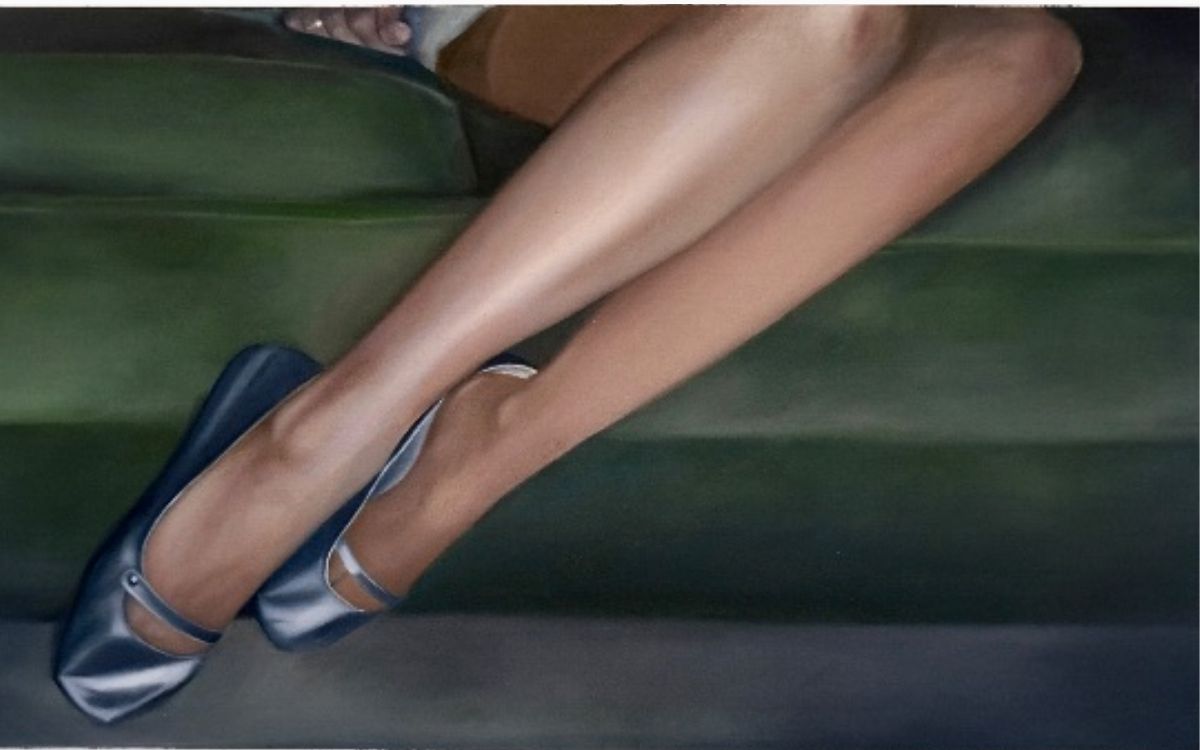
Liz Kölbl paints images that are already decaying. Working from the visual detritus of digital culture, low resolution screenshots, overexposed photographs, and images worn down through endless sharing and reposting, Kölbl translates these fleeting, circulating fragments into large format oil paintings, slowing them down, making them permanent, and asking what it means to call something real in an age of constant image reproduction. The work draws on Hito Steyerl's concept of the "poor image" and pushes it into the physical world, where something momentary is given weight, duration, and the quiet invitation to be looked at properly. What follows is a conversation about nostalgia, authenticity, and the strange honesty of painting from within a visual culture rather than standing outside it.
How does your art engage with or comment on pressing contemporary issues -social, political, or environmental?
In my recent work, I explore experiences of alienation in an age of digital hyperproduction, where images are constantly idealized, staged and reproduced, until they begin to replace reality itself. I am interested in the moment when representation turns into untruth and in questioning what we define as “real” or “authentic” today. Every couple of years the aesthetic of a medium itself changes. Subconsciously we think about certain cultural periods within their visual representation. The quality of a video, the way pictures felt, or how a movie looks.
In painting not the objects themselves, but rather the medium of the photo, the quality of the picture, i think there is something else captured: a nostalgic feeling that you get from looking at old youtube videos from the early 2010s, private photos from digital cameras, that are spread across the internet, or a screenshot from a low quality video.
In a text from Hito Steyerl titled „Poor Images“, she describes a modern phenomenon, where pictures and videos are losing their visual information through sharing, reposting, screenshotting, etc. They are copies without an original, they keep circulating through the internet like driftwood. In choosing them and translating them into big format paintings, a really slow and permanent medium, they get frozen in their state of visual decay. Their nature is permanently changed from a fluctuating state of appearing and disappearing to being permanently visible. At the same time, these images get transferred from the digital into the physical world and they regain a certain „realness“ and relevance.
Rather than offering direct criticism, my work invites to reflect on the subtle mechanisms through which contemporary image culture influences our perception of beauty, value, and authenticity. By translating hyperreal, digitally circulated imagery into oil painting, I slow down the act of looking and encourage viewers to reconsider the boundaries between truth and fiction, authenticity and performance. Ultimately, my paintings question, how digital, visual culture shapes not only what we see, but also how we understand ourselves and the world around us.
What do you think is the most meaningful role an artist plays in society today?
I think this is a really tricky question, because to a certain degree it feels like most artists can‘t have a really meaningful position in society that exceeds the artworld. Of course there are always new topics being addressed and the way of talking about art is always changing, but sometimes it feels like a loop, because oftentimes you can‘t reach most people outside of that specific bubble, that already have the same opinion as you.
For example, it was en vogue for the last 20-30 years to be against the capitalistic system and yet, most of the artworld is evolving around it. So how critical and provocative can a work of art be if it still plays with the rules of the system that it is against? I feel like artists often have to compromise and balance on the edge of being critical and still being representable by the art system.
I also don’t think the role of an artist is necessarily to provide answers or solve social problems directly. Instead, I believe art creates spaces for perception and association. It can leave room for ambiguity - for what remains unsaid - and allow viewers to develop their own interpretations rather than being presented with a clear message. Especially in a time of constant visual overstimulation, I think artists have the ability to slow down perception and encourage a more critical reflection on the images and narratives that shape our understanding of ourselves and the world.
Can you take us through the evolution of an artwork, from that first spark of inspiration to the finished piece?
The process does not begin when I start painting, or even when a particular image settles in my mind. It is an ongoing process that never really stops. I am constantly absorbing the visual language of contemporary image culture through social media, online platforms, films, and the endless stream of images that surrounds us. There is a constantly changing, never stopping flood of images that reflects the aesthetics and spirit of this time.
Over time, certain images begin to insist on themselves until they eventually find their way onto the canvas. I pay attention to the atmosphere, the quality of the image and what it hides beyond the visible frame, rather than what it explicitly shows. What interests me is not the subject itself, but the image as it exists within the digital medium. By transferring a fleeting digital image into the permanence of oil painting, I transform something momentary into a physical object with duration. This shift from digital to analogue allows me to question the boundaries between reality and staging, memory and construction, while reflecting on how our perception is increasingly shaped by media. It becomes something permanent, a slow, physical object, inviting viewers to spend time with it.
The surrounding empty space is not merely a compositional device but a deliberate conceptual element. It creates both intimacy and distance, directing the viewer’s gaze while simultaneously emphasizing the image as an object of observation. The frame becomes a reminder that every image is selected, constructed, and mediated.
Ultimately, my process is an exploration of transience, nostalgia, and contemporary digital aesthetics. Through painting, I slow down the endless circulations and invite viewers to reconsider how visual culture shapes the way we remember, perceive, and construct reality.
Describe a piece you've created that has held the most emotional weight for you, what makes it significant?
The piece that carries the most emotional weight for me is „Medium“. It was one of the first works in which I felt that I was on a right track—that I had discovered a question I wanted to continue exploring. The motif itself carries very little information about where it comes from or what it represents. It’s overexposed quality immediately recalls the nostalgic aesthetic of early digital cameras. In this case, the medium itself- the aesthetic of the digital camera - becomes the message. I think it is the vagueness of it, the non- expression of the face with the effect of an overexposed photograph, it almost has a transcendental quality to it. This vagueness and the aura-like glow, that is just the painted medium makes it special to me.
Do you believe the 'mad artist' stereotype still holds weight, or is creativity more grounded than we think?
I think it really starts with the definition of what being “mad“ means. Society constantly changes its definition of outsiders and misfits, people who would have been considered megalomaniac and greedy 100 years ago, now reach the highest positions. I think it is more about fitting in and accepting how the world works and people who can not accept it oftentimes turn to art as their expressive medium, because it can feel like the only platform, where you can break out of this value system.
Also I think the „image“ of creativity is linked too much to creating visual art, music etc., where self-expression is a big part of it. But creativity exists in science, business, technology and so on as well. So it is grounded in human nature and I believe that people in the arts are not necessarily more creative or more „mad“ than in any other field. A creative business person that has created a big influence through mad ideas, is seen as a valuable member of society.
Society tolerates „madness“ as long as it serves the system or has an economic value, while artists with the same attributes tend to be labeled differently.
What would the theme song of your artistic journey be, and how does it reflect your story?Can you share a moment when someone’s unexpected interpretation of your art gave you a new perspective?
Maybe I can mix up those questions a bit …
A friend of mine recently told me that the song „Sadeness“ by Enigma reminds her of my paintings. She described my work as beautiful, yet somehow untouchable. While this doesn’t directly answer the question, I feel that her interpretation captures something essential about my work, and I find it deeply fitting.
One interpretation of my work that has stayed with me came from a viewer who saw a feminist perspective in my paintings, especially with those that show the models: polished, perfected, and shaped according to external expectations.
I found this interpretation very interesting because it connected naturally to another recurring theme in my work: the way media, especially social media reshapes reality and in consequence contemporary beauty ideals. Older viewers sometimes describe the models as exaggerated, unnatural, or even unsettling. They immediately notice the artificiality of the figures. Younger viewers, often perceive the same images simply as elegant or beautiful. What one generation experiences as an unrealistic ideal, has for another become an almost ordinary visual language. I think this shift reveals how strongly our perception is shaped by the images we consume every day. The standards by which we judge beauty are not fixed; they are culturally produced and constantly changing.
The glossy skin of the models, which often appears almost porcelain-like, originally came to represent a form of escapism for me: the idealization and smoothing over of reality. It reminds me of collecting small porcelain figurines and displaying them on a dresser or in a glass cabinet simply to look at them and take pleasure in their perfection. I find that this sense of banality captures the spirit of our time remarkably well. In the context of contemporary beauty ideals, it can also be read through a feminist lens, revealing how women are increasingly aestheticized, polished, and turned into objects of visual consumption.
Although my intention was never to make an explicitly feminist statement, I realized that many of the images I am drawn to already carry these cultural associations. They reflect a visual culture in which perfection has become increasingly normalized.
Even though I try to approach these images critically, I am not outside of the system I am reflecting on. I am influenced by the same visual standards, the same ideals and the same algorithms that shape our perception every day. In that sense, my paintings are not observations from a distance, but are created from within this reality. I think that makes the work more honest.
Can you imagine ever choosing to stop creating art? What might lead you to such a decision
Right now, I can‘t imagine ever stopping creating art, but of course, you never know what will happen. I always wondered if being an artist automatically means to produce artworks or if it is more of a way of living and thinking. Theoretical reflection and artistic production are inseparable for me. While painting remains the most essential part of my practice, the place where these thoughts ultimately take physical form, I don’t see theory and practice as opposites. They continuously inform one another. For example, Marcel Duchamp stopped creating art publicly for over 20 years, but I think this didn’t stop him from being an artist at all! His example suggests that being an artist is less a profession than a particular way of thinking and relating to the world.
I see theoretical thinking and artistic practice as deeply interconnected. Reading, writing, and discussing art helps me to understand my own work more clearly, but they also allow me to position it within broader cultural and philosophical conversations.
If you had the chance to sit down with any creative mind from history, who would it be and what would you ask?
Probably it would be David Bowie or Jim Morrison and I would ask them how it was to live in the 60s and 70s.
What makes this conversation with Liz Kölbl particularly compelling is the refusal to position the work as critique from a safe distance. The same algorithms, beauty standards, and digital aesthetics that shape the images being painted also shape the painter. That honesty gives the work its particular charge: it is not an observation about contemporary image culture so much as a participation in it, made visible and slowed down through oil paint. The glossy, porcelain figures, the overexposed faces, the images frozen mid-decay: all of it reflects a world Kölbl is part of, not commenting on from above. That distinction, subtle but important, is what keeps the paintings from closing into a fixed argument, and what keeps them open long after the looking is done.