
What happens to a disaster once the news cameras leave?
For most places, the story just stops, the fire is out, the flood recedes, and the rest of the country moves on to the next headline. The people who actually live there don't get that option.
Evoia, Greece's second-largest island, has spent the last several years absorbing exactly that kind of aftermath. Wildfires have burned through more than 15% of its land. Storms and heavy rainfall have hit infrastructure and farmland that hadn't finished recovering from the last disaster before the next one arrived. The headlines came and went. The damage, and the work of living with it, stayed.
That's the ground the first round of Evoia's Local Urban Lab started from, part of the Turning the Tide project. Rather than treat Evoia as a case study in resilience from the outside, the lab put two Greek artists directly into its communities, with a brief that amounted to: don't let this fade, and don't just document it either.
Two Ways of Looking
Giorgos Gerontides and Christina Maridaki were selected through an open call to spend time in Evoia and build work out of what they found there. Giorgos, based in Thessaloniki, works in public art with a focus on social issues and collective resilience. Christina, based in Athens, works in eco-feminist, socially engaged art — gender, community identity, and participation as a form of healing. Both ended up somewhere different from where they started, shaped by the specific communities they spent time with.
Giorgos Gerontides — Vulnerable Nets
Giorgos's documentary, Vulnerable Nets, follows a network of grassroots groups in North Evoia doing the unglamorous work of recovery, made with local teenagers and young adults rather than about them. The Stagones Social Cooperative teaches permaculture and natural building. AMAL runs workshops and children's activities aimed at building ecological awareness early. The Forest Voice movement organizes volunteers around environmental protection; the Forest Firefighters' Voluntary Association trains people in fire prevention and shows up when emergencies hit; the Sideritis Collective works on conserving both natural resources and cultural heritage.
None of these groups on their own would make headlines. Put together, Vulnerable Nets argues they're the actual infrastructure of recovery; the thing holding a community together in the years between disasters, when nobody's watching anymore.
Christina Maridaki — Feminsularity
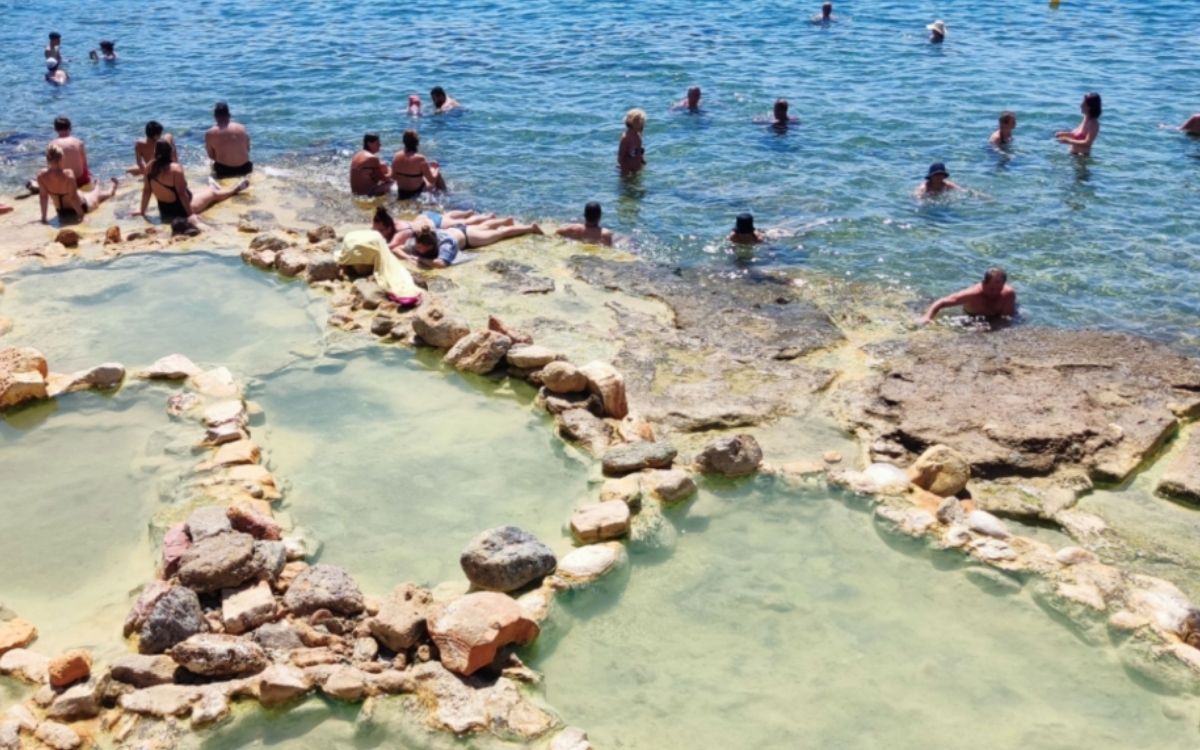
Christina spent eleven days in Edipsos, a town built around hot thermal springs, for a project she called Feminsularity, part documentary, part zine. Her focus was narrower and more intimate: how women in the town use the springs, and what that use reveals about identity, care, and connection to place.
The springs turn out to carry history as well as heat, Christina's zine weaves in the myth of Hercules alongside the women's present-day routines, tying a shared, communal space to something older than any of the people currently gathering in it. Her framing is eco-feminist, but the material is plain and specific: what it looks like when a place becomes a kind of shared body, tended and returned to across generations.
Building the Process
Neither artist arrived in Evoia cold. Before either of them set foot on the island, a digital workshop with Dr. Spyros Bofylatos of the Royal College of Art walked them through the environmental and social realities they'd be working inside, not just what had burned or flooded, but why, and who was left carrying the consequences. Later, a meeting with Istiaia-Edipsos mayor Ioannis Kontzias added a different layer entirely: the view from the town hall, where recovery is measured in budgets, permits, and infrastructure that either gets rebuilt or doesn't.
By the time the residency closed, Giorgos and Christina sat down together for a roundtable that wasn't just a formality, a real conversation about what had actually shifted in how they saw the place, what caught them off guard, and where the work still felt unfinished. Those conversations, as much as the finished pieces, were the point.
What came out of Round I wasn't a tidy resolution. It was two very different, very specific accounts of what it means to keep living somewhere after the disaster stops being news. Artists Angela Liosi and Maria Gouveli have since picked up where Giorgos and Christina left off, continuing the lab's second round in Evoia, with a handover session that let both pairs of artists compare notes directly before the baton changed hands.
To get the full picture, make sure to explore Giorgos’ and Christina’s works in detail.
This work is part of the Turning the Tide project, co-funded by the European Union under the Creative Europe programme, supporting artistic research into climate justice and resilience in waterfront communities across Europe.
