
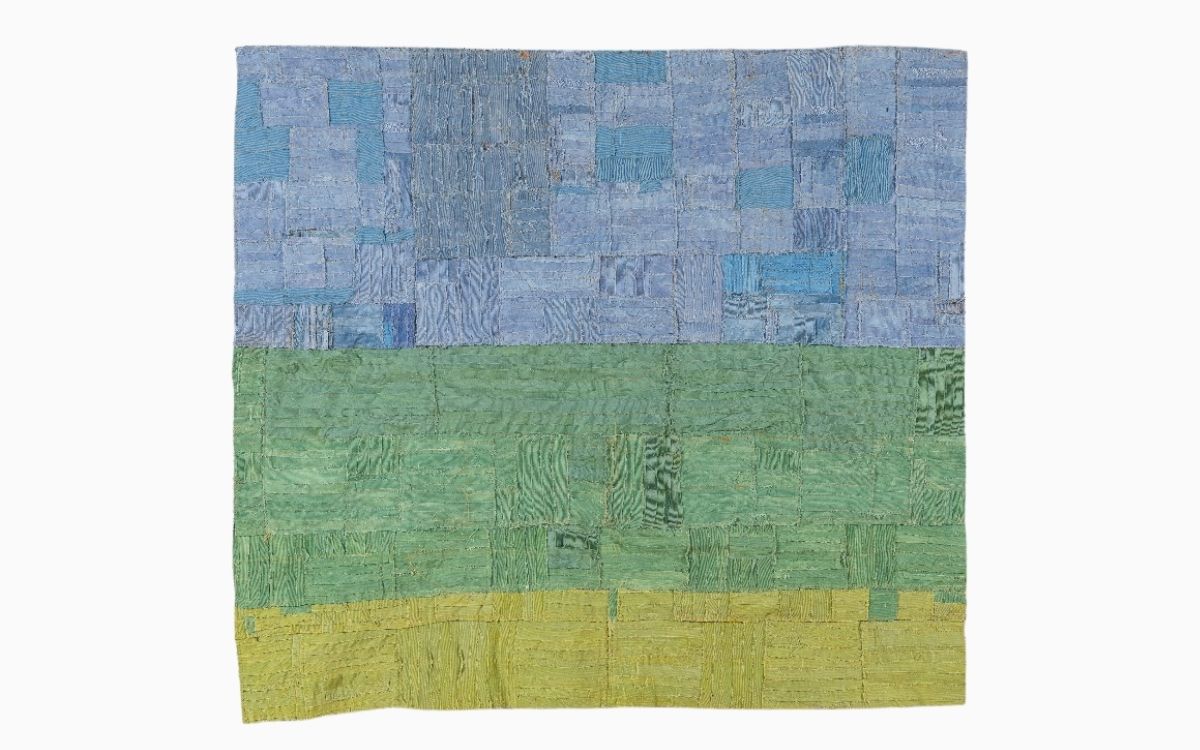
Asa Jackson builds images from the fabric of lived experience, quite literally. Beginning as a painter, Jackson's practice shifted during a period of constant travel into a textile-based process rooted in gathering, cutting, dyeing, and sewing garments donated by friends, families, and entire communities into swatches of color and texture that eventually become larger works. At the heart of it all is a sustained contemplation of the cosmos, the self, and the relationship between the two, drawing on spiritual axioms, esoteric knowledge, and universal truths that give the work its deeper charge. What follows is a conversation about transformation, storytelling, and the unexpected word that changed everything.
Does spirituality or a connection to something larger than yourself influence your creative process?
Yes, for sure. All of my work, in some way, is a contemplation on our place in the cosmos and our perspective on self, which is completely a spiritual conversation for self and the world. Most of my works delve into spiritual axioms, universal truths, esoteric knowledge, and references to spiritual scripts. My work is all about the relationship to mySelf, and man to the cosmos and the source. As a being created from the source it is my inherent nature to create. This is innately spiritual.
What do you think is the most meaningful role an artist plays in society today?
Artists are storytellers and way finders, and that is a great responsibility. Artists have the ability to shape and change perception. They can take people’s minds and hearts to another place. Throughout history, that ability has been understood in different ways. At different points in time, the artist has been shaman, spiritual guide, scribe, historian, and witness. Creators continue to play those roles today.
Can you take us through the evolution of an artwork, from that first spark of inspiration to the finished piece?
Inspiration happens nonstop. It can happen while driving down the street, noticing the colors of buildings. It can happen at a park, watching the sun move through the sky or seeing the sky change colors. It can happen in the way the leaves change throughout the day. Inspiration is always happening.
It also comes from things I am studying or spiritual knowledge I may be contemplating, certain histories or sites, truths or perspectives that I have seen or experienced. That inspiration may lead me to seek out a particular color, texture, or story within a garment.
The evolution of an artwork is a step-by-step process of cutting and sewing. It begins with gathering materials. Usually, the gathering of materials doesn't happen in direct response to the inspiration. The gathering of lived-with fabrics, mostly garments, is an ongoing part of my practice. Sometimes that means thrifting. Other times it involves receiving garments donated by friends, family members, or entire communities.
I then put those materials through a process of, at times, dyeing them to achieve particular colors, cutting them into small units, and sewing those pieces back together into swatches of color and texture that almost function like puzzle pieces. Once I settle on an idea, I begin pulling those different swatches together.
The breaking-down process suspends the original inspiration for a while. During this
stage, I work mechanically, creating representational swatches, a brown swatch for dirt, a green swatch for grass, for example. Once I have built a library of swatches with different colors and representations, I return to the original inspiration and begin shaping the work. That idea remains malleable until the piece is complete.
How has your artistic style transformed over the years? Are there specific influences, experiments, or moments that marked a turning point?
I started my career primarily as a painter, but textiles and a sewing machine were always in the background. I made and experimented with clothing, though it remained a separate practice. Sculpting, printmaking, and other modalities also found their way into my process, but painting was my primary focus.
Between 2017 and 2018, I was traveling with my family and wasn't able to maintain a painting practice because we moved so frequently. The one constant tool I had was my sewing machine, which at the beginning of that year I had been using to make clothing. In the middle of those travels, I began leaning into the possibility of using my sewing machine to make artwork. I could experiment, work wherever I was, and easily pack everything into a bag when it was time to move again.
That became the turning point in my practice, the transition from painting to working primarily with textiles.
Can you share a moment when someone’s unexpected interpretation of your art gave you a new perspective?
There was a moment in 2016 when I was curating an exhibition for a group of friends called the California Locos. During the week we spent together for the opening, one of the artists, an older artist whom I respect, came to visit my studio. He was only there for a minute. As he was walking out the door, he looked at me, and said, "derivative."
That statement infuriated me. For the next two years, every time I walked into my studio, the word came to me. It pushed me to experiment, to develop new processes and techniques, and to ask myself different questions.
That experience created the space for my practice to move somewhere completely new.
It led to the birth of my textile work in a way.
Is art created for the artist, the audience, or somewhere in between?
This is a great question. It is definitely somewhere in between. If an artist is not creating for themselves, I don't know if it can even be called true art. Inspiration comes from within and then has to be carried into the world by the artist. There has to be some inner motivation to create.
Once the artwork is made, it is inevitably experienced by others. Knowing that the gaze of another will eventually fall on the work makes it inherently for the audience as well, whether or not that is the artist's intention.
Name five pivotal lessons you’ve learned that shaped your artistic journey.
Walter Hopps 5 Points. I have used them to help me build organizations and the structure of organizations I work within as an arts administrator. I also use them to map my own path and the paths of other artists. These 5 points help me gain a perspective and a lens with which to see an artistic landscape.
In 2013 I was watching a documentary called The Cool School which was giving historic accounts of Walter Hopps and his journey in helping to pioneer the LA art scene. In the documentary it noted 5 key points that Walter noticed and used to make connections and help build an arts ecosystem as a young curator. Those 5 points are:
Making and housing globally competitive artwork within a geography
Places that the public and the audience can access artwork
Documentation around the work
Institutional buy-in
Patrons
The 5 Points are my compass.
What emerges from this conversation with Asa Jackson is a practice that holds together two things that might seem at odds: the deeply personal and the genuinely cosmic. The garments gathered from communities carry memory and history into the work; the spiritual framework gives that history a wider context to breathe in. Jackson describes artists as shamans, historians, and wayfarers, roles that feel entirely consistent with a practice built on slow, deliberate accumulation and an openness to being pushed somewhere new. A single word, "derivative," spoken at a studio door in 2016, led to years of experimentation and ultimately to an entirely new body of work. That willingness to be provoked, and to transform the provocation into something generative, says everything about the practice.