
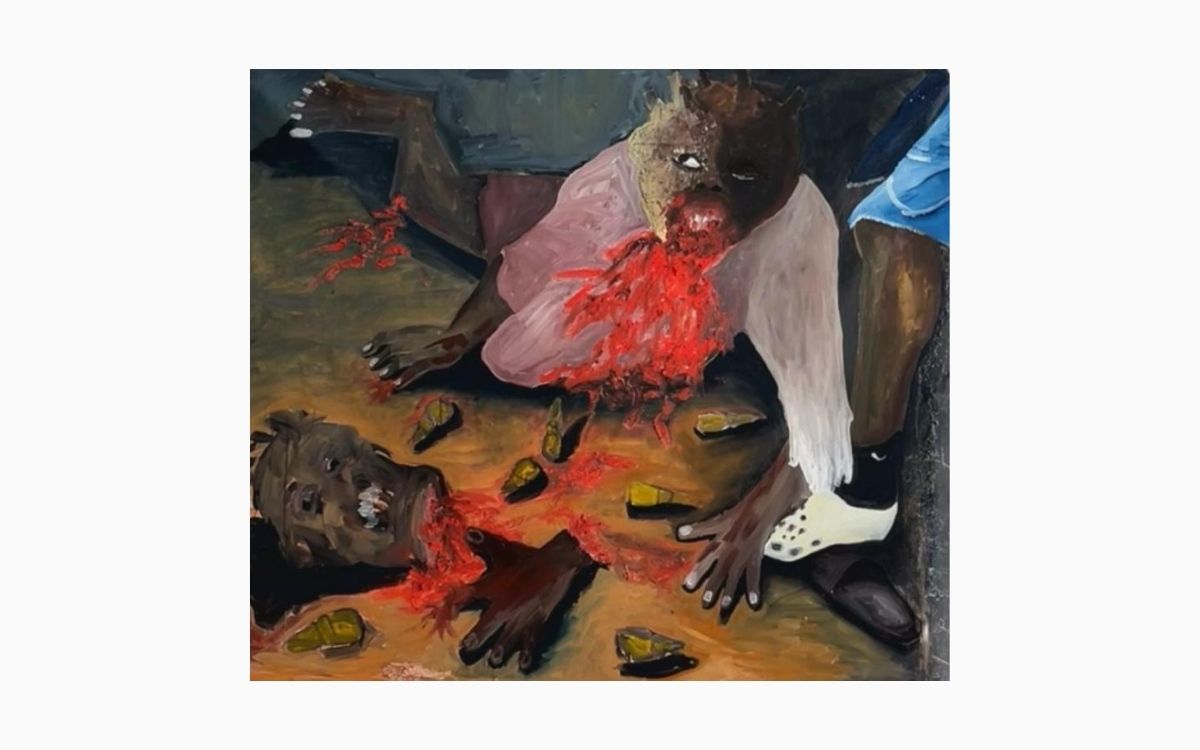
Junior Jacinto paints from a place where culture, identity, and survival are never far apart. Rooted in an Angolan context and shaped by research into activism, family, and the complexity of human nature, Jacinto builds layered, charged canvases that carry presence before they carry meaning. The practice began not with a plan but with a canvas, some paint, and the liberating feeling of expressing ignorance, and it has grown from there into a living, searching body of work that refuses to stand still. What follows is a conversation about origin, transformation, and the power of staying in motion.
Can you pinpoint a single moment in your life when you realized art was not just a passion but your purpose?
Everything began when practice became daily. I started drawing out of admiration for the great masters, but even I sometimes wonder where this artistic vein really comes from. Of course, I had been drawing since childhood, but only in the casual way children do, as a form of play and leisure. It never crossed my mind that I would become a painter. I think it all started with the desire to become better.
My journey into drawing was gradual, but I remember having a canvas and paint ready, waiting for the moment I felt it was time for the transition. When that moment finally came, it was the purest experience I had ever felt. To feel the paint in my hands and express my ignorance was liberating. What is funny is that I was not even satisfied with the first result, so I immediately moved into layers. That was when the addiction began, and with it, the dreams.
In that state of pure ignorance, I felt my purpose. I understood what I could bring to art culture, and that realization became stronger through an activist way of thinking. My studies around activism in Angola also shaped that path for me. From there, my spirit to help others grew, and art became the way.
Can you take us through the evolution of an artwork, from that first spark of inspiration to the finished piece?
My creative process is not a formula I follow. It is always an experience, always research, always movement. Every work demands something different, so I adapt depending on what the piece needs. Still, the process usually passes through research, narrative study, material exploration, and the design of details.
I spend time understanding the story behind the work, then I let the material speak back to me. I explore, test, layer, remove, and rebuild. I do not believe a painting is ever truly finished in a fixed sense. For me, my paintings and my process are alive. They are in constant change, in constant movement. A work is only really complete when it is no longer in my hands, because even then it continues to live, breathe, and transform in the eyes of whoever encounters it.
This is why I do not see painting as something static. It is a living dialogue between intuition, research, material, and emotion. The work evolves the same way life does.
How has your artistic style transformed over the years? Are there specific influences, experiments, or moments that marked a turning point?
My turning point came when I entered the industry. That was the moment when my relationship with human nature changed, and that changed my behavior and my work. It was a sudden shift, but also a necessary one. The more I understood people, the more my art began to reflect complexity, tension, and deeper observation.
My references come from many mediums. At first, in my ignorance, I looked mainly at the mainstream masters. I am still searching for more voices, more perspectives, and more paths, but discovering contemporary artists was a major turning point for me. It
opened my eyes to new ways of thinking and creating. That shift gave me permission to move beyond only looking backward and start engaging with the present in a more active way.
Some of the artists and thinkers who have influenced me include Virgil, Rick Rubin, Kanye West, Francis Bacon, Picasso, Jean-Michel Basquiat, Luaty Beirão, António Ole, Gerard Richard, Paulo Bragheti, Kerry James Marshall, Slawn, Henrique Hermes, Lino Damião, Casca, Tho Simões, Osias, Justin Bua, and Valete. Their influence is not all the same, of course, but each one has contributed something to my thinking, whether through attitude, freedom, structure, rebellion, or honesty.
How does your art engage with or comment on pressing contemporary issues—social, political, or environmental?
My work is shaped by the world around me, even when it does not speak about current issues in a direct or obvious way. I come from a context where culture, politics, identity, and survival are never far apart, so it would be impossible for my practice not to carry some of that weight. A lot of my work begins with a feeling that something in life needs to be looked at more closely, whether that is the tension between the individual and society, the pressure of human nature, or the need to reclaim dignity, power, and self awareness.
The activist side of my thinking has always been part of the work. It did not begin as a strategy to make political art, but rather as a natural extension of what I was studying and observing, especially around activism in Angola. That research gave me an awareness that art can do more than decorate a space. It can ask questions, create confrontation, and hold space for reflection. I do not see my role as giving answers, but as creating an atmosphere where people feel something, question something, or recognize something in themselves.
I also think contemporary issues live inside the material and the process itself. The way I build a painting, layer after layer, reflects the complexity of living in the present. Nothing is simple, nothing is flat, and nothing arrives fully resolved. That is how I see the world too. My paintings carry that same charge. When they are in a room, they are not passive objects. They bring energy, presence, and tension. They can change the atmosphere of a space, which for me is also a way of speaking to the present moment.
If you could communicate just one core message through your entire body of work, what would it be?
If I could communicate one core message through my entire body of work, it would be that art is a living force, and so are we. Nothing is fixed. Everything is moving, changing, and becoming. I want my work to remind people that there is power in process, power in contradiction, and power in not arriving too quickly at final answers. Life is layered, and I believe art should reflect that truth.
Another important part of that message is energy. I want my paintings to carry something that can be felt, not just seen. When my paintings are in a room, you have power in that room. There is a charge, an atmosphere, something that speaks before language does. That is what I care about most: creating work that holds presence. I want people to feel that the painting is alive, that it contains memory, thought, resistance, and spirit.
At the same time, my work comes from a place of searching. I am still trying to understand where this artistic vein comes from, and I think that uncertainty is important. I do not want to pretend I have everything figured out. In fact, part of the message is the opposite: that art can come from not knowing, from curiosity, from instinct, from the desire to become better. I started by drawing as a child, then later returned to it seriously through a deep need to improve, to search, and to transform. That spirit of searching is still with me now.
So if there is one thing I want my body of work to say, it is this: stay in motion, stay curious, and trust the power of your own transformation.
What unusual or unexpected sources of inspiration have deeply influenced your work?
The deepest sources of inspiration in my work are my father, my brothers, and my culture. I cannot escape them, and I do not want to. They are part of who I am, part of the way I think, and part of the way I create. My background is not something I place outside the work; it lives inside it.
My family has shaped my understanding of strength, responsibility, and identity. My culture gives me a wider memory and a deeper sense of belonging. Together, they form a foundation that is always present, even when I am not thinking directly about them. They influence my instincts, my visual language, and the emotional energy of the paintings.
I also believe that inspiration is not only about what is beautiful or expected. Sometimes it comes from what is inherited, what is lived, what is carried quietly over time. That is why my work feels personal to me. It is never just about image or style. It is about origin.
How do you envision the evolution of your work in the coming years?
Evolution is inevitable. More than producing, my focus is to recover my inner child, a part of me that was once forgotten through the journeys and pressures of life. I want to confront my practice with the questions raised by both myself and life itself. That confrontation is important to me because it keeps the work honest and alive.
The priority is clear: experiment, experiment, and keep feeding raw experimentation. I do not want my work to become comfortable or predictable. I want it to remain open, searching, and willing to change. The future of my practice is not about repeating what already works. It is about allowing the work to expand, to question, and to surprise me.
I believe that as long as I remain committed to curiosity and transformation, my work will continue to grow in a meaningful way. The goal is not only to produce more, but to go deeper into material, into self, into memory, into risk. That is where the next stage of my work lives.
What runs through this entire conversation with Junior Jacinto is a belief that nothing in art, or in life, should arrive too quickly at a final answer. The paintings are built in layers because that is how the world is built: complex, unresolved, and always becoming. Jacinto does not claim to have everything figured out, and treats that uncertainty not as a weakness but as the very condition that keeps the work honest. The goal looking forward is not to produce more but to go deeper, into material, into memory, into risk, and to recover the curiosity of the inner child that first picked up a brush without knowing where it would lead.