
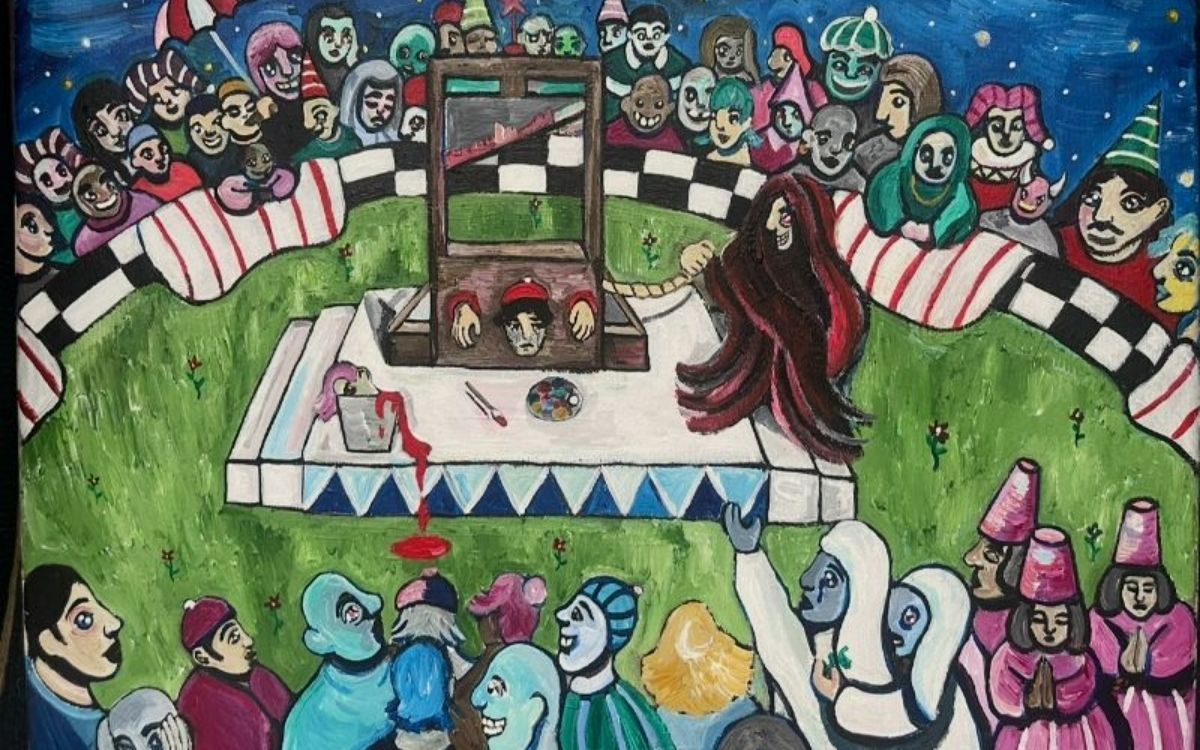
Kurtis Alexander paints because there is no real alternative. What began with a framed kindergarten drawing of Van Gogh's sunflowers grew, through tattoo flash work and a self-directed study of Matisse, Kirchner, and Philip Guston, into a self-taught practice built almost entirely through persistence. Alexander resists the idea of artist's block, treating bad paintings as a necessary cost of making anything at all, and approaches creativity as something that needs to stay grounded rather than romanticized. What follows is a conversation about stagnation, pretension, and the long, unglamorous work of figuring out a style that holds up over time.
How do you reignite creativity during those inevitable periods of self-doubt or stagnation?
I just keep working and try not to think about it too much while I’m doing it. It’s very easy to get trapped in a self-doubt loop as an artist, especially when 99% of your time is spent working through it alone. Over the years there will be paintings that I absolutely hate by the time I’m done with it, and a lot of times I’ll look back on that painting maybe months or years later and appreciate it. Or someone else will see it and it’s one of their favorite paintings I’ve made. I’ve gone through plenty of periods of stagnation, and during those times I try not to force it, or I’ll focus on other creative interests. There have been plenty of nights where I feel like I'm ready to paint something and then I just stare at a blank canvas for a couple hours. I don’t really believe artists' block is a real thing though, sometimes it just needs to come out in other ways. A lot of artists get creative block because they fear creating something bad. But I think it’s important to make 10 bad pieces of work over making nothing at all. You just have to find other ways to get it out.
How has your artistic style transformed over the years? Are there specific influences, experiments, or moments that marked a turning point?
I didn’t really know anything about art growing up but I’ve always drawn pictures since I was a kid. I remember in kindergarten my art teacher liked my drawing of Van Gogh’s sunflower so much that she framed it so that it probably planted a seed in my brain somewhere. Around my final year of high school, I was really into the idea of being a tattoo artist, so I was drawing a lot of traditional flash stuff. Eventually through the tattoo artists I followed around 2015 I found a painter named Danny Fox who most people in online art circles probably know by now. Finding his work definitely played a part in making the shift for me. At the time I was also just starting to study art history, and by the time I found painters like Matisse, Kirchner, and Phillip Guston I knew I wanted to paint. I wouldn’t say I’ve ever been naturally gifted artistically so my paintings started out pretty rough. But through the process of constantly working on it I eventually developed my own style. I took a few intro painting/drawing courses in college and learned a lot, but I eventually realized the academic path wasn’t really for me. I think overall though, my grandma was one of the biggest influences in my life to keep painting. I would show her my drawings that I didn’t really like and she would act like I just made the Mona Lisa. She was always very encouraging when it came to me being creative, and that kept me motivated to keep making things.
How do you feel social media is shaping the way art is created, consumed, and valued today?
Social media is great for artists in the sense that you can create something and share your work with thousands of people instantly and build a following or audience from it. But I believe the way algorithms have evolved over the years has drastically cheapened the value of art, at least in the way we produce and consume it online. It’s not enough anymore for most artists to just share their work and gain a following from it. You have to learn the algorithm and find ways to grab attention. I know a lot of painters, including myself, who don’t want to do all the extra gimmicks and just keep it entirely about the work. I don’t judge any artist who tries to play the algorithm game to drive more people to see their work, but sometimes I see it backfire where people are more interested in you as an “influencer” than the art that you actually produce. That path is usually just walking a tightrope between making your art but also not selling yourself out to get a few extra clicks. There are incredible artists with 100 followers and mediocre ones with 100k followers that just know how to use social media. I took a step back from sharing work online for a while because I couldn’t figure out if I was making something for the internet or making it for myself. It is what it is at this point, I haven’t figured it out yet but it would be nice to not have to think about it all.
Do you believe the ‘mad artist’ stereotype still holds weight, or is creativity more grounded than we think?
I think the tortured artist stereotype has some truth to it, and in a sense a lot of creative work comes from a place of pain or some dissatisfaction with everyday life. Overall, though, creativity needs to be grounded. It’s almost impossible to be productive when you are truly suffering mentally, or on a depressing multiple day drinking bender or something like that. I think to be truly productive creatively you need to be a bit boring and cut out the distractions. Most successful artists are probably more boring than they’d like to admit. I think the suffering artists generally experience comes from navigating how to make their work in a world that is constantly trying to pull them away from it, and that lingering feeling that they don’t really fit in neatly anywhere. It’s challenging to stay creatively grounded when you’re trying to figure out how to pay bills. Earlier this year I was unemployed for a month and during that time I was actually able to build a stable routine and really focus on painting for the first time in a while. I had a great time, but eventually reality started knocking at the door and I had to find somewhere to clock in.
Under what circumstances do you think art risks becoming pretentious? 5. Can art be truly therapeutic? Have you experienced its healing power personally, or seen it impact others?
I think an artwork risks being pretentious when it’s framed in a way that only a select chosen few can understand. Or when artists and critics project a hundred layers of meaning into a painting to make up for the fact that the painting doesn’t have much meaning to it at all. I try to avoid pretentiousness in my work and I don’t like to over intellectualize it. I want my work to be digestible to the average person even if they don’t really care about painting and art at all.
When I first started to get serious about painting it was therapeutic and relaxing, but over the years the therapeutic aspect has taken a different shape. I very rarely feel relaxed when I’m painting. It’s a constant battle to keep working and improving and feel satisfied with the results. I used to paint quickly and finish multiple pieces a week. Lately I've been taking more time to sit with a painting and find myself constantly editing a piece and then I eventually realize the first draft was actually the best one. Most artists probably reach a point where they feel like Sisyphus pushing that boulder up the hill and trying to find the point in all of it. It’s hard to put it into words, but there is a healing aspect somewhere in that process. For as frustrating and futile as it feels in certain moments there is something in you that keeps bringing you back to it to see it through.
How do you envision the evolution of your work in the coming years?
It’s hard to say exactly. I have this idealized version of what I want my paintings to look like years down the road, and each painting I make is just chipping away to get closer to that point. I don’t know if I’ll reach that perfect point that I’ve imagined in my head, but I try to think in the long term rather than the day-to-day process. When you mostly work alone it’s very easy to slip into a comfort zone where you aren’t really challenging yourself so I'm trying to find ways to not get too comfortable. I really enjoy working on big canvases and trying to figure out how to fill all that empty space is a challenge on its own. I draw a lot and I tend to like my drawings more than the paintings that come from it, so I'm in the process of figuring out how to bring harmony between the two. Eventually I'd like to start working through other mediums. I’ve always been interested in sculpture and occasionally work on learning music production and animation. I think my long-term goal is to bring it all together eventually. With the limited time I have I focus on painting and try not to stretch my focus too thin. Eventually I need to get my own studio space. I have paintings piled up in my apartment and I’m not brave enough to use as much oil paint as I'd like in here.
Can you imagine ever choosing to stop creating art? What might lead you to such a decision?
For as many times as I've thought of giving it up I never could. I wouldn’t really feel like I fully exist without some kind of creative outlet to work through. If I actually had the choice I would choose to be satisfied with working a regular job and a more conventional life path, but at this point I don’t really have a choice in the matter so I’m just going to keep painting and see what comes from it.
What comes through clearly in this conversation with Kurtis
Alexander is a refreshing lack of pretense. The work isn't framed as a
search for relaxation or therapy in any easy sense; it's described
instead as something closer to Sisyphean, a constant negotiation
between dissatisfaction and the stubborn pull to keep going anyway.
Alexander has little patience for art that requires a hundred layers of
explanation to justify its meaning, preferring instead to make
paintings that stay digestible without losing depth. There's no
idealized myth of the tortured genius here, only the steady,
sometimes boring discipline required to actually finish the work, day
after day, canvas after canvas.