
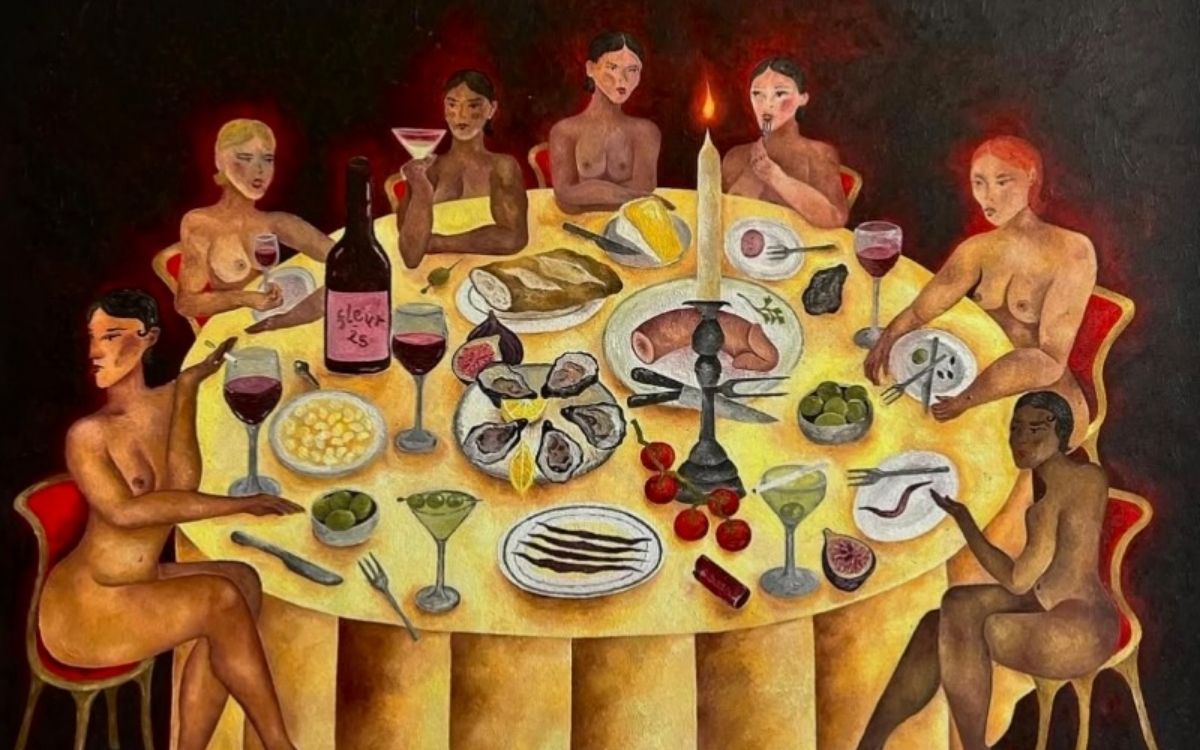
Amy Game paints from the in-between, drawing from personal experience through the female gaze. Her practice explores themes of womanhood, cultural identity and the liminal spaces where opposing forces coexist. Rather than seeking to resolve contradiction, Game embraces it, using painting to hold a space that doesn’t push to be understood but felt . Working primarily in oil, Game creates symbolic, narrative-driven paintings rooted in observation, emotion and lived experience. Guided by intuition as much as intention, she has built a practice that values authenticity over polish.What follows is a conversation about duality, freedom, and choosing art over a more conventional path.
How has your upbringing or cultural heritage shaped the themes and techniques you explore in your art today?
I think my upbringing and cultural heritage have shaped my practice in ways that are both conscious and subconscious. Growing up mixed-race, I often felt the duality of both worlds.
My father immigrated to Australia from Burma alongside his eight siblings, bringing a culture that became deeply rooted in my upbringing. It was rarely something loud or overtly discussed, but rather something quietly lived every day through food, family values, respect, resilience, and an unspoken understanding of hard work. Looking back, I realise how profoundly those ideals became embedded in me, often without my noticing.
Having an immigrant parent also instilled in me a deep appreciation for determination and perseverance. I grew up understanding that opportunities should never be taken for granted and that meaningful work is earned through commitment and discipline. Those values continue to shape not only my life, but also the way I approach my creative practice.
My mother moved to Australia from England, bringing an entirely different temperament and way of seeing the world. Where my father embodied discipline, resilience, and quiet strength, my mother offered warmth, softness, and an unwavering sense that I could do no wrong. Their personalities often felt like opposites. Growing up, I experienced a constant push and pull between those two worlds, and I think much of my work is still searching for the space where those opposing forces can coexist.
I think this perspective naturally influences the themes I return to in my work, not so much cultural identity, but what it means to exist in between.
Do you think art should have a political or ideological agenda?
I wouldn't say art should have a political or ideological agenda. The word "should" implies obligation, and I think one of art's greatest strengths is its freedom to exist without a prescribed purpose. Sometimes an honest act of self-expression is enough for people to see themselves reflected in it.
That said, I do believe art is inherently political because no artwork exists in a vacuum. I think art has the capacity to be a radical act of political expression, challenging dominant narratives, giving visibility to overlooked experiences, and creating space for conversations that might otherwise remain unspoken. Every painting, sculpture, or photograph is shaped by the social, cultural, and historical conditions from which it emerges. Politics extends far beyond governments or legislation. It influences the way we understand beauty, identity, gender, power, and whose stories are considered worthy of being told.
What do you think is the most meaningful role an artist plays in society today?
I think, now more than ever, art is freedom. In a culture increasingly shaped by artificial intelligence and constant consumption, it remains one of the few spaces where imagination, vulnerability, and authentic human expression can exist without needing to justify themselves. Art doesn't need to solve problems or provide answers. Its role is to make us feel, to question, and to remind us of the value of being deeply human.
Do you feel a personal connection to your subject matter is essential? How has this connection shaped your work?
For me, yes. My work is deeply rooted in personal experience and is filtered through my own perspective as a woman navigating the world. Almost every subject I paint carries emotional significance or represents a moment, relationship, or feeling that has shaped me in some way. Even when the imagery becomes symbolic or surreal, it almost always begins from something lived.
I think beginning from a place of authenticity creates space for genuine connection. If someone can recognise a part of themselves in a painting that originated from my own experience, then the work has moved beyond autobiography.
How do you feel social media is shaping the way art is created, consumed, and valued today?
I think social media is both a blessing and a curse. There is certainly the issue of oversaturation and a growing pressure to create for visibility rather than authenticity, to become a content creator before an artist.
That said, I think social media has been incredibly democratising. As someone with an unfinished art degree, living in one of the most isolated cities in the world and creating work that sits outside the mainstream, I often wonder where I'd be without it. I have no established connections to the art world, galleries, funding bodies, or institutions that have traditionally shaped an artist's career. Social media has given artists like myself the opportunity to share our work on a global scale without needing permission or proximity to those spaces.
For all its flaws, I think that's incredibly powerful. It has created a more accessible art world, where emerging artists have a genuine opportunity to be seen. The challenge is ensuring social media remains a platform for sharing authentic work, rather than becoming the reason the work is made.
How do you respond to debates about the accessibility of art, should it be exclusive, or is it for everyone?
Art is absolutely for everyone. I've never liked the idea that it should be exclusive. To me, art is freedom. It's one of the purest forms of self-expression, and I don't believe self-expression should ever be gatekept. Whether someone has studied art for decades or has never stepped inside a gallery, they're equally entitled to feel something when they encounter a work.
Art is often chosen as a medium for its freedom. Why do you personally turn to art, rather than another form of expression?
For me, painting allows me to express things that language often can't. A lot of my experiences and emotions exist in a kind of liminal space, somewhere between worlds, between realities, or between feelings that don't have a clear name. I've always found that images can hold contradiction in a way words often struggle to.
I rarely begin a painting knowing exactly what I'm trying to say. More often, I'm trying to understand something that feels just beyond language. Painting gives me the freedom to explore that uncertainty without needing to resolve it. Through symbolism, metaphor, and composition, I can communicate emotions that feel too complex or ambiguous to explain literally.
Have you ever felt drawn toward a conventional career path? What made you take the 'creative leap' despite the risks?
Yes. Originally I was pursuing a career in law, but for me it wasn't really a choice. It felt like law would have become the hobby on the side instead of the other way around, and that felt riskier.
What emerges from this conversation with Amy Game is a clear sense that painting functions as a way of understanding rather than explaining. The work begins in uncertainty and stays there, comfortable holding feelings that resist easy naming. Politics, identity, and self-expression all surface not as agendas but as natural consequences of an honest practice, one built without institutional backing and largely in isolation. Game treats art as freedom in its purest sense, a space where vulnerability doesn't need to justify itself, and where anyone, regardless of training or proximity to galleries, is equally entitled to feel something in front of the work.