
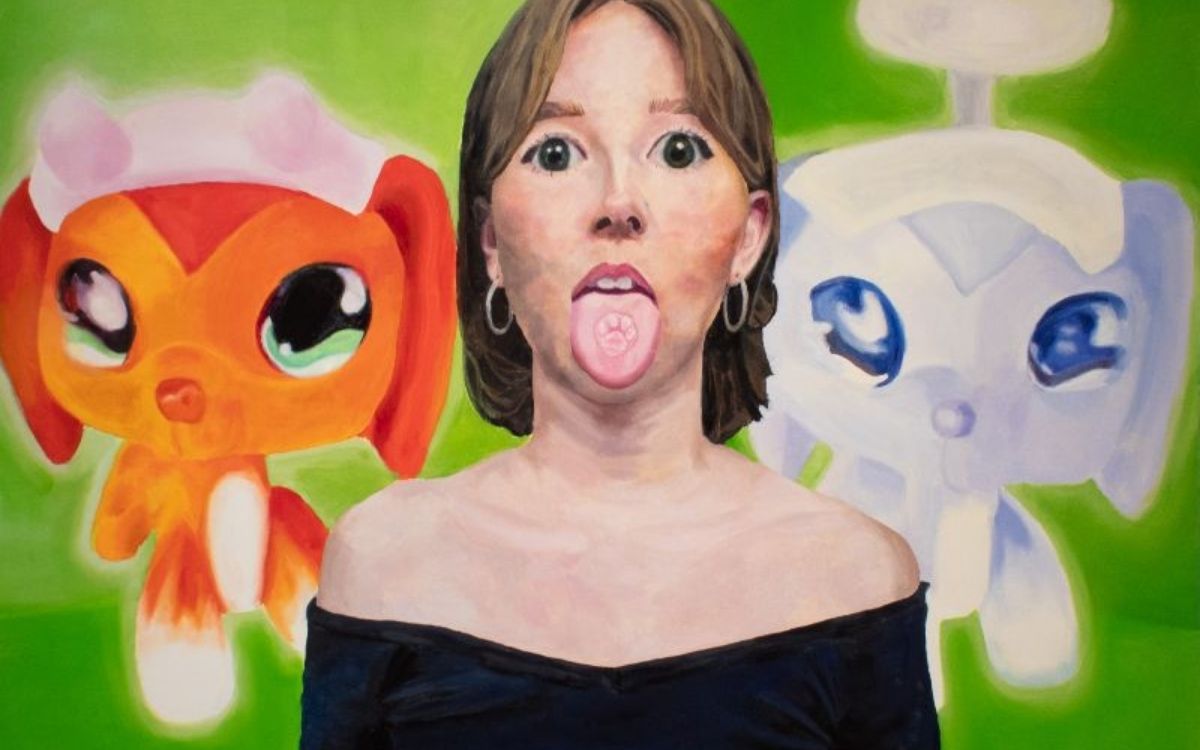
Olivia Watkins paints through the language of childhood to reach what childhood could not protect. Littlest Pet Shop figures, Animal Jam tigers, and the visual residue of early internet culture surface throughout the work, carrying both nostalgia and confrontation in equal measure. Beneath the play is a direct reckoning with the Troubled Teen Industry, drawing on two years spent inside an institution that claimed to help while causing lasting harm. Watkins paints these experiences not to soften them, but to give them a form that feels honest, even when that form is a five-foot toy or a half-remembered video game villain. What follows is a conversation about survival, identity, and the strange freedom of telling a serious story through play.
How has your upbringing or cultural heritage shaped the themes and techniques you explore in your art today?
Growing up, I was a serious LPS (Littlest Pet Shop) collector and aspiring YouTuber. It’s where I first started to experiment with creating. I would build sets for each video and write stories for each plotline. Because of this, I was always on my devices. I was involved in many supportive communities, but also, with unlimited access to the internet as a child, there are things out there that will harm you, too. Those spaces really shaped my creative direction, finding new ways to communicate my feelings through play.
Littlest Pet Shops left my work for a period of time, but I always found myself coming back to them, as I had basically built my life around them as a child. They were my chosen form or expression. I chose to sell my collection when I turned 18, thinking I was too old for these childish things, and I regret it to this day. I think that’s why they came back, they were my first true form of artistic expression, and I mourn the loss of my childhood that came along with selling them. These toys were witnesses to each stage of my life; they grew up with me and became a part of my identity.
When I was sixteen, I was sent to an abusive “treatment” center in the middle of the Utah desert. I was stuck there for a period of two years and endured abuse that I wasn’t fully aware of until after I left. These themes have always been evident in my work, but over the past year, I have been learning to embrace these parts of myself in order to not only raise awareness but to make work that feels true to who I am.
How does your art engage with or comment on pressing contemporary issues—social, political, or environmental?
My art has become a commentary on my own experiences within the Troubled Teen Industry. Through my current body of work, I talk about how online systems that are designed to protect children mask structures of control and institutional harm. My work engages with contemporary issues by exploring how emotional survival shapes personal identity. I examine the lasting psychological effects of institutionalization and the search for belonging.
The Troubled Teen Industry isn’t a widely known topic, especially in Canada, which only makes it more important to talk about. Children are ripped away from their lives and families and forced into physical labour and emotional abuse, all whilst being told it's their fault and that they have done something deserving of this treatment. You live in the middle of the desert, hiking for hours every day, and every interaction you have is recorded, and you are penalized for reacting.
These systems that claim to care profit from the abuse of children, leaving them with lasting trauma and wounds that may never heal. Making questionable choices and mistakes is part of growing up; sending children to these places robs them of their identity.
How has your artistic style transformed over the years? Are there specific influences, experiments, or moments that marked a turning point?
Starting off with painting, especially within the institution, can feel very daunting. There was always this unspoken expectation to already be perfect at what you do, or appeal to the professor’s interests in order to get a good grade. I tried for a long time to fit into the institutional box of what my professors expected from me. It’s hard as an artist in school to feel like part of your art’s worth is determined by a grade given by one person. It took me a while to realize the worth of my art and what I could achieve.
I painted my first Littlest Pet Shop in December of 2025. Painting it felt like such a joy; it was hilarious to me, painting myself morphing into a five-foot toy, and it became such a freeing experience. While painting, I wasn’t worried about what people thought or what grade I was going to get; it was just me in a pure state of flow. That painting changed the way that I thought about my art. I realized I could talk about such serious and traumatic experiences through play, just like when I was a child.
Can art be truly therapeutic? Have you experienced its healing power personally, or seen it impact others?
Art is an inherently therapeutic experience. When I paint, I lose myself in the work and become one with my body, especially with the physicality of working large scale. Of course, my art is coming from a place of personal experience and will always be deeply intertwined with my own life, but that doesn’t mean that others can't or won't reflect on their own as a result of interacting with it.
I’ve had the pleasure of connecting with others who have shared similar experiences with me through social media. I knew that art was a way to communicate, but I didn’t realize the extent of the connection it could achieve. Being a part of the Troubled Teen Industry can be such an isolating experience, trauma itself can be such an isolating experience, and getting the opportunity to meet and connect with these people has changed how I even view my own work. I believe that every work that is made is a self-portrait of the artist. We get the opportunity to try and understand how they see the world and themselves, and I think it is such a beautiful thing to get the opportunity to try and understand.
Describe a piece you’ve created that has held the most emotional weight for you. What makes it significant?
My piece Ignores Minor Inappropriate Behaviours will always carry the most emotional weight for me. It is an amalgamation of childhood and trauma; every time I look at it, I am reminded of why I made it in the first place. The image itself is based on a photo of me taken during my time at Second Nature wilderness therapy. During this time, they taught us how to make fires by busting, essentially using a bow, sticks, and stones to create fire. I was always terrible at this; I didn’t have much arm strength and could never get it right. There wasn’t much I could do there, but I thought maybe if I could just make a fire, and get it right, they would see that I’m trying, and I could go home.
This was the first fire that I made; it was a symbol of hope for me. All the physical and emotional effort I had put into learning this had paid off just for a moment. In this work, it is a symbol of hope and also a sign of distress, that maybe through the smoke, there is a clearer path for me. The tigers in this work are pulled from a game called Animal Jam that I was obsessed with when I was younger, and hidden is Fman122. (the wolf) These characters were players who overwhelm your screen, hack your account and take all of your items. As a child, these games become such a part of your life that it feels as if everything is being torn away from you, and you can’t do a single thing about it. In a way, they take a part of your innocence when they hack you.
This mirrors so much of the Troubled Teen Industry. When I was sent there, two random men were hired to handcuff me and kidnap me out of a hotel room. I had no idea where I was going or how I was going to get back. I didn't know if I would ever see my family or friends again. I will always carry the emotional weight of this experience with me throughout my life, but looking at both a physical and conceptual depiction of it always brings some of these feelings to the surface.
Has there ever been a time when the creative process felt more like a burden than a joy? How did you navigate that?
When I first started experimenting with making work about the Troubled Teen Industry, I based it fully on my emotions, but I was guided to do more research on the technicalities of why this has been continuously allowed to happen for a profit. I scoured through articles online about how these systems are designed to take your rights and trap you, how they lie to your parents about what's going on to keep getting more money. I felt so sick every day looking through countless children’s experiences in these places.
I also took the time to look through my own archives. I read letters I wrote to family, and the photos I had taken of myself. I looked through the clothes I wore when I was there and the notes that my friends had written me when I left. Working with such personally complex themes can be such a daunting experience, and gathering the materials needed to back up your work for proposals and presentations can be so mentally draining. It is always worth it in the end to put those parts of yourself out there; getting there can be taxing, but I truly believe that it is always worth it.
How do you envision the evolution of your work in the coming years?
I want to become bolder in my work and create more of a visceral reaction within the viewer. I am currently planning on using more of the subject in my work and exploring the uncanny further. I love to create work that makes the viewer uncomfortable. I pull them in with pop culture and nostalgia, yet push back with confrontation and unease. I want to evolve my work into its own visual code that takes time to understand and makes the viewer question what it really could be about. I have this unexplained need to keep creating, and doing it in a way that is unapologetically me. I also am interested in what's beyond the canvas, or what the canvas can be. Painting will always be my first love, but if I can create using unfamiliar materials to continue to push my ideas further, I am interested in what that can be.
What stays with you most after this conversation with Olivia Watkins is the courage required to turn personal trauma into something that can be looked at, shared, and ultimately understood by others who have lived through something similar. The work resists easy categorization, holding pop culture nostalgia and genuine distress in the same frame, asking viewers to sit with discomfort rather than look away from it. Watkins treats every painting as a kind of self-portrait, an attempt to make sense of identity after institutions tried to strip it away. What comes next, bolder, more visceral, less concerned with comfort, feels like a natural continuation of an artist determined to tell the truth, however unsettling that truth might be.