
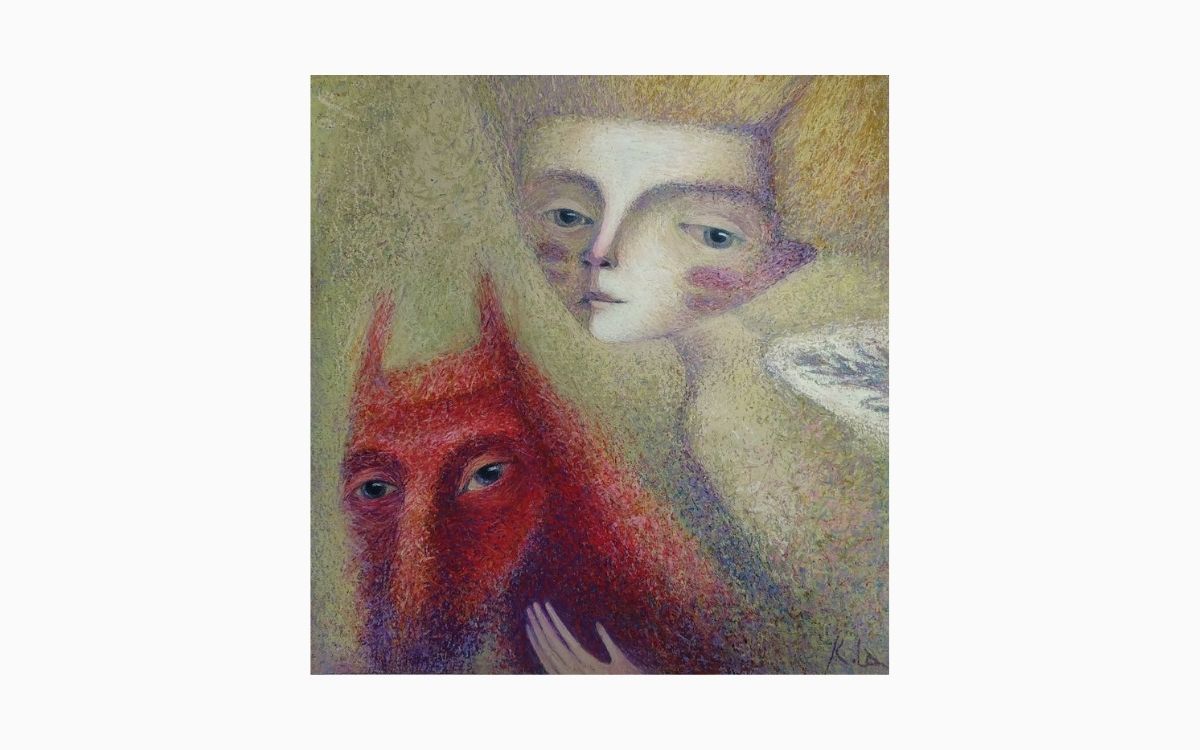
Kasia Lazarevich paints with a quiet, attentive wonder, treating everyday life as a film worth watching closely. Angels and mystical animals move through the work, gentle conduits for something Lazarevich describes as just beyond the edge of human understanding, a transcendent presence felt rather than explained. Painting honestly, without compromise, even when the imperfection would go unnoticed by anyone else, Lazarevich trusts intuition above intellect, seeking not a fixed message but a mood, an atmosphere, a tenderness that lingers. What follows is a conversation about stagnation, spirituality, and the discipline required to wait for a painting's true sound.
Art is often chosen as a medium for its freedom. Why do you personally turn to art, rather than another form of expression?
Art gives me the ability to perceive reality more broadly and more vividly. When I immerse myself in the creative process, I experience everyday routine as an interesting film. New reasons for wonder and joy appear — I'm never bored.
Even when I'm not painting, I'm still painting in my head. Or I'm in a state of reflection about an idea, searching for a visual language, or a subtle emotion. This gives me energy, joy, and even a sense of being part of something larger than myself.
A special happiness comes when I see the "sound" of a finished work. You see a world you've created that didn't exist before — with its own resonance that another person can perceive. And when that happens, the distance between "I" and "you" disappears.
Does spirituality or a connection to something larger than yourself influence your creative process?
I believe there is something beyond the limits of human understanding — something on the other side of our existence. A kind of looking-glass world, a transcendent ocean, a space. We don't know for certain what it is, but each of us carries an innate memory of it, a longing for it. An artist has the ability to be a small conduit from that space into reality.
And this belief shines through in my work. Despite the seemingly simple subjects, one of my most important goals is to depict the presence of that reality through simplicity and apparent naivety.
I create a space for the viewer where they, too, can intuitively and emotionally feel the breath of this "third guest" — through gestures, the expressions on faces, the tilt of a head, the warmth of textures, and the softness of lines. My characters — angels and mystical animals — help me with this.
How do you reignite creativity during those inevitable periods of self-doubt or stagnation?
Creative stagnation and self-doubt — strange as it may sound, I think they're actually a good thing. Admittedly, being in that state is uncomfortable. But wherever there is discomfort, there is potential for growth and a breakthrough. I try to see this period as an opportunity for transformation, rebirth, and evolution.Doubt always involves a critical look at yourself and what you do. It's a time to ask yourself questions and receive invaluable answers. But to think this way, you need to make a conscious decision.
Moreover, the very experience of this state of decline can later become fuel, a rich theme, and material for a new creative idea — however paradoxical that may sound.That's why I don't push this state away. I simply stay in it, live through it, and observe it with curiosity. I ask myself: what's going on inside me? How do I see it? What images does it evoke? And little by little, the creative gears start turning again, and constructive energy flows back to me.
Do you believe an artist's passion is something destined or a conscious choice?
I believe that passion is an innate quality — a part of the soul that is either present or not. But a person may simply not be aware of it. And if this ability remains unfulfilled in life, it's truly sad.I think many depressions stem precisely from this: there is a need for self-expression, but no understanding of what to do with it.That's why it's so important to stay curious and open to the new — that way, there's a better chance of "unearthing" this passion within yourself. It might even be connected to the choice of unexpected materials, for example ceramics or textiles. And once you realise this, everything falls into place.
How important is it for viewers to understand the intended message of your work? Does ambiguity add value, or do you seek clarity in your expression?
It doesn't matter to me whether the viewer interprets the images and symbols in my paintings exactly as I intended — as if this plum must mean this or that. A painting is not a riddle. If a viewer finds their own additional meanings in my work, I think that's wonderful, because art is boundless.
What matters more to me is that the person catches the mood, the atmosphere, the subtle emotion I've been meticulously working on, and becomes, for a while, part of the painting's space. That the viewer perceives it with their heart, not with their intellect.
The greatest value for me is when my painting becomes a reflection of some tender memory, a very personal experience. That's why I'm very careful, when creating a piece, to stay true to my intention — to convey specific states. It's important to me that the expressions, gestures, and composition all serve this purpose. And here, I trust my intuition completely. I genuinely rejoice when it works and resonates with the viewer.
What unusual or unexpected sources of inspiration have deeply influenced your work?
Oh, these are two very different things. One is the transformation from a doer into an observer — being a witness to what happens around you. And the simplest things transform inside you into plots and concepts, ideas and images.
I think it's important for an artist to be an artist even outside the canvas and pencil. Standing in line at a store, I hear what the customer in front of me is saying. He asks for pickles and garlic — and the way he says it, his intonation, his words — and suddenly a story starts spinning in my head. A character appears, and then more and more.It's like watching a movie in everyday life, in the routine. This quality is probably connected to the ability to be surprised. It's a quality children have. "Be like children" — I think this advice applies to our conversation as well.
I often go for walks alone (I've noticed that ideas come to me when I'm walking). And there are two ways.
The first — attention outward. I become a director, seeing cinematic plots in the reality around me. I record some things on my phone, sketch others. And these moments later crystallise into ideas for paintings.
The second way — to walk with attention inward, to be a witness to what's happening inside: to reflect on what I'm feeling, maybe to write poetry — that helps me too.
And personal memories from childhood — that's an endless source.
Has there ever been a time when the creative process felt more like a burden than joy? How did you navigate that?
I have a creative principle — "paint honestly," without compromise. This means: if some moment in a painting, by my subjective feeling, "doesn't ring true," I don't finish the work. Even if it's nuances that no one else would notice. There are two sides to this approach, and sometimes I have to fight for that "sound."
In those moments, I'm supported by the experienced understanding that there is exactly the right note — I just haven't found it yet. And when I do — harmony will happen, and with it, that long-awaited joy and lightness. This knowledge encourages me and even fuels my excitement. What's more, these moments sharpen my intuition — even beyond painting. It's a positive side effect I've noticed.
And there was one amazing case where the "sound" came together as soon as I gave the work its exact title. And in that same moment, everything started to work. Incredible!
Sometimes I get this feeling that I'm just an instrument, creating what asks to be revealed.
What are five things you do to overcome creative blocks or feelings of discouragement?
I flip through my sketchbooks.
I have a lot of accumulated material, and looking through my sketches can spark inspiration.
I read artists' memoirs (in the broadest sense) or watch interviews with creative people.
The experience of others — especially those I consider geniuses — really helps bring fresh air into my own work and break through blocks.
I observe myself.
I try to consciously live through this period, treating it as a resource and an experience.
I go for a walk alone.
I've noticed that good ideas come to me when I'm walking.
I give myself time.
And the main thing here is not to scold myself for the pause — because it can be very resourceful in terms of rethinking my work.
What stays with you after this conversation with Kasia Lazarevich is a gentle insistence on sincerity, the refusal to finish a piece until it rings true, even at the cost of time and certainty. Inspiration arrives here through small, overheard moments, solitary walks, and a lifelong curiosity that resembles, by Lazarevich's own account, the wonder children carry naturally. The paintings do not ask to be decoded. They ask only to be felt, to offer a viewer a few quiet minutes inside a space built from memory, intuition, and faith in something larger than the canvas itself.