
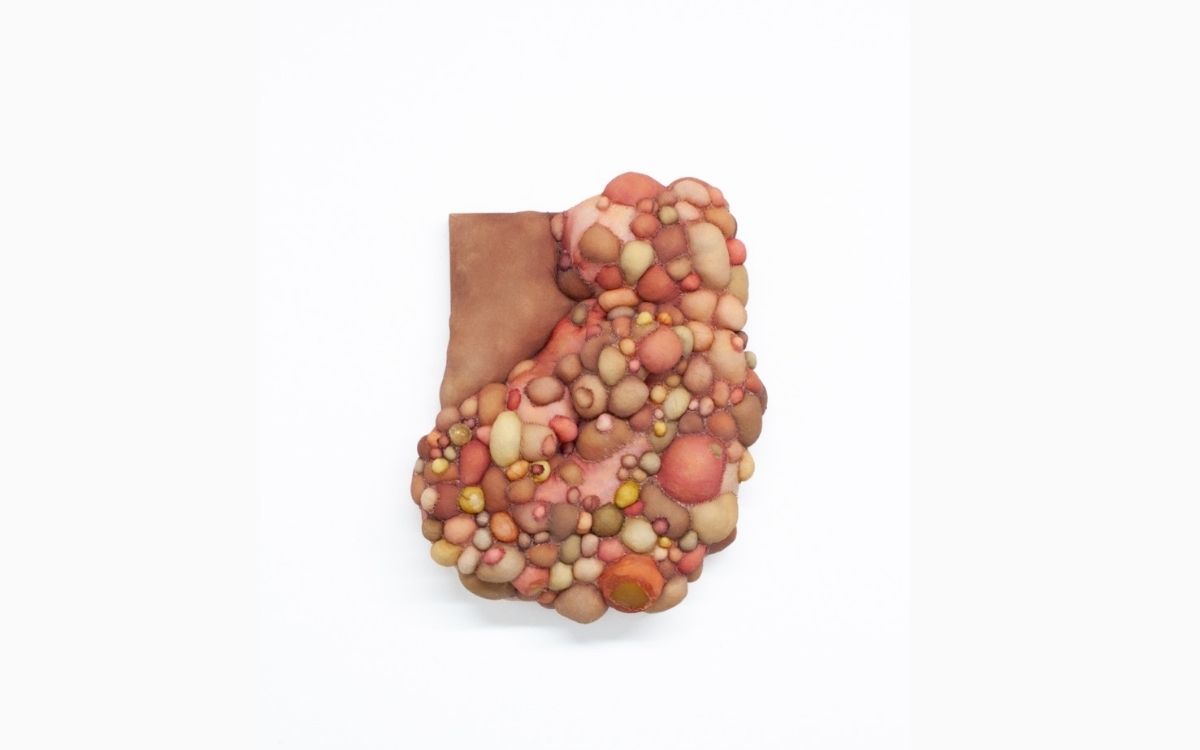
Isabella Covert makes sculptural work out of excess, residue, and care. Working with latex, suture, and the discarded fragments of past pieces, Covert builds organisms that mend, break, and regenerate, treating material less as medium and more as something to be mothered. The practice resists planning, leaning instead into impulse and material limits, where delicacy and decay are held in constant tension. At its center is a sustained inquiry into care, kinship, and what bodily autonomy might look like outside the systems currently claiming it. What follows is a conversation about discomfort, biological speculation, and the strange comfort of work that feels tactilely, viscerally human.
Can you take us through the evolution of an artwork, from that first spark of inspiration to the finished piece?
My work is birthed over time from an amalgamation of experiments, failed attempts, and old organisms that I have made and discarded. Everything that can possibly be kept is either stored to form a new life later on, or is preserved in a brine, IV bag, or enclosed specimen container of some form to be displayed as its own proof of life. This includes everything from swept up materials from my studio floor, excised and sutured fragments of pieces, excess threads, and the latex I peel off of my hands at the end of every day. I don’t plan anything for my work. I work from an impulsive and mindless space, reacting to material restraints and flexibility. It is a balance of delicacy and decay. Both giving in to material and pushing it beyond its limits. I try not to interfere with them too much in their process of becoming, relegating myself to the role of the surrogate for material. I don’t always keep that promise implicitly. I’ll push them slightly, sometimes totally break them, mend them, and break them again, like a mother.
If you could communicate just one core message through your entire body of work, what would it be?
A thought that circles my brain when I’m working is the question of what care is and how we can mother each other. All of the questions that circulate the work find that same endpoint. That thought extends from structural, political, and institutional frameworks, but also thinking about care as a term generally encompassing wanting autonomy for each other. My work sutures, operates on, and cares for themselves and each other. Because my process reuses past organisms that I have made and deconstructed, you can see when a few of the works are “related” to each other, and sometimes very non-related works are connected or growing from one another. Complicating what we understand as kinship, they fuse into each other, connect by their innards, or gestate inside one another. This breaking down of dyadic family models shifts perspectives of reproductive labor and its assigned role. Imagining a landscape where autonomy doesn’t need to be seized in a cycle of loopholes within a flawed system, but alternatively builds bodily possibilities is a speculative future to look toward.
Do you feel a personal connection to your subject matter is essential? How has this connection shaped your work?
Everyone has a personal connection to their work in some way. For me, it exists within the layers of the labor and research. I obsess over inhaling information that feeds into the work, but simultaneously feeds me in some way. A lot of the time it is healing without entering that space with that intention. Within layers of bodily excess, systemic restructuring of care, and relational dynamics, I see and learn about myself. It feels easier to imagine a different modality of seeing, caring for, and mothering each other when you have experienced fractures and breaks in
congenital relationships and subsequent family-building and kinship in other people. I kind of stumbled across these ideas as my work evolved, and despite not being a level of necessary understanding in the work, it makes me feel a weird kinship with the work once they have matured. By that I mean I can relate to them. I find comfort in it, and in the work I make.
How important is it for viewers to understand the intended message of your work? Does ambiguity add value, or do you seek clarity in your expression?
Everyone approaches a piece with their own experience, but where I think we all meet is in the middle ground of discomfort. It’s one of the most human commonalities that we can find. We see ourselves in the abject, in part due to constructs of shame. This same discomfort can simultaneously point toward possibility. We are reminded of ourselves and our corporeality. My work is thick and viscous both physically and conceptually, steeped in research, but also clunky, nurtured, and hand sewn. Even without a full understanding of the layers of labor put into the work, the messiness of being feels tactilely familiar. I think that in different ways, everyone leaves somehow feeling challenged through that inherent discomfort.
What do you think is the most meaningful role an artist plays in society today?
I think that our role, whether aware of it or not, is to poke at and think critically about where we are and our speculative future. All art inherently points toward this dissection of who and what we are becoming. Through my work, I’m processing broadly spanning circumstances surrounding biological evolutions that tend to turn toward control and domination on the body, particularly laboring bodies. Technological and biological intersections emerge from inaccessibility, and depict further potentials, such as artificial wombs, as outlandish. These innovations contemporaneously could serve as sites of possibilities. They aren’t inherently neutral or built with benefits embedded in them, and they emerge from problematic existing infrastructures that perpetuate imbalances of access. The tools have the potential to be neutral, or even beneficial, but the system is not. It ties my thinking back to Shulamith Firestone’s quote “to envision it in the hands of the present power is to envision a nightmare”. These are sites where artists tread and leverage potentials before they are considered permissible. It has always been this way, artists envisioning perspective shifts and utopian restructurings. We aren’t pioneers or declaring anything new by any means, but we synthesize and slowly marinate our surroundings. We chose to do something slow and human while the profit-driven, fast-paced world functions like a machine, preoccupying us from challenging our experiences.
What unusual or unexpected sources of inspiration have deeply influenced your work?
I collect imagery of some natural occurrences and studies in biological fields of reproduction, both human and animal. Science is not my language at all, so most of the time these scans, collection samples, and cross section documentation of the body serve as an index even when I don’t understand their purpose. Other sources that I find inspiration from typically range from film, puppetry, and prosthetic work. Sub-genres of French feminist horror are something that I enjoy and often return to. They play in the same waters, showing emancipatory monstrosity in a narrative structure, and pointing toward the limitations of our lived reality. Even if I can’t find a version with subtitles, and I don’t know any French, there’s a raw human commonality in the monstrous acts and defiance. There’s an unrelenting and overflowing excess that feels optimistic and liberatory. I think that my work exists on a similar plane of familiarity to the body in a repulsive yet strangely comforting way.
How do you envision the evolution of your work in the coming years?
I see my work evolving into pulsating environments that pump liquids to each other through tubes, fuse with generators, drip, and overtake a medical landscape. I’m talking tubes entwined everywhere, melding into appendages. I see the preservations of the process encased in an egg-like membrane or sac, tumorously extending and sagging from its mother-work. I would love to do an installation of work in an old medical building converted into an installation space. Seeing my work overtake a run-down deteriorating space would turn the conversation toward a certain resiliency. I envision the nurtured and organic materials in a space entwined with screens with a playback of video work, which I have always wanted to have my kinetic work interact with.
What lingers after this conversation with Isabella Covert is the sense of a practice that refuses to separate tenderness from rupture. The work sutures itself together and pulls itself apart in equal measure, mirroring a larger inquiry into care as something built rather than inherited, something that might one day exist outside dyadic family structures and institutional control. Covert does not offer comfort without first asking viewers to sit in discomfort, in the abject, in the corporeal mess that makes us recognizable to one another. What remains is a vision of bodies, materials, and futures still becoming, gestating inside one another, resistant to easy resolution, and quietly, defiantly alive.