
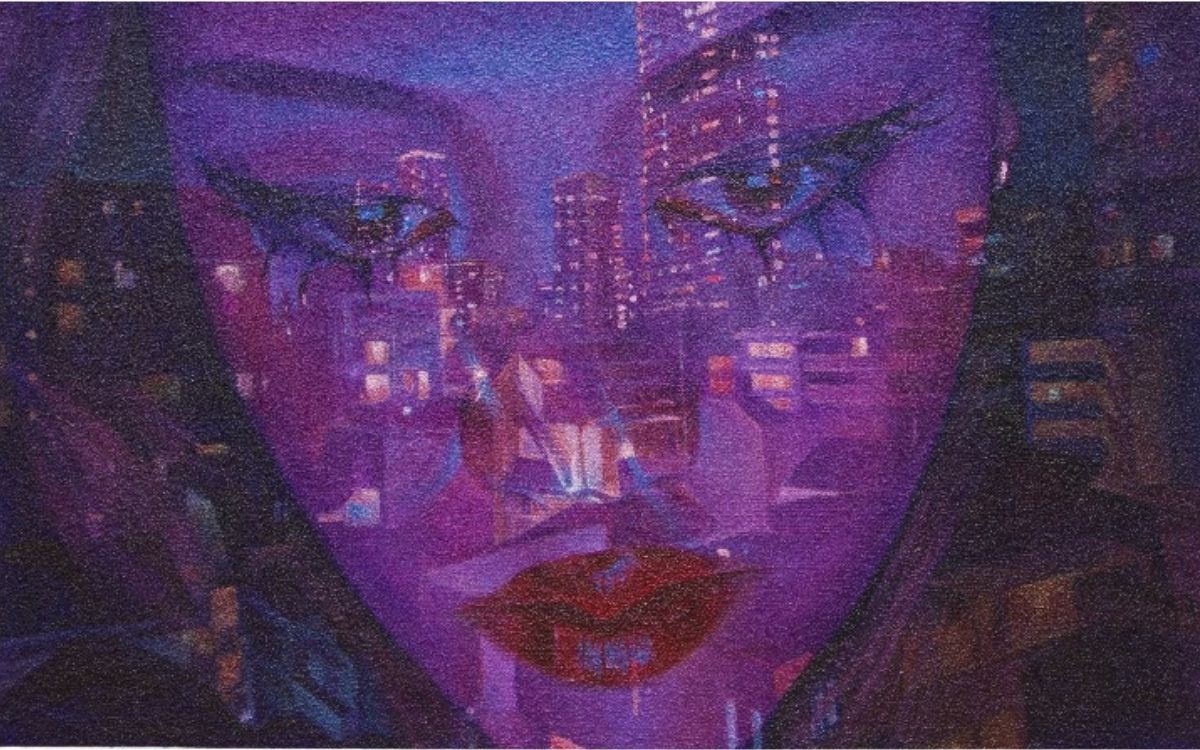
Nanary Sakamoto paints from inside a film that does not exist. Trained for over a decade in classical ballet before turning to canvas, Sakamoto carries the discipline's sense of balance, spatial and bodily alike, into a practice built around cinematic self-portraiture, acting as director, performer, and stager all at once. Every figure in the work is Sakamoto's own, a deliberate ethical choice rooted in a refusal to borrow another person's body for personal storytelling. Working with granular materials that echo the grain of film, the work blurs the line between performance and painting, memory and invention. What follows is a conversation about ballet, ethics, and the long way around that real growth sometimes requires.
How has your upbringing or cultural heritage shaped the themes and techniques you explore in your art today?
I am currently making work around the theme of self-portraiture through a cinematic perspective. In my paintings, I act as the director, actor, and stager all at once, creating scenes from a fictional film as if performing a one-person play.
I think the origin of this approach comes from my experience with classical ballet, which I practiced from the age of three until seventeen.
At that time, I was living an ordinary life in the countryside in Japan. What fascinated me was that the moment the music began, I could transform into a Spanish dancer, a fairy from the Land of Sweets, or a princess from a country I had never visited.
For a while, I could borrow a fictional life and imagine a version of myself who said different things, made different choices, became stronger, more beautiful, or no longer knew fear. I have always been fascinated by the gap between who we are in reality and who we imagine we could become.
My experience with ballet has also had a strong influence on the way I think about composition in my work.
At its core, ballet is about balance. Not only in the beauty of movement across a stage, but in everything: how a square space is used, and how symmetry and harmony are maintained. It extends all the way from the use of space on stage to the height of a dancer’s pelvis, the development of muscles, and the discipline of daily training.
Because this sense of balance on both a macro level (space) and a micro level (the body) has been ingrained in me since childhood, deciding the composition of a painting comes less from applying conventional theories of composition and more from a kind of muscle memory. For me, it feels closer to practicing the aesthetics of ballet than simply following the rules of painting.
Have you ever struggled with the ethics of your art such as who it represents or who it impacts?
Early in my practice, I struggled deeply with this question. At the time, I sometimes felt the need to reach for larger themes that were not really connected to my own life. Other times, I overthought things so much that my work became more abstract than I intended.
But through a lot of trial and error, I eventually arrived at a simple truth: I can only really make work about things I know deeply myself.
If I can speak for anyone, it can only be through things I have actually experienced, or through feelings that are genuinely real to me. Rather than making a leap toward some grand narrative or social cause, my work grows out of an extension of my everyday life. This way of thinking feels the most honest and natural to me now.
I’ve always felt a little uncomfortable with the idea of packing my work full of messages and presenting them to viewers as if I already have all the answers. It feels a bit one-sided, and somehow a little arrogant.
Instead, I want to make work that quietly enters into a dialogue with the viewer. If seeing one of my paintings can give rise to a new question or interpretation within someone and create a new room inside their mind that wasn’t there before, I think that would be wonderful.
Once a painting is hung on a gallery wall, I can no longer intervene in the relationship between the work and the person looking at it. Because of that, I am always thinking about the attitude that exists between a work that has been released into the world and the people who come to see it.
Do you think art should have a political or ideological agenda?
I think art is fundamentally free, and that an artwork does not necessarily have to contain a political message or a particular ideology. At the same time, I believe artists themselves should remain political and continue to develop their own ways of thinking.
I am surrounded by many different artists, and recently I have sensed a kind of fatigue within my community when it comes to incorporating political or ideological themes into artworks. But something I often think about is that this expectation—that artists should express political positions or communicate certain ideas through their work—is not a new phenomenon.
When we look back at history, art has always been intertwined with politics, religion, capital, and everyday life, whether it wanted to be or not.
Even when work does not carry a direct message, I do not think artists can stop thinking about the society they live in.
Art should be free. At the same time, when I think about the many freedoms that are threatened in the world we live in, I sometimes wonder whether continuing to make work that has no relationship to those questions at all might actually be more difficult for me.
That does not mean every artwork needs to make a statement. It is simply something I find myself thinking about from time to time.
How has your artistic style transformed over the years? Are there specific influences, experiments, or moments that marked a turning point?
Until around my third year of university, I actually didn’t like the texture of canvas, the rectangular shape of the support, or even the feel of oil paint. At the time, I worked mainly with charcoal on paper.
Yet, I have always loved colors. I kept wondering how I could reconnect with canvas and paint in a way that felt natural to me.
Around that time, some friends and I organized a group exhibition at a gallery called “Moto Eigakan”—which literally means "Former Movie Theater." The space had originally been an old cinema before being renovated into a gallery.
Having loved films since childhood, I felt a deep, personal connection to the venue. Inspired by the space itself, I decided to create work that reimagined my own life as a film.
Through that project, I could see this series continuing to grow in the future. For the first time, I felt I had found something I truly wanted to paint.
My next thought was simple: if this was what I wanted to paint, I wanted to try bringing it to canvas and welcoming color back into my work. When working with charcoal, I had always loved how tiny particles gathered to form a single image. I wanted to bring that same sensation into painting.
So, I began experimenting with granular materials in the ground of my canvases, wanting those particles to evoke the grain and raw texture of film. Through these experiments, I gradually arrived at the style I work with today.
Do you feel a personal connection to your subject matter is essential? How has this connection shaped your work?
Yes, absolutely. I believe I can only make work about things I truly know—things that exist as an extension of my own life.
There are always people in my paintings, and in most cases, I serve as the model myself. People often assume that they are self-portraits, but I do not paint myself because I particularly like myself. In fact, I have many insecurities about my appearance, and like many women, there are many parts of my body that I am unhappy with.
Even so, I continue to use myself as a model because I feel a strong discomfort with “borrowing” someone else’s body as a tool for my own stories. When I paint another person, I sometimes feel as though I am using their appearance for my own purposes. My own sense of ethics resists that.
My work is often shaped by things I am personally thinking about, as well as social issues that I find myself deeply concerned with. Because of that, I do not feel comfortable bringing someone else’s body into those questions. I feel that any ideas, opinions, or concerns I want to express should remain my own responsibility.
In a way, I sometimes feel that if a body has to be sacrificed to the work, it should be mine. That is why I choose to perform and paint every figure in my work myself.
How do you challenge yourself to continually grow as an artist while remaining true to your voice?
To grow while staying true to my own voice, the two things I value most are getting out of the studio and staying open to new experiences. It is comfortable to stay inside your own world, but I realized that doing so can also mean missing opportunities to grow. I’m actually quite introverted and naturally more of an indoor person, so this is also a conscious challenge for me.
Living in a huge city like Tokyo, I can get on a train and easily access countless museums and galleries. It can also feel as though any information or object I want is always within reach. Because of that, it’s easy to fall into a kind of luxurious numbness, where meeting people or going somewhere new keeps getting pushed aside. I felt that I needed to break out of that habit.
So in April this year, I finally traveled to India, a place I had dreamed of visiting for a long time. The trip became a major turning point for me. It reminded me of what I truly love and the kinds of feelings and experiences I want to hold on to.
We live in a time when information is everywhere. Because of that, I was reminded that sometimes, if you really want something important, you have to take the long way around. You have to go there yourself and find it with your own hands.
I also try not to quickly label things—whether it’s social trends, other artists’ work, or anything new that appears around me. Instead, I try to look at things with my own eyes before deciding what I think.
Strangely enough, when I consciously pay attention to what is outside of me, there are moments when my own outline becomes clearer. Looking at myself from both the inside and the outside, and constantly checking where I stand before returning to the canvas, helps me understand more clearly what I want to paint. I believe that allows me to focus on what is essential in my work.
Are there any upcoming projects or dreams that you're particularly excited about?
Starting this September, I will be studying in France as an exchange student. The program lasts for one semester, about six months, but I hope not only to stay in France but also to travel to other European countries while I am there.
I am a theater kid, so I am incredibly excited to experience musicals, opera, and classical ballet in the places where these traditions have such a long history.At the same time, I am just as excited to finally see many of the historical artworks that I have spent years looking at through books and phone screens with my own eyes.
This will be my first time living abroad for such a long period of time. By leaving the place I know so well, I hope to receive countless new inspirations and gain many new perspectives and experiences. I strongly hope that this will bring a new wind into my work.
While I am in Europe, I am genuinely looking forward to meeting many people. If anyone has recommendations for interesting events or exhibitions, please feel free to invite me. Right now, I feel full of the desire to see and experience everything I possibly can.
After this exchange program, I will return to Japan to begin working on my graduate thesis exhibition.
It will be an important milestone in my life as an artist, and one of the first opportunities I have had in a while to create work on a larger scale and fully engage with an exhibition space.
I still have no idea what the exhibition will look like yet. But I am certain that, after living and studying in Europe, the work I make will have a different depth than it does now. More than anything, I am excited to see how I myself will change and grow through the experience.
What comes through clearly in this conversation with Nanary Sakamoto is a deep trust in personal experience as the only honest material for art. The work resists grand statements and borrowed narratives, choosing instead to stay close to what can actually be known and felt firsthand. That same instinct shapes everything from the choice to use only the artist's own body as model to the decision to travel to India, and soon to France, in search of inspiration that cannot be found from inside a familiar room. Sakamoto's practice remains open and still forming, shaped by ballet's old discipline and a growing curiosity about the wider world. What lies ahead, a graduate thesis exhibition built on this season of change, promises to carry that evolution forward in ways not yet fully known, even to the artist.