
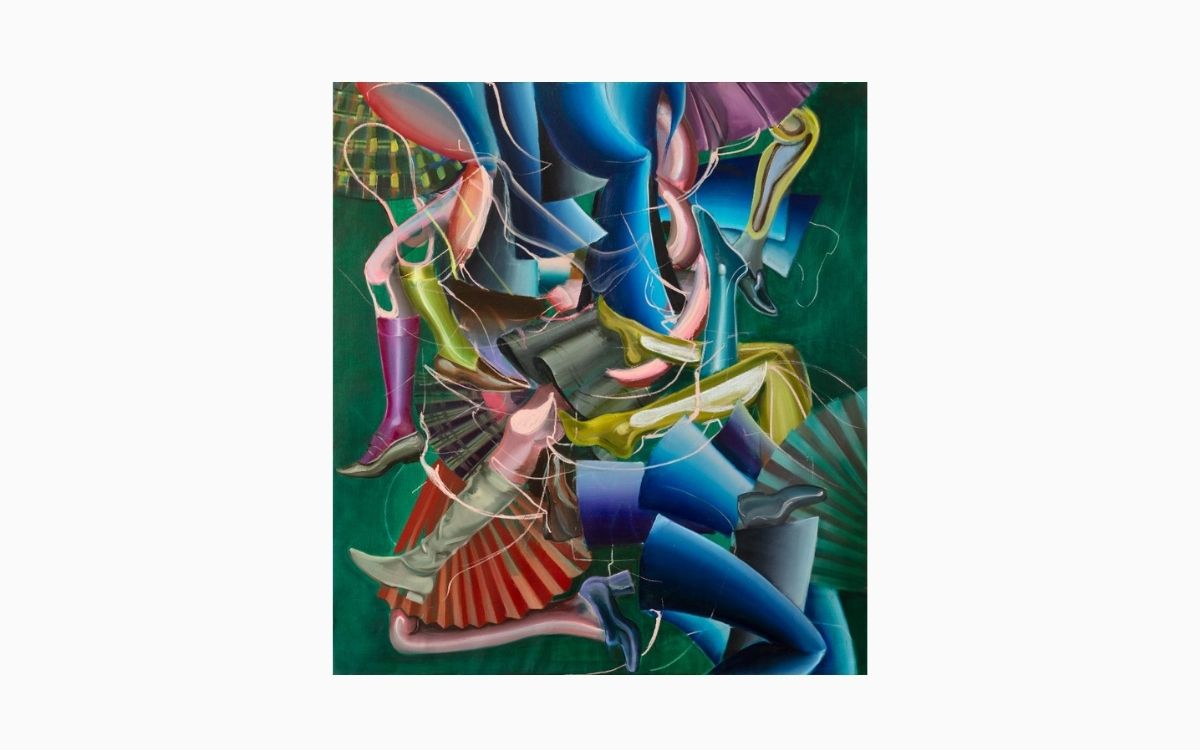
Justine Otto paints the tension between individual and group. Born in Poland and raised in Germany, Otto carries an early experience of migration into a practice centered on belonging, conformity, and collective identity, often staged through crowds, figures, and bodies that hover between recognition and dissolution. Working through layers of oil paint, masking, and erasure, Otto builds and unbuilds form in equal measure, treating each painting as a field of resistance rather than a fixed statement. What follows is a conversation about groups, ambiguity, and the ongoing question of what painting can do that no other medium can.
How has your upbringing or cultural heritage shaped the themes and techniques you explore in your art today?
I was born in Poland and came to Germany with my family as a child. This experience of migration shaped me deeply, although I only understood its full impact much later. As a child, you do not necessarily have the language to describe what it means to arrive somewhere new, to learn another language, to adapt to different social codes, or to feel both inside and outside at the same time. But the feeling remains.
This experience of belonging and not belonging has strongly influenced the themes I explore in my work. I am interested in groups, in the way people form communities, hierarchies, rituals, and collective identities. What happens to the individual inside a group? When does a group offer protection, and when does it become a form of pressure or control?
In my paintings, figures often appear fragmented, multiplied, layered, or partly dissolved. They move between figuration and abstraction, between recognition and disappearance. My techniques are connected to this as well. I build surfaces through layers, masking, scraping, wiping away, and repainting. Forms emerge and disappear again. A face, a limb, or a gesture may become part of a larger rhythm.
These experiences continue to influence my work, not as direct autobiography, but as a sensitivity to social structures: to how people belong, adapt, resist, or disappear within groups.
How does your art engage with or comment on pressing contemporary issues, social, political, or environmental?
My work does not comment on contemporary issues in a direct, illustrative, or journalistic way. I am not interested in making paintings that function like posters or statements with one fixed message. But I do think painting can absorb the atmosphere of a time. It can register tensions, fears, desires, and social structures in a slower and more ambiguous way.
In recent years, I have become increasingly interested in groups, crowds, and collective formations. In my Crowds series, I work with images of people gathered together: festivals, performances, political situations, or other social constellations. What interests me is the fragile relationship between the individual and the group. How much individuality remains visible when people become part of a collective body? At what point does belonging turn into conformity?
For me, these questions feel very contemporary. Much of our current political and social landscape seems shaped by group dynamics: polarization, collective identities, echo chambers, ideological camps, and the desire to belong to something larger than oneself.
At the same time, I do not reduce these themes to one political direction or one specific event. I am interested in more fundamental structures: inclusion and exclusion, power and vulnerability, rhythm and chaos. A crowd can be ecstatic, threatening, beautiful, absurd, tender, or violent.
Painting allows me to hold these contradictions open. The subject gives the work an inner pressure, a reason to begin. But in the studio, the painting has to become more than a theme. It becomes a field of color, surface, composition, resistance, and surprise.
How important is it for viewers to understand the intended message of your work? Does ambiguity add value, or do you seek clarity in your expression?
I have always had some difficulty with the idea of an “intended message” in art. For me, a painting is not a slogan, not an advertisement, and not a vehicle for delivering a clear instruction to the viewer. I am not interested in making work that tells people what to think. A good painting should first of all exist as a painting. It has to hold its own through its surface, composition, rhythm, contradictions, and physical presence.
Of course, my works often begin with subjects that move me: groups, crowds, power structures, historical images, music, bodies, or social constellations. These subjects create a kind of inner pressure and give the painting a direction. But once the work enters the studio, it becomes less controllable. The painting starts to have its own logic.
I am more interested in a form of communication that works beneath the surface. The work can affect the viewer quietly, through atmosphere, tension, color, fragmentation, or a certain instability of form. It might trigger a thought, a memory, discomfort, beauty, unease, humor, or even happiness. But this cannot be forced. It either happens, or it does not.
Ambiguity is essential for me because it leaves space for the viewer. I care deeply about the inner precision of a painting, but precision does not necessarily mean explanation. Painting is not a riddle with one correct answer. It is more like a living field of relationships between image and material, artist and viewer, the visible and the unresolved.
Can you take us through the evolution of an artwork, from that first spark of inspiration to the finished piece?
An artwork never really comes from nowhere for me. I usually begin with something already connected to a larger field of questions. My works often grow out of series, and these series are linked by recurring threads. There are branches and detours, but also a main line of investigation that continues through different bodies of work.
I am interested in constellations: groups, bodies, figures, social structures, and the relationship between the individual and a larger formation. This can appear through crowds, musicians, historical images, athletes, or more abstract configurations. The subject may change, but the underlying questions often remain connected.
For example, a tennis image is not primarily about sport or movement for me. It becomes a way to think about the multiplicity of a single figure: the body as something layered, repeated, split, or doubled. What interests me is not the athletic action itself, but the idea of the multiple within the individual.
Usually the process begins with looking. I collect images from archives, newspapers, books, film stills, the internet, or my own photographs. I am drawn to images that contain a certain tension, even if I cannot immediately explain why. Often, drawings or collages emerge from this material. They are not fixed plans, but attempts to understand the image through my own hand.
Once the painting begins, the image has to become independent. The work develops through layers, interruptions, and revisions: oil paint, oil stick, masking, scraping, wiping, repainting. A finished work is never just the execution of an original concept. It is shaped through time, through the hand, through corrections, doubts, and decisions. For me, this is one of the essential qualities of painting.
How has your artistic style transformed over the years? Are there specific influences, experiments, or moments that marked a turning point?
I come from figuration. During my studies and in the years that followed, the human figure and narrative situations were very central to my work. I was interested in people, gestures, social roles, historical images, and the stories that seemed to unfold around them. The figure was a way for me to enter painting.
Over time, however, my work has become increasingly open and more abstract. The narrative element has not disappeared, but it has moved further into the background. I became more interested in the image as an image, in painting as a specific language with its own possibilities. I began to ask myself: What can painting do that other media cannot?
This question changed my approach. I started to focus more strongly on the material and formal possibilities of painting: color, surface, composition, rhythm, layering, erasure, fragmentation, and the tension between control and accident. I became interested in the moment when a form still refers to a body, a face, or a gesture, but also begins to stand for itself.
I would not describe this transformation as a rejection of narrative or figuration. It is more a shifting of emphasis. The themes that have always interested me, such as the human being, social structures, groups, roles, and power relations, are still present. But they are no longer carried only by recognizable motifs.
Perhaps the most important transformation is that painting itself has become increasingly central. The themes and figures are still important, but I am now more interested in how they can be carried by painterly means: through color, surface, composition, layering, fragmentation, and the tension between recognition and dissolution.
Has social media democratized art or diluted its value? How do you feel platforms like Instagram influence modern creativity?
I think social media has done both. On the one hand, platforms like Instagram have democratized visibility. Artists no longer have to wait for a gallery, institution, or critic to show their work. They can present their practice directly, build a network, and create a public archive of their development. This can be very valuable.
At the same time, visibility is not the same as quality. The fact that something is seen, liked, or shared frequently does not automatically mean that it is artistically relevant. This is not only true in art. In everyday life, many things are consumed and celebrated not because they are particularly good, but because they are immediately accessible, decorative, or easy to understand. Social media often intensifies these mechanisms.
On Instagram, it can sometimes seem as if the moment of presentation has become more important than the work itself. A canvas is turned around for the camera, a studio moment is staged, a creative gesture becomes content. This can be charming and sometimes informative, but it can also flatten the perception of art. Not everything that works immediately also holds up over time.
I do not believe that an artist necessarily has to study at an art academy in order to make good work. There have always been strong self-taught artists. But I do believe that art requires time, talent, seriousness, and a deeper engagement with questions of form, material, history, and meaning.
Social media is a useful tool, but a very unreliable measure of artistic value. It can open doors and create visibility, but it can also lead to popularity being mistaken for quality. The challenge is to use these platforms without shaping the work according to their logic.
Artificial Intelligence is increasingly infiltrating creative fields. Do you see artificial intelligence as a threat, a tool, or a collaborator in the art world?
At the moment, I see artificial intelligence primarily as a tool, and in some situations as a very helpful one. I use it especially in relation to language: to structure thoughts, translate, refine formulations, or find a clearer way of expressing something that already exists in my mind. English is not my first language, so in this sense AI can be a real support. It does not replace my thinking, but it helps me shape it more precisely.
For me, the interesting part is the dialogue. I do not experience it as a machine simply producing answers for me. Rather, I speak, formulate, correct, reject, continue, and respond. The content still comes from my own experience, my work, my memories, my doubts, and my artistic questions. AI can help organize or sharpen this material, but it cannot create the inner necessity behind it.
I have also experimented with AI in more creative processes, and I find this fascinating. It can generate surprising combinations or bring together references very quickly. That can be productive. But I also notice its limits. It is often very good at producing something plausible, elegant, or efficient. Yet art is not only about plausible solutions. Art often begins where something does not quite fit, where there is a fracture, a resistance, or a strange connection.
AI works from a vast collective archive of existing images, texts, patterns, and formulations. It can recombine this material in impressive and sometimes surprising ways. But I still see an important difference between recombination and artistic necessity. An artist does not only arrange what already exists. Sometimes the work begins exactly where something has not yet been connected, where a very personal, strange, or risky combination appears.
AI can suggest possibilities, but it does not have its own lived experience, body, doubt, or need to make a work. The deeper decision of why something must exist in this particular form still belongs to the artist.
What are your long-term aspirations as an artist, both personally and professionally?
My long-term aspiration is to keep expanding the language of my work without losing its inner continuity. I do not think of artistic development as a straight line, but more as a system of branches, returns, and transformations. Certain questions stay with me over many years: the relation between the individual and the group, the body as part of a larger structure, the tension between figuration and abstraction, and the way images can shift between narrative, memory, and painterly presence.
Painting remains the center of my practice, but I have always been interested in what happens when painting enters into dialogue with other media. I also make sculptures, and in recent years I have become more and more drawn to the idea of extending the work into space. I would like to integrate the room more strongly, not only as a neutral place in which paintings are hung, but as an active part of the work.
This interest probably also has to do with my earlier experience in stage and set design. I often think about exhibitions not only as a sequence of individual works, but as spatial situations. How does one work affect another? How does a viewer move through a room? What happens when painting, sculpture, and installation begin to form a larger constellation?
Another direction I would like to pursue further is lithography. I learned this technique during the pandemic, and it opened up a different way of thinking about image-making. Lithography has a beautiful tension between drawing, surface, process, and reproduction. I am interested in how my painterly language can be translated into print.
Have you considered teaching your artistic skills to others? What excites or challenges you about that?
Teaching has already been an important part of my practice for quite some time. I have given workshops for many years, and I experience this exchange as something very enriching. I enjoy working with students, looking at their works, discussing their decisions, and trying to understand together what a painting or an image needs.
For me, teaching is not only about passing on technical knowledge. Of course, technique is important: composition, color, material, surface, the relationship between drawing and painting, or the question of when a work is finished. But what interests me most is the moment of looking closely. A good critique or studio conversation can open up a work. It can reveal where something is already strong, where it is still unclear, and where an artist might be avoiding a decision.
I find image discussions especially valuable. They are helpful for the students, but they are also important for me. When I speak about someone else’s work, I often become more aware of my own questions, doubts, and convictions. The act of formulating what I see sharpens my own position.
I also enjoy creating connections. Sometimes, when I look at a student’s work, I think of another artist, a historical reference, a film, a piece of music, or a certain artistic attitude that might help them see their own work from a different angle.
The challenge is to support students without imposing my own taste or artistic language on them. I try to help them recognize what is specific in their own work, rather than pushing them toward a predefined idea of what art should be. In the future, I would like to continue teaching and expand this part of my practice.
Justine Otto returns again and again, throughout this conversation, to the fragile space between the individual and the collective: how protection becomes pressure, how belonging becomes conformity, how a crowd can hold ecstasy and threat at once. The paintings refuse to resolve these tensions into a single message, choosing instead to let ambiguity do its quiet work beneath the surface. What stays consistent across decades of evolving practice, from early figuration to a more abstract, materially driven language, is a deep curiosity about structure: social, formal, and spatial. Otto is still asking the same questions that have always mattered, only now through an increasingly expansive vocabulary of color, surface, and form.