
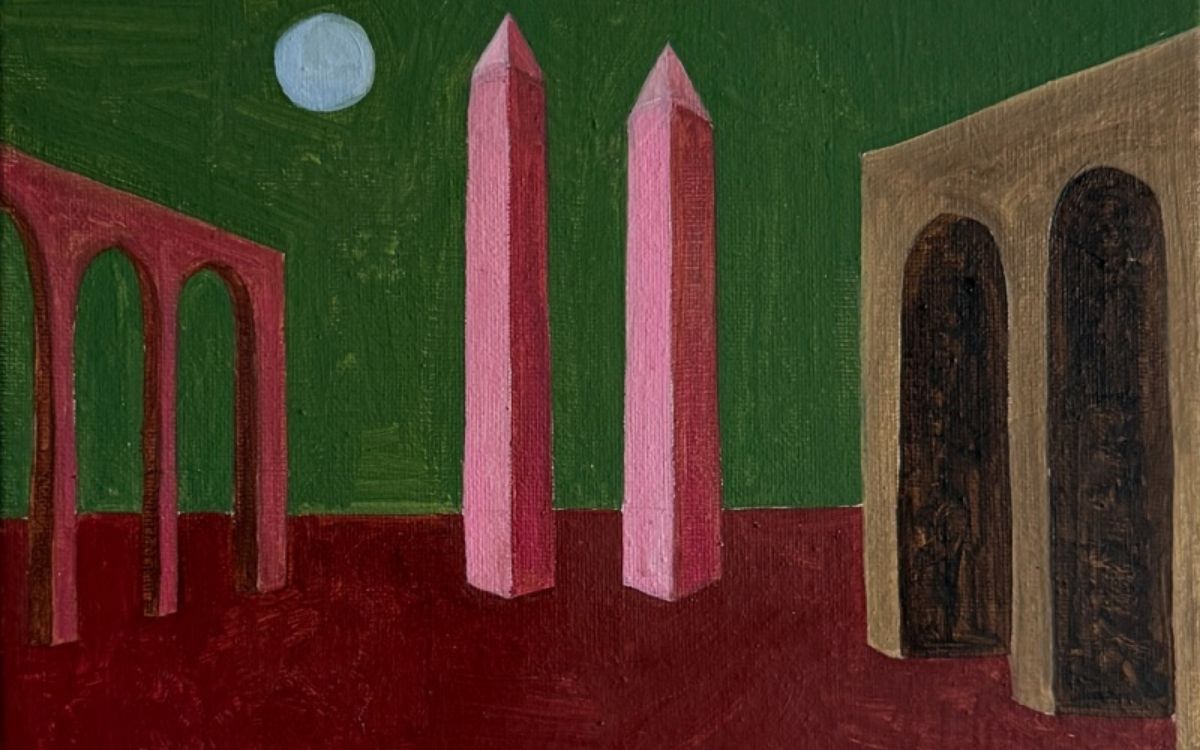
Dalel Ouasli paints from a place shaped by layered histories, born in Tunisia near the ancient Roman site of Bulla Regia, along a route that once connected Carthage to Hippo. That Mediterranean identity, formed at the crossing of Africa and Europe, East and West, runs through every layer of the work. After nearly fifteen years in banking, Ouasli left a secure career to commit fully to painting, treating the canvas as a kind of archaeological site where memory, material, and symbol accumulate over time. What follows is a conversation about transmission, ambiguity, and what it means to make art that holds onto what might otherwise be forgotten.
How has your upbringing or cultural heritage shaped the themes and techniques you explore in your art today?
My work is deeply rooted in a Mediterranean identity shaped by the meeting of Africa and Europe, and by the tensions and exchanges between East and West. I see myself as the product of multiple histories, places, and layers of collective memory.
These influences emerge through colour, material, texture, and recurring symbols. My practice is driven by a desire to revisit and reactivate memory, not as something fixed, but as something open to reinterpretation and transformation.
I was born in Tunisia, facing the Roman archaeological site of Bulla Regia, along the historic route linking Carthage to Hippo. This proximity and connection to ancient traces and civilizations deeply shaped my relationship to images, heritage, and the stories we choose to preserve.
Have you ever felt drawn toward a conventional career path? What made you take the "creative leap" despite the risks?
My path into art was not a linear one. I first completed a Master's degree in Finance and spent nearly fifteen years working in banking. Throughout that time, painting remained an essential part of my life. I attended evening classes in visual arts, worked with live models, and collaborated on creative projects, before later completing a degree in Fine Arts at Sorbonne University.
Over time, what began as a committed parallel practice became a necessity.
Leaving a secure job to dedicate myself fully to art was not an easy decision. It involved risks, both financially and personally. But it felt like a natural continuation rather than a radical change, as art had always been an important part of my life.
What do you think is the most meaningful role an artist plays in society today?
Beyond creating objects or images, I believe the artist’s role is to preserve and transmit memory. Artists give form to what is often overlooked, forgotten or on the verge of disappearing.
We live in an age of constant acceleration, where images and information circulate endlessly, yet very little is truly retained. What matters to me is not information itself, but its emotional and symbolic weight, what connects us.
Art allows memories, gestures, and narratives to remain active in the present. In that sense, artworks become traces, living archives of shared experience.
It also reveals what remains invisible in everyday life, inviting us to slow down and reconnect with what is essential.
How important is it for viewers to understand the intended message of your work? Does ambiguity add value, or do you seek clarity in your expression?
I don’t believe there is a single way to read a painting. While my work is rooted in specific histories and Mediterranean references, I intentionally leave space for ambiguity.
I work with fragments, symbols, and traces that carry multiple layers of meaning. Certain themes like memory, transmission and spirituality are central, but I do not expect them to be perceived uniformly.
Rather than conveying a fixed message, I aim to create an open space of interpretation. Once a work leaves the studio, its meaning is reshaped through the viewer’s experience. That dialogue is essential to me.
In an increasingly globalized world, how can artists preserve authenticity and cultural integrity in their work?
For me, authenticity is not about protecting a fixed identity. It is about remaining true to what internally drives the work.
My practice emerges from a Mediterranean context shaped by crossings between Africa and Europe, and between Eastern and Western imaginaries. Globalization does not erase these dynamics, it reveals that cultures have always evolved through exchange.
The challenge is not to preserve culture in a static form, but to engage with it consciously. Cultural integrity comes from understanding influences, not avoiding them.
I am particularly interested in layered histories and processes of cultural creolization, as described by Édouard Glissant. These overlaps are not a loss of identity, but the very condition through which identity is formed and reshaped.
Can you take us through the evolution of an artwork, from that first spark of inspiration to the finished piece?
Everything begins with a fragment, an archival image, a line of text, a childhood memory, or a fleeting sensation I can’t yet name. I gather these fragments in a notebook, blending research and intuition before the brush even touches the canvas.
From there, the studio process is beautifully organic and messy. It involves sketches, colour tests, and constant adjustments. Materiality is central to my work, I primarily paint in oil, often incorporating pigments and building up layers over time. I often erase, cover and rework, allowing the traces of previous gestures to remain visible beneath the surface, like an archaeological site.
What are your long-term aspirations as an artist, both personally and professionally?
I want to continue expanding my language while keeping painting at the core of my practice. At the same time, I aim to develop installations and research-based projects that explore memory, space, and transmission in more immersive ways. Artist residencies are also important to me, as they offer the conditions to deepen research and engage with new contexts.
I would like to exhibit more widely, particularly internationally, and to develop collaborations with curators, researchers, and institutions that share similar values.
Ultimately, what matters most is continuity: the ability to keep evolving, questioning, and creating over time, in a way that remains fully connected to my life.
What comes through clearly in this conversation with Dalel Ouasli is a deep commitment to memory, not as something fixed, but as something living and open to reinterpretation. The work resists easy resolution, built instead from fragments, archival traces, and the slow accumulation of gesture upon gesture. Ouasli does not see cultural identity as something to protect from outside influence, but as something formed precisely through exchange and overlap. What remains most important, in the end, is continuity: the ongoing act of questioning, evolving, and creating in a way that stays fully connected to a life shaped by crossings.