
Christopher Phillips paints the architecture of awareness. Having lived in more than forty homes across multiple continents, Phillips developed an early sensitivity to space, light, and atmosphere, an attunement later deepened by more than fifteen years of meditation practice and extended silent retreats. After a career as an art director in the technology sector, where attention itself was the product, a serious illness prompted a fundamental reassessment. What followed is a body of work that uses staircases, thresholds, and openings as metaphors for states of mind, treating architectural form as a way of giving shape to psychological space. What follows is a conversation about attention, stillness, and what it means to make paintings as invitations rather than statements.
How has your upbringing or cultural heritage shaped the themes and techniques you explore in your art today?
I was born in Zimbabwe and, through my father's work, subsequently lived in Iran, England, New Zealand and Australia. This movement continued into adulthood and, to date, I have lived in more than forty homes across a wide range of cultures and environments.
Living between cultures rather than being deeply rooted within a single one gives you a particular perspective on both yourself and the spaces you inhabit. Because your surroundings are continually changing, your awareness of them becomes heightened. The familiarity that often develops through repetition has less opportunity to settle in. Instead, you find yourself constantly comparing one place to another: the house with the large staircase, the apartment filled with ocean sounds, the room with a particular quality of light. Each space becomes intertwined with a chapter of your life and the person you were while living there.
Moving between cultures also makes you acutely aware of the challenge of belonging. Learning unfamiliar social rituals, finding friendship and developing a sense of ease within a new environment can be difficult. During these periods, the home often becomes an anchor for identity and security. The textures, smells, atmosphere, light and proportions of a space shape not only how we feel, but also how we remember significant periods of our lives.
In my mid-thirties, I began a meditation practice that evolved from a simple daily routine into an intensive exploration of consciousness, including regular ten-day silent retreats involving up to ten hours of meditation each day. Through this practice, I became fascinated by the psychological spaces of the mind. I was struck by how dramatically my inner experience could change, from joy to anxiety, agitation or peace, even while sitting alone in a silent room with no change in external circumstances.
This led me to question the extent to which our experience is shaped by the environments around us versus the landscapes within us. While external spaces undoubtedly affect us, I became increasingly interested in how awareness itself shapes our perception and emotional experience.
The intersection of these two lifelong inquiries: my sensitivity to physical environments developed through constant movement, and my exploration of inner psychological space through meditation forms the foundation of my artistic practice. Through the language of architecture, I explore how external spaces can evoke, reflect and cultivate particular states of mind.
How does your art engage with or comment on pressing contemporary Issues, social, political, or environmental?
My work explores what I have come to think of as the architecture of awareness.
Before becoming an artist, I spent many years working as an art director in the technology sector, creating digital products for companies such as Google and YouTube. In that world, success was measured by our ability to capture, direct and retain human attention. My working environment was characterised by speed, optimisation, productivity and constant distraction.
Over time, this way of living took its toll. A serious illness forced me to stop and re-evaluate the relationship I had with my own attention and wellbeing. During my recovery I began a meditation practice that has now continued for more than fifteen years, including extended silent retreats and thousands of hours of contemplative practice.
Through meditation I became fascinated by the nature of awareness itself. I discovered that awareness is not only the thoughts, emotions and sensations that occupy our minds, but also the spacious field in which those experiences arise. As my attention became less identified with the objects of awareness and more grounded in the space that contains them, my experience of life became calmer, richer and more expansive.
This shift fundamentally changed my artistic practice.
I began searching for a visual language capable of expressing psychological space. Architecture became the natural choice because architecture is fundamentally concerned with shaping emptiness. Its walls, openings, staircases and thresholds define not the structure itself, but the quality of the space it contains.
In my paintings, architectural forms function as metaphors for states of awareness. A staircase becomes a transition in consciousness. An opening becomes a possibility. A threshold becomes a moment of transformation. While viewers may initially focus on the structure, the true subject of the work is the spaciousness the structure creates.
In this sense, my work engages with one of the defining challenges of contemporary life: the commodification of attention. We live within systems that increasingly compete for our awareness, fragmenting our focus and narrowing our experience of the present moment.
Rather than offering a direct political statement, my paintings invite reflection on a more fundamental question: What is the quality of the psychological space we inhabit? How do our environments, habits and patterns of attention shape our experience of being alive?
By exploring awareness through the language of architecture, I hope to create spaces that encourage stillness, contemplation and a renewed sense of connection to ourselves, each other and the world around us.
Do you have any rituals or habits that help you enter a creative state of flow?
Meditation plays a fundamental role in my creative practice. It has been a daily ritual for more than fifteen years and has become inseparable from the way I approach both painting and life.
Before entering the studio, I will often spend five or ten minutes sitting quietly. The purpose is not to generate ideas, but to let go of everything else competing for my attention. Painting requires a different quality of awareness than everyday life. It asks for a slower, more receptive form of attention.
Many of my ideas emerge from this space. Meditation helps me move beyond conceptual thinking and into direct observation. It allows me to become sensitive to subtleties that might otherwise go unnoticed, the texture of a surface, the quality of light within a room, the tension between a hard edge and a soft curve, or the atmosphere created by an empty space.
Because my work explores the relationship between architecture and awareness, the act of painting becomes an extension of the same inquiry. The studio is less a place of production and more a place of investigation. Through sustained attention, I begin to notice qualities that cannot be accessed through analysis alone.
For me, creative flow is not something I chase. It emerges naturally when attention becomes settled, present and spacious enough for deeper observation to occur.
Can you share a moment when someone’s unexpected interpretation of your art gave you a new perspective?
One of the most memorable experiences occurred during my first solo exhibition.
Because my work explores psychological space through architecture, I became fascinated by how people responded to the paintings. Throughout the exhibition I would often ask visitors what they felt when looking at a particular work and whether it reminded them of a personal experience or state of mind.
What surprised me most was the diversity of responses. The same painting that evoked a sense of calm and openness for one person might evoke loneliness, nostalgia or introspection for another. What followed were often deeply personal conversations about memories, relationships, childhood homes and significant moments in people's lives.
Until then, I had assumed that viewers would experience the work in ways that were relatively close to my own intentions. Instead, I realised that people bring their own histories, emotions and associations into the space of the painting, and that these are just as important as the ideas I bring to the work myself.
That experience changed the way I think about art. It made me less interested in imposing a fixed interpretation and more interested in creating open works that allow viewers to find their own meaning. In many ways, the paintings function as invitations rather than statements. They create a space in which people can encounter aspects of their own experience that might otherwise remain unnoticed.
The experience reinforced my belief that the most interesting meaning in a work of art often emerges in the relationship between the artwork and the viewer, rather than residing solely in the intentions of the artist.
Can art be truly therapeutic? Have you experienced its healing power personally, or seen it impact others?
I believe art can be deeply therapeutic, although perhaps not in the way the word is often used.For me, art has never been about escaping life or expressing a fixed set of ideas. It has been a way of understanding myself and my relationship to the world around me. My practice has taught me patience, the patience to ask questions without immediately needing answers, and the willingness to sit with those questions over months or even years.
Painting is, in many ways, a daily practice of awareness. To work well, I need to slow down and become present to what is in front of me. That process inevitably brings me into contact with discomfort, uncertainty and aspects of myself that I might otherwise avoid. Over time, my relationship to that discomfort has changed. Rather than resisting it, I have learned to stay with it.
This has had a profound impact on my life. I feel more at ease with myself than I once was. I am better able to remain present when things are difficult or uncertain. I find that I am more open and forgiving toward both myself and others. I am more emotionally sensitive, but less reactive.
It is difficult for me to separate the effects of my art practice from those of my meditation practice because they have become deeply intertwined. Both are rooted in observation, attention and presence. Together they have helped me cultivate a greater sense of spaciousness, resilience and connection.
Whether art is therapeutic for others is ultimately for them to decide. What I do know is that the process of making art has been profoundly therapeutic for me. It has not removed life's difficulties, but it has transformed the way I relate to them.
If you could become one of your creations for a day, which would it be and why?
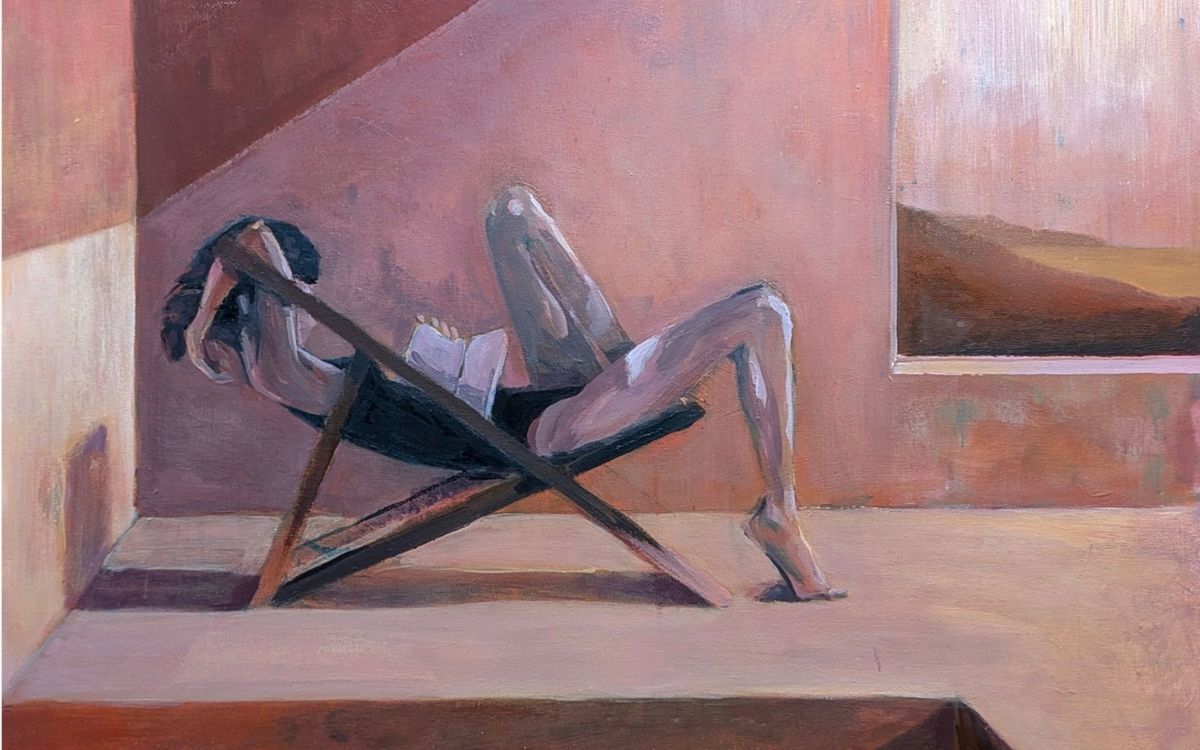
If I could step into one of my paintings for a day, it would be my most recent work, A Still Life.
The painting depicts a figure sitting in a deck chair on a rooftop terrace, reading a book. Sunlight pours across the scene and a large opening looks out towards an expansive coastal landscape. It is a quiet image, but one that carries a great deal of personal significance.
Like many of my works, the painting is a combination of observation, memory and imagination. The rooftop terrace was inspired in part by my own home, where I often sit listening to the ocean and feeling the breeze move through the space. It also draws on a memory from a holiday in Cadaqués, a small coastal town in Spain, where I spent an afternoon reading on a rooftop overlooking the sea.
What stays with me about that experience is not the location itself, but the quality of awareness I experienced there. I felt completely relaxed, yet fully present. There was nowhere else I needed to be and nothing I needed to achieve. Time seemed to slow down and I felt deeply connected to both myself and the environment around me.
That feeling is something I often search for in my work. Not happiness in a conventional sense, but a state of spaciousness, presence and ease.
If I could enter one of my paintings, I would choose A Still Life because it represents a moment where awareness, environment and experience felt perfectly aligned. It embodies the kind of psychological space that much of my practice seeks to explore.
Have you considered teaching your artistic skills to others? What excites or challenges you about that?
Yes, very much so.
While I enjoy teaching artistic skills, I am particularly interested in teaching the quality of attention that sits behind the creative process. Much of my own practice has evolved through exploring the relationship between awareness, observation and creativity, and I have often felt a desire to share that experience with others.
A few years ago, I developed a workshop called Meditative Photography, which I delivered through The School of Life in partnership with Sydney's Royal Botanic Gardens. The course combined meditation and photography as complementary practices of observation.
Throughout the day, I guided participants through a series of seated meditations interspersed with photographic assignments designed to focus attention on increasingly subtle aspects of seeing. As the sessions progressed, the meditations became longer and the photographic exercises more refined. I introduced constraints such as silence and specific observational tasks that encouraged participants to move beyond habitual ways of looking.
By the end of the workshop, participants had accumulated almost four hours of meditation practice without necessarily thinking of it as meditation.
What fascinated me was the diversity of people who attended. Some had never meditated before, while others had maintained a daily meditation practice for more than forty years. Some arrived with only a mobile phone camera, while others were professional photographers carrying extensive equipment.
Despite these differences, the feedback was remarkably consistent. Participants described a profound shift in their ability to focus and, perhaps more importantly, in their ability to genuinely see what was in front of them. Many realised that meditation was not limited to sitting with closed eyes. They discovered that the same qualities of presence, spaciousness and awareness could be brought into everyday activities such as walking, observing, creating and making photographs.
What excites me most about teaching is witnessing those moments of recognition. The technical aspects of art can certainly be taught, but helping someone experience a deeper level of awareness and observation can have an impact that extends far beyond the creative process itself.
In many ways, this is the same inquiry that drives my artwork. Whether I am painting, teaching or meditating, I am interested in how attention shapes our experience of the world, and how cultivating awareness can enrich the way we see, create and live.
If you could distill your artistic philosophy into a single idea, what would it be?
My work explores the architecture of awareness.
Architecture shapes the quality of space. Awareness shapes the quality of experience.
Ultimately, I am interested in the possibility that awareness itself has a kind of architecture, and that by becoming more conscious of the spaces we inhabit both physical and psychological, we can cultivate richer, calmer and more meaningful ways of being.
What lingers after this conversation with Christopher Phillips is a sense of unhurried clarity. The paintings are not concerned with arriving at fixed meaning; they are concerned with creating room, both architectural and psychological, in which something quieter can be noticed. From thousands of hours of silent meditation to a rooftop afternoon in Cadaqués, the same inquiry runs through everything: how does attention shape experience, and how might a painted threshold offer a way back to presence. Philips does not offer escape from life's difficulties. The work offers something more durable: a changed relationship to them, built one quiet observation at a time.