
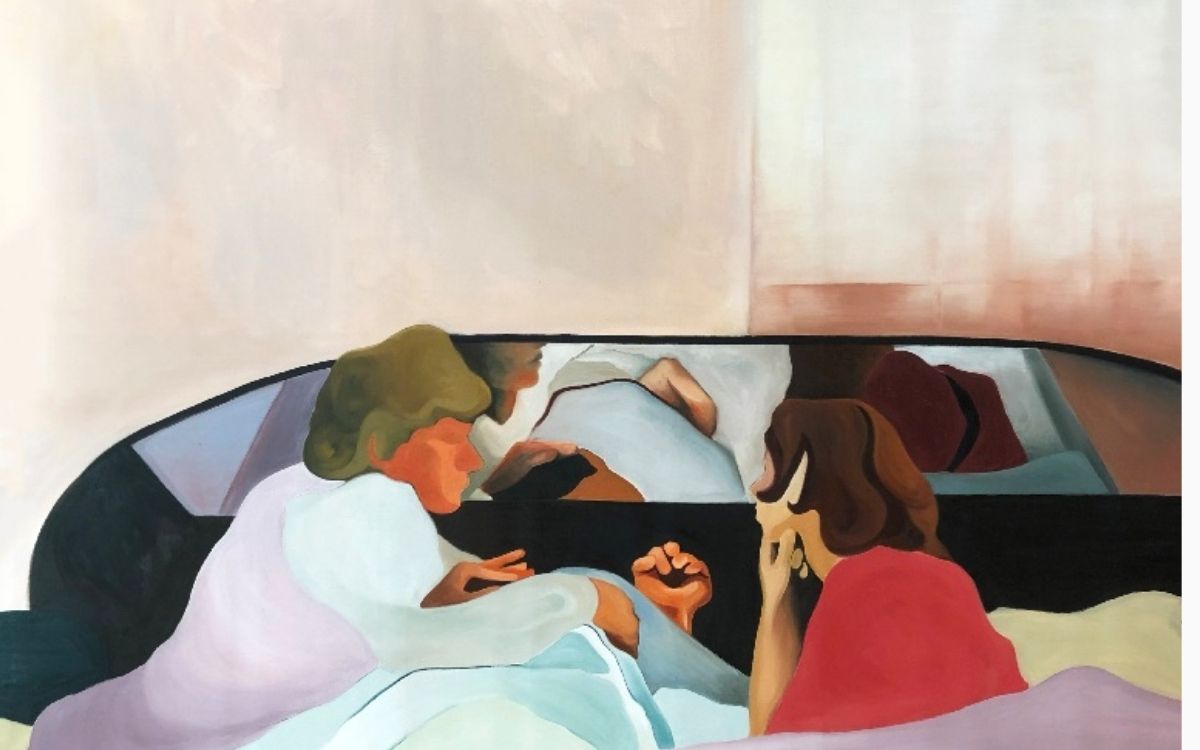
Agata Knapik came to art through a detour, leaving behind a family steeped in medicine to follow a quieter, more daydreaming temperament. What began as a path toward art restoration shifted into something more personal once the impulse to create overtook the impulse to preserve. Knapik's practice now sits at the intersection of painting and psychology, holding space for ambiguity, intuition, and the unconscious without losing sight of a clear interpretive core. The work is honest about its own uncertainty, treating self-doubt not as failure but as part of the process. What follows is a conversation about identity, therapy, and the ongoing work of making peace with the life of an artist.
Have you ever felt drawn toward a conventional career path? What made you take the "creative leap" despite the risks?
I come from a family strongly related to a medical field. Both my father and brother are doctors, my sister is a pharmacist and my mom used to work as a physiotherapist. When I was a child a similar career path seemed natural – I thought of becoming a cardiac surgeon as I’m ambidextrous. This idea however was a typical child’s desire to follow their beloved parent’s footsteps, it was all I knew back then. Later, when I went to school and grew older, it turned out I have more of a creative spirit-daydreamer type of personality. I started reading a lot of novels and was even writing my own short stories. Drawing and painting came later. At 15 years old I decided that I want to become an art restorer – I saw a portfolio of a woman working in a church my uncle was a parish priest of. After a couple of years, when I finally got accepted at my dream programme, I felt disappointed as I missed creating my own things and restoring other people’s pieces or painting raw still life felt lacking. I remember how proud I was, when for a summer semester drawing class finals I made my first mini comicbook. It wasn’t original or visually detailed – just a simple, handcrafted leaflet of expressive scribbles telling a story of an exhausted student during finals. Not until a few years later did I realise what a breakthrough moment it had been. I wanted this ‘creative high’ to last. So I took a gap year to reconsider my career path. To be fair, I wasn’t thinking much about risks – I had this romanticised vision of an artist’s life and, like most very young people, I was dreaming big. However, I had to admit – during my lows a sting of regret can still creep into my mind. I don’t know if given a chance I would have made this decision once again. I’ve just learned to live with it and realised this feeling is probably about my emotional needs that I must cater for rather than a profession itself. The question isn’t ‘would I be happier?’, it’s: ‘would life be less complicated?’. I don’t know the answer, but I’m sure a conventional career path would never let me get to know myself as well, as choosing to be an artist allows me to.
How do you reignite creativity during those inevitable periods of self-doubt or stagnation?
First and foremost, I must repeat to myself that every artist experiences this. It may seem odd ‘cause it’s obvious, but I do tend to forget that in the moments of creative and emotional despair. The thing is, in times of vulnerability, it is easy for me to think of this feeling as something deeply personal and unique, which makes handling the process even more difficult. Therefore, to be able to regain my creative self, I need to step back a little from ‘being an artist’ and instead pay attention to the fact that I do have other things going on in life – maybe more mundane, but no less important – which are also part of my identity. I try to focus on everyday activities I like, for example spending time with my loved ones, walking a dog, exercising, reading, knitting, the list goes on. During these periods of stagnation and self-doubt, I try to escape the constant stimulation nowadays the world floods us with, I avoid social media to resist the temptation to compare myself to others. As cliche as it sounds, I try to slow down and cherish small things. Just recently I’ve noticed how much I appreciate silence. In the past, going for a walk without my headphones on felt boring, now I find it more natural, soothing even. When I get stuck on a painting I try not to push myself too hard. Sometimes I let said painting lay untouched in my studio for months before I decide what’s next. I never did that during my years at uni. I was too scared of not being able to follow through even though it had never happened on a regular basis. I’m quite neurotic and I have a lot of irrational fears so developing any new coping skill feels like a giant step for my artistic practice. Trying to catch a moment when overthinking enters the chat has also been helpful – when I don’t like a painting I’ve just finished I just move on with a new one without much hope. Enjoying the process and staying mindful is the only thing that matters. Lately I’ve also been trying to go back to creating things just for the sake of it, just for myself and without self-assessment. Quick, life sketching has been a big part of it. When I was a teenager I used to produce thousands of expressive doodles. I'd love to retrieve this habit as I find it extremely useful for fighting perfectionism.
How important is it for viewers to understand the intended message of your work? Does ambiguity add value, or do you seek clarity in your expression?
Ambiguity definitely adds value. I would go even further and say that the best artworks are multidimensional in terms of their meaning. In my opinion every unique interpretation prolongs a piece’s mental range, so it goes further and further reaching completely new hidden layers. I found that out during my studies at art academy. One of my professors gave me a very simple yet exceptionally clever take on my project that I hadn’t previously thought about, even though it seemed almost too easy. It was an ‘aha moment’ for me. I like playing with the idea of subconsciousness in my works – I find pioneer psychoanalysts’ publications incredibly interesting. While some of their theories got debunked through the years, I still find their vagueness useful in my artistic practice. I just love how roughly intuition-driven they often were. This being said, I still believe that an artwork needs a strong interpretational core to begin with. For me it is like collecting various elements of the same riddle rather than scattering them around with no personal intention. However, adding an unexpected detail also spices things up. Thinking of possible paths for interpretation of my works is a significant part of my practice. I also love when a person looking at my painting gives it a new perspective while filtering it through their unique experience – a perspective I would never be able to come up with because of differences in our backgrounds, tempers and so on. However, it gets particularly interesting and exciting when their analysis somehow logically connects to my intention, but on a new previously unknown level. It’s the most satisfying part. Even though my paintings may seem almost too illustrative, I need to achieve at least some sort of interpretative grey area to perceive a piece as successful. When I can’t find a new way to analyse it, I get disappointed with it. It is like letting my overthinking everything side, go in a healthy and creative way.
Can art be truly therapeutic? Have you experienced its healing power personally, or seen it impact others?
Definitely! Art is an underrated therapeutic tool. Not only is the process of creating therapeutic itself, especially nowadays when the world is shamelessly pushing fast consumerism narrative, but also being forced to carefully think of what you want to convey with your work enables you to understand yourself better and gain a new perspective. In my opinion it gives you access to the unconscious. I’ve learnt it recently and currently I’m making the most of this superpower. A few years ago I thought that treating art as a part of a therapy is pointless, immature even. During my studies at the academy, we were even told that by one of the cooperating gallerists. Why would anyone be interested in your intimate struggles and complexities? I had this conviction that the most valuable art has to address crucial social and political issues. For a long time I was trying to engage and find something I could fight for. Now I feel some sort of cringe, when I think of things I made back then. Not because of the issues themselves, but because of them being forced, because I was sometimes inevitably ignorant trying to tell the stories I’ve neither experienced nor ever been drawn toward. I desperately wanted to fit in while ignoring the individual aspect of art.
Therefore, discovering the therapeutic power of art had been coming to me gradually. It started when I was preparing my diploma. It was the very first time when I was asking questions about my own identity through exploring broader issues. The feeling was refreshing, I felt that I was truly developing my own painting integrity but still couldn’t find the source of that feeling. After graduation, lacking of that understanding got me stuck in a dead-end. I was struggling trying to find some issue to address with my art. I truly wanted to define my body of work. Then, some day, it hit me. That probably was a result of many things coming together in the right place at the right time. I can’t explain it. Long story short, I’ve figured that my interest in psychology has been playing a crucial role in my art and that I want to explore that field further and more consciously. Finally, I feel that I’ve found my niche. I believe that every artist whose practice revolves around topics genuinely coming from their personal experiences benefits from art’s therapeutic value. I don’t know if there is a scientific explanation to that, but I see it as some sort of psychological processing.
Identify five habits or concerns you are actively trying to let go of in your practice.
First of all, I would like to be more considerate and caring when it comes to my own needs and fears connected to my artistic identity. I tend to be my harshest critic and sometimes this leads to bitter conclusions and severe cognitive distortions. As a result, I question my practice as a whole, which is an ultimate joy and creativity killer. I learn to find balance and grey areas instead of keeping the ‘all or nothing’ attitude. I’ve been struggling to accept the fact, that at the moment I do need my 9-5 job, even though it takes so much time and drains me. That’s the most difficult I think, as this is a reoccurring issue. There are days when I’m raging about the inability to do what I truly love as a full-time job. I hate waking up at 5 a.m. while at the same time, I’m feeling like I’m a terrible human being complaining about something which is most people reality. A single negative self-doubting thought can cause a domino effect of catastrophic, often cynical conclusions that makes me even more exhausted. I try to recognise and stop it, as that affects my practice. I attempt to truly convince myself that anytime spent on painting is better than nothing, and that
doesn’t make me any less of an artist than a person, who can afford to be a creative on their own conditions. This leads to another issue of mine, which is comparing myself to other artists. Nowadays, it is easier than ever to find your ‘flaws’ as we are constantly exposed to carefully curated images presented on social media. Artists are no exception to it. I try to avoid doom scrolling, as for now I don’t feel I’m strong enough to emotionally dissociate from this competition. I want to appreciate my own experience as it is, instead of assessing its thorough juxtaposition to others.To let all the concerning thoughts go, I’ve started writing in my journal before every painting session. It’s been oddly effective. I try to keep my perfectionism in check and stay mindful during my practice. Lately I’ve been reframing questions I ask myself, leaning towards my intuition while facing both formal and contextual matters. Giving myself some space and time instead pushing harder is another goal. I remind myself, that growth isn’t linear and not every painting will be better than the previous one. Honestly, I feel like I’m trying to catch up with things which come natural to most people. But on the other hand, it can be another distortion caused by the characteristics of the digital reality we live in. Last but not least, my goal is to let go of some of the expectations, hopes and fears regarding my artistic career to simply enjoy the process instead of constantly question or even regret the path I’ve chosen.
If you could step back into any artistic era, which would it be and why?
20th century as in my opinion it was sort of a golden age for art. After centuries of strict rules and one-dimensional approach, completely new and unexplored – both formally and intellectually – fields emerged. While art has retained its best qualities, it also gained new ones which created previously unknown contexts and connotations. In my opinion breaking with tradition gave artists of that time an almost infinite field for experimenting and testing bold theories. It must’ve been amazing to be a part of that revolution. It was almost like rewriting art as a whole, turning it upside down while keeping its core. Because of all sociological and historical conditions, I perceive that age as a burst of pure creativity which probably won’t be repeated in ages or even ever again.
What are your long-term aspirations as an artist, both personally and professionally?
As I mentioned above, my main goal is to come to peace with some of the aspects of an artist’s life that still sometimes make me question my decisions, things withdrawing joy and excitement from the act of creating itself. Being able to make a relationship with my practice healthier – less love-hate type of relationship – could save me a lot of mental hassle. Of course, I would love to be able to make a living solely from painting, but I don’t want to make it a necessary condition to let myself be happy, as it may never happen. I want to participate in exhibitions, travel and meet other artists to share and exchange artistic experience with. I would like to find my place in the art world, as for now I feel like an outsider. Currently, I’m also thinking of going further with my academic training by entering a PhD programme to explore particular areas where art and psychology intertwine. For me, continuous growth as an artist equals getting better at reading and expressing emotions, hence it creates a better understanding of ourselves and our surroundings.
There is a particular kind of honesty running through this conversation with Agata Knapik, one that resists the temptation to tidy up the difficult parts of an artistic life. The early mornings, the 9 to 5 job, the comparison and self-criticism: none of it is smoothed over or romanticized. What emerges instead is a practice grounded in psychological curiosity, shaped by years of learning to trust intuition over expectation. Knapik does not claim to have resolved the tension between conventional stability and creative fulfillment. What comes through instead is something more honest: a willingness to keep painting anyway, and to keep asking better questions of the process, even without certainty about where it leads.