
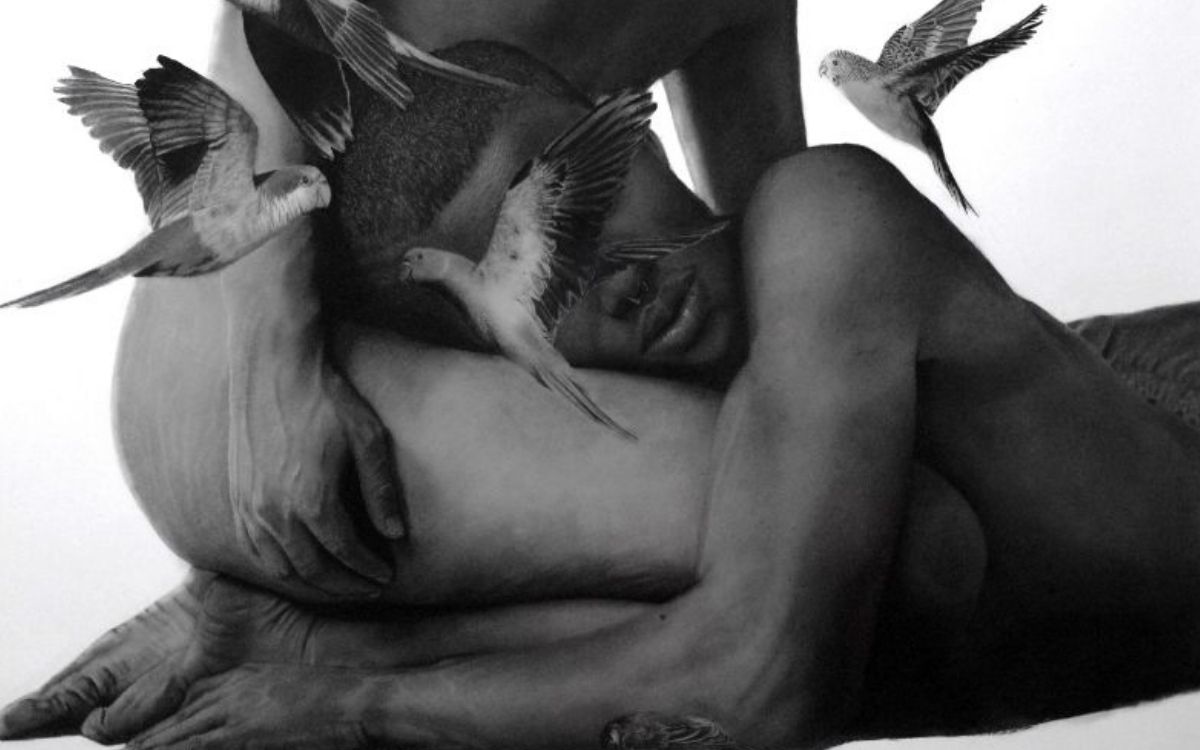
Ritchelly Oliveira makes work rooted in what is not easily said. Beginning with personal experience and expanding outward into the collective, Oliveira's practice explores vulnerability, belonging, and the long reach of early life on everything that follows. Black bodies occupy the center of the work, not as a statement, but as a natural consequence of a practice built on honesty and self-examination. Through painting and an ongoing engagement with the stories of others, Oliveira has developed a visual language that holds both intimacy and universality at once. What follows is a conversation about where that language came from, and what it continues to seek.
Can you pinpoint a single moment in your life when you realized art was not just a passion but your purpose?
Drawing has always been present in my life, but it was at the age of fifteen, when my family discovered my sexuality, that art ceased to be merely a form of entertainment or a hobby and became a language. At a moment when there was no space for me to be who I had always been, and lacking the courage to openly express what I was feeling, my art became the means through which I could communicate what no words were capable of expressing.
Years later, in 2015, speaking only about myself through my work was no longer enough. That was when I created an ongoing series called Lacunas (Gaps), in which I invited people to share what they understood as love and how their relationships—whether romantic or otherwise—had impacted their lives. This project became a turning point in my artistic journey, as it helped me understand that being an artist, beyond a choice, was a calling.
Realizing that my work could also be about the collective, and not solely about my own experiences, opened up a world of possibilities for me. Recognizing that themes as universal as affection, vulnerability, and belonging can be absorbed in such unique ways by each individual reinforced my conviction that there is a greater purpose in what I strive to create. It is precisely within this encounter between personal experience and the experiences of others that I find the deepest meaning of my artistic practice.
How do you reignite creativity during those inevitable periods of self-doubt or stagnation?
I feel that, from a very early age, I always knew what the foundation of my work was, and because of that, what we often call “creativity” has never really been the issue for me during periods of stagnation or self-doubt. Beyond the many meanings that art holds in my life, at the end of the day, it is also my profession. It is through the work I create that I am able not only to sustain the life I have, but also to invest in my own artistic practice. I mention this because, when I find myself in moments of anxiety or uncertainty, they are usually connected to that reality, and that is often where feelings of stagnation begin to emerge.
In truth, what tends to challenge me during these periods is not a lack of ideas, but the relationship I have with them. More often than not, the anxiety comes from the pressure of meeting certain expectations, whether they are personal, professional, or financial. Even so, I have learned that returning to the reasons that led me to create in the first place is an important exercise. It is through that return that I reconnect not only with confidence in my process, but also with the understanding that creativity does not disappear; it simply moves through different rhythms throughout life.
Without trying to romanticize it, I also believe that self-doubt can have value. Rather than seeing it as evidence of failure, I try to view it as part of the creative process—a sign that I am questioning, evolving, and searching for new ways to express myself. Some of the most meaningful artistic breakthroughs emerge from periods of uncertainty.
Finally, I remind myself that creativity is not a constant state of productivity. Rest, reflection, and even moments of apparent inactivity are often essential parts of making meaningful work. Trusting that these quieter periods have a purpose helps me move through them with greater patience and openness.
Do you think art should have a political or ideological agenda?
Especially in today's world, I believe that being an artist is a political act, whether the artist intends it to be read that way or not. Even when there is no explicit activist agenda, art has the power to shape perceptions, challenge norms, and create spaces for dialogue. Every artwork emerges from a particular experience of the world and, as a result, carries values, references, emotions, and questions that are inevitably connected to the social context in which it was created.
In my case, for example, Black bodies are present throughout much of my work. Although this developed naturally through my visual practice and personal journey, it would be impossible to say that my work does not engage with a political dimension. The simple act of representing certain bodies, stories, and forms of affection already generates meanings that extend beyond the image itself. These representations exist within a reality marked by absence, inequality, and competing narratives.
I also believe that the political dimension of art lies in its ability to create encounters and shifts in perspective. An artwork does not need to provide answers or advocate for a specific position to be political. It can still provoke reflection, create discomfort, or expand the way we perceive certain issues. To me, art becomes political because it participates in the construction of collective imaginaries and influences how we relate to the world and to one another. Even when it begins with intimate and personal experiences, it never exists in isolation from the reality that surrounds it.
If you could communicate just one core message through your entire body of work, what would it be?
To put it simply, I believe that the experiences we go through early in life - especially our traumas - have the power to shape us profoundly. They influence the way we relate to others, how we see ourselves, and even how we are perceived by society. For a long time, these experiences can feel like wounds, limitations, or absences. Yet I believe there is the possibility of transforming them into something greater.
Much of my work emerges from this reflection. I am interested in exploring how our vulnerabilities coexist with our ability to move forward, build connections, and find meaning within our own scars. To me, trauma does not have to define who we are permanently, nor should it be understood solely as a weakness. It can also become a path toward self-discovery, empathy, and the recognition of an inner strength we may not have known existed.
If I could communicate a single message through all of my work, it would be that vulnerability is not the opposite of strength. On the contrary, it can be one of its deepest expressions. Learning to acknowledge our pain, accept it, and share it with others is an act of courage. Above all, learning to be vulnerable is an act of self-love—a way of understanding that our imperfections and wounds are also part of what makes us human.
How do you challenge yourself to continually grow as an artist while remaining true to your voice?
I think growth happens when we allow ourselves to remain curious without losing sight of what truly motivates our work. For me, staying true to my voice does not mean repeating the same images or ideas over and over again. Instead, it means remaining connected to the questions, emotions, and experiences that have always been at the core of my practice. With that, growth, for me, is less about reinventing myself and more about deepening my understanding of the subjects I have been exploring for years.
At the same time, I believe it is important to remain open to influences, conversations, and experiences outside of my own perspective. Reading, observing other artists, traveling, and engaging with people from different backgrounds often challenge my assumptions and expand the possibilities within my work.
Again, ultimately, I stay true to my voice by returning to the same fundamental questions that have guided me since the beginning: how our experiences shape us, how vulnerability influences our relationships, and how we search for connection and meaning. As long as those questions remain present, I feel free to evolve without losing the essence of what I do.
Can you share a moment when someone’s unexpected interpretation of your art gave you a new perspective?
Perhaps not a single moment, but rather a period of time.
As I mentioned earlier, the protagonism of the black bodies in my work emerged quite organically; it was never a conscious or carefully planned decision from the beginning. That said, it was through the perspectives of those around me - especially friends and people close to me - that I began to notice something I had not previously recognized so clearly. As they shared their own experiences and identified connections between those experiences and the figures represented in my work, they prompted me to question why I was so consistently placing these bodies at the center of my images.
It was a period of deep reflection and self-questioning for me as an artist. I believe we have a responsibility to understand the motivations behind our choices, whether in art or in life itself. Especially at a time when polarization continues to grow and shape so many important conversations, examining the meaning and implications of our actions becomes a necessary exercise.
What affected me most during this process was realizing that an artwork can reveal aspects of ourselves that we have not yet fully understood. These interpretations did not just change the way others viewed my work; they also changed the way I began to see myself through it. It was an experience that taught me that art does not always communicate only what we consciously intend to say. Sometimes it exposes deeper layers of our experiences, interests, and concerns. Since then, I have come to value these unexpected readings as a fundamental part of the dialogue that art creates between the artist and the audience.
How do you respond to debates about the accessibility of art—should it be exclusive, or is it for everyone?
I believe art should be for everyone. For example, the first time I ever stepped into an art gallery, I was already eighteen years old. I come from a family where access to the arts was virtually nonexistent, let alone something that was actively consumed or encouraged. Becoming an artist was a consequence of life itself. Until I became aware of all the possibilities that existed, being an artist never seemed like a realistic path for me, much less a way to make a living. I share this because I do not believe art should belong only to a specific group of people, as it was often perceived or imposed for so long.
At the same time, I do not believe that art must be immediately understood by everyone. Some works require time, context, or even a willingness to engage in dialogue. That is part of the artistic experience. The problem arises when the complexity of art is used to create barriers or reinforce the idea that only certain people are capable of participating in these conversations.
Accessibility is also tied to financial realities. As an artist, I understand that art has economic value and that artists deserve to be fairly compensated for their work. However, I believe that owning an artwork and having access to art are two very different things. Not everyone will be able to purchase a work of art, regardless of its medium or language, but that should never prevent someone from experiencing, reflecting on, or connecting with it. Museums, exhibitions, public spaces, publications, and digital platforms all play an important role in expanding access to art beyond the marketplace.
As an artist, I am interested in thinking about art as a space for encounter. Even when viewers interpret a work differently from what I originally intended, that exchange remains valuable. I believe art becomes richer when it is open to different perspectives and generates multiple readings. Ultimately, perhaps the role of art is not to provide universal answers, but to create opportunities for more people to ask questions, feel, reflect, and recognize themselves within an experience.
As an artist is to continue deepening my understanding of human relationships and translating those reflections into images that can resonate with others. Throughout my career, I have become increasingly interested in how art can create spaces for empathy, dialogue, and self-recognition. Personally, I hope to remain curious and open to transformation, allowing my work to evolve alongside my experiences and the questions that emerge throughout my life.
Professionally, I want to continue expanding the reach of my practice through exhibitions, residencies, and collaborations that challenge me to grow both creatively and conceptually. I hope to engage with different cultural contexts and audiences, as I believe these encounters enrich not only the work itself but also my understanding of the world.
At the same time, one of my goals is to build a sustainable career that allows me to dedicate myself fully to my artistic practice. Art is not only a form of expression for me; it is also my profession. Being able to support myself through my work while continuing to invest in its development is something I consider essential for maintaining a long-term commitment to creation.
Ultimately, I hope my work can continue to generate meaningful conversations long after it leaves the studio. If my canvases can encourage people to reflect on their own experiences, relationships, and ways of seeing the world, then I feel I will have fulfilled an important part of my role as an artist.
What runs through this conversation, from the first drawing made in place of words to the ongoing question of who art belongs to, is a consistent belief that vulnerability is not a weakness to be overcome but a form of strength worth defending. Ritchelly Oliveira has built a practice around that conviction, one that began as a private necessity and grew into something shared, debated, and genuinely open to reinterpretation. The work does not offer easy resolution. It offers something more useful: a space where people can bring their own wounds, hold them up to the light, and find that they are not alone in carrying them.