
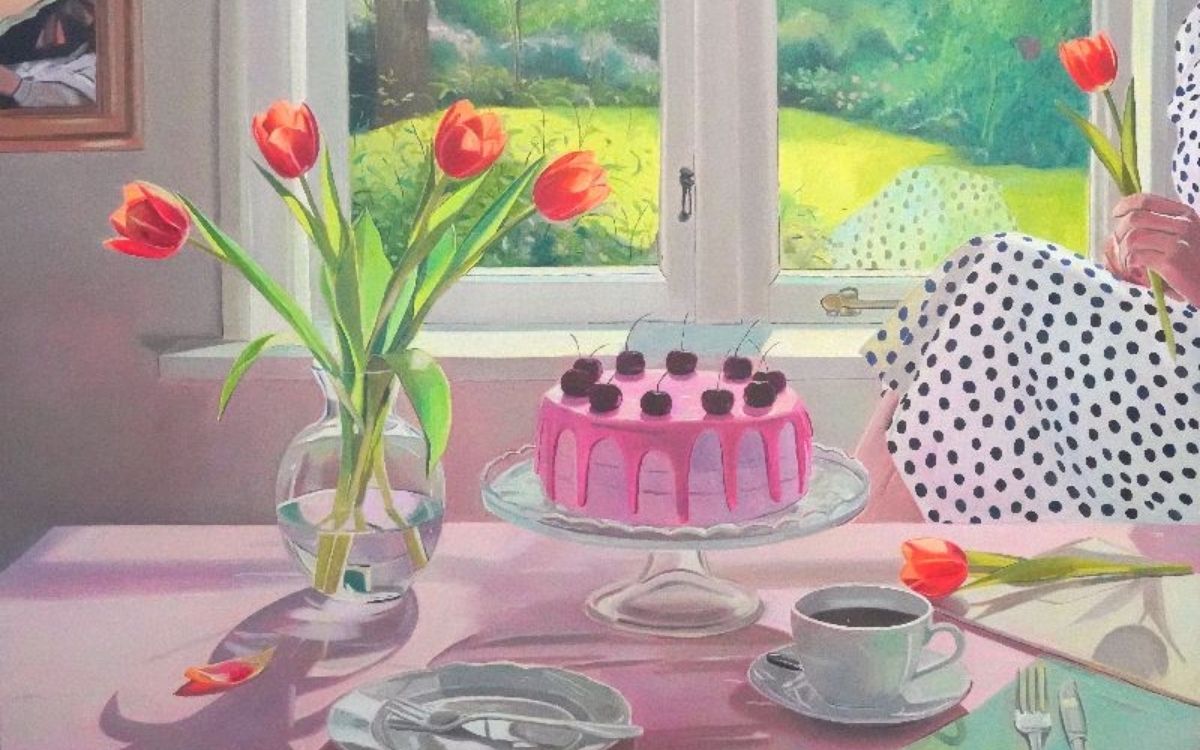
Deb Koo paints the things worth remembering. Born in South Korea and raised in Wisconsin, Koo brings a quietly personal eye to the still life tradition, staging tableaux of cakes, flowers, fruit, and carefully chosen objects that sit somewhere between memory and idealization. The work is meticulous in its staging and warm in its intention, driven by a deep belief that ordinary things deserve to be made permanent. Alongside a full-time teaching practice and the demands of raising a family, Koo continues to paint with consistency and patience, finding in the studio a space that is entirely and essentially its own. What follows is a conversation about where that dedication comes from, and where it is headed.
How has your upbringing or cultural heritage shaped the themes and techniques you explore in your art today?
I have more than one theme in my work, but my cake, dessert and food tablescape paintings look back to the time when I was growing up in Wisconsin. I was born in South Korea and my family immigrated to the United States in 1995 when I was five years old. My first friend that I made in the States invited me to my first American birthday party. Her cake was made of box cake mix, colorful canned frosting, Wilton icing decorations and confetti sprinkles. I thought it was the prettiest cake I had ever seen, and requested a similar cake for my birthday and for the years following my favorite moments included decorating cakes for friends and family members.
I also have a sweet tooth like my father and some of our fondest times were spent biking to McDonald’s to get an ice cream cone. As I am much older I know eating sweets and cake frequently is not good for my health so I try to satisfy my sweet tooth through painting sweet foods. This also brings back my favorite memories as a child. Many times in my food paintings I will recreate some of the table settings from my memories but they are embellished and idealized. I believe this is a combination of my love of setting up still lifes and romanticizing some of the memories revolving around food.
Have you ever felt drawn toward a conventional career path? What made you take the "creative leap" despite the risks?
Yes, I have felt drawn toward a more conventional career path. I first intended to study government in college but realized it was not for me. As I was taking different classes to see what I was interested in majoring in, I randomly took a drawing course with Jane Lund and enjoyed it a lot, to the point that I wanted to major in it. The rest is history. I took my first oil painting class my second year and loved it so much. I did not know what I would do with art, and I feared that my parents would not be supportive so I secretly majored in it. This is not something I share with many people. Obviously my parents were not happy but in the end they supported me and encouraged me to get my master’s degree in Korea.
I also am a full-time art instructor at Rowan-Cabarrus Community College and so I am teaching and painting while raising two small children. One of the reasons I am able to do this is because of the support I receive from my husband and family. Although being a teacher, artist and mother is a handful it is a blessing and fuels my focus and art practice all the more. I also keep telling myself that I will have my time back in the studio in the future.
Can you take us through the evolution of an artwork, from that first spark of inspiration to the finished piece?
For my table setting themed paintings I first start with a written and visual list of objects and foods I would like in the composition. Often I get inspired for a table setting painting from an observation ranging from a color or pattern that I saw at a restaurant, a flower that caught my eye, a food I ate with a friend, etc. For the next few days I collect and make what I need for my still life. Many times I include a cake that I bake and decorate, tulips (which are my favorite), fruits, hand, figurines, etc. I enjoy the act of finding objects, setting them up, and seeing how they interact with each other. One way that I have objects interact with each other is through beautiful lighting (which helps bring out the vibrancy of the objects’ colors, textures and surfaces, as well as their shadows). I like that, for still life, I can stage and paint objects that are very close to me, or very far away. Some objects have a close and intimate history, and are located within reach - such as inside my home. They can be objects that I use every day. Some objects are unreachable or temporary (such as food). The act of staging a mixture of both permanent and short-lived objects, and giving both types a permanence through the act of painting, is oddly satisfying.
Then when I have everything I need I wait for the perfect light from the right time of day, set everything up and take hundreds of photos. I do this again a couple more times until I am satisfied with my photo references. Then I will start sketching and painting.
Do you have any rituals or habits that help you enter a creative state of flow?
Before I go to my studio I do my best to empty my thoughts from anything that is not art related and focus on what it is that I want to get done for the session. I put on my favorite songs playlist, or a non-serious podcast (which helps me not to overthink and distracts me from more stressful events that may be going on in my life), set up the studio with paints and brushes I will need for the day and start painting. I also always have a pack of gum and this helps with any food cravings so that I do not waste time eating. A few times I will face away from the painting for a few minutes and look at it again so I can reset my eyes and brain.
How do you challenge yourself to continually grow as an artist while remaining true to your voice?
This is truly difficult to do because it is easy to be comfortable and lazy and not want to challenge myself and grow. The other difficult part is challenging myself while remaining true to my voice. For me I accept that my voice does not have to have one style or medium and remind myself that it is okay to try or many make attempts and mistakes or ugly paintings. I give myself opportunities to try a different technique or style of painting, be inspired by past and current artwork and let myself process through the act of painting and sketching. As well, I constantly seek opportunities to show and publish my work and reflect upon my work. Seeing my work in an exhibition outside of my studio helps me to see my work in a different perspective and receive feedback from a wider audience. Most importantly, I remind myself that art is self expression and that is the essential part of artistic practice.
What are your long-term aspirations as an artist, both personally and professionally?
My personal long-term aspiration as an artist is to paint consistently for as long as I can and to grow! I believe that growth is something that is endless. Growing takes time, patience, humility, discipline and hope. I do not have much of each of these things but I remind myself that growth will come slowly but surely if I keep trying. I also hope to make it through maintaining my art practice while raising my children and teaching full-time. I have 17 more years until my youngest goes to college but I know that is not the end. I would also like to teach until I am not able to any longer. Perhaps I am being too ambitious.
Professionally, I would like to show consistently, both in group and solo exhibitions. I would love to have a solo show in Korea again, as it is my mother country.
Have you considered teaching your artistic skills to others? What excites or challenges you about that?
I never considered teaching my artistic skills to others when I first started painting in college. In fact it was the last thing on my mind as I am very introverted and most of all shy. After I completed my master’s in Korea I wanted to stay and work in Korea while maintaining my practice. However, this was more difficult than I hoped so I applied to adjunct positions in the States and when I got my first interview I packed my bags and left for Salisbury, North Carolina. I remember I could not make eye contact with my students in my first class. I stared at the ground and my face was red the entire class. After becoming full-time and teaching for eight years now I have become much more comfortable and I have come to realize that my teaching and art practice fuel each other. I also appreciate that my students often give me a fresh perspective to art and often my students are much more creative and talented than me! This humbles me so much every semester!
There is something quietly radical about Deb Koo's approach to art and life. No grand gestures, no single defining moment, just a steady accumulation of effort, guided by honesty and an enduring love of the practice itself. The cakes, the tulips, the carefully arranged tables lit from the right angle at the right time of day: each one is an act of attention, a way of holding onto something before it disappears. Koo is a teacher, a painter, and a parent, all at once, and the work carries the weight of that full life without being burdened by it. Growth, as Koo puts it, comes slowly but surely. The paintings are proof of that.