
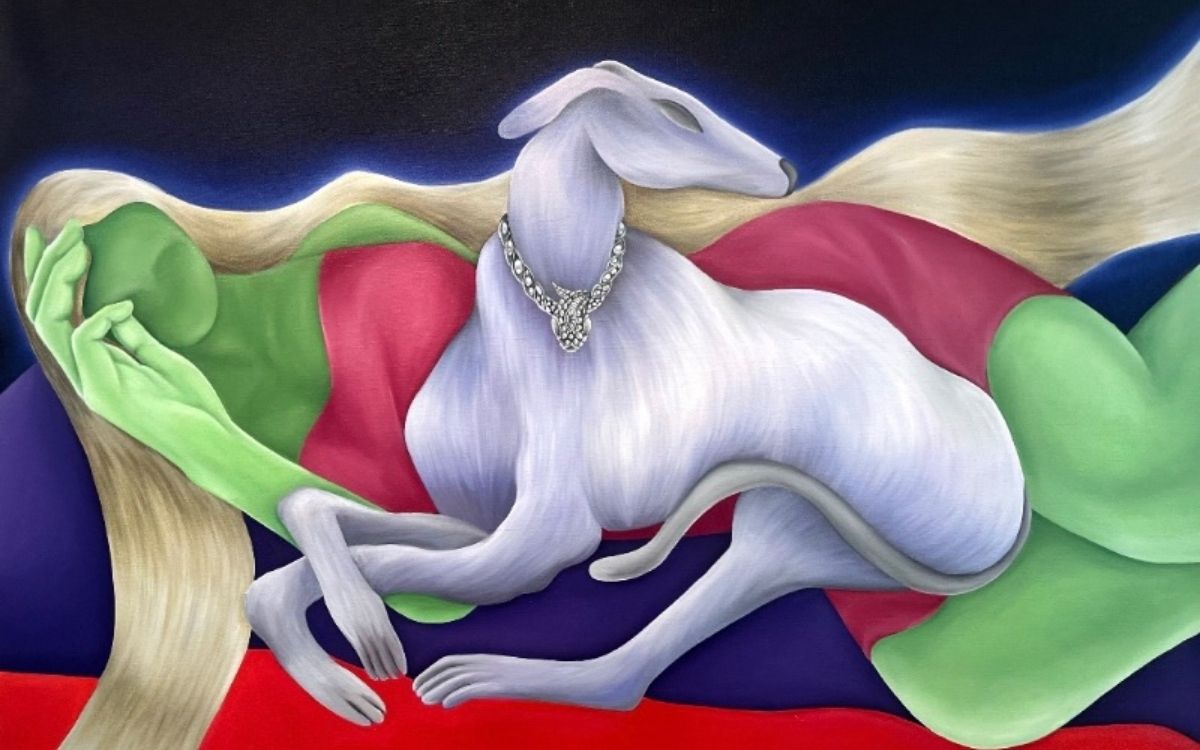
Tuna Özkaragöz is an artist who thinks in layers. Working primarily through figurative painting, Özkaragöz builds narrative-driven compositions that sit comfortably in the space between the conscious and the subconscious, the personal and the universal, the human and the natural world. The work is intuitive by design, open-ended by intention, and deeply rooted in a belief that a painting is never truly finished until it meets a viewer. What follows is a conversation about creativity, doubt, storytelling, and the quiet discipline of staying curious.
How do you reignite creativity during those inevitable periods of self-doubt or stagnation?
At first, creative stagnation can feel frightening. When you are used to constantly producing work, periods of doubt and uncertainty can easily create the feeling that something has gone wrong. Over time, however, I have learned to see these moments differently. Rather than viewing them as obstacles, I now see them as an essential part of the creative process.
I believe creative blocks often emerge when we spend too much time within the same environment, following the same routines and thinking in the same patterns. In my experience, they are rarely caused by a lack of ideas. More often, they happen when ideas begin to repeat themselves and something new is trying to emerge. It feels as though my mind is pushing me toward new experiences, new observations, and a different perspective. What initially feels like a dead end is often a signal that a transition is taking place beneath the surface.
Sometimes I think creative stagnation is the mind’s way of forcing us out of the studio and back into life. We can become so focused on producing work that we forget how much inspiration actually comes from life itself. When I feel stuck, I usually step away from painting completely and almost behave as if I am not a painter at all. Giving myself that distance allows me to reconnect with the world without the pressure of constantly searching for ideas.
I spend time wandering around Istanbul, visiting places I love, and immersing myself in everyday life. Because Istanbul is such a vibrant and constantly moving city, stepping outside often means encountering different people, different stories, and different ways of living. Alongside this, I make a conscious effort to spend more time in nature. I also try to spend more time with animals, especially my cats. Since animals frequently appear in my paintings, observing nature and animal behavior has become a continuous source of inspiration for me. Sometimes a brief conversation, an unfamiliar face, a particular gesture, or even the movement of an animal can become the starting point of an idea that I would never have discovered by sitting in the studio. These experiences remind me that creativity exists far beyond the canvas.
Another important source of inspiration for me is cinema. Since I usually approach my paintings as if I am constructing a narrative or a scene, analyzing film narratives often influences my own creative process. While writing about a film, I find myself thinking about character relationships, emotional tension, symbolism, and storytelling in new ways. Revisiting those texts later often helps me complete the missing pieces of narratives I have been developing in my paintings. Sometimes inspiration arrives not while painting, but while trying to understand and interpret another work of art.
One of the most important lessons I have learned is not to panic. Creative stagnation can create the illusion that productivity has stopped, but I no longer believe that is true. Beneath the surface, ideas are still forming, experiences are accumulating, and new connections are being made. Looking back, many of the works that have brought me the greatest sense of satisfaction emerged after periods of uncertainty. For that reason, I no longer see creative blocks as walls standing in my way, but as signs that a new chapter is about to begin.
How important is it for viewers to understand the intended message of your work? Does ambiguity add value, or do you seek clarity in your expression?
I rarely begin a painting with a fully defined message that I want to communicate. More often, the process starts from an intuitive or subconscious place. Only later do I begin to understand the psychological layers, emotions, and ideas that have found their way into the work. In that sense, creating a painting often feels less like illustrating a conclusion and more like discovering something about myself and the way I perceive the world.
This is also one of the reasons why I rarely enjoy explaining my paintings in great detail. Once a work is completed, I prefer to leave some space between the painting and its interpretation. If I define everything too clearly, I feel that I am limiting the possibilities the work can hold. What is interesting to me is that my own understanding of a painting can change over time. Years later, I may discover meanings, emotions, or connections that I was not consciously aware of while creating it. If my relationship with a painting can continue to evolve, it feels natural that viewers will bring their own interpretations to it as well.
I also believe that ambiguity encourages participation. It invites viewers to construct their own narratives, imagine relationships between figures, and bring their own experiences into the work. Some of the most interesting conversations I have had about my paintings came from interpretations that I had never consciously considered myself. Rather than seeing this as a misunderstanding, I see it as evidence that the work has developed a life of its own.
In many ways, this approach reflects how I experience life itself. My thoughts are rarely linear, and I have learned to be comfortable with uncertainty, contradiction, and change. Because of that, I am more interested in asking questions than providing definitive answers. My paintings do contain messages, but I prefer those messages to remain flexible enough to grow, shift, and reveal new meanings over time.
Of course, it is important to me that viewers connect with something in my work. I believe every artist communicates ideas, emotions, or perspectives through what they create, whether intentionally or not. I certainly want to communicate something through my paintings. However, the messages within my work are rarely singular or fixed. They are often layered, open-ended, and capable of holding multiple meanings at once.
Can you take us through the evolution of an artwork, from that first spark of inspiration to the finished piece?
In this work, the figure on the left represents humanity, the central figure embodies the artificial body, and the figure on the right symbolizes nature. All three are connected through a bond that originates from nature, while the artificial body at the center is shown in a state of ascent and transformation.
I chose to depict all the figures as women because fertility and creative power lie at the heart of this narrative. This future-facing reinterpretation of the sacred trinity represents a new form of sacredness—one that emerges through the shared evolution of humanity, nature, and artificial existence.
Before I began painting, I had the idea to reimagine a classical triptych painting but with a futuristic and feminine twist. At that stage I already knew I would name it Epiphany, which makes it the only painting of mine that I named before finishing the full artwork. Even though I am referencing classical triptychs with the format of the painting, the name Epiphany is used in a philosophical and literary sense rather than religious context. For me the painting doesn’t represent a personal “Epiphany” but a realisation in a cultural sense that will happen in the future with the recent place of technology in our lives and zeitgeist. To portray that first I planned to paint three paintings that are hung slightly apart but also connected in a visual sense, so they show three different yet connected ideas. All three have the same background with the horizon and a vast sky to show ascension. I kept the ground smaller to give an infinite feeling. Next I painted the human on the left canvas as a start of the story, the human is a female figure in a fetal position but she has an unnatural skin and color, and her veins are visible but they don’t pump blood instead they connect to the futuristic elements in the next canvas, making her look asleep in an artificial womb. Then I moved on to the canvas on the right, leaving the one in the middle for later. I knew I would paint an animal with old roots and some form of electric. For the third installation, I painted a stingray to represent mother nature and the life it gives. Stingrays live in the oceans with us but they can be tracked back to 150 million years ago, that’s why I chose to paint one as a representation of life that we know today. The stingray in the painting is connected to every figure in the painting just like how they have been with us for a long time, and gives electricity to the figures. The fetus on the left is connected to it from her belly, in the way a fetus is connected to their mother. Electricity is a powerful source of energy even used in emergency situations to fix someone's pulse, and an animal with electricity is a good fit for the message for the story of my artwork. Finally, it was time for the artificial aspect of the tryptic. The figure in the middle is a humanoid that looks like a human but also not as much as it would be confused with one. It doesn’t have a face or fingernails, so it is not quite human yet but a very close shape with its limbs and silhouette. The figure is ascending in a powerful yet delicate way and radiates in a way similar to holy figurines in classical paintings. There is water below gravitating towards it because it is a classical symbol of life and our planet. chose to depict all the figures as women because fertility and creative power lie at the heart of this narrative. This future-facing reinterpretation of the sacred trinity represents a new form of sacredness—one that emerges through the shared evolution of humanity, nature, and artificial existence. All three are connected through a bond that originates from nature, while the artificial body at the center is shown in a state of ascent and transformation.
Is art created for the artist, the audience, or somewhere in between?
I truly believe it depends on the artist, but if I had to choose, I would say that art is created for the artist first. I see art as a form of self-expression, and I try to keep my work personal. The ideas, emotions, questions, and experiences that shape my life naturally find their way into my paintings. Because of this, creating art has always felt like a way of understanding myself and making sense of the world around me.
At the same time, I do not think the audience is unimportant. In fact, I believe a work of art remains incomplete until it is encountered by a viewer. Once a work leaves the studio, it begins a new life beyond the artist. Viewers bring their own experiences, emotions, memories, and interpretations to a piece, allowing it to expand beyond its original intentions. In that sense, I think an artwork is completed through the act of being seen. The artist creates the work, but the viewer helps bring it fully to life.
This is one of the reasons why I enjoy hearing different perspectives on my work. Sometimes viewers notice meanings or connections that I had not consciously considered myself. Rather than seeing this as a misunderstanding, I see it as evidence that the artwork has developed a life of its own. A painting may begin with me, but it does not end with me.
However, I think there is a challenge that many artists face as their audience grows. The more people engage with your work, the easier it becomes to internalize their expectations. At some point, many artists begin to think not only about what they want to create, but also about what their audience might want to see. I believe this is a phase that almost every artist goes through. While it is natural, it can also be confusing because it becomes harder to distinguish your own voice from the voices surrounding you.
For me, artistic growth involves learning how to navigate that tension. I care about my audience’s opinions, and I value criticism. Constructive criticism can be an important tool for growth because it allows us to see aspects of our work that we may have overlooked. At the same time, valuing criticism does not mean agreeing with every opinion or changing direction every time someone suggests it. Artists need to learn which criticism can help them grow and how to use it in a way that remains true to their own vision.
I do not see this selectiveness as disrespect toward the viewer. On the contrary, I believe people are drawn to an artist’s work because they want to encounter a unique perspective. If an artist constantly adapts their work to satisfy expectations, there is a risk of losing the individuality that made the work compelling in the first place. Originality is one of the qualities that makes art feel alive.
There are trends in every aspect of life, including art. Trends can be inspiring and exciting, but they are also temporary. They come and go. What remains is an artist’s personal voice and visual language. For that reason, I try to focus on developing my own style rather than following what happens to be popular at a particular moment.
Ultimately, I believe art exists somewhere between the artist and the audience. The artist should create from an honest and personal place rather than from a desire to satisfy expectations. Yet once the work is finished, it no longer belongs entirely to its creator. It becomes something that can be experienced, interpreted, and transformed by others. That shared space between creation and interpretation is one of the things I find most beautiful about art.
Has social media democratized art or diluted its value? How do you feel platforms like Instagram influence modern creativity?
I do not think there is a simple answer to this question because I see both positive and negative effects of social media existing at the same time. Looking at my own experience, social media has provided me with important opportunities. A significant part of my visibility as an artist has come through these platforms, so it would be impossible for me to ignore the advantages they offer.
In the past, artists often needed to be present in more physical spaces, build more connections, and find different ways to present their work to a wider audience. Today, social media can function as a portfolio in itself. It allows people to discover your work more easily, connect with artists from different countries, and gain direct access to a visual world that might otherwise remain unseen. In that sense, I do believe social media has made the art world more accessible to a certain degree.
At the same time, however, it has introduced new challenges. Many artists today are expected to be more than artists; they are often expected to become content creators as well. There can be a tension between making art and maintaining visibility. Even during periods when you want to focus entirely on your work and disconnect from distractions, social media can create pressure to remain active and present.
Another important factor is the influence of algorithms. It is becoming increasingly difficult to exist on these platforms without being aware of how they operate. As a result, artists can sometimes find themselves adapting to the expectations of the platform rather than following their own creative rhythm. The pressure to post constantly, capture attention quickly, or fit into certain formats can inevitably affect the creative process.
Greater visibility has also brought greater competition. At times, it can seem as though follower counts, engagement, or online visibility are direct indicators of artistic value. Personally, I do not believe this is true. Visibility and artistic quality are not necessarily connected. Social media can make some artists highly visible while equally talented artists remain relatively unnoticed. For that reason, I think it is important not to confuse popularity with artistic merit.
Despite these concerns, I still believe social media has made it easier for artists to share their voices. It has created opportunities for people to reach audiences and communities that may have been inaccessible in the past. Because of this, I do not think social media has completely democratized art, nor do I think it has completely diminished its value. Instead, I see it as a system that has replaced old barriers with new opportunities and new challenges.
Throughout history, the art world has constantly evolved alongside society and new technologies. Social media is simply another part of that evolution. For me, the real challenge is learning how to exist within these systems without losing your own voice. That is not always easy, but I believe it is one of the most important tasks artists face today.
What are five steps you’re taking to ensure your continual growth as an artist?
One of the most important things I do for my artistic growth is knowing when to step away from the studio. As I mentioned earlier, I believe distance can be incredibly productive. When I spend too much time focusing on a work, I sometimes lose perspective. Stepping away allows me to return with fresh eyes and often helps me solve problems that felt impossible while I was immersed in them. It also creates space for new experiences, conversations, and observations. Sometimes a concert, an unexpected encounter, or simply spending time outside can become the starting point for new ideas. Even when nothing specific happens, the act of creating distance itself can be refreshing. In many ways, it is like stepping back from a painting in order to see it more clearly.
Another important practice for me is spending time in nature. Looking at trees, plants, and the sky, or simply being outdoors, helps me feel renewed. It restores my energy and brings a sense of balance to my daily life. Alongside this, I spend a great deal of time with my three cats and caring for the plants I grow on my balcony. Watering them, pruning them, and observing their growth has become a small but meaningful ritual. These activities help me slow down, reconnect with the present moment, and maintain a sustainable relationship with my work. Nature and animals have always been among my greatest sources of happiness, and they continue to influence my artistic practice in subtle but important ways.
I also make a conscious effort to learn from artists I admire. I read essays and books about their work, explore their biographies, watch interviews, and listen to conversations about their creative processes. I find it fascinating to see how different artists think, solve problems, and develop their own visual languages. Learning about their journeys often encourages me to reflect on my own practice and reminds me that artistic development is a lifelong process.
One of the strongest sources of inspiration in my life comes from music. Watching music videos and live performances by musicians I love constantly motivates me and fuels my creativity. I am fascinated by the way musicians create atmosphere, emotion, and visual identity around their work. Their performances often remind me of the power of storytelling, rhythm, and emotional expression. More than almost anything else, music helps me maintain my excitement about creating and continuously pushes me to explore new possibilities within my own work.
Another important source of inspiration for me is fashion. I have loved watching runway shows since I was a child, and I still find them incredibly inspiring. I enjoy following designers whose work resonates with me and observing how they build entire worlds through clothing, styling, movement, music, and presentation. The unexpected combinations of colors, textures, silhouettes, and materials often open new creative pathways in my mind. Fashion shows remind me that visual storytelling can take many different forms, and they frequently inspire ideas that later find their way into my paintings. In many ways, they encourage me to keep experimenting, stay curious, and push my work in new directions.
Taken together, these practices help me stay curious, motivated, and open to change. For me, artistic growth is not only about producing more work; it is about continuously finding new ways to engage with the world around me.
What artistic superpower would you most like to possess, and how do you think it would influence your work?
If I could have any artistic superpower, I would choose the ability to record my dreams. I often dream of unusual places, encounter fascinating people, and experience situations that feel completely real while I am inside them. I do not necessarily want to control my dreams or change them. Instead, I wish I could photograph them, or even film them, and revisit them later with complete clarity.
Many of the images I encounter in dreams disappear almost immediately after I wake up. Sometimes I can remember fragments, atmospheres, or emotions, but rarely the entire experience. I often wish I could return to those places and examine them more closely. There are dream spaces I would love to revisit, details I would like to study, and moments I wish I could preserve exactly as they appeared. If I had this ability, I imagine creating a personal archive of dreams that I could return to whenever I wanted.
Another reason this idea fascinates me is that dreams can sometimes feel even more real than reality itself. There are moments when I wake up carrying the emotional weight of a dream as if it were a genuine memory. Certain places remain with me for days, and some encounters feel as vivid as experiences from my waking life. Because of this, I do not see dreams simply as fantasies. They feel like an alternative visual reality that exists somewhere between memory, imagination, and the subconscious. Being able to preserve that reality and build a visual archive from it would be incredibly valuable to me as an artist. Dreams have always influenced my work in one way or another, whether consciously or unconsciously. They often contain unexpected narratives, unusual relationships, and visual combinations that I would never invent intentionally. Because of that, I think being able to preserve them would become an endless source of inspiration.
What excites me most is not the idea of reproducing those dreams exactly as they appeared. Instead, I would use them as raw material. I would take images, characters, spaces, and fragments from that dream archive and reinterpret them through my own visual language. In a way, I imagine creating a collage from those collected memories, transforming them into paintings that combine dream imagery with my own symbols, emotions, and personal narratives.
I think dreams contain a kind of visual freedom that is difficult to access in everyday life. Being able to preserve and revisit those worlds would open countless possibilities for my work. More than anything, it would allow me to continue exploring places that exist somewhere between memory, imagination, and the subconscious. For an artist who is deeply interested in intuition, psychology, and storytelling, I cannot think of a more inspiring ability.
How do you envision the evolution of your work in the coming years?
I wouldn't want to plan my future in detail because the most interesting discoveries I have made have come from unplanned experiments. However I do know that at a certain point I would like to explain my art less verbally, instead create a feeling, and combine my strengths to form a new visual language. Rather than having a set goal, I wish to develop a multi dimensional world that evolves with me through time. Looking back, my art process has been full of trying new things, and trusting my instincts, so I am hoping for more surprises in the future. I prioritise my sense of wonder before anything as my main force to keep my artistic inspiration alive. Learning, observing, feeling, and staying excited for the world will fuel my artistic growth.
I am also interested in different forms of art, I even did a film and tv minor in university. In the future I would love to become an all rounded artist using different mediums and disciplines, such as combining traditional art with filmmaking or architecture. For example an ambition that excites me is to create a piece that works directly with the architectural structure it is in. My paintings have always existed within spaces, but the idea of integrating them into a building itself is fascinating to me. I like the idea of a painting becoming a part of a place that people move through, experience, and live alongside everyday, giving it a different sense of permanance. One of my all time goals is to paint a huge area like Diego Rivera, and in the future I would like to work on this dream step by step as I make my artwork bigger. In a way bringing together different disciplines feels like an opportunity that can exist beyond the limits of a canvas and become a part of life. Content wise, I want to continue with figurative paintings, keeping exaggerated human and animal forms as my subjects for storytelling to represent my point of view. While I am open to change and new ideas, the way I express myself and give out the messages I want works well with the symbolism I do today. Although I believe these figures will remain, how they will look, which forms they will take and the relationships they have will change, only time can show that to me. One of my biggest fears as an artist is to keep recreating the same painting, that is why I hope my artwork evolves in the future, some themes may remain but the way I express them should change, growing as an artist while staying loyal to my true self. My biggest hope would be that my work never becomes too comfortable.
What emerges from a conversation with Tuna Özkaragöz is a portrait of an artist who has learned to trust the process, including the uncertain, unproductive parts of it. The stagnation, the distance, the wandering through Istanbul, the cats on the balcony, the runway shows and the dream fragments that vanish at dawn: all of it feeds the work. Özkaragöz is not chasing a fixed destination. The goal, as expressed throughout this conversation, is something more alive than that. A visual world that keeps growing, shifting, and surprising, loyal to its own voice, and never too comfortable to change.