
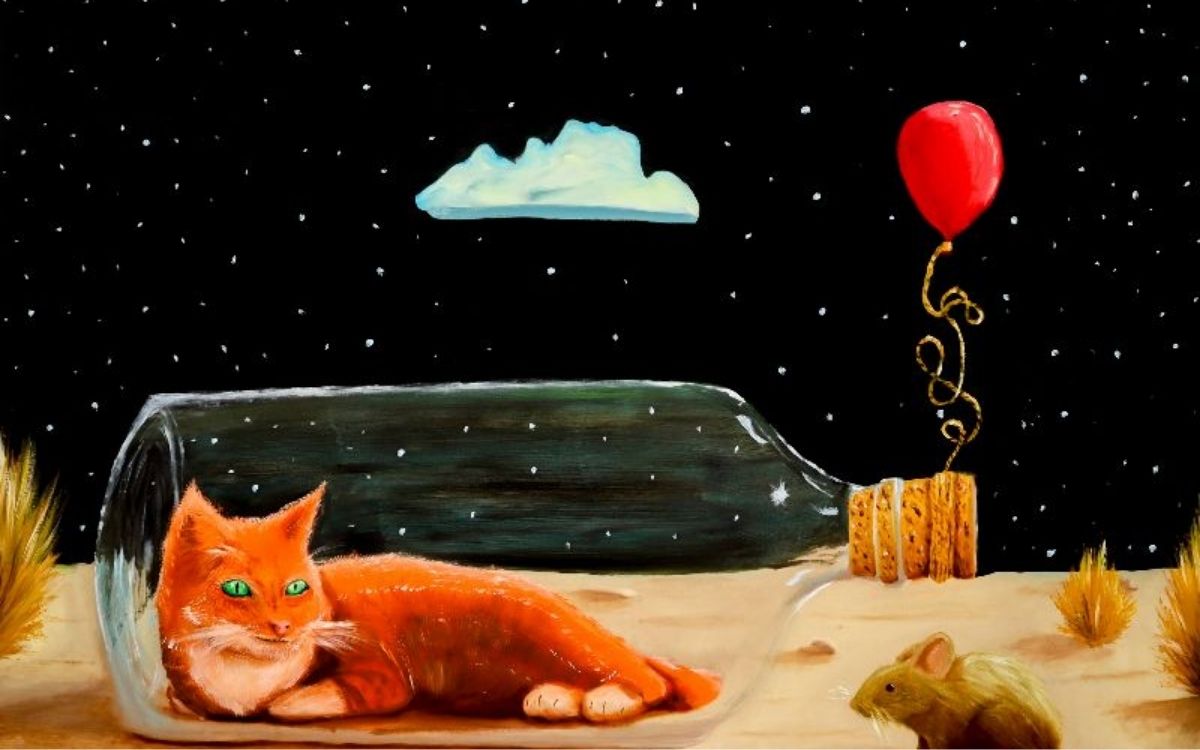
Keegan Evans grew up in a zebra-striped house full of cockatoos, found cinema seats, and the kind of parents who believed strange and wonderful things deserved to exist in the world. That upbringing left a permanent mark. Evans is an Australian artist whose paintings layer expressive abstraction beneath refined surrealism, using a coded visual language to explore the space between opposites: conscious and unconscious, internal and external, the seen and the unseen. The work is restless, deliberate, and unmistakably singular. What follows is a conversation about where that vision came from, and where it is headed.
How has your upbringing or cultural heritage shaped the themes and techniques you explore in your art today?
I was fortunate enough to be born to parents as strange as myself, or perhaps I am who I am because of them. We are all products set between nature and nurture.
When I was 2 years old, we painted the exterior of our house entirely in a zebra pattern, much to the shock of the neighbours on our street (who quickly became lifelong friends). Our zebra house only grew with curiosities from there; a giant mosaic of a snake done by my mother next to the driveway, a big permaculture garden designed by my father to be shaped like a pizza; surrounded by fruit trees and native flowering banksia trees that still bring in flocks of cockatoos, rainbow lorikeets and giant screeching fruit bats.
Pretty much all of mum and dad’s projects were done with second-hand, free or found materials. The giant metal climbing frame shaped like a boot, with a slippery dip coming off it into our sandpit, came from a school that was getting rid of it. The rows of vintage wooden cinema seating around the back deck were indeed from an old cinema that was remodelling and giving its old seats away.
My mother is a teacher, and my father is an ecologist. Their combined love of education and of exploring ideas and places eventually led them to take my brother and I out of school for a year to travel. We travelled throughout Australia and Ireland, which are my parents' birth countries and the countries in which I hold dual citizenship. This was a massively formative experience for me as a 10-year-old child and is what started me down the path of exploring dualities and binary forms.
Mum and Dad bought a Toyota Coaster off some nuns in Sydney, gutted it, and built one hell of a holy roller. It was a home on wheels (minus the zebra stripes). One day we would be searching for opals in the desert, the next we would be looking off the edge of the world, down to the ocean far below the cliffs of the Nullarbor. One day mountains, one day rainforest. One day beaches, one day desert. One day Perth, one day Dublin. I found the duality of the world around me to be mesmerising. I was fascinated by what was between two things. Was there a middle point, a common ground or something new? When did one thing become another, where did somewhere become somewhere else? Where was the defining barrier between everything and me? Where do the internal and the external meet? The duality of experience and the binary systems that dominate our lives in unseen ways. That is what my work is fundamentally about. The emulsification of an individual experience, externalised into something everyone can see.
I was always told by my parents, “We don’t care if all you do in life is clean toilets; just make sure you’re good at it and that you’re happy”. I have always been comforted by that. I have still always feared failing, but I understand that you must, at the very least, try. Make what you want; disregard the naysayers of your vision. In the end, we are all the triumphs of our failures.
Many years later, these things, and the countless other peculiarities of my childhood, continue to inform me that you are allowed to make strange and wonderful things. The joy of existence is not in the plain white suburban temple of mediocrity; it is in a zebra house full of life.
How important is it for viewers to understand the intended message of your work? Does ambiguity add value, or do you seek clarity in your expression?
My work is an attempt to communicate with others in a way that is entirely me. I will happily tell anyone who asks what a piece is about, but I also love hearing what people take away from my work.
For example, I recently sold a piece titled "Smokers ‘r’ Jokers”, an oil painting of a jester, inspired by “Stańczyk” by Jan Matejko. I made the piece as an exploration of the duality of life and death. The collector purchased it because they said it reminded them of the first moment you have to yourself after a gruelling week of work. For them, the piece was a moment of reprieve against the monotony of existence. That reprieve, I imagine, to many may feel like a jester smoking a cigarette halfway between life and death. Taking a moment alone to decompress, still dressed in your work clothes, is itself a universal image.
I feel that the conceptual meanings found in art lie somewhere between what the artist intends and what the audience takes. My work is filled with recurring symbols and figures that are deeply personal to me. A kind of coded visual language that I hope someone connects with. It does not bother me if someone prefers their own interpretation to what I intended; if they connect with it, they connect with me.
Ambiguity can be useful to hide behind; most artists are guilty of this to some degree, but if it is all you have to rely on, I think your work will suffer, and your audience will become alienated. I do not necessarily seek clarity in my work, but I constantly seek cohesion that people can recognise unambiguously as Keegan Evans.
How has your artistic style transformed over the years? Are there specific influences, experiments, or moments that marked a turning point?
From the time I could hold a tool to scratch a mark on this world, I have been doing so. Over the course of that time, my work has inevitably changed multiple times before settling into something I feel is entirely me. I have incubated, pupated, and emerged with something entirely my own.
Coloured pencils and crayons were my first medium as a child. It was during this stage of my career at the ripe old age of 4 that I encountered my first critic. A girl in my kindergarten class made fun of me for weeks for only having 6 non-brand crayons, comparing them to her 20-pack Crayola-branded crayons. Eventually I told her it didn’t matter if she had more than me because she couldn’t draw if her life depended on it; she cried, and I got in trouble from the teacher. Everyone is a critic, including me, I suppose. Many years later, I was watching the movie “Waking Life”, and there was a scene where a character is discussing how it doesn’t matter how many crayons you have, but what you do with them. I was immediately transported to my childhood. I paused the movie and created a piece titled "6 Pack Crayon Box”, which was the first time I had really tried to work expressively. I think these moments combined to create a turning point for me artistically. That piece sold at my last exhibition, and I think it goes to show that you never know what will inspire you.
From my childhood, I spent many years just drawing with a graphite pencil. I would trace printed images against a sunny window until I could draw them from memory. Later, this would prove to be a useful skill, as I can now accurately turn anything I see into a line drawing by imagining how it would feel to draw.
In my teenage years, I started committing myself to painting more than drawing. I am still better with a pencil than a brush, I think, but I much prefer the art I make with a brush. During this stage of my artistic development, I formed a lot of the initial proto-Keegan style. Bold colour choices, surrealism, humour and often a sense of unease or cerebral disconnection.
After finishing high school, I worked various jobs while studying at university. I was in warehousing for a bit, a courier for a bit and a kitchen hand for a bit. Much of my work life until now has been about lifting heavy objects, waking up early and being covered in some degree of dirt. Art fell a bit by the wayside, but it was always in the background. It was around this time I decided that I would like to attend art school. I thought it might be a waste of time, but I found it to be anything but. I met many like-minded people, great teachers and people in the broader art scene of Newcastle (Australia) while taking on new mediums and artistic experiences.
Now I have combined everything into one process. Going back to the idea of emulsification and duality, I layer surrealism over expressive work to drape the abstract in the non-abstract. I want to see the unseeable and reality coalesced into one cohesive package (a tall order for a mortal man). I play with covering and uncovering different aspects of my work to compare and contrast these ideas. I usually start with a colourful and expressive base painting using the same colours for this step of the process throughout all my work. During this initial expressive stage, I think about the unseen aspects of reality: whizzing atoms, universal forces, consciousness, thoughts, dreams and spiritualism. Then, when that dries, I begin to choose which aspects of the painting to cover up with a refined surreal painting, based around what I am looking to communicate. I may fragment the head or disconnect it from the body. I might leave the eyes abstract, refine them completely, cover them entirely, or do some combination of the three. I might leave the background with one flat colour or create an entire scene. A flat black background represents unconsciousness; these paintings come from dreams. A yellow background means the painting was an entirely conscious creation, and pinkish-red is a combination of the two.
Name five pivotal lessons you’ve learned that shaped your artistic journey.
Do not fear the failure of not being immediately good at something. When approaching a new medium, or if you are just getting started in your artistic journey, chances are you won't have a clue what to do. That is okay. The work of people you admire who seem to have it all together is only there because at one point they could not do what they are doing. They failed countless times, and you are seeing the product of their journey. An athlete trains every day to get a little bit faster, a little bit stronger, to refine their form. If you had never worked out before and went to the gym once expecting to win a bodybuilding competition the next day, you would find yourself disappointed. The same is true with your art. If you have never held a brush before, don’t expect to make the Mona Lisa, but you can, if you keep picking up the brush.
Showing your work publicly is intimidating, but the best thing you can do for yourself. Get amongst the thick of it. If I could go back in time and tell myself to get involved in my local art scene sooner, I would. The more shows you attend, the more work you see that isn’t your own, the more artists you meet, the more ideas you will inevitably have. If you make art to connect with others and the world around you, show it. You will meet many great people, and the connections you make will end up benefiting you. Enter an emerging art prize, submit your work to group shows, get to know the artists who work in your community. The experience you will gain is invaluable.
Do not dwell on criticism. If it is well-intended and constructive criticism, consider it; if it does not benefit your vision, leave it by the side of the road. You can’t please everyone. There are over 8 billion people on earth. If one person doesn’t like what you do, someone else will. Nobody decides what you should be making except you.
Aiming towards a general idea of where you might want to be will get you further than if you don’t. You do not always have to know how to get somewhere in your life to get there in the end. Nobody has a straightforward path. Shoot for the moon… something about stars… I am sure you know the rest.
You can always come back to an artwork if it isn’t working out. I used to agonise over finishing every painting I started before starting something new. It wasn’t helpful. Now, if I get stuck on a piece, I set it aside and start something new. In other words, sleep on it. It isn’t going anywhere, and it is okay to abandon a piece. After a time, you can come back to it and rework it, or just paint over it with something completely new. Not every idea is going to be good. Understanding that will help you.
If you could become one of your creations for a day, which would it be and why?
Funnily enough, in a way, this will become a reality for me very soon. I am currently creating a big papier-mâché wearable head of one of the recurring figures in my dreams that often features in my work. The figure is a misshapen cyclops I have taken to calling Grace Matango. This figure represents my subconscious mind communicating with my waking mind. Bringing Grace Matango to the real world has always been a dream of mine. I envision creating several large papier-mâché heads of the recurring figures in my work, to be worn by people during my exhibitions. To have my work and ideas walking around the audience and not just hanging on a wall would be a sight to see.
In a less real sense, I would also choose to be Grace Matango for a day to explore all the aspects of inner space that I could use in future work.
How do you envision the evolution of your work in the coming years?
Bigger, bolder and more immersive. I suppose my desire to execute large-scale, but well-thought-out weirdness probably comes from my parents. I already paint on a larger scale than many artists I know, but I have visions of work that goes beyond my current scale. I am also working on incorporating sculptural pieces as part of my repertoire, which is becoming an exciting addition to my visual language. Currently, I am still working out what works best in three-dimensional space in conjunction with my paintings. It will be interesting to see how this aspect of my practice develops.
It is hard to commit to a style without fearing stagnation, but seeing the ways your style can stretch and bend as it evolves with you is one of the most exciting things for me. I think that if you aren’t furthering your own practice with new ideas and forms, you are missing out. I like drawing, painting, printmaking, photography, knitting and crochet, sewing, welding, sculpting, soldering, writing and music. I am compulsively drawn toward any form of creative expression. I work every day on my artistic output; if I feel burned out in one medium, I switch to another. I am non-stop with my production and often have several projects happening at once. I never feel like I am out of creative energy. The idea tank is always full. It’s just a matter of making time to get it done.
I think as I expand from just exhibiting paintings, my work will evolve into its own world that I get to be a part of. Bringing people into my work, creating an experience for them, and connecting on a deeper level is always the goal.
Are there any upcoming projects or dreams that you’re particularly excited about?
Long-term, I am working on a large-scale exhibition that will contain upwards of 100 paintings, supported by sculptures and interactive performance art. My goal, both for myself and the audience, is to create an experience that feels less like a gallery and more like the inside of a mind. I want to build a living world populated by the recurring figures of my art existing physically in the exhibition space, allowing a complete immersion into the circus of my mind.
I also have many irons in the fire for art competitions, commissions, and group shows coming up over the next 12 months while I focus on building the body of work I envision.
What becomes clear, reading through this conversation, is that Keegan Evans is not simply making paintings. The work is an ongoing attempt to map the territory between things: between waking and dreaming, between artist and audience, between the self and the world outside it. From six crayons in a kindergarten classroom to a vision of one hundred paintings filling a gallery like the inside of a living mind, the throughline has always been curiosity and a refusal to settle for the plain white wall. The zebra house was just the beginning.