
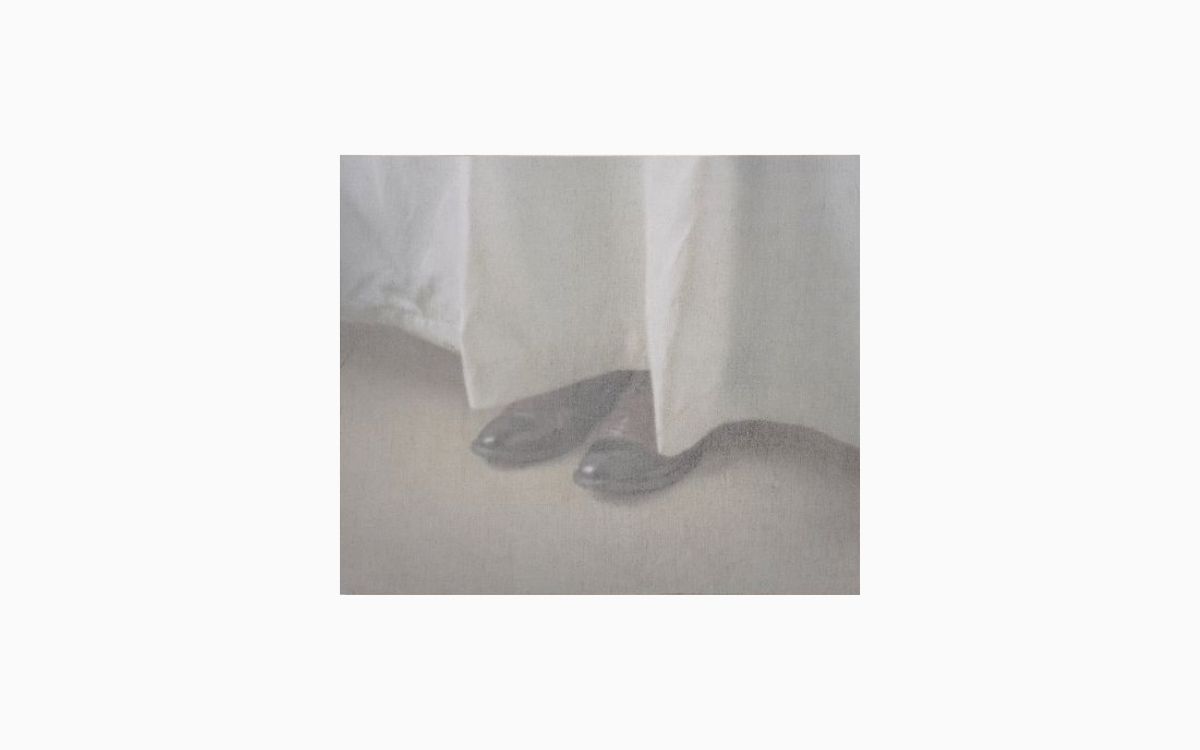
Alejandro Javaloyas grew up in Mallorca, left at seventeen, and has spent the decades since working through what that upbringing left behind. A Catholic school education, a conservative environment, the experience of growing up gay with very little room for it: these are not distant biographical details but active materials in the work, returning in the form of religious imagery, ritual, guilt, devotion, and a slow reconciliation with a cultural heritage that was once a source of fear. The practice moves between photography, painting, sculpture, and colored-pencil drawing depending on what a given project demands, always circling the same concerns: time, decay, disappearance, and the anguish of not knowing what lies beyond this material life. What follows is a conversation about nightmares turned into drawings, and why insisting on sensitivity in a time of brutality is not nothing.
How has your upbringing shaped the themes and techniques you explore in your art today?
My upbringing has had a very clear impact on the way I make art today, both thematically and technically.
I was born and raised in Mallorca, in a Catholic and fairly conservative environment. I went to Catholic school until I was 18, and growing up gay in that context, especially in the late ’80s and early ’90s, was not easy. Fortunately, things have changed a great deal since then, but at the time there was very little space to exist openly or without fear. As soon as I could, I left Mallorca at 17 to study filmmaking at ESCAC, in Barcelona. I was deeply interested in cinema, of course, but I think I was also looking for a place where I could feel safe enough to bring my whole self into the world.
That background still appears very clearly in my work. Childhood, Catholic imagery, religious symbolism, ritual, guilt, fear, devotion, redemption — all of those elements are part of the visual and emotional vocabulary I return to. For many years, I had a conflicted relationship with faith. Over the last decade, I have slowly reconciled with that part of my cultural heritage, and art has been one of the main ways of doing so.
I am not interested in religion from a strictly doctrinal point of view. However, I do feel close to many of the Catholic values I was raised with: honesty, humility, non-violence, forgiveness, compassion, and selflessness. At the same time, questions around the passage of time, death, and whether there is anything beyond this material life are still very present in my work. Religion, for me, is one way of approaching that universal fear, and of dealing with the anguish of not knowing — with finitude, mystery, and the limits of human understanding.
There is also a technical side to that upbringing. As a child, I was always drawn to drawing, and I had a natural ability for it. From the age of six, I attended different art academies in Mallorca, studying with Ernest, Malena Tous, and Antònia Oliver. My training was very classical and academic, based on drawing, observation, discipline, and craft. That still informs the way I work today. I understand painting and drawing as practices that require patience and technical rigor. For me, mastering technique is not about virtuosity for its own sake, but about reducing the distance between intention and image.
How has your artistic style transformed over the years? Are there specific influences, experiments, or moments that marked a turning point?
I see myself as a multidisciplinary artist — almost like a polyhedron with many different faces. I was trained in classical drawing and painting, but also in music, through piano and voice, as well as classical dance, filmmaking, and even cooking. To me, most of these creative practices feel deeply connected. They may use different tools and materials, but they seem to come from the same place in the brain, or at least from the same kind of sensitivity.
That has naturally led to a very eclectic practice. In 2023, I presented Floating Matter, a solo exhibition curated by Fernando Gómez de la Cuesta, made entirely of photographic work. In 2024, I developed a project called Poèmes Chromatiques around expanded painting, exploring the boundaries between painting and sculpture. I was interested in pushing the object-based condition of painting by bending the support itself, creating arched canvases that became partially detached from the wall. My current body of work, Un cuchillo que no corta, moves in a different direction again: it is mostly composed of colored-pencil drawings on cotton paper mounted on wood, and the pieces feel much more realistic, intimate, and academic in their execution.
I truly believe that form should derive from the project. Usually, there is an idea, a theme, or a question that I want to confront, and the medium emerges from the needs of that investigation. Depending on what I am trying to think through, the work may become photographic, sculptural, painterly, or something in between. This can lead to very different outcomes, but I do think there is always a common ground beneath the surface.
Formally, there is often a sense of economy in my work: a reduction of elements, subdued color palettes, soft or diffuse light, and a certain restraint in the composition. The work tends to avoid excess, even when the subject matter is emotionally charged. Thematically, certain concerns keep returning again and again: the passage of time, decay, disappearance, mortality, and the awareness that everything is moving toward its own end.
Many artists have a clearly defined and consistent formal vocabulary that makes their work immediately identifiable across time. That kind of coherence is often appreciated by galleries and collectors, and I understand why. But it is simply not my nature. Trying to force my work into a single recognizable style would feel artificial. Over time, I have learned to accept that different projects may need to look different, and I have started to embrace that as a strength rather than something to fight against.
Do you think art should have a political agenda?
I don’t think art necessarily should have a political agenda, at least not in the sense of being didactic, programmatic, or activist by default. I understand my own practice primarily as a form of creation, not activism. That distinction matters to me. Activism has its own language, urgency, strategies, and responsibilities. Art can participate in political life, of course, but I don’t believe every artwork has to function as a direct statement, a campaign, or a tool for persuasion.
At the same time, I also don’t believe art can ever be completely outside politics. Every choice we make as people carries a position, even when it is not explicit: what we choose to look at, what we choose to ignore, what we consider worthy of time, attention, care, beauty, or grief. George Orwell wrote that “no book is genuinely free from political bias,” and that the idea that art should have nothing to do with politics “is itself a political attitude.” I agree with that. Even silence, withdrawal, intimacy, slowness, or ambiguity can become political depending on the context in which they appear.
Toni Morrison also spoke very clearly about this. She argued that good art can be political and beautiful at the same time. That is important to me, because sometimes political art is discussed as if beauty, ambiguity, or formal complexity were somehow suspicious, as if a work had to renounce those qualities in order to be ethically serious. I don’t believe that. A work can be quiet and still have a position. It can be deeply personal and still be connected to the world. It can refuse slogans and still be shaped by history.
I am highly interested in issues such as global warming, the acceleration of inequality, and the global rise of the extreme right and populism. I am also a politically engaged person in my daily life. I follow Spanish politics closely, because Spain is my home country; I follow French politics, because France is where I currently live; and I follow the international situation with real concern. In a moment marked by terrible armed conflicts, such as the wars in Ukraine, Palestine, and Iran, it can sometimes feel almost impossible to continue making humble, intimate, highly personal work. There are days when it feels immoral, irrelevant, or unnecessary.
That conflict is very present for me. I often ask myself what it means to make drawings about dreams, fear, childhood, spirituality, or death while the world is experiencing so much visible violence. But, so far, I haven’t found an honest way to push my practice toward a more directly activist landscape. If I did it only because I felt I had to, I think the work would become illustrative or false. I would rather accept the discomfort than force the work into a language that does not belong to it.
Audre Lorde’s idea that poetry is “not a luxury” also resonates with me. I think there is something necessary in giving form to fear, grief, memory, vulnerability, and uncertainty. That may not be activism in the direct sense, but it is not nothing. In a time of brutality, to insist on sensitivity, attention, ambiguity, and emotional complexity can also be a way of resisting the flattening of experience.
Can you take us through the evolution of an artwork, from that first spark of inspiration to the finished piece?
My most recent project is a body of work called Un cuchillo que no corta — A Knife That Doesn’t Cut. I recently opened a solo exhibition under the same title at Galeria Reus, in Palma, Spain, on June 4. The project brings together a series of small-format colored-pencil drawings that come from a very personal source: my recurring nightmares.
I have had intense nightmares since I was a child. Many of them return again and again over the years, sometimes with slight variations, sometimes almost unchanged. For a long time, I have kept notebooks by my bed where I write down whatever remains when I wake up: a sentence, an image, a color, an object, a gesture, a strange atmosphere. Most of the time, a dream disappears very quickly. You wake up with the feeling that you have just experienced something incredibly vivid, but within minutes it begins to dissolve. What remains is usually incomplete, almost like a fragment of evidence.
That is where the process begins. The first spark is not usually an image in the traditional sense, but a residue: a note from a nightmare. It might be something very simple, like a burning house, a mouth open in fear, a curtain, a moth, a religious figure, or a child’s object charged with unease. These notes are never enough to reconstruct the dream completely, but they contain a kind of emotional truth. They are small verbal remains of something that was once visually and psychologically overwhelming.
From there, I use artificial intelligence text-to-image tools to generate visual material from those notes. I am interested in the paradox of that translation. A nightmare moves from image to memory, from memory to language, and then, through AI, from language back into image. Of course, the result is never a faithful reconstruction. It is always distorted, incomplete, slightly wrong. But that “wrongness” is important to me. The AI introduces deviations, misreadings, and unexpected associations. It becomes a kind of external unconscious, producing images that are not exactly mine, but that still seem to belong to the same emotional territory.
I usually generate a large number of images and then go through a long process of selection. Most are discarded. The ones that remain are reframed, edited, adjusted, desaturated, softened, or blurred until they reach the atmosphere I am looking for. I am not interested in using the AI image as a finished artwork. For me, it is a transitional image, a reference, a ghost image. It gives me something to work from, but the real piece begins when I start drawing.
The final works are made with colored pencil on cotton paper mounted on wood. This stage is slow and very physical. I work through many delicate layers, gradually building color, tone, and texture. There is a strange tension in the process: the source image is unstable, artificial, and mediated, but the drawing requires time, patience, and direct contact with the surface. I try to rescue the image by hand, but only partially. I don’t want it to become too clear. The finished work has to remain suspended between apparition and disappearance, as if it were still being remembered or still fading away.
In that sense, each artwork is the result of several translations: nightmare into note, note into AI image, AI image into edited reference, and reference into drawing. What interests me is not only the final image, but also everything that is lost, distorted, or transformed along the way.
Artificial Intelligence is increasingly infiltrating creative fields. Do you see artificial intelligence as a threat, a tool, or a collaborator in the art world?
I see artificial intelligence primarily as a tool. A very powerful one, and therefore a potentially disruptive one, but still a tool.
I completely understand why many artists feel threatened by it. AI raises serious questions about authorship, labor, intellectual property, consent, environmental impact, and the speed at which images are produced and consumed. I don’t think those concerns should be dismissed. Kate Crawford has written very clearly about the material and political cost of AI, and I often return to her idea that “AI is neither artificial nor intelligent.” It may seem immaterial from the outside, but it depends on very real infrastructures: data, labor, energy, minerals, and water. Those issues matter, and I am still trying to understand them, research them, and find my own position.
At the same time, I have chosen to embrace AI within my own limits. I am not particularly tech-savvy, and I don’t approach it from a place of fascination with technology itself. I use it in a very specific way, as part of a larger artistic process. In Un cuchillo que no corta, AI is not used to produce the final artwork. It is used to generate reference images from notes based on my recurring nightmares. Those images are then selected, reframed, edited, and transformed before becoming references for colored-pencil drawings made by hand. What interests me is not the technological novelty of AI, but the imperfect translation it introduces: nightmare into note, note into prompt, prompt into image, image into drawing.
That process is conceptually important to the series. A nightmare is already something unstable. It is vivid when you wake up, but it quickly begins to disappear. When I write it down, I am already losing part of it. When I ask AI to generate an image from that note, another distortion appears. The result is never exactly what I dreamed. It is always slightly wrong, excessive, or displaced. But that distance is precisely what interests me. AI becomes a tool for misremembering, for producing a visual echo of something that cannot be fully recovered.
I have encountered people who react with immediate rejection when they hear that AI is involved in the process. I understand the hesitation, but I also find that reaction a little unfair when it dismisses the work without looking at how the tool is actually being used. I don’t want to hide the use of AI, because it is part of the concept of the project. But I also don’t think its presence automatically devalues the work or removes the human decision-making behind it.
Art history is full of moments when new tools or production methods were initially viewed with suspicion. Walter Benjamin, writing about mechanical reproduction in the 1930s, argued that “the technique of reproduction detaches the reproduced object from the domain of tradition.” He was describing a major shift in how art was made, circulated, and valued. Photography, printmaking, film, and later silkscreen all changed the relationship between hand, image, originality, and reproduction. Those changes were frightening at first, but they also opened entirely new artistic languages.
We do not usually discredit Renaissance paintings because they were produced within workshop systems, where assistants and apprentices often participated in the making of an artwork. We do not reject Warhol because he used silkscreen, a mechanical and reproducible process, rather than painting every image by hand. In those cases, we understand that the meaning of the work is not located only in manual execution, but also in the artist’s choices, context, framing, and transformation of the image.
I don’t want to compare myself to those artists, of course, but I do think the historical pattern is useful. New technologies often create anxiety because they disturb existing ideas of skill, authenticity, and value. Over time, that initial aversion usually becomes more complex. Some uses of the technology will be lazy, extractive, or ethically questionable. Others may become meaningful, critical, or poetic. For me, the important question is not simply whether AI is involved, but how, why, and to what end.
Can art making be truly therapeutic? Have you experienced its healing power personally or seen it impact others?
Absolutely. In my case, art has always been deeply therapeutic.
I was a very unusual kid in many ways: gay, highly sensitive, a fast learner, and later diagnosed with ADHD. I never really fit in, and during my school years I was exposed to bullying. In that context, the privacy of my bedroom became essential. I would spend hours on the floor drawing and painting, and that space became a very real refuge for me. It gave me joy, confidence, calm, and a sense of control at a time when many things outside that room felt hostile or confusing.
That relationship with art has continued throughout my life. I am an introvert, and although I would not describe myself as shy, I do need a significant amount of time alone almost every day. My studio time is very important to my mental and emotional balance. Spending four or five hours in silence, or listening to jazz or classical music while I read, think, draw, or paint, is deeply healing for me. It allows me to slow down, to organize my thoughts, and to return to myself.
I am also very drawn to repetitive tasks. My current colored-pencil drawings are extremely labor-intensive and take a long time to make. The act of layering, shading, and slowly building an image through repeated gestures has something ritualistic about it. The same happens when I self-publish and make fanzines: folding, assembling, numbering, arranging, repeating the same gesture again and again. I find those processes calming and almost meditative. They help reduce anxiety because they create a rhythm, a structure, and a form of attention that is physical rather than purely mental.
As for the effect of my work on others, that is harder for me to say. I hope some of the work I make resonates with people and triggers something in them, whether that is comfort, unease, recognition, sadness, curiosity, or any other kind of emotion. But I don’t think about that while I am making the work. In the studio, I create for myself. I follow the needs of the project and my own internal questions.
Once a body of work is finished and leaves the studio for the exhibition space, I go through a kind of detachment. The work no longer feels entirely mine. It belongs to the world, or at least to the people who encounter it. How they react to it is something I cannot control, and I try not to anticipate it too much.
Are there any upcoming projects or dreams that you’re particularly excited about?
Yes, there are several projects coming up that I am very excited about.
My solo exhibition Un cuchillo que no corta opened on Thursday, June 4, at Galeria Reus in Palma, Spain, and will remain open to the public until September 1, 2026. It is a very meaningful project for me because it brings together many of the concerns that have been present in my work for years: dreams, fear, childhood, Catholic imagery, the passage of time, death, and the attempt to give form to something that is constantly disappearing. Since the show has just opened, I am still very much inside that emotional moment of seeing the work leave the studio and encounter an audience.
At the end of June, my gallery will also be bringing my work to CAN Ibiza, the international contemporary art fair. We will be showing some of the new pieces there, which is exciting because it allows the work to exist in a very different context.
I am also currently working on a new solo show that will open in December at Sa Refinadora, a public art space in Marratxí, Mallorca. The exhibition will be titled Now it’s time for monsters. It is still in development, so I prefer not to define it too much yet, but I can say that it continues some of the darker psychological and symbolic concerns of Un cuchillo que no corta, while moving toward a new body of work.
Beyond that, I am currently in conversation with a gallery in Paris and another one in London about possible solo exhibitions in 2027. Nothing is fully closed yet, but those conversations are very encouraging. After many years of working quite privately and persistently, it feels important to see the work beginning to travel, to enter new contexts, and to build conversations outside of the places where it first emerged.
Alejandro Javaloyas works slowly, in silence or with jazz, building images through repeated layered gestures that have something ritualistic about them. The studio is a refuge, as it has been since childhood, and the work that emerges from it travels at its own pace. A solo exhibition open in Palma until September, a fair in Ibiza, a new show titled Now it's time for monsters in development for December, and conversations underway with galleries in Paris and London: after years of working privately and persistently, the work is beginning to move. Each piece in the current series passes through several translations before it arrives, nightmare into note, note into AI image, image into drawing, and something essential is lost at every stage. That loss, it turns out, is the point.