
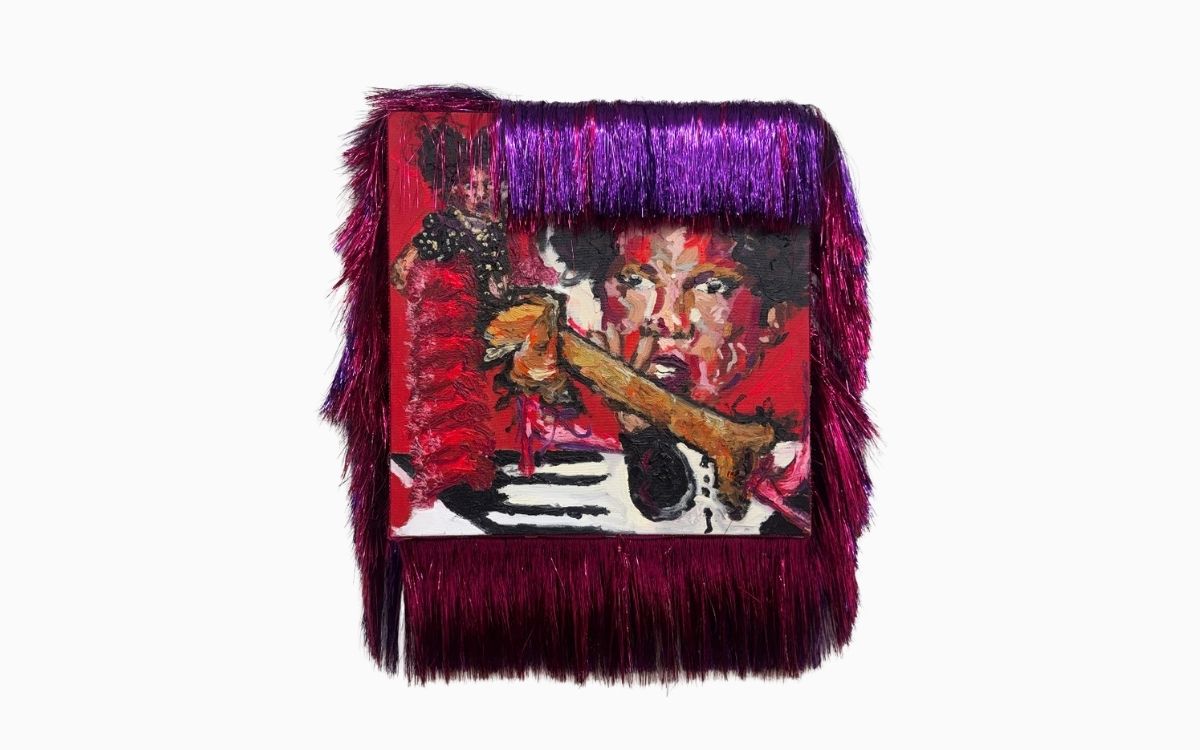
Ademar Marinho grew up in an evangelical Christian household in Manaus, watched a grandmother crochet, and carried both of those things, the inherited narratives about morality and beauty, and the logic of accumulation and construction, directly into a practice that now operates at the intersection of devotion and desire. The work refuses to separate the sacred from the profane, the personal from the collective, the high from the low. Catholic iconography, Madonna, romance, fashion, queer identity, and the visual languages that quietly shape our understanding of love and belonging all coexist within the same image, layered until they form new meanings. What follows is a conversation about the right to excess, the refusal to resolve contradictions, and what happens when everything that was once considered too much is embraced as the point.
How has your upbringing or cultural heritage shaped the themes and techniques you explore in your art today?
I grew up in a Christian household where religion and family were deeply embedded in everyday life. Many of the themes that continue to shape my work today emerged from that environment.As a queer person, I became interested early on in the narratives we inherit about morality, beauty, and identity. Much of my practice is rooted in revisiting those narratives. One of my earliest creative memories is watching my grandmother crochet. That logic of accumulation and construction remains central to my practice: layering materials, references, memories, and symbols until they form new meanings. I was born in Manaus and now live in Rio de Janeiro, but I don't think of my work as being tied to a specific geography. Instead, it is shaped by the emotional and cultural landscapes that formed me.
Does spirituality or a connection to something larger than yourself influence your creative process?
Very much so, although not in a straightforward way. I grew up in an evangelical Christian household, but I was always fascinated by religious imagery, ritual, and the idea of devotion itself. As a teenager, I became curious about traditions that existed outside the environment I was raised in, particularly Catholicism. I was drawn not only to its visual language, but also to its rituals, symbols, and collective gestures.
Today, I find inspiration in different cosmologies. Rather than following a single path, I am interested in the spaces where different beliefs intersect. In many ways, this reflects the cultural reality of Brazil itself, where religious identities often overlap and coexist in complex ways. I am interested in the proximity between pleasure and guilt. Spirituality enters my work not as certainty, but as a form of curiosity, longing, and continuous transformation.
What unusual or unexpected sources of inspiration have deeply influenced your work?
I am often drawn to images that exist somewhere between devotion and desire. In that sense, I think there is a fundamentally punk impulse running through my work. As a willingness to challenge hierarchies and find value in things that are often dismissed as vulgar, sentimental, decorative, or excessive. One of my strongest influences is Pierre et Gilles. Their work feel almost like collages, accumulating symbols, ornaments, and layers of meaning until they become something simultaneously sacred and theatrical. I am also deeply inspired by popular imagination itself: Catholic institutions and iconography, romance, music, fashion, and the visual languages that quietly shape our understanding of love, beauty, and belonging.
Music is a constant influence in my practice. Madonna, in particular. I also find inspiration in artists such as Alair Gomes and Hudinilson Jr., whose work expands conversations around desire, masculinity, intimacy, and the body. My works are often built through the collision of references that would not traditionally belong together. Rather than separating high and low culture, sacred and profane, or personal and collective memory, I am interested in what happens when these worlds coexist within the same image.
Describe a piece you've created that has held the most emotional weight for you. What makes it significant?
One of the most significant works I have created is Here Comes the Bride. The piece brings together crocheted fragments originally made with my grandmother, lace, embroidery and safety pins. What makes this work meaningful is that many of its materials come directly from my own history. The crochet elements are actual pieces connected to moments I shared with my grandmother. Revisiting them became a way of revisiting parts of myself as well, while confronting the lasting effects of growing up as a queer person within a conservative religious environment. The process felt like excavation. The embroidery borrows a line from Madonna's spoken-word piece that reinterprets biblical language through the lens of desire, temptation, and autonomy. For me, this phrase encapsulates the process of reclaiming parts of oneself that were once shaped by repression. The work evokes bridal imagery while simultaneously disrupting it. It references institutions and expectations surrounding love, marriage, and belonging, while also creating space for identities and desires that have historically been excluded from those narratives. More than any single artwork, it feels like a self-portrait.
If you could communicate just one core message through your entire body of work, what would it be?
If there's one thing my work advocates for, it's the right to excess.
I have always been interested in everything that exceeds the boundaries of what is considered appropriate, restrained, or acceptable: excessive devotion, excessive desire, excessive sentimentality, excessive beauty, excessive longing. Much of my practice emerges from questioning why certain forms of intensity are celebrated while others are dismissed as too much. As a queer person growing up within religious structures, I often felt encouraged to simplify myself, to resolve contradictions, or to choose between different parts of who I was. Over time, both life and art have taught me that these tensions do not necessarily need to be resolved. Desire and devotion can coexist. Pleasure and spirituality do not have to be opposites.
How do you challenge yourself to continually grow as an artist while remaining true to your voice?
Everyday life is what continually shapes my practice. Everything I do eventually becomes material, narrative, or methodology. The places I inhabit, the people I work with, the challenges I encounter, and even moments of uncertainty or discomfort all find their way into my work in some form. Growth as an artist comes from remaining curious and allowing myself to learn through experience. Navigating unfamiliar situations often push me toward new techniques, materials, and ways of thinking. I am particularly interested in the possibility of transformation: taking materials, symbols, or narratives that already exist and shifting their meaning. Many of my works emerge through this process of displacement. I am also interested in questioning ideas that we often accept as fixed truths. Whether these involve institutions, notions of beauty, desire, identity, or devotion, my practice attempts to create space for alternative narratives. Remaining true to my voice has less to do with maintaining a consistent aesthetic and more to do with staying connected to the questions that continue to move me. The desire to challenge inherited narratives and find new meanings within them remains constant.
In a world flooded with imagery, what responsibility do artists have to stand out and say something authentic?
The abundance of images isn't necessarily a problem. In many ways, my work embraces excess rather than resisting it. I often think through painting as a form of collage. I work with pre-existing images, symbols, and narratives, layering and reinventing them through accumulation. I am interested in visual overload and in what emerges when seemingly unrelated references coexist within the same space. I think authenticity comes from the way we engage with the images that already surround us and the meanings we choose to construct from them.
People have often assumed that my work is overtly militant or explicitly political, but I have never experienced my practice in those terms. I am less interested in delivering clear messages than in creating spaces where complexity can exist. At the same time, I recognize that my experiences inevitably shape the work. Questions surrounding queer desire, devotion, freedom, and romantic longing emerge naturally because they are part of how I move through the world. Sometimes simply insisting on complexity, pleasure, tenderness, and the freedom to exist outside rigid expectations can become a meaningful statement in itself.
How do you envision the evolution of your work in the coming years?
I hope to continue deepening the connections between the different fields that already inform my work: visual arts, fashion, and music. These practices have never felt separate to me. They are all different ways of exploring similar questions surrounding identity, desire, devotion, performance, and image-making. Moving forward, I am interested in creating experiences and bodies of work that allow these worlds to coexist more fluidly, rather than existing as isolated aspects of my practice. I am particularly interested in expanding the relationship between my artistic practice and fashion. Given my background and longstanding interest in clothing and adornment, I would love to collaborate with brands that resonate with my values and aesthetics, creating wearable pieces that carry the symbols, narratives, and emotional landscapes present throughout my work.
Materially, I am excited by experimentation and scale. I hope the evolution of my work reflects the complexity of my interests rather than simplifying them. I want to continue building a practice where art, fashion, music, and object-making exist in dialogue with one another. I also hope that this journey allows me to connect with and be recognized by people whose work I deeply admire, creating meaningful exchanges through the things I make.
What kind of legacy do you hope to leave in the art world?
I think more about leaving a legacy in the world itself. This might sound overly ambitious, but I often wonder: what's wrong with ambition? For me, art has never existed separately from life. My work is an extension of who I am, just as I have been shaped by the process of making it. Over time, I have come to understand artistic practice not simply as the production of objects, but as an ongoing process of self-construction and self-understanding. I admire figures like Madonna and Andy Warhol not only because of the work they created, but because of how inseparable their practices became from the way they moved through the world. They understood that identity itself could be a creative act. I hope my own legacy reflects that same complexity. Rather than being remembered for a single body of work or discipline, I would like to be recognized for building a life where art, music, fashion, spirituality, desire, and human connection continuously informed one another.
Ultimately, I hope my work encourages others to embrace the ongoing process of becoming. The self is never fixed; it accumulates experiences, contradictions, relationships, and desires over time. Perhaps my legacy is simply this: to have lived authentically through that process, and to have invited others to imagine broader possibilities for themselves as well.
Ademar Marinho thinks more about leaving a legacy in the world itself than in the art world specifically, and sees no reason to apologize for that ambition. The practice has never existed separately from the life, just as the life has been continuously shaped by the practice. Art, fashion, music, spirituality, desire, and human connection are not separate fields but different ways of exploring the same questions. The self, as this conversation makes clear, is never fixed. It accumulates. It contradicts itself. It transforms. The invitation extended through the work is the same one extended to anyone willing to look: that becoming is ongoing, that complexity does not need to be resolved, and that the freedom to exist outside rigid expectations is, in itself, something worth making art about.