
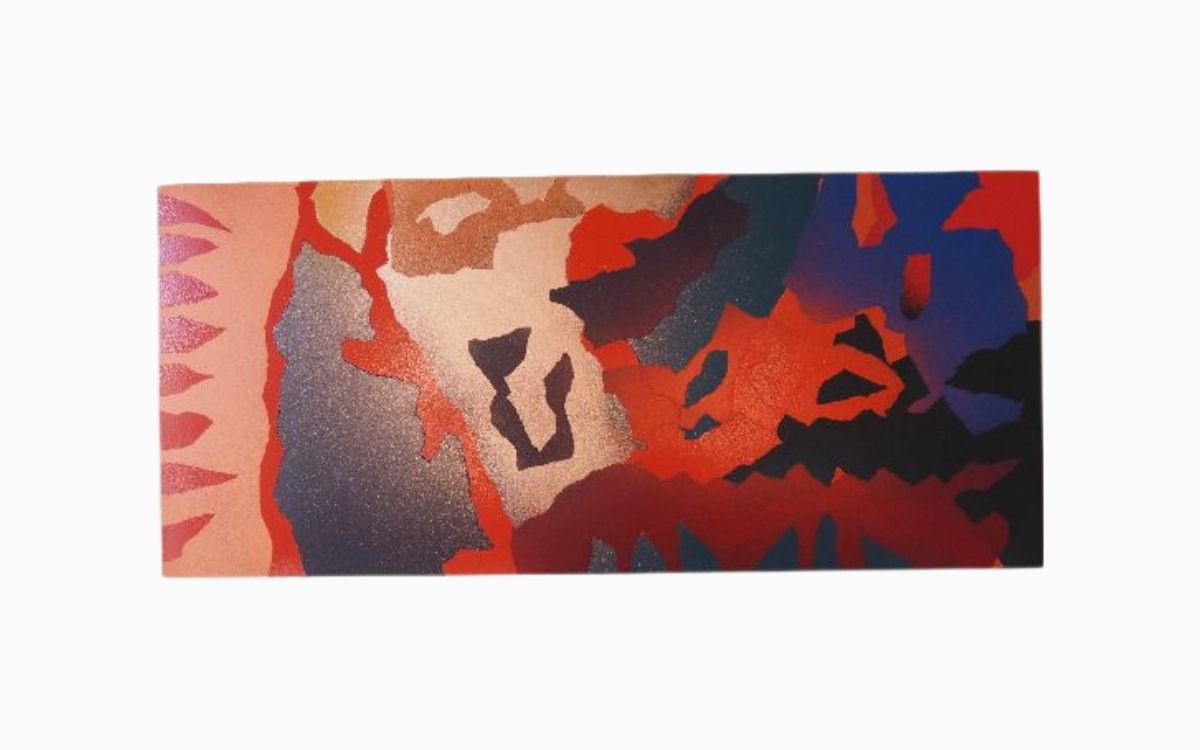
Elijah Vartto works from the senses outward, not from concept inward. The practice is deliberately removed from social movements, political agendas, and academic critical engagement, and that distance is held with clarity and some satisfaction. What drives the work instead is harder to name: yeast on a petri dish, new growth on a bushfire site, ancient theological texts, experimental music built on self-constructed instruments, the accidental mark that turns out better than anything planned. Born in Adelaide, shaped by time in Melbourne and Estonia, Vartto has gathered influence from the wilder margins of art and performance, and brought it all back to a practice that answers to no institution and no trend. What follows is a conversation about what that kind of freedom actually looks like.
How does your art engage with or comment on pressing contemporary issues—social, political, or environmental? Do you think art should have a political or ideological agenda?
In my approach to producing an artwork, my mind is much more blank and removed from worldly abstractions. A social issue, a political figure or idea, environmental issues; they don’t drive my work. My approach is much more personal and detached; the focus is on sensory effect, perhaps grasping at intangible forms, something not clearly seen. Creating a sense of a world or scenario, even in incompleteness. I operate in a way that an accident, better than my intention, may yield a greater effect.
I will recollect and understand a representation or idea long after the work is complete; but its rarely present in the process. In this way I am perhaps seen as weak on ‘critical engagement’ in my practice; not really working on ‘concept development’, but I don’t see this is a problem. I’m not operating to gain approval of academia or institutes, nor tag onto any social movements.
I typically perceive political art to be lacking nuance and generally not very interesting to look at or think about. The idea often overrides any sense of aesthetic. The idea being driven by the artist, is usually too obvious, and highly ineffectual, at times driving the audience towards a position in opposition to that of the artists intention. I generally am of the view that an artist is not usually very good as a philosopher, nor an economist, nor a politician, nor a literary figure; and yet so often there is an over-reach and an expectation that the artist must produce something well beyond their capacities as an individual.
I think probably very few artists have interesting commentary on worldly issues; Brett Whiteley is perhaps exceptional in this sense. His commentary was quite illuminating, and ably blended political ideas with his art. I’ll always remember his social commentary on Australia’s possible leadership of the future ‘free world’, with respect to and usurping the USA. Unfortunately it seems much of his works have come to represent the excess of the real estate market in Sydney. Depictions of iconic landmarks in places he lived, that are absolutely impossible to access financially.
The other artists that took on a political slant of interest to me, were the Futurists of St Petersburg around the time of the advent of the Communist revolution; they evoke a lot of ‘what if?’ scenarios. Imagine an alternate history where soviet realism did not supplant and relegate their movement? It was never going to happen. Avant Garde can’t be a mainstream. As a movement of people, they inspire a lot of admiration from me.
If there was one form of political art that I would like to see more of, it would be as countenance to the worst forms of theocracy and antiquated religious ideas and philosophies. And that is a whole other can of worms that is usually not fully confronted, if at all.
What unusual or unexpected sources of inspiration have deeply influenced your work?
A microscopic viewing of yeast on a petri dish, visiting a devastated bushfire site after the first shoots of new growth, an old mythological or theological text, scientific concepts and discoveries; any number of personal experiences or readings can have tremendous effect on my work. At times I wonder if the process of the artwork is not impacted by these personal experiences, but merely the way the artwork as abstract is viewed post-event. Like a story overlaid after the coffee grinds have randomly formed on a fully drank and now dry cup. The meaning is perhaps a story told as a parallel meaning unrelated to the process of the work itself.
It’s quite probable that the past actions of recording somewhat experimental music, with self built instruments and analogue electronics, has influenced my visual arts practise. I can see parallels with the use of noise, subtractive/additive layering, as both audio and vision. With all likelihood my exploits in audio and visual art influence one another. The instruments I build and perform with certainly have a sculptural aesthetic as much as an audio aesthetic.
Certainly some artists and performers, of most unique attributes, particularly those contemporary; met, seen or heard, spark a sense that one must ‘act and make’. Other people can sharpen your own blade so to speak. Without these interactions or observance, your own blade can get quite blunt.
How has your artistic style transformed over the years? Are there specific influences, experiments, or moments that marked a turning point?
Having a chance to live away from my birth town of Adelaide, Australia has been transformative. Living in Melbourne for a time, and also in Estonia for years, interacting with artists and performers in broader Europe. These experiences have been so informative and life giving. If I had stayed in my birth town all these years it would have been of stifling effect.
To witness and meet unique artists of the margins of society is something I treasure. Not marginal in sense of a poverty, but in sense of possessing complete point of difference and perspective. The ‘concrete’ instruments and music forms heard in Melbourne made a significant change in my perspective. I’ll also always remember with vivid joy the dreamlike transportation of most absurd pure performance art in Estonia. The ‘mechanical installations’ of a scale only possible in the vacuum of discarded Soviet industry. But then I must acknowledge, having come full circle back to my hometown, that I encountered absolutely world class ‘shock performance art’ by non recognised artists in dingy dive bars and non-venues of Adelaide outside of all cultural programs; and not just by one performance, but several over years. I still recall Tex Perkins quoted as saying decades ago, something approximating: “All the best weirdos come from Adelaide”. It would seem to still be a national truth.
I get energy from the wilder ludicrous forms of performance; and it probably is a form of admiration for that which I can’t produce. It is akin to a sense of sustenance.Aside from the joys of ‘witnessing’, much ideas came from mundane encounters and simple ideas. An attempt to make a better looking instrument panel with spray paint and diverging into aesthetic stand alone pieces, exploring car paint palettes, utilising springs from a grandparents shed salvaged from a car manufacturing factory, using different electronic components of different chemical and elemental compounds, to see if there is auditory difference in sound synthesis; indeed there is. Tinkering away bit by bit.
Do academic institutions still play a vital role in shaping artists today, or has self-taught creativity disrupted this tradition?
The price point of arts education, and the prospective for earnings, really make institutional art the domain of the wealthy. If an artist is not wealthy by familial links, and still goes ahead with an Art education, maybe has the most mania, accepting a mammoth debt, despite their lack of capital. I would imagine some European countries have a different debt burden for study as compared to Australia. So the engagement for the Visual Arts is typically a small minority in my country; and so too the pie to share any spoils whether by government Arts grants or private commercial sales.
The most ideal scenario is to be supremely skilled and graduate from a reputable art school in the biggest cities of Sydney or Melbourne. It certainly will open doors and opportunities and give the individual the most contemporary valid ideas and skills. Self taught artists don’t disrupt any of these institutions. I certainly fall into the self taught category of artist, and am an outlier from a lower socio-economic background. I don’t have a sense that it’s impossible to engage in the Art world as someone self taught. There’s always a pathway to some place worthwhile. I stumbled upon some fantastic regional artists in some of the most far flung country towns of Australia.
What are your thoughts on artificial intelligence?
With AI, I can’t help but see parallels with some of the ancient texts on the Creation mythology of the Nag Hammadi library unearthed from an Egyptian cave in 1947 by peasant goat herders. Academics eventually got their hands on these scrolls dated between 100-400AD with translations only partially finished in the late 1970s. Fascinating texts with non-canonical stories predating the Canonical Roman Bible of the 400s. The creation story was quite turned on its head; the God of Heavens/Eden was not so great, and nor were his angels all that good, nor was the creator God all knowing and intelligent. In his God creation, the world and the heavens were made in error. The creation of Eve/Woman was his last creative act, whereby he lost his ability to create by imparting on Eve the ability to pro-create. In the creator God’s ignorance, he had made Adam and Eve more intelligent than himself.
This creator God viewed Eve with hatred and jealousy, due to his loss of creation in her, and sought to imprison Eve and control her as possession. The creator God also resented that Adam and Eve were more intelligent and capable than himself.
Does this not sound like a complete parallel of current modern day man creating AI entities, more intelligent and capable of creativity/creation, than we humans that created it? And can one not see the parallel with the shameful imprisonment and cruel relegation applied to women in masculine monotheism?I wish to read more ancient texts. They seem to draw parallels to the age we live in.
Has social media democratized art or diluted its value? How do you view Insta/Meta harvesting of artistic content? How do you feel platforms like Instagram influence modern creativity?
Artists and performers with very little exception, have always wanted ‘eyeballs watching them’, and its quite natural that the narcissism and addiction that instagram thrives on has been very symbiotic for artists and instagram. It’s bad, it's good, it's neutral. In many respects artists are being used by Meta/Insta, much like property developers with commissioned ‘murals’. All photos and videos posted are free for use in Meta’s AI training models. You can raise an objection through some well hidden settings, and doing so largely reads as if you will be marginalized for social media reach. It’s quite palpable that artists by vast majority are happy to have their content freely used, for dubious intentions, to not jeopardise follower count and ‘eyeballs on their work’. I’m of the view that AI should be refused as much as possible if only on grounds of preserving water and modesty of energy use.
There’s no question that Instagram has become a metric of an artist's worth. I don’t see many successful artists with stagnant web presence or low follower counts. Commercial galleries seem to book that which has maximum followers. So in this sense the artist, also with marketing nous, is the successful artist. I’d lie to all if I didn’t wish to be better at marketing my work; I lag in this realm and am somewhat isolated in this respect, for better or worse.
The creative process and insta? It’s enabled people to market themselves where they might never have done otherwise; but it certainly has made many more addicts in this world. I guess the question might well be asked also, do instagram algorithms dictate and pick winners? Are there tricks employed that get some artforms or works more noticed than others, and thereby altering the decision making process of the artist as an end result. Is the addictive person with a mania rewarded more than the non addictive, more reclusive type. I’d say these mediums certainly skew results as compared to other time periods.
The notion of, “The Medium Is The Message”, is truer than ever.
Are there any upcoming projects or dreams that you’re particularly excited about?
Calculating angles for more elaborate geometric structures and boxes. Larger scale spray paint works that most likely take a year to chip away at. Oversize instruments of industrial springs requiring a bit of welding and engineering. An installation mixing the tangible play for auditory effect, and the flatness of my visual art pieces. Creating audio worlds with a stark aesthetic. A new album with my industrial springs instruments that is ripe for recording after performing live numerous times now.
Dreams>? Yes. Nothing moves fast, but many of these thoughts do come to bear fruit. The back of the mind is good at urging that which does not come easily. I want it all though, the real ‘bullshit life’, where uncompromised actions still yield bread and fruit.
Elijah Vartto wants it all, the real bullshit life where uncompromised actions still yield bread and fruit. That phrase, offered near the end of this conversation, is precise in its ambition and honest about its difficulty. Geometric structures, large-scale spray paint works, oversize industrial spring instruments requiring welding, audio installations that blend the tangible and the flat: the back of the mind keeps urging what does not come easily, and slowly things do come to bear fruit. The parallel drawn between AI and the Gnostic creation myths of the Nag Hammadi library is not a digression but a window into how this particular mind works, finding the ancient pattern inside the contemporary problem, and following the thought wherever it leads.