
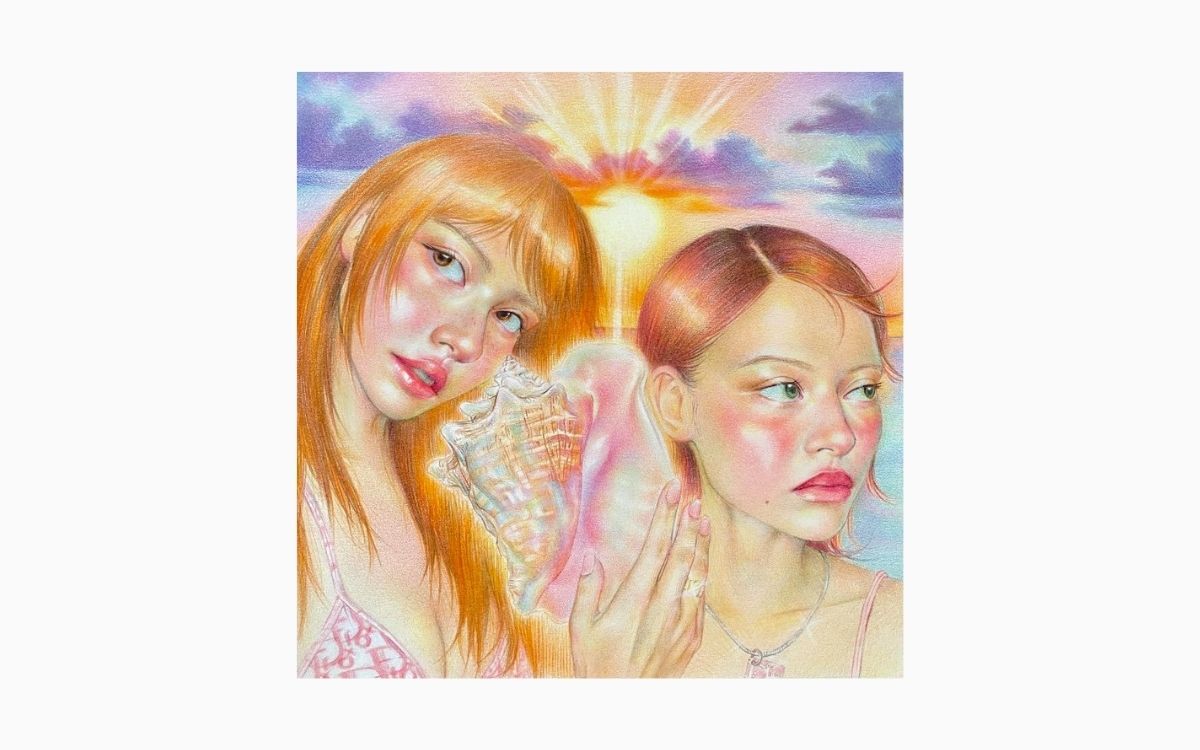
Kamryn Tulare is self-taught, and the work makes that clear in the best possible way. The drawing style, the subject matter, the internet-era references and the K-pop and anime sensibilities folded into a contemporary visual language: none of it came from an institution, and all of it is the stronger for it. The women depicted are never at an end result, always mid-process, carrying feelings that sit somewhere between the ordinary and the spiritual, open enough for a viewer to bring their own emotions without being directed. What follows is a conversation about finding and keeping an authentic voice in a world that constantly pushes toward the safe and the sellable.
How has your upbringing or cultural heritage shaped the themes and techniques you explore in your art today?
Most of my art is based on what I feel and experience now, but also I know that it’s largely shaped by my childhood and upbringing. Many of my pieces are influenced by the internet both today and its rise/evolution through the early 2000’s and 2010’s eras. I often try to connect that time to today’s zeitgeist, along with finding or pointing out synchronicities between nature and the current trends/moments. Being a self-taught artist definitely allowed me to freely explore several different styles and avenues of art - all of which I still admire and take inspiration from today. I think the subject matter in my pieces and my drawing style reflect the fact that I didn’t receive a traditional/ institutional art education, but I like to think that’s what gives me unique ideas. I grew up as a nerdy little wasian girl with a K-pop, anime, and video game obsession, living in a dysfunctional family dynamic and, for lack of a better phrase, white trash household, so I’m sure all of those components of me inadvertently show up in my art.
Does spirituality or a connection to something larger than yourself influence your creative process?
I consider myself a pretty spiritual person and I think it does go hand-in-hand with my art practice. To simplify it greatly, I don’t know if there is something or forces that are ‘larger’ than us necessarily, rather than something that exists within us, although is unseeable and manifests in different ways, from different experiences. Probably all of the women I depict are in some sort of process of the self - they’re never at an end result - and that spiritual influence exists within those processes I try to communicate. I find that even ordinary feelings can be spiritual especially if they’re heightened, like for instance a feeling of deep sadness or intense joy, or perhaps if they’re very intentional like a sense of empowerment or determination, because I think that all leads to something better, or simply closer to where you want to be. I imagine that whichever situation or feelings the women in my drawings are experiencing, there is an inherent unknown influence, and if you can’t see it in my pieces then maybe you can feel it.
Do you believe an artist's passion is something destined or a conscious choice?
Both. Not every artist is born with natural artistic talent, creative or skill-wise. I think what feels destined is the sort of “calling” people get to create, but sometimes that calling comes from a conscious choice to try making art in the first place. Just because someone has to put in more effort to be creative or skillful doesn’t make their art less valuable or authentic. I think I had that calling from a very young age, but when I think back on certain moments in my life, I totally could have lost that drive to create art if I hadn’t made conscious decisions to further my skills or pursue my ideas. I believe passion comes from doing, and the deeper you delve into something the more passionate you get.
How important is it for viewers to understand the intended message of your work? Does ambiguity add value, or do you seek clarity in your expression?
I rarely ever put clear messages in my work, not because I feel that my art needs to have a sense of ambiguity, but because my ideas mostly come from observations and feelings, so they end up being pretty open to interpretation or something for the viewer to attach their own emotions to. I don’t think every piece of art needs a message. Even if I create something with a message behind it, I’m fine with my pieces existing for people to simply admire them. I acknowledge that art (including my own) is and can be very meaningful, political, serious, etc, but at the end of the day I am putting out a product to an extent - something for people, the public, to behold and consume, so I don’t put much importance on how the viewer interprets it and I don’t feel I have a right to put that responsibility on anyone. I also think a ‘message’ can be a very simple statement and that’s just as valid. Overall I think it depends on the artwork, but I don’t like feeling pressured to make something deep when it doesn’t need to be.
How do you challenge yourself to continually grow as an artist while remaining true to your voice?
It can feel overwhelming because there are several ways to grow as an artist that can affect your practice and career. I’m constantly working to grow professionally, where I’m treating my art like a business, making more connections and sales and growing on social media. But if I focus on that too much I can neglect growing creatively and internally which, for me, requires a bit of isolation, deep reflection and leaving space for just me, the art-making process, and nothing else. I think that challenge of remaining true to my voice really lies in the professional growth, because in that sense I do work to make art that people would want to buy, so that I can continue to find opportunities that allow me to make art and share it with the world. I know that as long as the art I’m making comes from an idea that I feel is authentic and makes me excited (rather than something that just feels like a moneymaking or trendy opportunity), then I’m staying true to my unique voice and vision.
How do you feel social media is shaping the way art is created, consumed, and valued today?
In my experience it definitely depends on what art spaces you’re a part of online, but from what I’ve seen it's had a positive impact on the art world and all different kinds of artists. Since I didn’t go to art school, the best and most career-advancing opportunities I’ve received were all from people discovering my art on Instagram, and now I’m able to be a little more picky about which galleries/spaces I show my work in because I’ve already garnered an audience and people buy directly from me. There are also a lot of artists that share not only their art, but their creative process, emotional struggles, and advice on social media just because the format allows people to feel comfortable sharing that kind of stuff, and that makes it so easy for other artists to connect to and learn from. Of course there is a lot of slop on social media (don’t get me started on AI), but I do think it’s a net positive, working as a community-building tool and bridging a gap between both small/big or new/established artists, galleries, and buyers alike.
Identify five habits or concerns you are actively trying to let go of in your practice.
Working up until the very last minute when I have deadlines. I usually underestimate how long something will take me, or I get caught up in little details before I’ve finished the main parts of the piece, and I’m always left pulling all-nighters to get something done.
Settling on an idea that I’m not fully happy with. When I feel rushed to get something done or get a piece finished, it’s not uncommon for me to settle on an idea that’s not fully thought-out, and each time I follow through on a concept like that, I’m never happy with the outcome.
Not sharing a piece of art because I don’t personally like it. A lot of times the pieces I like the least are other people’s favorites, so I always have to convince myself to just put it out there, try to grow from it and move on.
Slowing down on my progress when I’ve already made good progress. I’m terrible at ‘rewarding’ myself when I've done something good, which leads to me not taking advantage of the momentum I’ve built by working efficiently, but deep down I know the most rewarding feeling is finishing something I feel good about, and maybe I can wait to play video games. Unfortunately at almost any point in the day, I would rather be playing video games….
Comparing my work to other artists (and being hard on myself about it). I can admire other art and artists, work to improve my own art, and be proud of what I’ve made all at once. Being mean to myself has never resulted in anything productive.
How do you envision the evolution of your work in the coming years?
I expect to make larger works in the near future. I love making big pieces but they can take so long with colored pencil, though I believe I now have a work ethic and process that is conducive for finishing those kinds of pieces. I also see myself making a series of art that come together as a collection, possibly with specific themes. I love the idea of making multiple artworks around a theme - I can get so many ideas just from one simple concept. My future plans and upcoming shows will require me to be putting out a lot more work, so I look forward to implementing both of these elements quite soon!
Kamryn Tulare would, at almost any point in the day, rather be playing video games, and that kind of honesty runs through the entire interview. The habits being worked on, the all-nighters, the settled ideas, the self-criticism that has never once been productive, are named with the same directness as the ambitions: larger works, themed collections, more output, more shows. Social media opened doors that art school never could have, and the audience built from that has created genuine freedom of choice. The work that comes from a real idea, something authentic and exciting rather than merely trendy or commercially safe, is the work worth making. That line is held carefully, and it shows.