
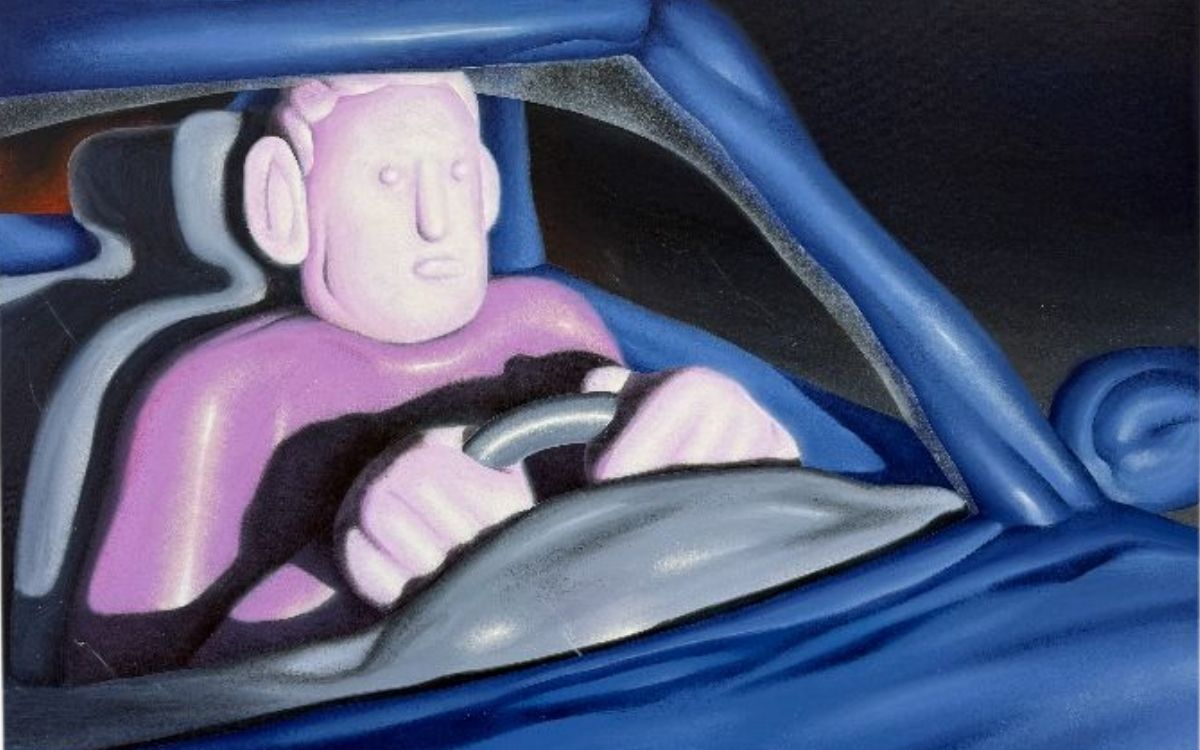
Martynas Auz discovered graffiti in a magazine around 2005 and has never really looked back. That first encounter with Berlin street art, pages full of photographs of something entirely unfamiliar, set off a chain of developments that would move through lettering, character illustration, animation, commercial burnout, and an eventual return to murals and canvas painting that brought everything together. The work that exists now carries all of those layers: the aesthetics of computer graphics translated through traditional drawing tools, the scale of murals compressed into paintings, the instinct of a person who has always drawn simply because it was the most natural thing to do. What follows is a conversation about what it means to follow a stream of images without overanalyzing them, and why creativity, like a sport, must be constantly nurtured or it fades.
Can you pinpoint a single moment in your life when you realized art was not just a passion but your purpose?
Creativity has been by my side since childhood - something that always felt natural, almost self-evident. I never overthought it; it was simply what I did whenever there was nothing else to do. There were periods when I had to spend time alone outside, so drawing became the only thing left to keep me occupied.
Later, in my teenage years, around 2005, I came across a magazine featuring an article about Berlin graffiti, filled with photos. That article completely blew my mind. I had never seen anything like it before, and from that moment on I started actively drawing graffiti myself. That’s also when character figures began to appear in my work.
All of this eventually led to my first small mural commissions. That was when I realized creativity was not only a part of who I am and my calling, but also something I could actually make a living from.
If you could communicate just one core message through your entire body of work, what would it be?
In my creative process, I follow one principle - not to question or overanalyze the stream of images that come to me when I choose one of the ideas that appears and decide to bring it to life. It’s during the actual process of creating a painting that I begin to analyze the image and try to understand it. More often than not, I discover connections to things I’ve experienced or witnessed before in life, resurfacing in this kind of form. Through all of this, I’ve come to feel that creativity, for me, is a way of understanding both the world and myself.
How has your artistic style transformed over the years? Are there specific influences, experiments, or moments that marked a turning point?
Over time, since the beginning of my graffiti journey, my creative work has continuously evolved and mutated into new forms and expressions. Graffiti lettering progressed, and my hands began to draw characters, illustrations, and paintings.
After finishing school, I entered a phase of animation and computer graphics, which unfortunately led to burnout in 2017 after an endless stream of advertising animations and commercial projects.
The cure for my soul became a return to my creative roots: murals and illustrations, which eventually transformed once again into paintings on canvas. And when looking at my current works and their stylistic approach, I see all the creative practices I have experienced merging into one place - the aesthetics of computer graphics translated through traditional drawing tools and techniques.
Can you share a moment when someone’s unexpected interpretation of your art gave you a new perspective?
Lately, an interesting new perspective has been coming to me - one that other people helped me discover. After finishing mural pieces, I would usually forget about them, while they continued living their own lives. But every now and then, strangers would photograph those works, tag me, or send them to me, and it would give me a strange feeling.
As if a part of me still exists there in the present moment, interacting with those people, crossing paths with different passersby every single day. At the same time, I’m present in many places at once. Like a mushroom in a forest, connected to other mushrooms through an underground network stretching across great distances, all of them sensing the same shared pulse.
Artificial Intelligence is increasingly infiltrating creative fields. Do you see artificial intelligence as a threat, a tool, or a collaborator in the art world?
I believe AI can be useful in many different fields, including for artists themselves - as an assistant that helps handle certain repetitive or tedious tasks. I’m part of the camp that sees the ideal collaboration between AI and the art world as one where AI handles the everyday chores around artists, giving them more time to focus on creating. I want to see works made by people, for people. I think we’re currently in a historic moment where there’s a real opportunity to focus more on physical artworks, because I’ve noticed that people have started valuing them more again. Myself included.
Name five pivotal lessons you’ve learned that shaped your artistic journey.
Perfectionism holds back progress. It’s far better to capture the evolution of your thoughts through different works than to endlessly redo and refine the same piece every time your mood or mindset shifts. Staying stuck on one work can keep you from making bigger discoveries.
Curating and limiting what I consume on social media. I try to surround myself with things I genuinely find beautiful, because they shape my sense of aesthetics and the way I see art. I think this is essential when it comes to developing your own style.
Creativity is not like learning how to ride a bike, where once you know it, you can jump back on anytime. Creativity is more like a sport. After a longer break, returning to it becomes harder and takes more effort. Creativity needs to be constantly nurtured.
Building connections with different people and creators. And also sharing your work everywhere you can. If nobody knows you exist, then the opportunities coming your way will simply pass you by.
If a creative block hits, there’s no need to panic - the desire to create will come back. Sometimes it simply means I’ve drained myself creatively. Short breaks or mini vacations can help, as long as I don’t completely disconnect from creativity - just slow things down to a minimum and use the rest of the time to absorb new experiences and impressions.
If you could step back into any artistic era, which would it be and why?
Without a doubt, I would want to go back to the West during the 1980s–2000s — the period when graffiti and street art were growing and evolving. It was an exciting era that shaped many important figures in the scene, people who played a huge role in the development of street art as a genre.
To have the chance to return to that time and become part of that collective movement - before social media existed, when artworks truly lived in the streets, and you had to physically travel to a location to experience them - feels incredibly exciting to imagine. Just thinking about it gives me a rush.
Have you considered teaching your artistic skills to others? What excites or challenges you about that?
Yes, I’m very interested in sharing these experiences and knowledge. Over time, I hope to dedicate more and more of my time to it.
At the moment, whenever opportunities come up to give talks or lead workshops for younger creators, it always leaves me feeling positive. It also pushes me to grow myself and to share things that may feel obvious or second nature to me now, but for them can become major discoveries.
Martynas Auz describes the experience of encountering a forgotten mural through a stranger's photograph as feeling like a mushroom connected to others through an underground network, sensing the same shared pulse across great distances. It is a precise and unusual image, and it says something true about a practice built on presence distributed across many places at once. The lessons learned, about perfectionism, about curating what one consumes, about sharing work broadly and building genuine connections, are offered not as rules but as hard-won discoveries. The next phase involves passing them on. Workshops, talks, time spent with younger creators: the underground network keeps extending.