
Thomas Lapine walked into a figure drawing session one Saturday morning at the University of Utah, looked at the north-light windows and the model stand surrounded by people of every level and intention, and understood that something sacred was happening. That recognition has never left the work. The paintings that have followed are built on a conviction that art should proceed with love and play rather than doubt and fear, that the act of making something is ultimately a celebration of life, and that the kid who first picked up a crayon at three years old and played with dinosaurs and spaceships never really has to grow up. What follows is a conversation about how that spirit of serious play shapes a practice still early in its journey, and why fun and wonder are not lesser ambitions but essential ones.
Can you pinpoint a single moment in your life when you realized art was not just a passion but your purpose?
I remember there used to be a figure drawing session on Saturday mornings at the University of Utah. The room had these huge north-light windows looking out over the campus and mountains, and the model stand was in the center of the room, surrounded by all kinds of people with different levels of experience and different goals. This was a place to pay homage to and respect the human form. I entered something sacred, and it changed my life.
In a world flooded with imagery, what responsibility do artists have to stand out and say something authentic?
I think our responsibility is to be true to ourselves and try to interpret the flood. I love and need the overload of imagery, and as my work develops, I pull from this excess to collage stronger abstraction and narrative into my work. It’s a buffet—we pick what we want and usually come back for more.
Describe a piece you've created that has held the most emotional weight for you.What makes it significant?
Hot Sauce Part 3: Unquenchable has had the biggest impact on my life. The series is very personal and reflects changes I’ve made in my relationship to painting and to myself. In order to keep painting, I realized I had to approach it with love and play rather than doubt and fear. Simply put, the Hot Sauce series is about feeling good and having fun.
Part 3 involves a collaboration with one of my best friends and colleagues, Ethan Martin. Influenced by Delacroix, Caravaggio, and Jacob Jordaens, the painting depicts Ethan’s drag character, Ronda, as the main figure. It recalls her giving birth to an alien child and saving humanity from the tyranny of demonic reptiles known as Terrtilians.
Can art be truly therapeutic? Have you experienced its healing power personally, or seen it impact others?
I don’t know if it is therapeutic in the sense that you recover and that is the end of the story. Rather, I think it opens a new chapter or vision you didn’t realize was possible before. Painting is a kind of odyssey, and the person who starts is not necessarily the same person who finishes. I’m not saying it is easy or positive all the time, but it demands an honest look at oneself.
How do you respond to debates about the accessibility of art- should it be exclusive, or is it for everyone?
Art is for everyone, and I don’t believe there is one particular way to make it or initially experience it. It’s up to each person to seek out their own goals and present them to the world in a way that is engaging and inspiring. The act of making something is ultimately a celebration or reflection of life and our time. The more people engage with art and present their work, the more clarity I gain about reality and who I am.
What are five steps you're taking to ensure your continual growth as an artist?
These are five things I remind myself before I start working each day. They don’t necessarily go in a certain order or get stated this way, but repeating this mantra ensures that I don’t become stagnant or dull. I want to keep climbing higher, and I have to remember these key points in order to continue the journey.
Be brave
Be fearless
Have faith
Proceed with love
Have fun
If you had a chance to sit down with any creative mind from history, who would it be and what would you ask?
I was an art student for seven years, and in many ways I will always be asking questions of others and of myself. If I had the chance to go back in time and spend a day with an artist, I would choose James Castle. I would simply be his shadow for a day. I don’t see myself asking anything—I would just watch
There is a drawing in the Whitney Museum that really touched me—it actually haunts me in the best way. The piece is a small landscape drawing, I believe on the back of an old receipt. It depicts a barn or some kind of shack and a few trees. It is raw, tactile, and sincere. James Castle is a hero of mine, and his work and journey are deeply inspiring to me. Watching him would be the best lesson I could ask for.
What kind og legacy do you hope to leave in the art world?
I would want to leave a message saying that there is magic in the world, and that the kid who picked up a crayon for the first time at three years old and played with dinosaurs and spaceships upstairs never grew up. In the words of Philip Guston: “This serious play which we call art can’t be static. You have to keep learning how to play in new ways all the time.”
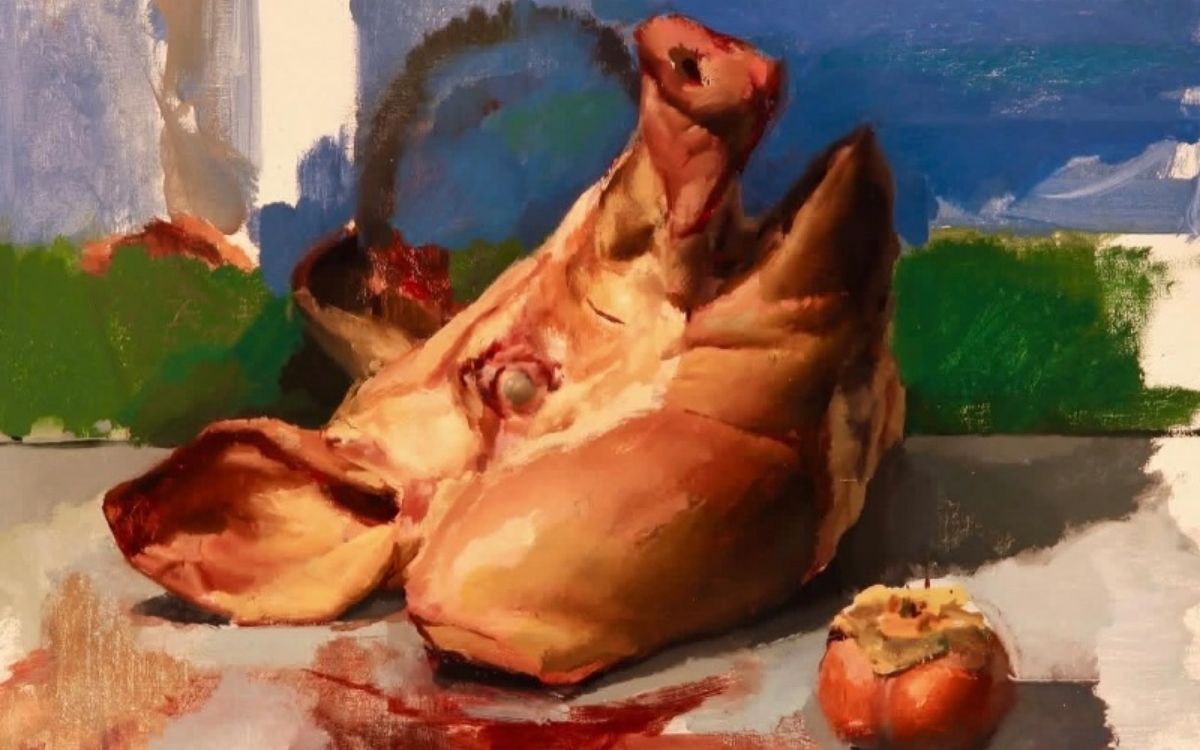
I want to keep playing until the end and beyond, pushing the boundaries of what still life can be, or what a contemporary interpretation of Baroque painting could look like. I am at an early stage of my career, with a vast unknown in front of me, but as of now—and without apology—I want to give a painting to the world that tells the story of a 33-year-old kid who still plays with dinosaurs and spaceships, who loves Willem de Kooning and Jean-Auguste-Dominique Ingres, and who gave everything to present fun and wonder to the world. It’s my story, and I hope it inspires the viewer to make their own.
Thomas Lapine wants to keep playing until the end and beyond. The Hot Sauce series, the collaboration with a best friend, the drag character giving birth to an alien child while saving humanity from demonic reptiles: none of this is incidental or ironic. It is the work, undertaken with the same reverence brought to Delacroix and Caravaggio, to James Castle's small haunting landscape on the back of an old receipt, to the vast unknown that still stretches ahead. The legacy hoped for is simple and completely serious: that there is magic in the world, and that a painting can tell the story of someone who gave everything to present fun and wonder, and meant every stroke of it.