
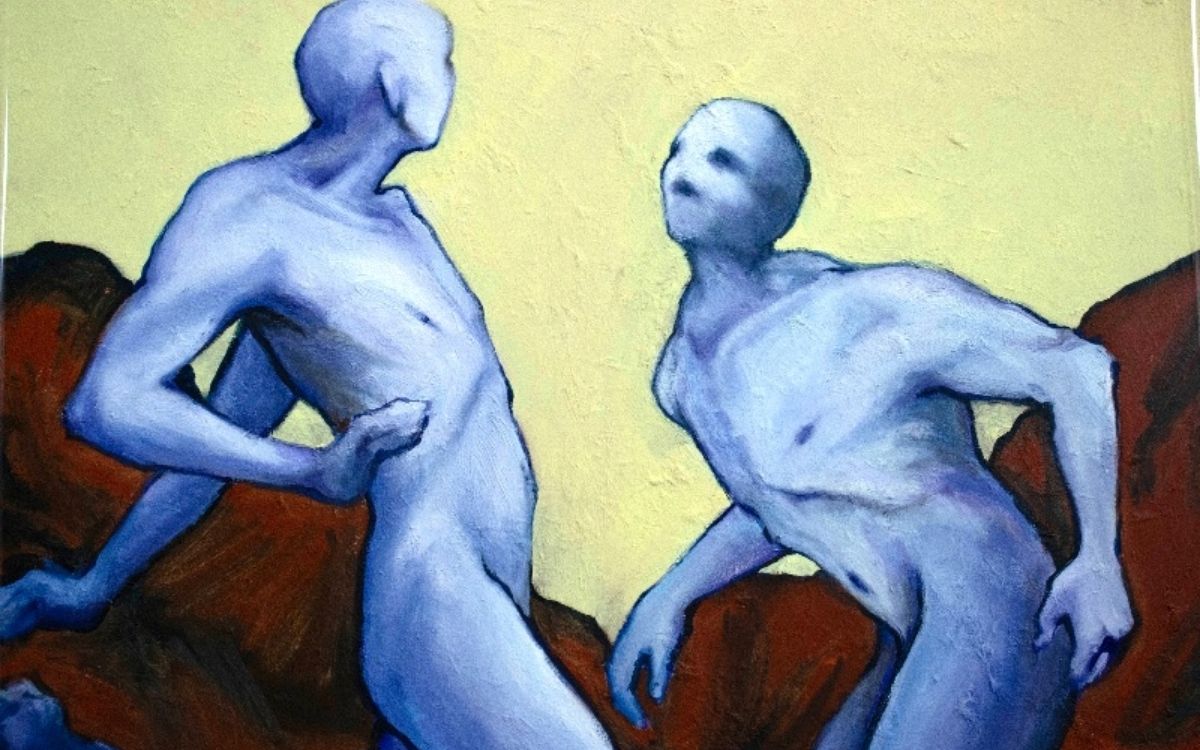
Jovana Preradović paints what language cannot fully contain. The practice is built around what remains beneath everyday interaction: the invisible weight people carry, the distance that persists even within closeness, the psychological exhaustion of living in a world of constant visibility where genuine connection grows increasingly fragile. The figures that emerge from this process are not portraits but psychological states given form, bodies suspended between presence and disappearance, between intimacy and emotional distance. The compositions are rarely planned in advance. They shift and accumulate through layers of drawing, erasure, and repetition until the image finds its own internal rhythm. What follows is a conversation about what it means to stay close to ambiguity, and why unresolved spaces feel more truthful than fixed ones.
Why do you personally turn to art, rather than another form of expression?
Art, for me, is not a replacement for communication, but a way of reaching what language cannot always fully contain. I’m a deeply communicative and emotionally aware person, yet there are certain psychological states, tensions, and contradictions that lose their complexity the moment they are explained directly. Through painting and drawing, I can stay closer to ambiguity, silence, and emotional residue.
I’m interested in what remains beneath everyday interaction: the invisible weight people carry, the distance that can exist even within closeness, and the fragmentation created by constant visibility. Rather than describing reality, I try to translate the atmosphere it leaves behind.
Can you take us through the evolution of an artwork, from inspiration to the finished piece?
Most works begin with an emotional impression rather than a concrete idea. Sometimes it is a gesture, a memory, a moment of silence, or simply an atmosphere I carry internally for days. I usually begin intuitively, allowing figures and spaces to emerge gradually through layers of drawing, erasure and repetition. Throughout the process, the image continuously shifts direction. I rarely sketch fixed compositions beforehand because I want the work to remain open and unstable. At a certain point, the painting begins to create its own internal rhythm, and my role becomes less about control and more about listening.
Do you feel a personal connection to your subject matter is essential?
Yes, even when the work is symbolic or abstract, there has to be an emotional truth behind it. My figures are not portraits of specific people, but they emerge from internal psychological states that feel deeply familiar to me. I’m interested in bodies that appear present yet emotionally distant, suspended somewhere between intimacy and disappearance. Without personal connection, the process feels empty to me. I think viewers instinctively sense when a work carries genuine emotional weight. That sincerity is more important to me than clarity or narrative explanation. The work begins from something personal, but ideally transforms into something collectively recognizable.
How does your art engage with contemporary issues?
My work reflects emotional conditions created by contemporary life rather than directly illustrating political events. We live surrounded by endless information, visual stimuli, and constant communication, yet genuine connection often feels increasingly fragile. Presence becomes superficial, while identity fragments under pressure to remain endlessly visible. I’m interested in that psychological exhaustion and emotional distance. The figures in my work function as symbols of those internal conditions — bodies caught between connection and isolation, visibility and disappearance. Rather than offering direct commentary, I try to create spaces where viewers can emotionally recognize aspects of themselves.
If you could communicate one core message through your work, what would it be?
At the core of my work is the idea that emotional vulnerability carries its own strength and truth. Through unresolved psychological states such as loneliness, intimacy, tension, and longing, I try to preserve space for emotional ambiguity and create images in which viewers may quietly recognize fragments of their own emotional experience.
If you could live anywhere in the world to further inspire your creativity, where would it be?
I’m drawn to large, densely populated cities where intensity, pace, and cultural energy shape everyday perception. My experience in Xi'an had a lasting impact on me, as it made me realize how strongly I respond to movement, scale, and the constant presence of people. I’m most inspired by environments with a strong contemporary art scene, where artistic dialogue feels active and necessary. More than comfort or idealized places, I’m interested in environments that challenge perception, create creative tension, and encourage continuous artistic and personal development.
How do you envision the evolution of your work in the coming years?
My work is evolving through deeper psychological exploration, more refined atmospheres, and increasingly layered emotional narratives, while remaining rooted in painting and drawing as my primary language. I’m focused on how figures, space, and absence function within the image, creating more emotionally immersive works without leaving the medium itself.
My ongoing work within a contemporary gallery environment, various collaborations, and my participation in the Innopraktika School in Saint Petersburg in July 2026 will all contribute to this development. Above all, I aim to preserve emotional honesty, ambiguity, and sensitivity as the work continues to evolve.
Your works often exist between presence and disappearance, intimacy and emotional distance. What draws you to fragmented figures and unresolved psychological spaces?
I’m interested in the emotional void created by contemporary existence. Constant exposure to people, information, and visual content often produces not closeness, but exhaustion and emotional detachment. Presence becomes automatic, communication repetitive, while identity gradually fragments under pressure to remain endlessly visible. The figures in my work exist inside that tension. They appear physically present, yet psychologically distant - suspended somewhere between intimacy and disappearance. I’m drawn to unresolved spaces because they feel closer to lived emotional reality than fixed narratives. For me, ambiguity is not uncertainty, but a space where the work can remain psychologically alive.
Jovana Preradović is drawn to cities that challenge perception and create creative tension, environments where artistic dialogue feels active and necessary. That preference says something accurate about the practice itself: it does not seek comfort or resolution but the kind of pressure that keeps the work psychologically alive. Deeper atmospheric layers, more emotionally immersive works, continued participation in international artistic contexts, including the Innopraktika School in Saint Petersburg in July 2026: the direction is clear even if the destination is not. Emotional honesty, ambiguity, and sensitivity are not qualities to be arrived at. They are the ground the work stands on, and they are not going anywhere.