
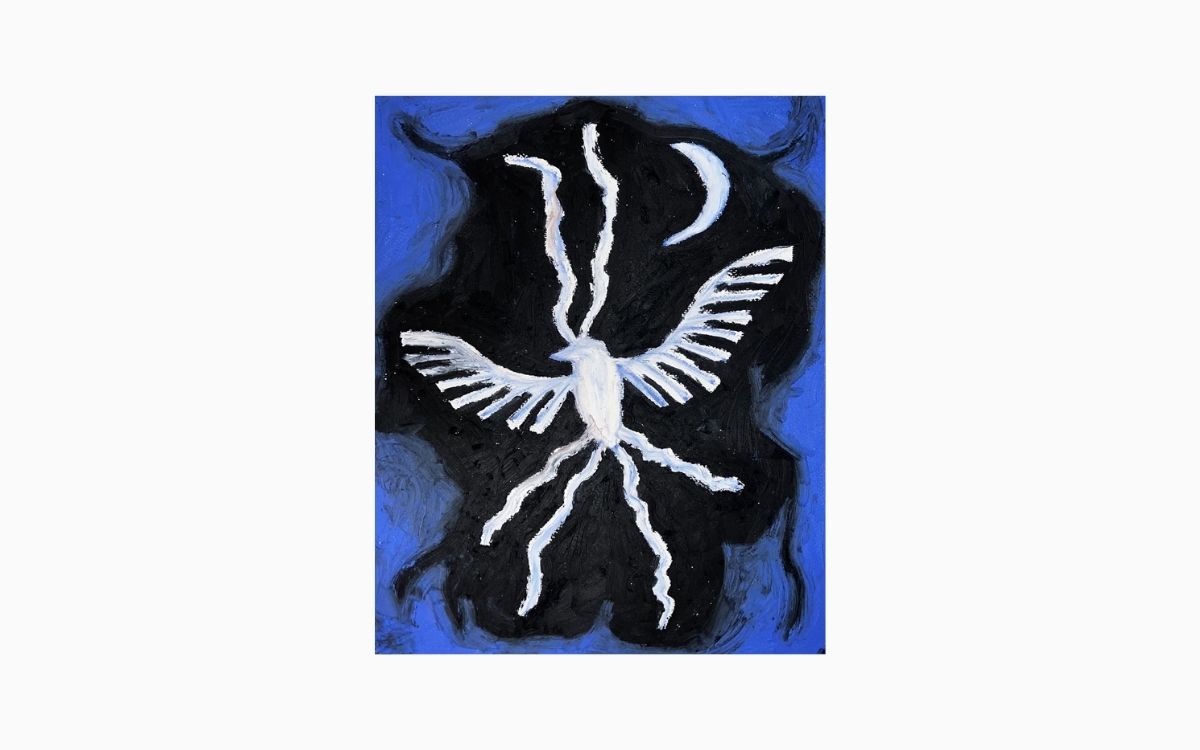
Lukas Keysell grew up traveling, and those early encounters with ancient monuments in Egypt and Mexico left something permanent: a conviction that there is more truth in the supernatural than intellectual arrogance tends to allow, and that humanity was once far more spiritually connected to something beyond physical existence. Loss deepened that conviction. By thirteen, all grandparents and a mother were gone, and what followed was not only grief but a strange freedom, and an eventual pull toward painting that could last twelve hours at a stretch. What follows is a conversation about a practice built on flow states, ancient mythologies, and the belief that the best ideas come from somewhere beyond the ego.
How has your upbringing shaped the themes and techniques you explore in your art today? Can you pinpoint a single moment in your life when you realized art was not just a passion but your purpose?
I have been lucky enough that my dad has taken me and my brother travelling a lot, which has led me to a deep fascination with ancient cultures and the supernatural similarities that are shared upon cultures that existed miles apart from each other. We have always traveled together for as long as I can remember and so from a very early age I was exposed to all kinds of cultures and particularly historical monuments. I remember clearly two trips that really sparked my interest in mythical ancient storytelling: a trip to Egypt, visiting the Valley of the Kings and the other was Mexico, visiting Chichén Itzá. We had a guide telling us all these ancient stories that sounded like dreams and showing us how they are depicted through monuments and murals. I remember realising the amount of time and effort it must have taken to build and paint such monuments and thinking how could these dream-like experiences hold so much significance in real life. I think from then, I always have believed there is a lot more truth in the supernatural that we dare to believe or simply disregard out of intellectual arrogance. I think we have once been far more spiritually connected to something beyond human physicality and slowly through cultural destruction and societal conditioning, we have lost touch with the practices that allow access to these other realms of reality. When I make art, there is an active element in me that is trying to access an ancient way of being.
A theme throughout my work is the idea of spirit energies and the impermanence of materiality. I sadly lost all of my grandparents and my mother by the time I was 13 and so the idea of death was very apparent and something I thought about quite a lot growing up. Very soon after my mother passed away, I accepted my own death and through this came relief and, oddly enough, lots of joy. I felt the freedom to do anything I wanted in life and she would always be with me, supporting me. She definitely guided me to move from England, where I grew up and move to Denmark, where she grew up. I didn’t have a sudden realization about becoming an artist, but it felt more like an inevitable path that became more apparent as I arrived in Copenhagen. I started to take my art more seriously and could feel a stronger presence and connection to my mother. Through this, I got strong urges to paint, sometimes for almost 12 hours straight on my days off work. I was painting abstract energetic lines, often with eyes floating around the canvas. For me the eyes were, and still are a representation of being looked after and protected by spirits who have passed away. I think paintings have this incredible power to contain energy and radiate it upon those who connect with it.
How has your artistic style transformed over the years? Are there specific influences, experiments, or moments that marked a turning point?
When studying graphic arts at university in Winchester I was screen printing a lot and I became fascinated with exploring form and colour in its raw essence. There was a sense of contentment that arose when the forms were not trying to communicate anything at all, but were purely compositional elements of colour. I specialised in graphic design, but often hung out with illustrators, which influenced me into sketching a lot more in sketchbooks. I have never been great at realistic drawing, so I found comfort in drawing abstract and simplified forms. This way of drawing also had the ability to transport me back to being a 6 year-old child, scribbling with crayons on paper. I made my own stencils which made drawing even easier. There was no need to think about what to draw, I just had to match the stencil forms together and create growing networks of lines and shapes. I stopped using stencils, but continued to draw in uniform width lines that grew, exploded, imploded, zig zagged, weaved and turned. I became obsessed with a uniform-width line because I found that it could become anything and everything. It represented a kind of life force that had infinite potential. Unintentionally, my paintings at this time had visual references to aztec patterns and other ancient cultures. It was only after about a year or two of painting without conscious inspiration, that I began to reflect over why I was painting the way I was. It came to me slowly like a fractured dream or memory, but I started to make the connection that I was possibly drawing inspiration from my past travels as a child. When I became consciously aware of this, I started to research deeper into ancient cultures and began drawing inspiration directly from the things I was reading. I became particularly fascinated by Graham Hancock’s book: Supernatural, which draws similarities of shamanistic cultures from ancient cultures all around the world who have never had contact with each other. I remember feeling the concept of nationality fade and a larger sense of being human on earth arose. The motives in my paintings became much more figurative than abstract forms because I was sketching directly from reference images. After years of painting obsessively sharp acrylic lines in a meditative state, a shift in my artistic expression came when I realised there was a lot of focus on what I was painting and not how I was painting it. Last summer I attacked a big canvas with oil sticks trying to forget how I paint, which freed me into a new kind of expression. A way of creating that didn’t need a preconceived sketch, or any conscious idea at all. The shift from acrylic to oil also opened up so many new possibilities of blending colours and generally having stronger pigments excited my visual brain box.
Does spirituality or a connection to something larger than yourself influence your creative process?
Definitely, I believe all ideas come from a higher / other realm or dimension. From a void of infinite potential. When painting in a flow state, it can feel like the strokes and marks are flowing through me, as opposed to me - my ego - creating images. Hours can disappear like minutes in these moments of creation. There is also a reflective benefit of not being the sole creator of your art because if the painting is bad then it is easier to emotionally detach from it and blame that particular stream of creativity that flowed through me. In this way, the pressure to be a “good” artist everytime I paint is slightly relieved. I can move on swiftly and make something new with a different creative stream borrowed from the void and hope that it’s better than the last one.
Do you believe the ‘mad artist’ stereotype still holds weight, or is creativity more grounded than we think?
I think creativity comes from elsewhere and we cannot fully control how we access it. My old crazy uncle, David “Zen Master” Chitty, once told me that if you can draw a perfect circle then you are either completely insane or attuned to pure zen and stillness. I love the duality in this statement and I think it illustrates the fluidity of being mad and grounded at the same time. I think artists often operate in this fluctuating space. I know I do. I occasionally try to draw perfect circles and think about this idea.
Can you take us through the evolution of an artwork, from that first spark of inspiration to the finished piece?
My creative process can be very sporadic and almost manic at times, however a lot of my most recent works have been a much more meditative process. Firstly, I spend an hour floating inside a sensory deprivation tank, meditating. Directly after, I sit for roughly 2 hours sketching anything that flows to the surface. Sometimes images come to me when meditating and it can be challenging to not focus on them too much that I lose my presence in the meditation, but I try to place them in a small pocket somewhere that I can access when I get out of the tank.
From there, I go back to my studio and start turning the sketches into large paintings using acrylic mixed with sand to get a base layer and sketch out the painting in rough forms. I then grab oil sticks and go over the sketch, often adding elements and painting over other areas completely. I absolutely love oil sticks because I use my whole hand to hold it and it really feels like I’m a 5 year-old child again attacking an A4 paper with crayons. The oil sticks require a few separate sessions as the layers have to dry so that I can add more. On the last few layers, I start to blend the oil with my hands to soften edges and smudge gradients together.
Do you have any rituals or habits that help you enter a creative state of flow?
I have a dart board in my studio and it has become a ritual to throw at least 6 darts when I enter the studio, when I leave the studio, and when I feel a bit stuck in whatever I’m working on. Or simply to enjoy playing darts. The focus it requires helps me empty my mind. I work best with an empty mind. Skateboarding is also a great mind-emptier and joy recharger.
How important is it for viewers to understand the intended message of your work? Does ambiguity add value, or do you seek clarity in your expression?
I hover between telling visual stories and painting ambiguous and abstract scenes. I like it when my paintings are ambiguous and open for the viewer to reflect themselves into. Even the clearer messages intended in the works are not specific to culture, age or context, but rather try to reflect the shared human and non-human experience.
Do you think the boundaries of what can be called "art" are being stretched too far, or is this evolution necessary?
This is a funny question. I can sometimes get irritated by art that ‘pushes the boundaries’, but usually I find myself simply amused. I think it can get a bit silly and sometimes even lazy. I never challenge the fact that it is or isn’t art because I think if you care about something and you have intention then anything can be art. I personally prefer art with some kind of craftsmanship involved. When I go to exhibitions I love looking into how things are made and even how they are hanging or standing.
List five core themes or messages you aim to convey through your art.
I often think about the constant flow of energy around us that we all feel but can’t necessarily see. My compositions are almost always full of form from top to bottom which for me is a depiction of the energy in the “empty spaces” between people, nature and even objects. Just because you can’t see something, it doesn’t mean that there isn’t anything there.
Transformation is a big theme I work with. The idea that everything is constantly in motion and changing. The atoms that make up our body, can and will become everything conceivably possible in the universe. I generally hope that my art brings joy to people. I hope that my art allows people to reflect upon the absolute greatness of being alive.
What are five steps you’re taking to ensure your continual growth as an artist?
Always trust my intuition. Don’t judge myself harshly. Let life flow and don’t force myself to paint. I find myself in a continuous flow of intense periods of creation and then lots of time with friends, family and enjoyment of life. I also find it important to step back and reflect upon where I am, where I’m heading and how I’m feeling about it all. I can sometimes say yes to too many new projects, which on the one hand is great because I learn a lot along the way, however some endeavors can end up becoming stressful rather than enjoyable. I find it’s important to reflect on the things that aren’t giving me joy in life and do something about it so that I can move forward. Continue joyfully the dance of life.
Lukas Keysell throws darts to empty the mind, skateboards to recharge joy, and spends an hour floating in a sensory deprivation tank before picking up a brush. These are not eccentricities but necessities, ways of getting out of the way so that something else can come through. The paintings that result are full from edge to edge, dense with the energy of spaces that appear empty but are not, with transformation, with the sense that everything is in constant motion and that the atoms of any given body will eventually become everything conceivable in the universe. That is not a small thing to carry into a studio. It is, for Lukas Keysell, simply where the work begins.