
Ivanka Nechyporuk paints what cannot be translated into words. The practice is built on a sensitivity to ordinary moments, textures, light, shadow, unexpected visual combinations, the brief and easily missed instances when everyday life reveals something poetic. Beneath that attentiveness runs a deeper current: the conviction that reality is always more complex than it first appears, that what seems simple on the surface contains layers of meaning waiting to be noticed. The work has been tested by extraordinary circumstances, by war, by the disappearance of stability, by a period when creativity felt more like survival than joy. What emerged from that pressure is a visual language that is more intuitive, more honest, and more willing to hold chaos and beauty at the same time. What follows is a conversation about how that language developed, and what it continues to reach for.
Why do you personally turn to art, rather than another form of expression?
For me, art is the most natural way to express what cannot always be translated into words. I often experience emotions, states, and inner processes that are difficult to explain logically, but they can be felt and transformed into visual form. Painting allows me to organize my inner world and give structure to what is invisible. It is also a space where I can be completely honest with myself, without filters or limitations.
What unusual or unexpected sources of inspiration have deeply influenced your work?
I am deeply inspired by everyday life — simple moments that often go unnoticed. It can be textures, light, shadows, movement, or unexpected visual combinations in nature and urban spaces. I am especially drawn to contrasts, when elements that seem unrelated suddenly create harmony together. Inspiration often comes from very ordinary moments that briefly reveal something poetic or visually unexpected.
How do you reignite creativity during periods of self-doubt or stagnation?
For me, balance outside of art is essential. I reconnect with creativity through real life — spending time with family and friends, traveling, and allowing myself to rest. These pauses help me reset and return to a more natural inner state. Often, when I step away from pressure and expectations, creativity returns more freely and intuitively.
What do you think is the most meaningful role an artist plays in society today?
I believe one of the most important roles of an artist today is to create spaces for reflection. In a world overloaded with information and images, art can slow down perception and invite people to look deeper. It is not necessarily about giving answers, but about opening emotional and visual dialogues that allow viewers to reconnect with themselves and the world.
If you could communicate just one core message through your entire body of work, what would it be?
The core message of my work is that reality is always more complex than it first appears. What seems simple on the surface often contains multiple layers of meaning, emotion, and symbolism. I am interested in encouraging viewers to look deeper and to notice what is hidden beneath immediate perception.
Can you take us through the evolution of an artwork, from that first spark of inspiration to the finished piece?
The process usually begins with a very subtle impulse — an image, a color, or a feeling that appears during ordinary moments such as a walk, morning coffee outdoors, or traveling. I carry that impression within me for some time, sometimes making quick sketches or mental notes. Then I begin working on compositions and sketches, where the idea slowly gains structure. Color is one of the main languages in my work, so I spend a lot of time searching for the right combinations. The final stage is transferring the work onto canvas, where intuition becomes the most important guide throughout the process.
Describe a piece that has held the most emotional weight for you.
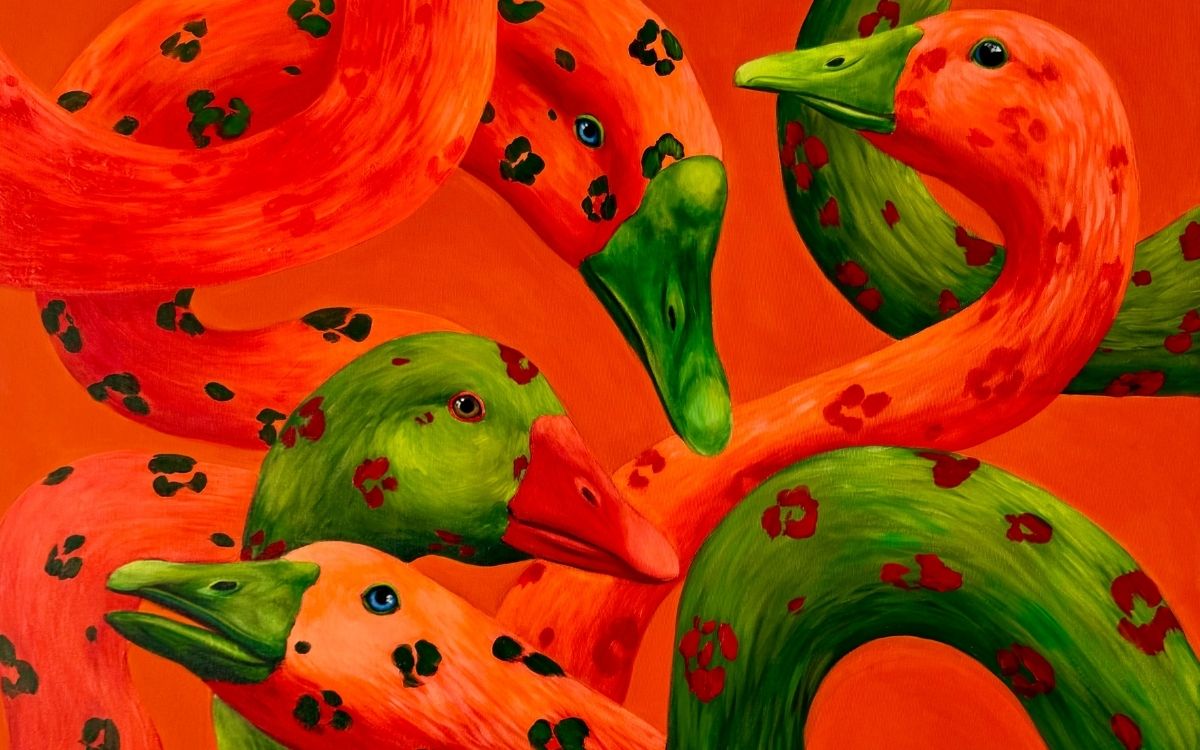
One of the most emotionally significant works for me is ‘Mimicry of Chaos’. The painting was created as a reflection on the reality of living through wartime and the emotional instability that came with it. In the piece, geese with extremely long necks resembling snakes intertwine with leopard-like patterns, creating an image of chaos constantly changing its form. The idea behind the work is mimicry — the way chaos can disguise itself as harmony. At the same time, it is an attempt to find beauty and balance within instability. This painting became an important milestone in my artistic practice and a very honest reflection of my inner state during that period.
How has your artistic style transformed over the years?
My artistic style gradually became more intuitive and confident. A turning point for me was allowing myself to let go of control and trust the process more deeply. I began creating through feeling rather than through strict structure, and that gave my visual language more freedom, honesty, and emotional complexity.
Has there ever been a time when the creative process felt more like a burden than a joy?
Yes, there was a period when creativity felt more like survival than joy. It began with the full-scale invasion and a deep sense of uncertainty, where stability completely disappeared. My main focus was safety — for myself and my family. During that time, I created very emotional works that I did not share publicly. It was a way of processing everything internally. Later, I slowly returned to painting. The support and feedback from people online, as well as reactions to my work, helped me regain strength and reconnect with the creative flow.
How do you feel social media is shaping the way art is created, consumed, and valued today?
Social media has changed art significantly, making it more immediate and accessible. It allows artists to share their work directly with a wide audience without traditional barriers. At the same time, it also creates pressure for visibility and constant output. I see it as both an opportunity and a challenge — it connects people to art more directly, but it can also influence how art is perceived and valued.
Has social media democratized art or diluted its value?
I think it has done both at the same time. Social media has democratized access to art, allowing more artists to be seen and discovered without traditional gatekeepers. At the same time, it can dilute attention and shift focus toward visibility rather than depth. It depends on how it is used — it can either support meaningful artistic presence or reduce art to fast consumption.
Five core themes in your work
Hidden layers of perception
Transformation and instability
Nature and symbolic animal imagery
Inner states and identity
Balance between chaos and harmony
If you could live anywhere in the world to further inspire your creativity, where would it be?
I would choose a place near the sea. The sea has a natural rhythm that feels both calming and powerful. I am drawn to its constant shifts of light, movement, and atmosphere, which deeply resonate with my creative process.
Ivanka Nechyporuk wants to live near the sea, drawn to its constant shifts of light and movement, its rhythm that is both calming and powerful. That image says something accurate about the work as a whole: always attentive to what is in flux, always looking for balance within instability, always finding something worth holding onto inside the chaos. The painting called Mimicry of Chaos, with its snake-necked geese and leopard patterns, captured a particular moment of that search with striking honesty. The practice continues in that spirit, trusting intuition over control, feeling over strict structure, and the quiet certainty that looking deeper is always worth the effort.