
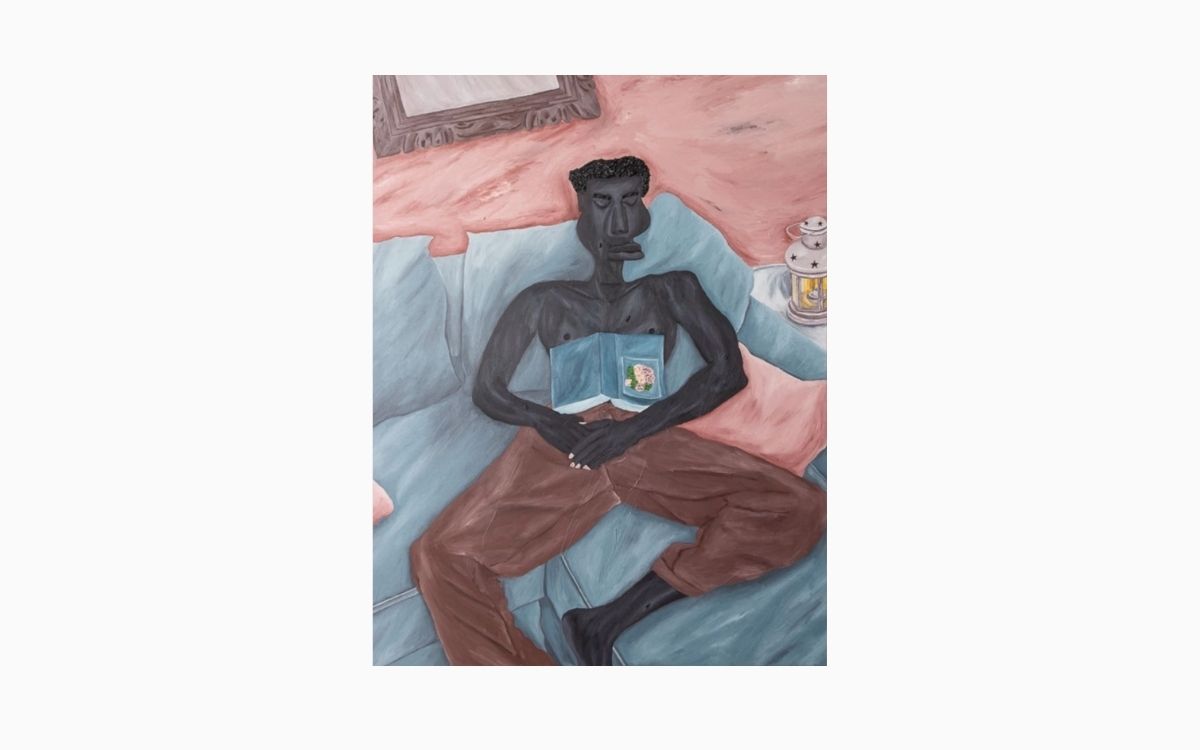
Sènámié grew up in Lagos in a household where art was already a language, a father who pursued it passionately, a mother who studied it formally, and a culture whose vibrancy and storytelling traditions would eventually become the heartbeat of a practice that now unfolds thousands of miles away in Poznań, Poland. The distance between those two places is not just geographical. It is the subject of the work itself: identity under pressure, belonging in flux, the tension and beauty of cultural displacement. A Master's degree in Horticulture added another layer, an understanding of organic growth cycles and natural transformation that now runs through the paintings as metaphor. What follows is a conversation about how all of that converges on the canvas, and why resilience is not just a theme but a lived condition.
How has your upbringing or cultural heritage shaped the themes and techniques you explore in your art today?
My upbringing in Lagos, Nigeria, played a foundational role in shaping who I am as an artist. Growing up in a creative household with a father who pursued art passionately part-time and a mother who studied it formally, I was immersed in artistic expression from a very young age. This environment taught me that art is a language of connection and emotional release.
My African heritage remains the heartbeat of my work. The vibrancy, resilience, and storytelling traditions of Nigerian culture deeply inform the bold colors, exaggerated forms, and rich textures in my paintings. As an immigrant now based in Poznań, Poland, I often explore the tension and beauty of cultural displacement, identity, and belonging. These experiences have led me to address themes of social anxiety, migration, and the human condition.
My Master’s degree in Horticulture from Poznań University of Life Sciences also left a lasting mark. I learned to observe organic growth cycles, forms, and transformations in nature, which I now translate into metaphors for personal and emotional evolution in my paintings. This scientific understanding of life’s processes combined with my cultural roots allows me to blend traditional techniques with contemporary vitality, creating work that feels both timeless and urgently alive.
Can you pinpoint a single moment in your life when you realized art was not just a passion but your purpose?
There wasn’t one single dramatic moment, but rather a powerful convergence. After years of exploring photography and completing my Master’s in Horticulture, I found myself at a crossroads. I was struggling with self-destructive patterns, and painting became the outlet that helped me process and transform my pain into something constructive.
The turning point came when I realized that creating art gave me a sense of purpose and clarity I had never experienced before. Every brushstroke felt like reclaiming agency over my story. What began as a personal necessity gradually revealed itself as my calling. Art wasn’t just something I enjoyed, it was how I made sense of the world, connected with others, and contributed something meaningful. That realization solidified my decision to dedicate myself fully to painting.
Why do you personally turn to art, rather than another form of expression?
Art, particularly painting, offers a unique freedom and depth that I haven’t found in other mediums. It allows me to manipulate reality, to stylize forms, exaggerate emotions, and layer textures in ways that capture the inner world of my subjects rather than just their physical appearance.
Painting also became my primary emotional outlet during difficult periods. It gave me space to explore vulnerability, resilience, and hope without the constraints of words. For me, art is both
therapy and testimony, a way to document personal evolution while speaking to broader societal issues.
If you could communicate just one core message through your entire body of work, what would it be?
The core message I hope resonates through all my work is resilience and hope in the face of adversity. As an African immigrant navigating new cultural landscapes, I’ve experienced social anxiety, identity struggles, and the complexities of migration. My paintings reflect these challenges but always point toward strength, healing, and the beauty of human endurance.
I want viewers to leave my work feeling seen and encouraged, also feeling reminded that even in our most fragmented moments, there is potential for growth, connection, and renewal.
Can art be truly therapeutic? Have you experienced its healing power personally?
Absolutely. Art has been profoundly therapeutic in my own life. During periods of emotional difficulty, painting became a constructive outlet that guided me away from self-destructive patterns. The act of creating allowed me to externalize inner turmoil, transform it, and ultimately find clarity and strength.
I’ve seen similar healing in others through my work and the community projects at Mothrland Atelier. When people connect with a piece that mirrors their own struggles or aspirations, it creates space for empathy, reflection, and emotional release. Art doesn’t just depict life; it actively participates in shaping it for the better.
Name five pivotal lessons you’ve learned that shaped your artistic journey.
Authenticity is magnetic. Staying true to my personal story and cultural roots has created the most powerful connections with audiences.
Discipline and freedom coexist. While creativity feels innate, mastery requires consistent practice and technical growth.
Vulnerability is strength. Sharing my experiences with social anxiety and migration has made my work more resonant.
Community multiplies impact. Founding Mothrland Atelier in 2025 taught me that art is more powerful when created and experienced together.
Growth comes from discomfort. Moving from Nigeria to Poland and shifting from horticulture to full-time painting pushed me to evolve both personally and artistically.
List five core themes or messages you aim to convey through your art.
Resilience: The human capacity to rise despite challenges.
Identity and Migration: The beauty and complexity of navigating multiple cultural worlds.
Emotional Evolution: Personal growth mirrored through organic, natural metaphors.
Hope amid Anxiety: Finding light in moments of social and personal struggle.
Human Connection: The shared essence beneath our different surfaces.
How do you envision the evolution of your work in the coming years?
In the coming years, I see my work continuing to deepen in emotional and technical complexity. I want to push the dialogue between figurative and abstract elements even further, perhaps incorporating more experimental textures and larger-scale pieces that reflect the growing ambition of Mothrland Atelier.
I’m excited to explore more collaborative projects and installations that bring my paintings into immersive environments. As my practice evolves, I hope to maintain the core of raw emotion and cultural storytelling while reaching wider audiences. Ultimately, I want my work to contribute meaningfully to conversations about identity, belonging, and collective healing in an increasingly fragmented world.
What are your long-term aspirations as an artist, both personally and professionally?
Personally, I aspire to continue growing as a human being through my art, maintaining honesty, curiosity, and openness. Professionally, I want Mothrland Atelier to become a significant cultural hub in Europe that supports emerging voices from diverse backgrounds. I dream of international exhibitions that bridge African and European perspectives, and of building a body of work that stands the test of time while remaining deeply relevant today.
Sènámié founded Mothrland Atelier in 2025 with the conviction that art is more powerful when created and experienced together, and that ambition now shapes the horizon of what comes next. International exhibitions bridging African and European perspectives, larger scale works, immersive installations, a cultural hub that supports emerging voices from diverse backgrounds: the vision is clear and the direction is outward. Through all of it, the core remains unchanged. Every brushstroke is still an act of reclaiming agency over a story that began in Lagos, passed through difficulty, and arrived somewhere that looks, with growing certainty, like purpose.