
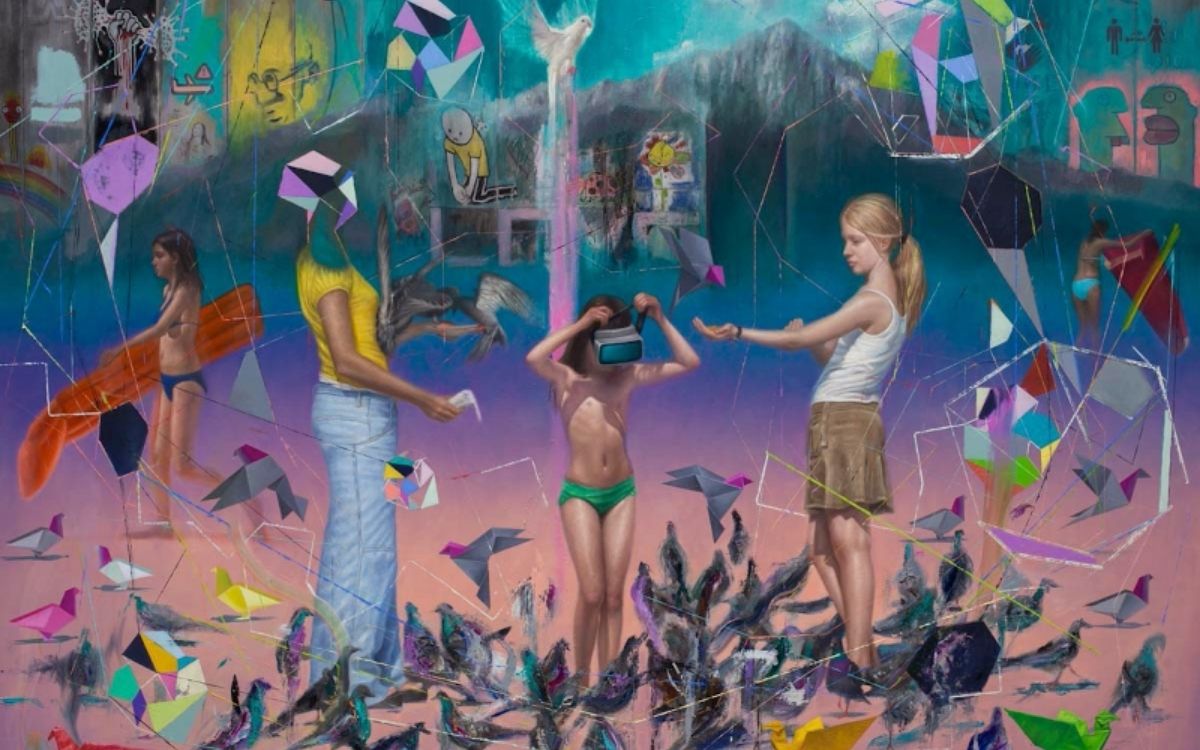
Rasher Mark Kavanagh did not choose art. Art chose him, in the way things choose us when there is no other option left. Living with dyslexia and ADHD, failing state exams, shut out of art college, the path that was supposed to exist simply did not. What remained was the work itself, and the discovery that doing something well, and being recognised for it, could pull a person back from the edge of self-doubt. For over thirty years the practice has continued without institutional support, without funding bodies, without the scaffolding that others take for granted, sustained entirely by persistence, sacrifice, and the refusal to disappear. The paintings that have emerged from that refusal are politically charged, ecologically urgent, and grounded in a deep engagement with the natural world. What follows is a conversation about what it costs to stay visible without permission, and why art is not what is given but what one simply is.
Can you pinpoint a single moment in your life when you realized art was not just a passion but your purpose?
Art chose me; I never felt like I had a choice in becoming an artist. Living with dyslexia and ADHD, I struggled in school, failed my state exams, and often felt inadequate beside my peers. I didn’t get the chance to follow the traditional path or fulfil my dream of going to art college.What changed everything was discovering that I could do something well. When people both my peers and elders praised my artistic ability at a young age , it gave me something I hadn’t felt before: a sense of worth. That recognition pulled me out of self-doubt and stopped me from slipping into self loathing.For me, art became a form of self-medication. The more I created, the more I felt grounded, understood, and valued. It gave me a way to process the world and my place in it.Art is still my therapy, but it’s also more than that. Through it, I explore the world around me and reflect society back to itself. In doing so, I feel like I contribute something meaningful I add colour, perspective, thought provoking beauty or ugliness and emotion to the viewer.
How does your art engage with or comment on pressing contemporary issues—social, political, or environmental?
A little song bird inspired Beethovens 5th symphony, Beethovens 5th symphony played backwards inspired the rock band Deep Purple to write , Smoke on the water. Artist take nature and create a masterpieces and some business elites take nature and torture it and devour it to stimulate there senses.In my recent exhibition I created a painting that was a double meaning with a political observation a painting called Don’t Anger The Gods, I placed three figures eloquently dressed seated at a dinner table, their faces concealed beneath napkins. This gesture, drawn from the ritual consumption of the Ortolan bunting, is traditionally said to hide the diner’s shame from God. Here, it becomes a symbol of wilful blindness an attempt to obscure not only guilt, but complicity.
The Ortolan ritual itself is one of quiet brutality: a songbird captured, confined, force fed, and ultimately consumed whole in an act that merges indulgence with violence. It is a practice historically associated with privilege, secrecy, and excess where refinement masks cruelty, and ritual aestheticises harm.This work draws a contrast between two ways of engaging with the natural world. On one hand, nature can inspire transcendence transformed into music, art, and cultural legacy. On the other, it can be dominated, consumed, and destroyed for pleasure. This duality reflects a broader tension within human behaviour: the capacity to revere and to exploit, often simultaneously.Within this painting, the Ortolan becomes an allegory. It represents the vulnerable those without power, voice, or protection. The diners, in turn, embody systems of authority and privilege that sustain themselves through quiet acts of consumption, shielded by ritual, tradition, or distance from consequence.
We are the Ortolan.
And those who hold power retain the ability to consume, silence, or reshape us often unseen, often unquestioned and unpunished.DONT ANGER THE GODS asks the viewer to confront this imbalance: to consider not only the spectacle of cruelty, but the structures that allow it to persist, hidden in plain sight. This is how I engage with or comment on political issues.
Do you feel a personal connection to your subject matter is essential? How has this connection shaped your work?
A personal and emotional connection to my subject matter is essential to my practice. Without that, I find it difficult to sustain the level of engagement required for works that often take months to complete.My work is largely informed by a sustained interest in the structures and systems within nature, particularly the mechanics of natural processes and theories of evolution. I engage in research as a way of understanding these phenomena more deeply, and then translate that knowledge through a process of visual analysis and reinterpretation in painting.
Ultimately, my practice is a way of situating myself within my environment both intellectually and emotionally. By dissecting and reconfiguring elements of the natural world, I aim to communicate that process of understanding to the viewer through a visual experience.
Do academic institutions still play a vital role in shaping artists today, or has self-taught creativity disrupted this tradition?
I am the product of institutional rejection.
I had two options: accept silence and step quietly into the margins, or refuse disappearance entirely.
I chose refusal.
Art is my voice.
Art is my vocation.
Art is my natural language.It is not a lifestyle choice. It is not an accessory to identity. It is the only thing that has ever come without instruction.
For over thirty years I have sustained my practice through sacrifice, persistence, and endurance. I am still here. Still working. Still making. Still paying the cost of staying visible without permission.
I have done this without Arts Council security.
Without institutional protection.
Without Aosdána recognition.
Without the guarantees that are often extended repeatedly and for life to those already inside established networks.In Ireland, Aosdána functions as a closed loop of nomination and recognition. A lifetime stipend awarded by peers, regardless of market success or ongoing need. Meanwhile, many working artists outside those circles continue without support, without stability, and without access to the same visibility or validation.
This is not a personal grievance. It is a structural imbalance.
Public cultural funding should not ossify into permanence for a select few while emerging and mid-career artists carry the instability of an entire sector. If state support exists to sustain artistic practice, it should circulate, evolve, and respond to the present not freeze into lifetime privilege.
A more just system would rotate opportunity. It would distribute support across time, not concentrate it indefinitely. Five-year cycles. Transparent renewal. Broader access. Active inclusion of new and working voices.
Because the reality is this:
Artists are already succeeding outside of institutions.
Outside of galleries.
Outside of funding bodies.
Outside of legacy networks.But they are doing so under strain, and often in isolation, within a small national market where the collector base is limited and opportunity is concentrated.
The structure is not neutral. It selects. It repeats itself. It rewards proximity as much as practice.
And yet art continues anyway.
This is what remains true:
Art is not granted. It is practiced.
Art is not validated. It is lived.
Art is not dependent on permission.I am still here.
And I will continue to make work whether the system recognises it or not.Because art is not what is given to me.
It is what I am.
{Aosdona is a 20,000 a year payment in Ireland to elected Artists they receive it until the day they die}
Do you believe artists have a responsibility to address climate change or environmental concerns in their work? Why or why not?
Its not just Artists Responsibility its everyones. We don’t own this planet. We’re guests — and we’re acting like vandals.
Earth doesn’t belong to us. It tolerates us. It allows us to exist, to breathe, to feed, to witness the sheer complexity of life. And we repay that by poisoning it. And here’s the part that makes it worse: we know exactly what we’re doing. Humans are not like every other species. We don’t get to hide behind instinct. We can see the damage in real time. We can measure it, predict it, model the collapse before it happens. We understand ecosystems, climate, extinction we’ve named every consequence. And we do it anyway. This isn’t just on corporations. It’s not just governments.
It’s everyone who sees it and shrugs. Everyone who benefits and stays comfortable. Everyone who thinks responsibility belongs to someone else. Because consciousness isn’t a gift it’s a burden.
If you understand the damage and keep contributing to it, that’s not ignorance. That’s complicity. Every other species lives within limits.
Humans are the only ones arrogant enough to pretend those limits don’t apply. We rip resources out of the ground, choke the air, flood the oceans with waste then act surprised when the system starts to break. As if the planet owes us stability while we dismantle it piece by piece. You wouldn’t shit on your own doorstep.
Unless you’ve convinced yourself it isn’t your problem. That’s what this is, really:
denial dressed up as convenience. The truth is brutal and simple:
If you live here, you’re responsible.
Not later. Not when it’s easy. Now.
Because this planet doesn’t need us.
We need it. And if we keep acting like this, it won’t be some dramatic ending just a slow, deserved consequence of knowing better… and doing worse. Yes big corporations and governments play a bigger part than individuals and Artist but if you have a platform use it in a positive way and create awareness weather your an influencer or Artist.
What are five things you do to overcome creative blocks or feelings of discouragement?
Get use to Rejection its part of your journey
Constancy under emotional financial pressure and keep creating when no one is watching.
When the air gets thin and the silence is deafening keep creating
The industry breaks nervous systems not ability or talent
Protect your self trust don’t feed self doubt
If your moving your grooving , if you stand still there will be no thrill.
You are the pilot of a very sophisticated nervous system control it or it will control you. 4 billion years of evolution you are special.
In the context of the universe , your a grain a sand on the beach so stop stressing.
What would the theme song of your artistic journey be, and how does it reflect your story?
Band : Alice in Chains Song : Nutshell
Its a song that’s relevant as I played it a lot when I failed my state exams at age eighteen and the realisation of not going to college I felt alone and didn’t know what to do, the lyrics that stood out are “we face the path of time and yet I fight and yet I fight this battle all alone no one to cry to no place to call home. The song has a different meaning for layne Staley, but that’s what I took from it, and the melody is so haunting dark and beautiful all at the same time.
And yet I fight… this battle all alone”
hits especially hard because it captures that quiet kind of struggle when nothing is visibly happening, but internally everything feels uncertain or heavy. Failing exams and feeling like your path suddenly disappeared can absolutely trigger that same sense of isolation. It’s not just about the event it’s about the loss of direction and identity and not experiencing college with my peers and been thrown in the deep end trying to navigate somewhere with no guidance and having to figure it out for yourself. College isn’t just academics its time to develop emotionaly and technically it’s structure, shared experience, a built-in network. When that suddenly drops away, you’re left doing something much harder than your peers: building a path and figuring out who you are without that scaffolding. That’s not a small ask.
Rasher Mark Kavanagh is still here. That phrase, repeated in this interview with the weight of someone who has had to mean it, is both a statement of fact and a quiet act of defiance. The system selects and repeats itself and rewards proximity as much as practice, and yet the work continues anyway. The paintings keep asking viewers to confront what is hidden in plain sight, the cruelty dressed in ritual, the power that consumes without consequence, the planet we treat as though it owes us stability while we dismantle it. None of that has required permission to say. None of it ever will.