
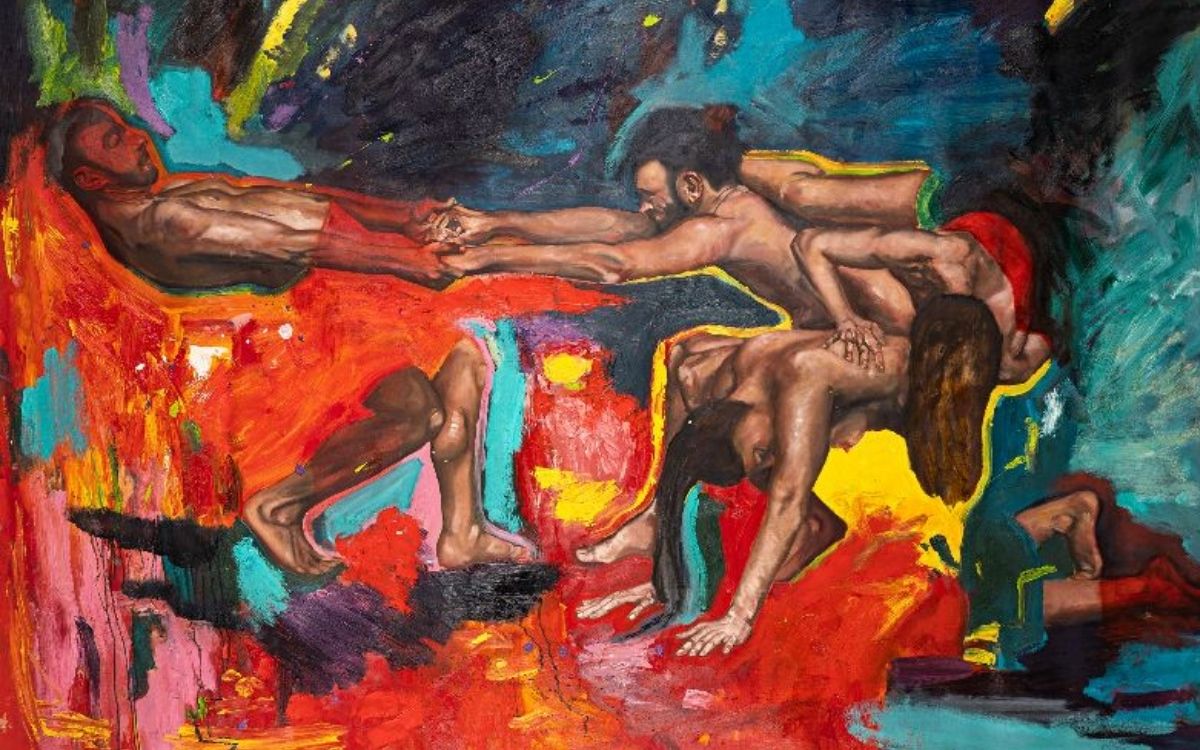
Juan Tardivo builds work from the conviction that vulnerability is not a weakness but a form of awareness and resistance. Through painting and writing, the practice investigates what happens to the individual body inside systems designed to privilege productivity and control, drawing on philosophical references from Camus to Adorno to Nancy as tools for questioning rather than decoration. The work does not represent political events directly. It creates spaces where tension becomes emotionally and visually perceptible, where alienation, fragmentation, and identity can be felt before they are named. What follows is a conversation about what it means to maintain depth and integrity in a world that rewards speed, and why authenticity is as much an ethical position as an aesthetic one.
How does your art engage with or comment on pressing contemporary issues—social, political, or environmental?
My practice engages with contemporary issues by exploring the tension between the individual body and the historical and social structures that shape it. Through painting and writing, I investigate themes such as alienation, identity, social fragmentation, and the psychological consequences of systems that often privilege productivity and control over human vulnerability.
Rather than representing political events directly, I try to create spaces in which these tensions can become emotionally and visually perceptible. My research is informed by philosophical and social references, particularly authors such as Albert Camus, Adorno, Horkheimer, Oswald Spengler, and Jean-Luc Nancy, whose reflections help me question the crises, transformations, and contradictions of contemporary society.
If you could communicate just one core message through your entire body of work, what would it be?
That vulnerability is not a weakness, but a form of awareness and resistance. I would like my work to remind people that, even within fragmentation, uncertainty, and social pressure, there is still space for sensitivity, reflection, and human connection.
How do you measure the impact of your work—by its reception, its personal meaning, or something else?
I measure the impact of my work through the depth of the dialogue it is able to create, rather than through visibility alone. Its personal significance matters to me, because art arises from an authentic necessity, but I also consider those moments in which a viewer recognizes something of themselves within the work. If a painting or a text is able to generate reflection, discomfort, or emotional resonance, then it has already fulfilled an important function.
In a world flooded with imagery, what responsibility do artists have to stand out and say something authentic?
I believe artists have a responsibility to resist superficiality and overproduction. Today, images are consumed extremely quickly, often losing their emotional or symbolic weight. For this reason, authenticity becomes an ethical position as much as an aesthetic one.
For me, creating authentic work means beginning from a real process of reflection and lived experience, rather than adapting creativity exclusively to visibility or algorithms. Art should not merely attract attention; it should also create pause, questioning, and presence. The sense of being obliged to share everything one does in the studio all the time is, in my view, one of the things that most undermines spontaneity and reflection in artistic work. I do not believe an artist should become a visual influencer, but rather a subject capable of contributing to society's critical thinking.
Do academic institutions still play a vital role in shaping artists today, or has self-taught creativity disrupted this tradition?
I believe academic institutions still play an important role because they offer historical context, critical thinking, and spaces for dialogue that can deeply influence an artist's development. They also provide technical training, which can support greater freedom in the creative process.
At the same time, self-taught practices and independent research have become equally significant. I see value in both dimensions: structured education offers solid foundations, while independent learning encourages experimentation and personal freedom. Even so, I generally recommend academic study and direct learning from artists when one wants to develop technique or a particular creative approach.
How do you feel social media is shaping the way art is created, consumed, and valued today?
Social media has transformed art into something immediate and constantly accessible. They have opened new possibilities for visibility and connection, especially for emerging artists, but they have also accelerated the speed at which art is consumed. Works are often reduced to rapid visual impressions optimized to capture attention rather than contemplation.
This can influence the way artists produce, sometimes pushing them to respond more to algorithms than to a genuine artistic necessity. At the same time, social platforms can be valuable tools when used consciously, especially for building communities and sharing independent practices.
How do you approach criticism, whether from peers, critics, or audiences?
I approach criticism as an important part of artistic growth. Constructive criticism helps me understand how the work communicates beyond my own intentions and can reveal aspects I had not considered. At the same time, I try to maintain a balance between listening and preserving the integrity of my personal research. Not every reaction should determine the direction of the work, but meaningful dialogue remains essential, because art always exists in relation to others. For this reason, I am strongly in favor of creating communities among artists, as well as with gallerists and critics. Good criticism can genuinely help a practice grow.
Has social media democratized art or diluted its value? How do you feel platforms like Instagram influence modern creativity?
I think they have done both at the same time. On the one hand, they have democratized access to visibility, allowing artists outside traditional circuits to share their work globally. On the other hand, they have contributed to overproduction and the rapid consumption of images, where visibility risks becoming more important than depth. Platforms such as Instagram influence creativity by privileging immediacy and visual impact, often shaping artistic choices unconsciously. The challenge today is to use these tools without allowing them to define the meaning or direction of one's artistic practice.
Do you think the boundaries of what can be called "art" are being stretched too far, or is this evolution necessary?
I consider this evolution necessary. Art has always transformed itself alongside society, technology, and human perception. Expanding the boundaries of art allows new voices, languages, and experiences to emerge.
I believe the real question is not so much what can be called art, but whether a work possesses intention, reflection, and the capacity to generate meaning or dialogue. The expansion of possibilities should not eliminate critical depth. Doing something creative does not automatically mean making art; art carries with it an awareness and a message that must be thought through and deepened in daily practice.
List five core themes or messages you aim to convey through your art.
The tension between vulnerability and social structures.
The relationship between body, identity, and memory.
Alienation and the search for meaning in contemporary society.
Transformation through emotional and existential crisis.
The dialogue between image, language, and human perception.
How do you envision the evolution of your work in the coming years?
In the coming years, I want to deepen the relationship between painting, writing, and philosophical research by developing projects in which these disciplines function together in an increasingly organic way. I am interested in creating immersive works that combine exhibitions, publications, and textual elements as interconnected experiences. I also want to expand the scale and complexity of my painting while continuing to explore themes related to the body, social transformation, and the contemporary existential condition.
What are your long-term aspirations as an artist, both personally and professionally?
Personally, I wish to continue developing an honest and rigorous artistic practice that remains intellectually and emotionally meaningful over time. Professionally, I hope to exhibit internationally, publish my written work alongside my visual practice, and collaborate with institutions, curators, and other artists in contexts that allow my research to evolve. More than recognition in itself, my goal is to build a body of work capable of maintaining depth, coherence, and resonance over time.
Juan Tardivo is not interested in becoming a visual influencer. The goal, stated with quiet clarity throughout this conversation, is a body of work that maintains depth, coherence, and resonance over time, one that generates reflection, discomfort, or emotional resonance rather than simply attracting attention. The ambition for the coming years is to bring painting, writing, and philosophical research into an increasingly organic relationship, building immersive works where these disciplines function together rather than alongside each other. Recognition is not the point. The point is that something genuine keeps being made, and that it continues to mean something to the people who encounter it.