
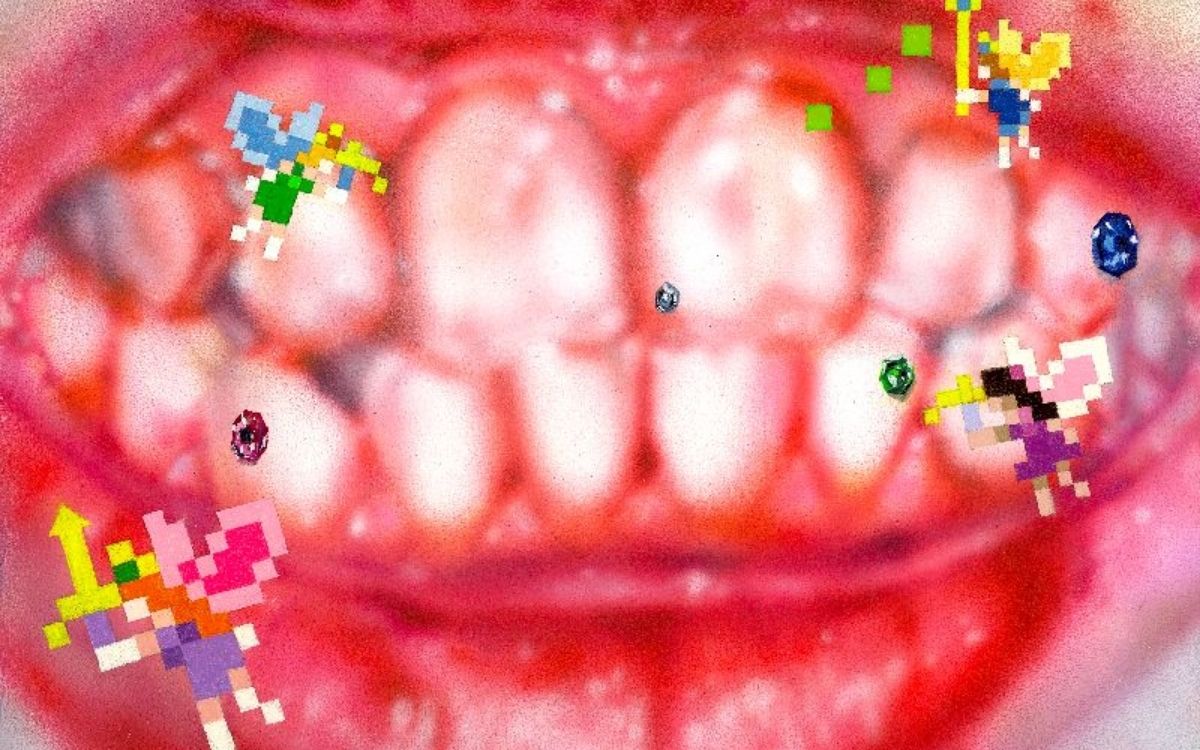
Emily Toots made a secret vow one night after a brutal shift at Starbucks, head on the pillow, with the sudden and absolute certainty that painting was the only thing that had ever felt sure. The path to that moment ran through Microsoft Paint, tablet drawing, art history books, YouTube tutorials, and the particular solitude of an anxious only child who found in drawing a way to make interior life visible. What followed was not a tidy career arc but a series of lucky breaks, layoffs, airbrush purchases, and the stubborn decision to owe something to oneself. Today the work moves between oil paint and airbrushing, between Photoshop planning and instinctive mark-making, between the fun and the freaky. What follows is a conversation about what it means to persist in the impulse to create, and why the role of the fool might be the most powerful one available to an artist right now.
Can you pinpoint a single moment in your life when you realized art was not just a passion but your purpose?
Microsoft Paint was my playground as a child. I was an only child with an anxiety for the world around me, a general fear of other people, and a strange interiority. The passion I had was for drawing the faces of pretty girls, butterflies, and a strange fascination with recreating the checkerboard pattern of our kitchen tiles. I doddled my life away on the computer, and I carried that passion straight into my teenage years, where I discovered a whole new world of digital painting with a tablet. I spent most of my time in online art spaces, growing my passion, watching all corners of art YouTube and Twitch. When it came time to consider university, I had developed a newfound interest in art history and realised for the first time that I was situated in a world of art I knew so little about. Despite going to university to better understand my own art, most of my life I had considered myself not an artist, but a person who likes to draw, if you can see the distinction. The enjoyment in art for me was less about communicating anything at all, but in the satisfaction of taking my thoughts and making them come to life. I’d say only until I had gone to university for art history did, I understand that there was an ocean of greater depths for me to explore.
I found myself one night at the age of 26 getting ready for bed after a long horrible brutal butt nasty day of working at Starbucks. My head hit the pillow, and in a strange stroke I suddenly felt like the only thing I was meant to do in this world was to paint. It really did feel like some strange revelation that shifted me from passion to purpose. I knew at that moment that throughout all my stages of life and in all my moods, art was the only thing I’d ever had any surety of knowing that I loved. Maybe in that moment I just felt I was wasting my life; I had always felt a strange lingering doom when I wasn’t able to carve out time for myself to paint. It felt like if I couldn’t paint, something terrible would happen. As if a part of myself would be stripped away and melted in a vat of acid or something horrible. It’s really an almost indescribable feeling. It was that night I sort of made a secret vow to myself to really try and pursue art. Not under any pretence that it would amount to anything, but that I owed it to myself to do something I loved, just in the hopes of mitigating my suffering.
So, then I started painting as much as I could between shifts. For some reason I kept catching horrible colds (working with the public I realise it’s not that surprising), and I cherished those sick days knowing I could paint to my heart's content without guilt, even without pay. Still, it was not nearly enough for my liking, I felt in ruts all the time between working under horribly dangerous conditions at Starbucks, with a horrible manager, that I felt so trapped. But it wasn’t until a year later that my whole store got shut down and the entire staff got laid off. It was devastating! Everyone who worked there lost so much, but with my severance money I bought myself an airbrush, and the excitement of a new toy spawned a well of creativity. With the immense luck of online traction, the encouragement of sweet people who leave nice comments about my artwork, and even more luck to have friends who helped me set up my website, make a logo, and brainstorm with me about the possibilities of a life in art, I felt something so impossible could be made possible. I still consider myself a fledgling in art, and who knows how long I will have the privilege to live off my paintings, but I’m happier than ever now knowing I have to try.
Can you take us through the evolution of an artwork, from that first spark of inspiration to the finished piece?
There’s something kind of mystical and otherworldly about where art comes from. I don’t really know from where ideas generate, but I know where I find them. I see something that tickles me online or in my life, I have a shower thought, or sometimes a mind blast obliterates my optic nerve and sends me a strange blur and an urge to paint it. It feels like these ideas just come from absolutely nowhere, like some deeply unconscious processing of information that becomes revealed to me at a later date, similar to the way ideas work themselves out in dreams, the mind just takes care of it. Wherever they come from, I like to write all these ideas down or sketch them out in my notes app of all places… and I often forget what they mean but I think that’s fun too.
I take these ideas straight into Photoshop, that’s where I synthesize the concepts into visual ideas and do most of the compositional work. I like to keep things very planned; I definitely prefer to have a concrete idea of what I’m doing before I start. I believe this evolved for me when I picked up airbrushing. There’s a lot of careful planning and considerations you have to make when using this medium, accounting for things like layers of opacity, colour theory, and overspray. That’s at least true for the type of art I usually find myself making. On a compositional level, I really like to play with layering, it feels distinctly digital and I find I keep chasing that look when I compose an artwork, naturally this all lends itself to the need for a good and solid plan. A great deal of the fun lies in messing around with settings in Photoshop that I’ve forgotten about, downloading font packs, importing 3D models, converting images into ASCII art/dot art, and just playing around with that until the idea sings. Then begins the process of transferring the final idea to canvas, which usually I sketch out with a prayer in my heart. Lately, when it comes to text or detailed work (like ASCII art) I’ve been moving away from hand-sketching text and instead using a graphite transfer method, I find it more accurate and expeditious, with better results.
I am completely self-taught in art, not accounting for the myriad hours spent on YouTube tutorials in my youth and the art friends I’ve made along the way, so a lot of things I’m just figuring out through trial and error. Coming from an oil painting background, I've always preferred painting alla prima, and never found myself planning anything at all before the painting starts. Truthfully, I really enjoy both modes of creation: the free laying down of strokes guided by impulse and intuition; and the little victories of building an artwork piece by piece with a methodical touch. I don’t think I’ll ever be able to give up either medium, and combining them is definitely what I enjoy most, and will likely keep doing for as long as I paint.
What do you think is the most meaningful role an artist plays in society today?
I think just for an artist to exist is radical. Against all adversity, (rising cost of living, social and political censure of radical ideas, trend-focused art spaces leaving little room for innovative or counter-cultural voices, lack of accessibility into real life showcasing spaces) I feel that persisting in the impulse to create is simply enough. Ever further, to share one’s artwork with others is commendable and meaningful in its own right. Not all artists must shine a great big revelatory stage light on the world, fitting along with this long tradition of metacommentary and deconstruction that exists in canonical western art history. Art necessitates existing in every form and in every state, from ridiculous, disgusting, horrific, fetishistic, mundane… Like a prism, art reflects all aspects of human nature, and in that, all sides of an artist should be welcome and should be free and cherished, especially now more than ever.
I don’t mean to reject the premise of the question, but it’s important to preface my thoughts in this way, because we live in a world full of limitations for artists, and I don’t want to contribute to that. The capitalism that underpins the circulation of art prioritizes safe and trend-forward art, we see this across all media. I think we live in a great period of regurgitation, ideas that we have already seen and have already loved are the surest bet and the fastest route toward profit. In a lot of ways my art falls safely in this niche, in art I mostly just enjoy making stuff fun and freaky for people, I think it’s important to exert some self-awareness about that. But my admiration for different types of artistry is wide, and I believe we have a duty to protect artists: their way of life and their livelihood, if we really want to advance the arts. To me, art is pushed and progressed by the underclass. I do believe nonconformists are usually those who have something really interesting to say. That’s not to fall within the trope that those who suffer the most create better art. But rather, in the underclasses of society, people push against dominant narratives and ideas, and this is the process I cherish and consider worth protecting.
This is all to say that I think artists should play the role of the fool. That’s not to say that all art should be funny, even though that’s normally the waters I wade in; I think the fool is deeply powerful in society. A jester can artfully demystify the mirage around us all, pointing towards and critiquing very important happenings in our time, in a way that can embolden people towards a certain cause, awaken people to a truth, or otherwise relate to them in a meaningful way. In that interplay between jest and joust there exists room for something very profound and reaching. I think I am most proud of my artwork when I feel I think I’ve accomplished this.
Does spirituality or a connection to something larger than yourself influence your creative process?
When you think about the lengths people have gone to make paintings, even just in sheer man-hours, I think there’s an element of devotion in the act of depiction. To painstakingly commit to a project is an act of devotion that I believe is akin to worship. The slow and careful studying of a subject, the willingness to feel what something is, and to strip it bare to its contingent parts, and then to recreate it in your own mind and with your own hand has always made me feel like there is an intangible relationship between the subject and the artist. I feel that just as though an artist makes up the identity of an artwork, the artwork in kind makes up the identity of the artist, even if only in some small imperceptible way. I consider there to be a reciprocal nature between the artist and their work, both give and take from each other. Maybe this is only true for my relationship with my art, but I feel that when I go to paint, I pour a lot of myself into the artwork, even in the most impersonal of subjects, and still each artwork reinforces my self-perception in the end. There’s something akin to a reverence that happens when you take care to take a part of your time, your life, your skill and turn it towards something outside of you. For me this manifests not in a religious way, but still in the tradition of devotional art. It explains to me why I’ve always felt it difficult to paint things that I do not love. From early childhood, persisting into my life today, I’ve almost only been compelled to draw and paint things I admired or cared for. In fact, it feels downright wrong for me to paint something I actively loathe. I think this is in part the reason I’ve never been able to transition my art towards an outright political or activist route, despite being a very politically-minded person — although I’m not against it at all.
Artificial Intelligence is increasingly infiltrating creative fields. Do you see artificial intelligence as a threat, a tool, or a collaborator in the art world?
There’s nothing more infuriating to me right now than the mass adoption of A.I., in and outside of art. Even though this topic is a bit of a dead horse these days — many people have already come to their own conclusions, and there’s likely little room to sway anyone; I continually find myself in the ring with the gloves on. Thankfully, I feel like artists of all kinds are some of the first canaries in the coal mines to speak against the use of A.I. in creative spaces, as artists often do for many key issues, and I’m happy to be a part of that.
One common argument posits that A.I. provides access to those without years of learned skill. Not only does this miss completely that technical prowess is not solely what makes art valuable, but I also have to refute the assertion that art without A.I. is inaccessible. Yes, not every medium is accessible as every other, (material costs make some artforms a privilege to try, I say this as both an oil painter and airbrush artist) but good artmaking can happen from anyone, in any class, of any means, with any materials. The assertion that AI democratises and makes artmaking more accessible to the everyday person is the saddest, most boneheaded excuse to destroy the planet.
To me art is an exertion of conscious will on the world, and in that I see exactly zero applications for A.I. as a tool, without conscience there is only regurgitative noise. Insofar as I consider “A.I. art” as completely antithetical to art, and don’t consider artificial intelligence as a concern in a creative sense, I do believe it does pose some serious threats to working artists. Art sector jobs are getting cut in a world where we already value artists so little, leaving only a few to squeak by on a liveable income. If there’s any silver lining in this, it’s a reminder of the failure of the 2020-21 crypto-NFT boom. When daring to corrupt the inherent value of art and artists for the sake of capital, the lack of criticality of its adopters eventually led to its own demise. I don’t dare downplay the degree that A.I. hurts us; The inability to successfully urge governments to regulate A.I. is a serious loss for our society, even outside of art. But artists have persisted under immensely odious conditions for way too long, which is at least a testament to their resilience.
Has there ever been a time when the creative process felt more like a burden than a joy? How did you navigate that?
At the risk of being too vulnerable, I’m ashamed to admit it happens more often than I’d like. I’m constantly overcome by my own inadequacy, and although I don’t like to engage in the comparison game, I can't help but remember that the world is so full of artists with spirit and ingenuity and vivacity. I feel it bear down on me when I paint. I have a mind that loves to chew; I enjoy the process of deconstructing and critiquing artwork, it’s the mind of a critic, and I try not to use it on myself. Although editing is an essential part of the artmaking process, I’m burdened with jade-coloured glasses, and will often stop myself at any stage of a painting, for any reason, and in really important ways and from achieving important things. But, I’ve learned with time that it's best not to oppress yourself and your creativity if you can help it, especially when it seems the world is trying to do that anyway. It’s not always possible, but the only way I've learned to navigate self-doubt is to remember that the only way out is through. You sometimes have to tell yourself that the mere fact you can create anything is interesting enough, and treat yourself with the gentleness you would treat a friend.
What artistic “superpower” would you choose to have, and how would it shape your work?
I would love to take snapshots of my vision at any given moment. I have this memory of being a child looking out watching the city lights refract through wet eyelashes, or sometimes through raindrops on the car window, and I always felt I wish I could bottle exactly what it looked like to see everything in that kaleidoscopic way. I often think about how we are always seeing our eyelashes and the tips of our noses, and maybe even the tops of our cheeks, but we never think about it. For our brains it’s just useless visual information. Ever since I was young, I’ve always wanted to try to depict that. I'm obsessed with the almost trueness and purity of it, like the perfection of an exact POV, but I’ve never gotten any closer to figuring out how to do that technically-speaking. I think it’s a limitation of the brain, not being able to really qualify what your own eyelashes look like, it just seems so hardwired to ignore them. Hopefully one day I will figure it out and do it convincingly.
Emily Toots still considers the whole thing a privilege that could end at any moment, and holds that uncertainty lightly. The self-doubt is real, the critic's mind is always running, but the lesson learned with time is that the only way out is through, and that the mere fact of being able to create anything is interesting enough. Somewhere in that space between jest and joust, between the ridiculous and the profound, between a careful devotional attention to subjects that are genuinely loved and the kaleidoscopic vision of city lights refracting through wet eyelashes, the work keeps finding its shape. The vow made that night has held.