
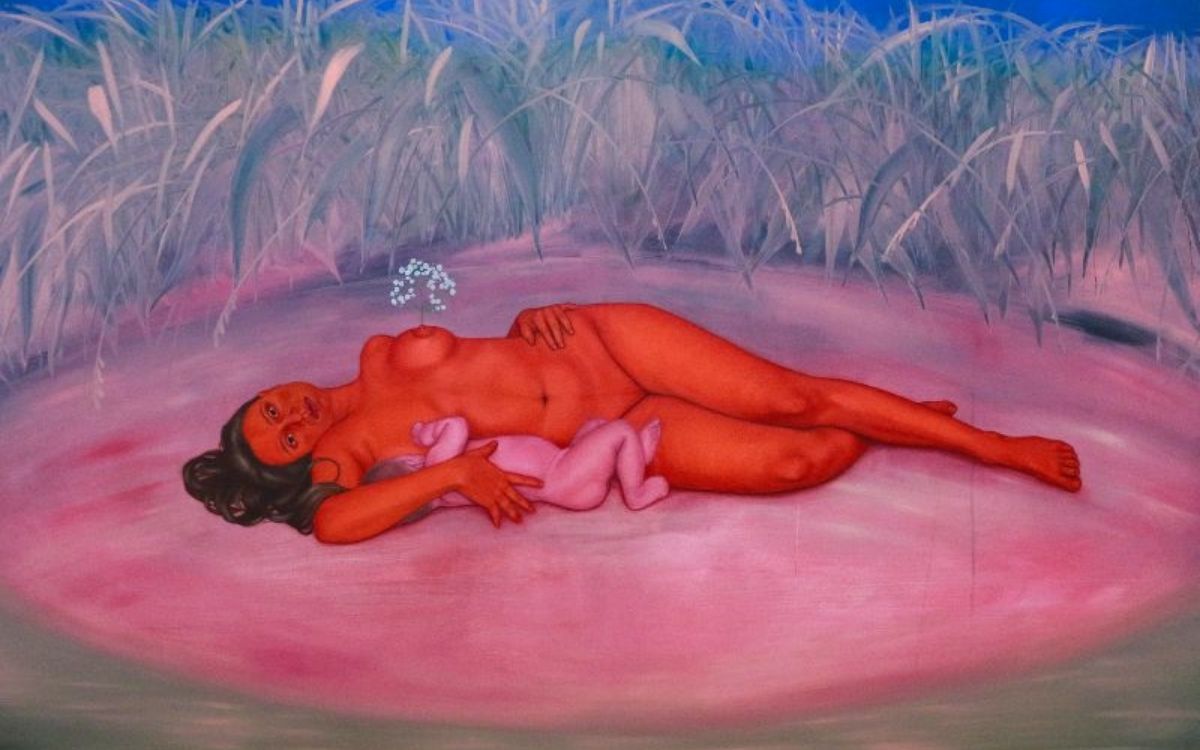
Judit Ágnes Gallai has always worked with the body as the closest available instrument for capturing existence. Growing up as a solitary being, escaping into a self-created inner world, the practice that eventually emerged was less a career choice than an inevitability. The raw material is always intimate: personal trauma, dream logic, and the visual language of ancient mythologies folded into a personal mythology entirely of one's own making. The process that shapes it is always methodical. That tension between the volatile and the disciplined is where the work lives. What follows is a conversation about what it means to build that kind of inner world, and why art began as survival before it became anything else.
How has your upbringing or cultural heritage shaped the themes and techniques you explore in your art today?
My works often draw from personal and cultural traumas and memories. Iconography, Greek, Roman and Hindu mythology deeply inspired me in my university years. I also believe that my way of thinking and working carries a certain Eastern European melancholy. It all merges with my own memories and symbols to become my personal mythology.
I have always worked with my own body to express my ideas. I felt that was the closest thing to how I could capture existence. I was a solitary being since my childhood, often felt like an outsider, escaping to my own world that I have created. It gave me a sense of self and freedom.
How do you reconcile the tension between raw, innate creativity and the discipline required to master your craft?
My ideas usually come in a very raw, instinctive way. They come suddenly, through everyday realisations of life. They are very volatile, hard to capture. My process on the other hand is very methodical. I feel my ideas need clarity and discipline to be able to communicate them, and capture them. This is what gives me balance in my art.
How important is it for viewers to understand the intended message of your work? Does ambiguity add value, or do you seek clarity in your expression?
I do seek clarity, I do want to clearly communicate what I am trying to express. Yet this is mainly a conversation with myself. My works are inner dialogues about questions of life, the unknown. These questions start to form in the subconscious in a very distorted way, which makes them elusive. I do like to be mysterious too, and my works are talking about things that are unclear to even myself. Though my works are talking about personal experiences they are universal at the same time, and the viewers connect with them.
What unusual or unexpected sources of inspiration have deeply influenced your work?
My sources of inspiration are personal traumas, memories and weird dreams. I found that what most resembles dreams are different mythologies. They are strange stories of the heroic self. Although they are stories of Gods they talk about human nature and its fears and desires. And like dreams they are highly visual stories. Our dreams draw from the collective subconsciousness but they are deeply personal at the same time. In every dream, if you think about it, you are playing all the characters because it all happens in your own mind. In your dreams you play all the roles of the day, like a body double, in a grotesque way in the theatre of the night.
Do you have any rituals or habits that help you enter a creative state of flow?
No habits or rituals, it happens on its own. I get my ideas whenever my mind has clear moments to log out. On the bus, or in the shower, or when I fade out watching clouds in the sky. But mainly in the in between of awakeness and sleep, in the border of dreaming. And once I have the idea I only need time to execute the image on the canvas. What happens in the state of losing myself, what is the best part, because it becomes a kind of meditation and this is why subcouqcously I started to make art. It gives me a way to escape reality.
Can art be truly therapeutic? Have you experienced its healing power personally, or seen it impact others?
I think that’s why I started to paint. From early childhood going in a corner with a pencil and a piece of paper was my way of healing. Later forming images that talked about my deepest fears, traumas and memories was a way to process them. Career as an artist was a byproduct of this. I wasn’t able to exist any other way. Since then I have a more conscious relationship with my art and it became a lot more than a coping mechanism, and a way of life. Seeing how the viewers see them made me realise that my works have their own life of their own.
What artistic “superpower” would you choose to have, and how would it shape your work?
If I had a superpower as an artist it would be to make works super fast. I don’t want quantity at all, that’s not the reason. I would want to make works fast because I have lots of ideas that feels burning, and my process of making each painting is very slow, because they are very detailed. Although it is meditative to do something monotonous, creating details stroke by stroke, slow down and be with an idea for a couple of months, but seeing it go so slow can also be stressful. I just feel I am running out of time.
I would also like to be able to shift between times, within my own lifespan. To be able to go back in the past and see myself with the knowledge and perspective of today. I think I would be able to make very interesting works if I could revisit times of my life with the same intensity as it happened. It could be painful though.
How do you envision the evolution of your work in the coming years?
As an artist I mainly work with painting, but I like to express my ideas in different mediums like installation, sculpture, performance based photography and video. In the future I would like to extend the mediums even further and also try, and experiment with different materials.
About my themes, and painting techniques I would like to maybe go from instinctive to slightly more conscious and conceptual. I guess this is part of growth to slowly have a bit more distance from ourselves and try to see things from outside to be more objective.
Judit Ágnes Gallai is running out of time, and knows it, not as resignation but as urgency. The ideas arrive burning and the process is slow, and that gap between the two is something the work has learned to hold rather than resolve. The paintings are inner dialogues about questions that remain unclear even to the person asking them, yet viewers consistently find their own way in, because the most personal territory often turns out to be the most universal. Moving forward, the ambition is to extend into new mediums and materials, and to gradually introduce more distance and objectivity into a practice that has always operated from deep inside. The theatre of the night, as Gallai puts it, is still running. There are more roles yet to play.