
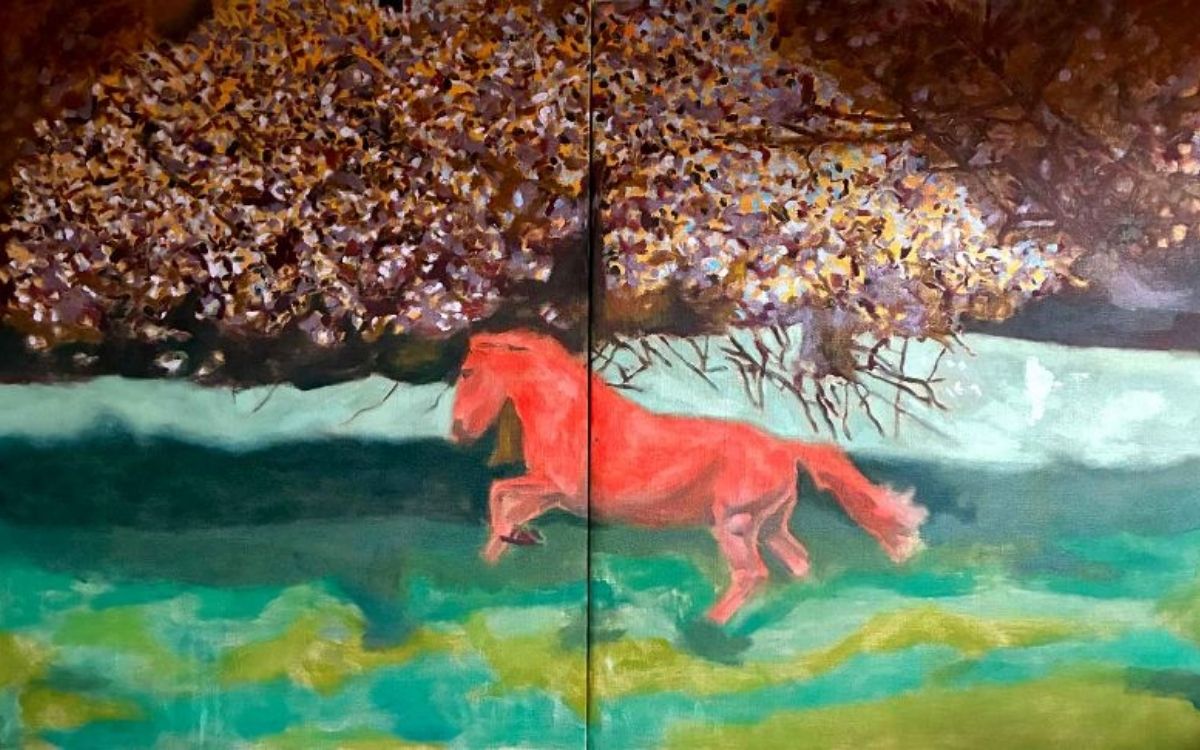
Alex Slonimsky paints slowly, deliberately, and in full awareness that slowness is itself a position. In a world of accelerated, disposable images optimised for scrolling, choosing painting is a statement about the time an image deserves and the time asked of the viewer. The practice resists the explicit, the didactic, and the image that closes its own meaning before anyone has the chance to inhabit it. What emerges instead is work that stays open, that continues working after the encounter, that asks something of the person standing in front of it without telling them what to find. What follows is a conversation about why ambiguity is a necessary condition rather than an aesthetic device, what observation has to do with subversion, and why authenticity is not a responsibility the artist owes the world but a demand the work makes of the artist.
How does your art engage with or comment on pressing contemporary issues—social, political, or environmental?
The mere fact of dedicating myself to art already places my work in dialogue with its context. There is no artistic practice that occurs in a vacuum, even if the artist intends it that way. What I choose to represent and how I depict it are decisions mediated by the contemporary — by what is happening around us, by what weighs on us, by what is impossible to ignore even if it is not explicitly named. Every formal decision, every subject, every omission is also a position, even if it is not declared as such.
To be more specific, my intention is to communicate without propaganda. That implies a deliberate effort to resist the temptation of the explicit, the didactic, the image that closes its own meaning before the viewer has the opportunity to inhabit it. Propaganda, regardless of the cause it serves, reduces. It shrinks the experience to confirmation. And I believe art can — and should — do something more interesting than that.
By working through painting, an analogue device for constructing images, I am also communicating something about the medium itself. Painting has an inherent slowness, a materiality, a resistance to immediacy that is in itself a statement in the current context. We live in a regime of accelerated, disposable images, optimised for scrolling. Choosing painting is neither nostalgia nor technological rejection — it is a decision about the time an image deserves and the time I ask of the viewer.
One thing is what I can construct discursively — in interviews, texts, statements of intent — and quite another is what I place on the canvas. I am clearly more interested in the latter. The words I use to speak about my work are always an approximation, an imperfect translation of something that chose not to be verbal. If I could say it in words, I wouldn’t need to paint it.
My work is not understood in a single painting. It requires series, accumulation, something that sediments over time. An isolated painting may be beautiful or unsettling, but deeper meaning emerges in the relationship between pieces — in what repeats, what mutates, what disappears. It is in that longitudinal dimension that I believe the dialogue with the contemporary becomes more honest and more complex.
That said, everything I think and feel about the world is undeniably present in the work. Violence, fragility, the tension between what is shown and what is concealed, discomfort with certain orders, attention to what goes unnoticed — all of that is there. Just not explicitly, not in a way that can be pointed at and labelled. I prefer the discomfort of openness to the comfort of resolution. I prefer the viewer arriving at something of their own rather than confirming what I have already thought.
In that sense, I believe the most honest link between art and contemporary issues does not always lie in their direct representation. Sometimes it lies in form, in tempo, in the decision to do something slow in an accelerated world, something ambiguous in a world that demands clear positions, something material in an increasingly immaterial world. These are also responses — perhaps the most sincere ones I have to offer.
What do you think is the most meaningful role an artist plays in society today?
I am not inclined to fix meanings, but if I had to choose one, I would say our role is to observe. I know it may sound like a minor answer, even trivial given the scale of the question. But the more I think about it, the less trivial it seems.
Most people live deeply embedded in the vortex of the productive system: schedules, assigned tasks, conventions, urgencies, metrics. This is not a moral judgement — simply a description of how the world functions for most. Free time exists, of course, but even that time tends to be colonised by consumption, by entertainment designed not to demand too much, by functional rest that prepares the body to produce again. There is little room for genuine contemplation, for a gaze that has no purpose beyond looking.
The artist, by contrast, is allowed — or tolerated — a certain eccentricity, a certain misalignment with that logic. And that misalignment is not decorative privilege or harmless oddity. It is functional. It exists precisely so that someone can pause, open up, and contemplate without that being considered a waste of time. Society needs someone who is not in a hurry, even if it does not always recognise or properly reward that.
Observation, in this sense, is not passive. It is a form of sustained attention that requires training, disposition, and a certain tolerance for the discomfort of not yet knowing what one is seeing or what it is for. It is resisting the impulse to classify too quickly, to name too soon, to reduce experience to something manageable. The artist who observes well is not the one with the most answers, but the one capable of holding questions for longer.
What the artist brings back is not necessarily a solution or a coded message. It is a capture of what goes unnoticed by the accelerated eye — a residue, a detail, a texture of time that would otherwise be lost in noise. Sometimes it is something small and everyday that suddenly acquires unexpected weight. Sometimes it is something everyone saw but no one truly looked at. That difference between seeing and looking is perhaps where art operates most honestly.
That said, this does not make the artist superior or the guardian of any truth. What distinguishes them is not innate sensitivity but the practice of a certain availability — a constantly renewed decision not to let perception become entirely automated. To keep that channel open even as the world continually pushes towards closure, efficiency, and the familiar.
In that sense, observation may be the most subversive act today. Not because it directly challenges power, but because it withdraws time and attention from a logic that demands immediate, measurable output. Contemplation does not yield. And that is precisely why it matters.
Do you think art should have a political or ideological agenda?
No. I believe in the freedom of individuals to choose, and that includes the artist. No one should be obliged to place their practice at the service of any cause, however legitimate it may seem — much less to declare it publicly as a condition for being taken seriously.
That said, politics and ideology are unavoidable for anyone. No one operates from a vacuum. Every aesthetic decision, every chosen subject, every omission carries a worldview, whether or not it is explicitly stated. In that sense, saying art has no agenda does not mean it is neutral, but that its relationship to the political is more complex and less direct than that of a manifesto or public statement. That complexity is precisely what makes it valuable.
Art, as a communication device, can lean towards propaganda or design. And in my view, the more graphic and literal it becomes, the more it degrades into one of those categories. It loses density, ambiguity — precisely what distinguishes it from other forms of communication. An image that already knows what it wants to say before being looked at does not need to be art; it can be a poster, an infographic, a post. None of these are lesser in their own domain, but they are not the same.
I do not agree with the particular expectation placed on artists to publicly display explicit political or ideological positions. It is a pressure that comes from multiple directions: the market, which needs sellable narratives; certain ideological circuits, which need visible alignments; and a culture of constant opinion that mistrusts silence and ambiguity as if they were complicity. In all these cases, the pressure reduces. It turns artistic practice into a platform and the artist into a spokesperson for something already decided.
If you do not see it in the work, there are two possibilities: either it is not there, because the artist legitimately chose not to include it, or it is there in a form you do not yet recognise. In either case, the correct response is the same: leave it be. Do not demand a literal translation of something that chose not to be literal.
Sometimes artistic labour is overestimated as a political platform, while the audience’s intellectual capacity is underestimated. It is assumed that if the message is not underlined, people will not find it. That distrust of the viewer is itself a form of condescension. The audience is perfectly capable of reaching its own conclusions if given the space to do so.
The art that interests me most does not tell me what to think. It places me in a situation where I must think for myself. That difference, small as it may seem, changes everything.
How important is it for viewers to understand the intended message of your work? Does ambiguity add value, or do you seek clarity in your expression?
Strictly speaking, I do not fully understand my own message. And I want to be precise here, because I do not say it as a pose or an evasion — it is an honest description of how the process works. If I knew exactly what I wanted to say before I began painting, the painting would be redundant. It would be an illustration of an idea that already existed elsewhere. What interests me is what emerges in the making — what arises in the process that was not available beforehand.
Therefore, discursive clarity is not a priority, and I actively work to keep it that way. I believe in something that is not expressed or understood through words — something that exists in a dimension language cannot fully reach, or only reaches approximately and with loss. That is why I protect it from the machinery of logic. The moment I name it, I domesticate it, make it manageable, reduce it. What was open closes; what was alive becomes fixed. I prefer to keep it in that state of indeterminacy where it can still move and mean different things to different people at different times.
Ambiguity, in that sense, is not an aesthetic device I choose because it sounds sophisticated. It is a necessary condition for what matters to me to remain alive in the work. An image that has already resolved its own meaning does not need to be truly looked at — only confirmed. And confirmation is not a particularly interesting experience.
That said, I do not believe ambiguity and clarity are opposites. I can be very precise in a brushstroke, very deliberate in a formal decision, fully aware of why I choose one colour over another or one composition over another, while leaving meaning completely open. Clarity operates on the level of making — technical and formal decisions — not on the level of saying. They are different registers, and confusing them comes at my own risk.
What the viewer understands or does not understand is entirely legitimate in any direction. I do not seek confirmation that they have understood what I intended, partly because I do not always know precisely what that is. But neither do I seek confusion — I am not interested in hermeticism or artificial obscurity as a sign of depth. That would be another form of pretension.
What I seek is that something moves: a discomfort, a question, a sensation that does not fully resolve — something the viewer takes with them and that continues working after they have left the painting. That the experience does not close in the moment of encounter but continues somehow, even if neither the viewer nor I know exactly what continues or where it leads.In that sense, the understanding that matters to me is not intellectual but experiential. I do not want them to understand the painting. I want them to inhabit it, even if only for a moment.
How do you measure the impact of your work—by its reception, its personal meaning, or something else?
I like not knowing too much about the impact of my work. I am aware that this can sound like indifference or affectation, but it is neither. It is a fairly deliberate decision about where to place my attention and what kind of feedback to allow in. I understand that it generates something, and that manifests in concrete ways. It manifests in the fact that I am able to continue dedicating myself to painting, which is the most basic and most honest indication that something is working. Sometimes people write to me — a message that arrives weeks or months after an exhibition, from someone who saw something and felt the need to say it. Other times it appears in person, during exhibitions, in a conversation that begins in front of a painting and ends somewhere unexpected, in a gaze that lingers longer than one might anticipate. I register all of that. But I do not accumulate it as a metric, nor do I process it as data to adjust what I do.
I believe that, although it may seem contradictory at first, the healthiest thing for an artist is not to think too much about impact. The concrete risk is becoming success-driven or sensationalist — beginning to produce for reaction rather than for that which does not yet know how to name itself. The moment impact becomes the objective, the work starts bending outward, towards the imagined viewer, towards what is believed will work. And that is precisely the movement I am most interested in avoiding.
What I do is more focused on creating the conditions for something to happen, without fully controlling it. Preparing the ground, caring for the work, being rigorous in formal decisions, maintaining honesty with the process. But the result — what ultimately happens to someone in front of a painting — does not belong to me, and I should not pretend that it does. The moment the work enters the world, it ceases to be entirely mine. It begins to exist within the experience of others, and that experience is, by definition, inaccessible and uncontrollable.
In the end, aesthetic experience is irreducibly subjective. What profoundly moves one person may leave another completely indifferent. And neither response is more valid than the other, nor does it say anything definitive about the work. The real challenge, if there is one, is not to impact a particular person in a particular way, but to construct something sufficiently open and sufficiently charged to encompass as many subjectivities as possible without betraying one’s own. That something genuine can resonate across different registers, in different people, from different places.
That cannot be measured — or it can only be measured poorly and with considerable delay. And I think that is as it should be. The need to measure impact in real time is a logic that comes from elsewhere — from advertising, from content production, from engagement metrics. It is not the logic that corresponds to a practice working with long durations and with what cannot be easily quantified.If the work is honest and rigorous, something will happen. I do not know exactly what, or when, or with whom. But it will happen.
In a world flooded with imagery, what responsibility do artists have to stand out and say something authentic?
I do not think it is a matter of responsibility per se. The word responsibility implies an external obligation — something owed to someone — and I do not think that is the correct relationship between the artist and their practice. When art originates from obligation, from a debt to the world or to the times, something in its origin is already distorted.
Since antiquity, we have lived mediated by images: caves, frescoes, the printing press, photography, cinema, television, the phone. At every moment in history there have been those who point to the visual saturation of their time as something new and unprecedented. And in every case they were partly right and partly mistaken. Today we may be experiencing a vortex of that constant — an undeniable acceleration — but not an anthropological rupture. Human beings have always needed images to construct and inhabit reality. It is not a recent weakness nor an exclusive symptom of late modernity. It is a condition of the species.
Much is said about today’s visual saturation as though we previously depended less on images to orient ourselves in the world. That was not the case. What has changed is the speed, the volume, and the device. But the function remains essentially the same. In that context, the role of those who produce images remains fundamentally unchanged. I do not believe that the abundance of images makes the artist’s task more urgent or more heroic. It simply alters the background noise against which they work.
That said, I do not like to think that artists carry a special responsibility to say something authentic, as though they were the last guardians of some threatened truth. That narrative seems inflated and, at its core, rather comfortable — it turns the artist into a redemptive figure without demanding much in concrete terms. I do not believe art should carry a prescribed morality or ethics from outside, nor that it should respond to any agenda or urgency other than its own.
But if it is not authentic, it is not art. And that is not a responsibility — it is a condition. An internal condition, not an external one. It is not about owing authenticity to the world, but about the fact that without authenticity the work simply does not function; it lacks density, it lacks a life of its own. One can immediately sense when something has been made to meet external expectations rather than from a genuine place. The eye detects it even if it cannot name it.
Authenticity does not need to be proclaimed, justified, or actively distinguished from what is not authentic. It simply stands apart. Not because it is superior in some cultural hierarchy, but because it operates from a different place — with a different intention, a different temporality, a different relationship to the outcome. A meme and a painting may share the same subject, even the same image, but the experience they produce is radically different because their origin and process are radically different.
In that sense, authenticity is not a responsibility the artist has towards society. It is a demand the work makes of the artist. And the difference between those two formulations is not minor. One comes from outside and can be ignored. The other comes from within and, if one takes the work seriously, is rather difficult to evade.
How do you feel social media is shaping the way art is created, consumed, and valued today?
To quote Marshall McLuhan, the medium is the message. It is not a decorative phrase or an easy reference. It is one of the most precise — and most uncomfortable — ideas ever formulated about communication, and it becomes more relevant each year. The medium is not a neutral channel through which content passes independently. The medium transforms the content, imposes its conditions, its rhythm, its logic, its scale. Both artists and audiences are shaped by social media in how we communicate, perceive, and value what we see.
The hyper-virtuality we inhabit today undermines the quality of aesthetic experience. This is not a nostalgic claim or a generational complaint. It is an observation about what happens when an image designed to exist in physical space — with a certain scale, materiality, and relationship to light and the viewer’s body — is reduced to a reproduction on a five-by-five centimetre luminous screen. It is not the same. It is not a degraded version of the same thing. It is something entirely different that retains superficial attributes while losing what is essential.
And that reproduction does not appear in isolation. It appears alongside countless simultaneous stimuli: memes, news, family, advertising, videos, opinions. Everything on the same plane, with the same visual hierarchy, all competing for the same fragment of attention. Context contaminates everything. An image that in another setting might generate genuine contemplation becomes just another item in the scroll — processed in fractions of a second and immediately replaced.
The almost inevitable result of operating within that logic is images that seek the ‘like’ — designed, consciously or not, to trigger rapid responses, to engage the limbic system, to provoke immediate reaction. Images that function as attention traps rather than genuine proposals for visual experience. And this is not only a problem of content but of process. When an artist begins producing with the small screen in mind, in competition with everything else, formal decisions change. The work shrinks, becomes more immediate, more legible, more impactful in the most superficial sense of the term.
What is concerning is not that such images exist — kitsch has always existed, as has production aimed at immediate gratification and rapid consumption. What is concerning is that the algorithm systematically selects and amplifies them above all else. This shapes not only what is consumed but what is produced. It shapes audience expectations, which grow accustomed to certain stimuli and become less patient with what demands time and attention. And it shapes, whether acknowledged or not, the decisions of artists who observe in real time what works and what does not.
That said, I do not believe the answer is to ignore social media or pretend it does not exist. It does, and its reach is unprecedented. But it is important to be deeply aware of what the medium does to the work when one chooses to circulate within it — to understand what is gained and what is lost, and to make that decision consciously rather than being carried along by the system’s logic.
Do you believe the ‘mad artist’ stereotype still holds weight, or is creativity more grounded than we think?
Stereotypes are products of consumption, and art is no exception. We need simple narratives to process complex realities, and the mad artist is one of the most persistent — and most marketable — of them. Van Gogh without his ear, Basquiat self-destructing, Pollock drunk in front of the canvas. These are stories that function dramatically, that have narrative arcs, that generate both fascination and morbid curiosity. The problem is that they are not merely descriptions — they are prescriptions. And that makes them dangerous.
The stereotype of the mad artist is particularly harmful because it rewards self-destructive behaviour. It elevates addiction as a sign of depth, romanticises suicide as the inevitable consequence of a sensitivity too great for the world, and presents personal deterioration as proof of authenticity. As though suffering were the necessary price of creativity, rather than simply suffering. That equation causes real and measurable harm to actual people, especially those who are just starting out and are looking for models to identify with. If the available model is the troubled genius who consumes himself, some will attempt to embody that model. And that has consequences.
Mental health is an extremely important issue for everyone, and artists are no exception — nor a separate category with special needs or unique pathologies. There are unstable people everywhere: in medicine, in politics, in finance. But we do not construct the stereotype of the “mad doctor” or the “mad accountant” with the same insistence or romantic charge. Only the artist is labelled this way, as though it were a requirement of the profession or a marker of authenticity.
What I want to encourage — and what I find in the artists I most admire — is something quite different: discipline, self-care, play, regularity. My artistic references have been individuals more committed to sustained work than to channelling pathology through the medium. Artists with organised studios, clear routines, a functional relationship with their own lives. Who produced not in spite of being well, but in part because they were well enough to work consistently and deeply.
In my experience, creativity does not emerge from chaos but from a certain regularity. From a studio one returns to every day, even without desire; from habits that sustain the process when inspiration does not appear; from a relationship with time that does not depend on mood. The myth of the creative outburst — the artist producing in bursts of genius between periods of darkness and self-destruction — is cinematic, but not particularly useful as a real working model.
That said, I do not wish to deny that some artists have produced significant work under conditions of great personal instability. But I believe that work was made despite those conditions, not because of them. And romanticising those conditions as though they were the source of talent is a convenient narrative for the cultural industry, which thrives on compelling stories, but not an honest account of what actually allows work to be made and sustained over time.Creativity is more grounded than the stereotype suggests. And that does not make it less interesting — it makes it more accessible, more practicable, more real.
Under what circumstances do you think art risks becoming pretentious?
Pretension is a symptom of insecurity — not arrogance, even if it manifests as such. At the root of any pretentious gesture lies an unresolved need for external validation, a dependence on others’ judgement disguised as indifference towards it. It is one of the most common paradoxes in any creative practice, and also one of the most difficult to recognise in oneself precisely because it presents as its opposite.
Art moves from the inside of the artist outward. That direction matters. The genuine movement is centrifugal: something that exists in the artist’s inner world seeks form, finds a medium, and emerges. The pretentious movement is centripetal and inverted: the artist looks outward first, identifies what appears to be valued, sophisticated, or profound within the circuit in which they wish to operate, and then attempts to construct inward from that external image. They work backwards from the desired effect instead of forward from something genuine.
The concrete problem with this inverted movement is that one is working with the materiality of an assumption — with an imagined audience as the primary interlocutor, with an idea of what art should be or appear to be, rather than with what actually exists in one’s own experience. And assumptions are poor working materials. They are unstable, subject to trends, dependent on external approval to sustain themselves. The inner world, by contrast — though not material in the physical sense — is profoundly real. It belongs to each individual in a way no external assumption can replicate or challenge from outside.
There are specific circumstances where this risk becomes greater. One is over-explanation. When a work requires a five-hundred-word wall text to justify its existence, something is not functioning in the work itself. Words should not support the image — at most, they should accompany it. When the explanation is more interesting than the work, the work has a problem. Another is undigested reference. Quoting Heidegger or Lacan in an interview is not a sign of depth if those references have not been truly assimilated into one’s thinking and transformed. Performative erudition is one of the most recognisable — and most empty — forms of pretension.
There is also an institutional pretension worth mentioning — one that comes from the system itself: galleries, museums, fairs, curatorial texts that wrap anything in sufficiently opaque language so that questioning the work appears as ignorance rather than a legitimate response to its emptiness. That pretension is not the artist’s, but the artist who accepts it without resistance becomes complicit.
Ultimately, the only pretension art can sustain — if it can even be called that — is the attempt to communicate the inner world faithfully. To wager that what exists within, which cannot be demonstrated, argued, or institutionally validated, is worth externalising with rigour and honesty. That wager always requires a certain audacity. But it is an audacity that comes from within and is supported by the work, not one constructed outwardly to impress a jury that, more often than not, does not fully know what it is looking at either.
Do academic institutions still play a vital role in shaping artists today, or has self-taught creativity disrupted this tradition?
That is a question the academy asks itself. And I am quite accustomed to hearing it within those circuits. I take it, quite honestly, as an attempt not to lose relevance or power within the field. I do not say that as an attack, but as an observation about who formulates the question and from where. Institutions that ask whether they remain vital usually already have the answer they want to hear.
The first Western art academy dates back to 1563 — the Accademia delle Arti del Disegno, founded in Florence by Vasari and Cosimo de’ Medici. Human beings, however, have been making art for over 500,000 years. That distance between those dates says something. It tells us that artistic practice existed, developed, reached extraordinary heights, and generated rich traditions long before any institution formalised or certified it. The academy did not invent art, nor the capacity to teach and learn it. It came later, when art was already an established practice, and provided an institutional framework — with all that entails, both positive and less so.
Even in more recent history, we can point to a considerable number of self-taught artists who have had a decisive influence across fields: Basquiat, Frida Kahlo, William Blake, Henri Rousseau, among others. The list is long and spans genres, geographies, and periods. It is not an exception or a rarity — it is a consistent enough pattern to be taken seriously.
Where I do believe the academy remains genuinely useful is for what we might call “desk artists”: understanding the bureaucratic world of funding, grants, residencies, cultural institutions, museums, galleries, and their internal logics. It provides access to networks within a circuit that, frankly, remains quite insular, where personal connections often matter as much as — or more than — the work itself. In that sense, the academy functions well, even if it does not always acknowledge it explicitly.
But the specific knowledge of the craft — techniques, materials, art history, visual language — can be acquired in other ways: independently, in studios, through reading, looking at work, practising consistently. That does not mean it is easy. It may require even more discipline than the institutional route, as there is no external structure or imposed timetable. But it is entirely possible, and there is ample historical evidence to support that.
The rest is practice and craft. And craft is not learned in any classroom — it is learned by doing, by failing, by doing again. That is true both inside and outside the academy.
But the more interesting question, the one underlying the one being asked, is this: what tradition are we actually referring to? Because if the tradition the academy preserves and transmits is a certain Western, male, Eurocentric canon, then we must also ask what is lost and what is distorted in that transmission. And if self-taught creativity disrupts that particular tradition, perhaps that is not a problem but part of a necessary — and long overdue — conversation about what deserves to be called tradition, and who has the authority to define it.
Alex Slonimsky does not accumulate impact as a metric. A message arriving weeks after an exhibition, a gaze that lingers longer than expected, a conversation that begins in front of a painting and ends somewhere unforeseen: these are registered but not processed as data to adjust what comes next. The work is pointed inward and forward, toward what does not yet know how to name itself, toward what emerges in the making rather than what was planned before it began. If it is honest and rigorous, something will happen. Not immediately, not measurably, not on any platform's terms. But it will happen. That quiet certainty is, in its own way, the most radical position in the room.