
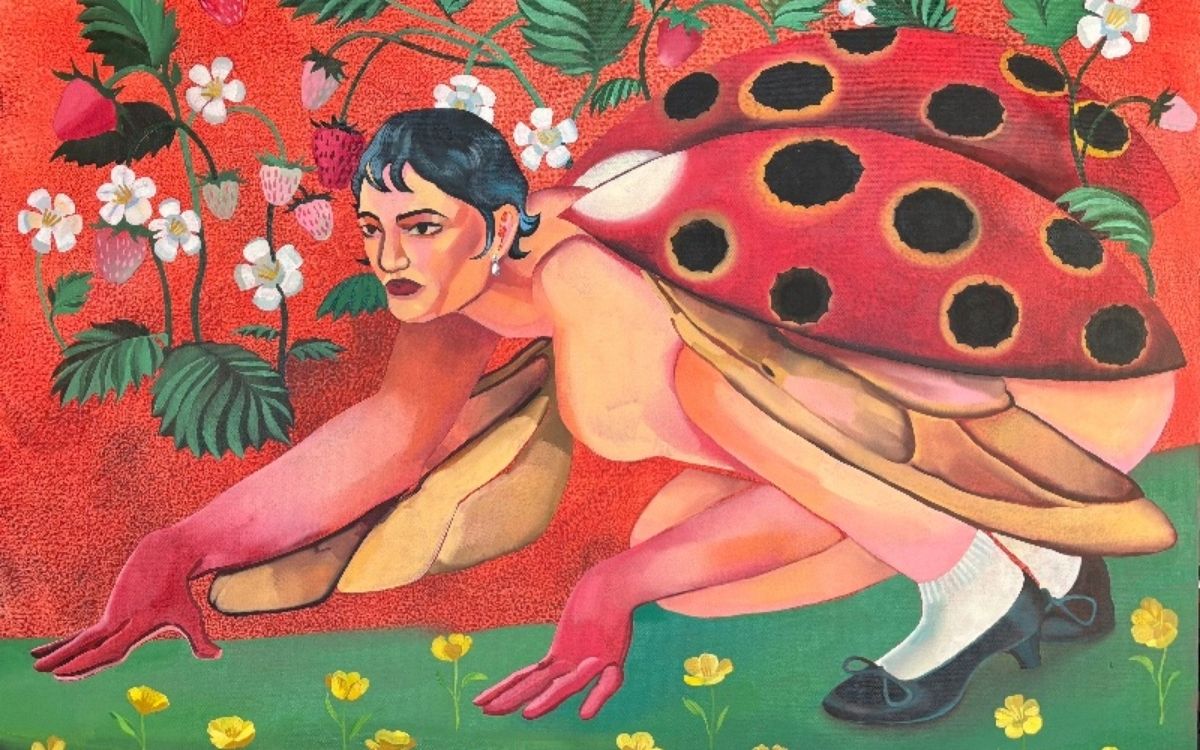
Darika Bakeeva grew up in Kyrgyzstan, surrounded by women, and that early world has never really left the work. The female figures that populate the paintings carry the emotional weight of aunts, sisters, and grandmothers, rendered with a strength that feels less like a stylistic choice than a natural inheritance. The style Bakeeva describes as "naive symbolism" is precise in its ambitions: meanings that are readable without being rigid, and symbols that communicate without demanding a single interpretation. Underneath all of it is a practice built on sincerity, on the belief that authenticity comes not from adapting to trends but from staying close to one's own experience. What follows is a conversation about where that experience comes from and how it finds its way onto the canvas.
How has your upbringing or cultural heritage shaped the themes and techniques you explore in your art today?
I was born and raised in Kyrgyzstan, a place where children are often raised by several family members at once. I grew up surrounded by women: my aunts, sisters, and grandmothers, they shaped much of the emotional world I carry within me, which is why female figures appear so naturally in my paintings. Through the heroines of my works, I reflect on both my own experiences and the stories of the women around me. I am drawn to portraying women as emotionally and physically strong, and the body itself often becomes an important language in my art.
How important is it for viewers to understand the intended message of your work? Does ambiguity add value, or do you seek clarity in your expression?
I would like viewers to understand the meaning behind my works, and I truly appreciate feedback from people who follow my art. Most of my paintings contain readable and recognizable meanings, which is why I like to describe my style as “naive symbolism.” But sometimes flowers are simply flowers, and there is no hidden meaning behind them.
Do you have any rituals or habits that help you enter a creative state of flow?
Lately, I have been challenging myself more and more, trying to take on something new, whether it is a different format or a new technique. Because I am often afraid to begin, I ask the Universe to give me the strength and ability to do the work well, so that in the end I can genuinely like it myself. I promise myself that this will be my last painting and that I will never pick up a brush again, but if the work turns out well, I take my words back. Somehow, that helps me.
Is art created for the artist, the audience, or somewhere in between?
When it comes to the question of who art is created for, I personally feel that art exists on its own, and the artist is simply a guide or a medium. An artist can explore different themes and speak to the viewer in many ways, but personally, I want to be understood and I want my art to resonate with people.
In an increasingly globalized world, how can artists preserve authenticity and cultural integrity in their work?
I think it's important to remain sincere. Authenticity is born when a person does not try to adapt to trends or the expectations of mass culture, but instead expresses their own experience, feelings, and views. Globalization gives artists the opportunity to explore different cultures and styles, but at the same time it is important not to dissolve into the general flow and to preserve their uniqueness. It is the combination of openness to the world and loyalty to one’s own identity that helps an artist maintain cultural integrity in their works.
Name five pivotal lessons you’ve learned that shaped your artistic journey.
Maintaining social media is very important for an artist, even if you do not enjoy it.
Do not compare yourself to other artists, because everyone has their own path.
Small merch items and small paintings are just as important as large canvases, because people want to buy art, you simply need to give them that opportunity.
It is very important to stay connected with other artists and be part of an artistic community.
Do not be shy
If you had the chance to sit down with any creative mind from history, who would it be and what would you ask?
I would like to talk to Frida Kahlo, as she is one of my favorite artists. I deeply resonate with her work, from her painting technique to the meanings she puts into her art. I visited her joint exhibition with Diego Rivera in Moscow and was amazed by how much emotion there is in her paintings. It is astonishing how a person who experienced so much pain could create something truly beautiful, vivid, and alive. I would simply love to see how she works.
Are there any upcoming projects or dreams that you’re particularly excited about?
I would like to experience an art residency abroad. I think it is not only an opportunity to travel, but also a chance to immerse myself in a new cultural environment, meet artists from different countries, and see art from a different perspective.
Darika Bakeeva ends each painting by taking back a promise. The ritual of swearing off the brush, only to return when the work turns out well, is a small and telling detail: it suggests a practice held together not by certainty but by the ongoing negotiation between fear and desire. The dream of a residency abroad, the openness to new formats and techniques, and the quiet conviction that art exists on its own terms, with the artist as guide rather than author, all point in the same direction. The work is still unfolding, and the next canvas is already waiting.