
How do you reignite creativity during those inevitable periods of self-doubt or stagnation?
For me, the creative process is also very much about routines. I do sometimes go through periods of stagnation, but I have a sketchbook where I draw ideas, I have albums in my gallery on my phone with photos that inspire me, and titles and motif ideas in my notes on my phone. When I really do hit a wall, I have a look at these and usually find something I can and want to paint. Most of the time, I actually have too many ideas all at once. Generally, I’ve got into the habit of painting every day, which helps prevent stagnation, as I’m used to painting and usually have a plan. The more you practise something, the greater the role it plays in your life. Because I paint so much, I’m also constantly thinking about it subconsciously. I’m actually convinced that you can develop habits in this way. A bigger problem that comes up sometimes is when I’m in the process of painting and I no longer like the subject, or it isn’t turning out as I’d imagined. What also helps a lot is discussing my paintings with friends. I now have a great circle of friends who know me and my paintings very well. I really enjoy expressing my concerns and getting constructive feedback. Usually I’ll make drawings and sketches and we’ll discuss what the best solution for the picture would be.
How does your art engage with or comment on pressing contemporary issues—social, political, or environmental?
I’m very concerned about what’s happening in the world. Sometimes it’s quite frightening, and it’s certainly worrying. Many of these issues really get to me. At the start of the war in Ukraine, for example, I painted children who had been orphaned by the war and ‘transported’ to places where they could be looked after. Lately, however, I’ve been moved by the social constructs we live with every day – constructs that many no longer question because they’ve been around for centuries, but which have serious consequences for women. For instance, I painted a picture called ‘You don’t play with women’(mit Frauen spielt man nicht), in which I wanted to express my dismay at the case of Collien Fernandez, but also clearly show how happy and grateful I am that she is so courageously sharing her story. I mean, there’s a man who takes control of you and uses your identity and your body, on the grounds that you’re his wife and therefore his property. But no, we women are not pawns in a perfidious game. Unfortunately, this is not an isolated case, as can be seen from the story of Gisèle Pelicot, or the 132 femicides in 2025.
How important is it for viewers to understand the intended message of your work? Does ambiguity add value, or do you seek clarity in your expression?
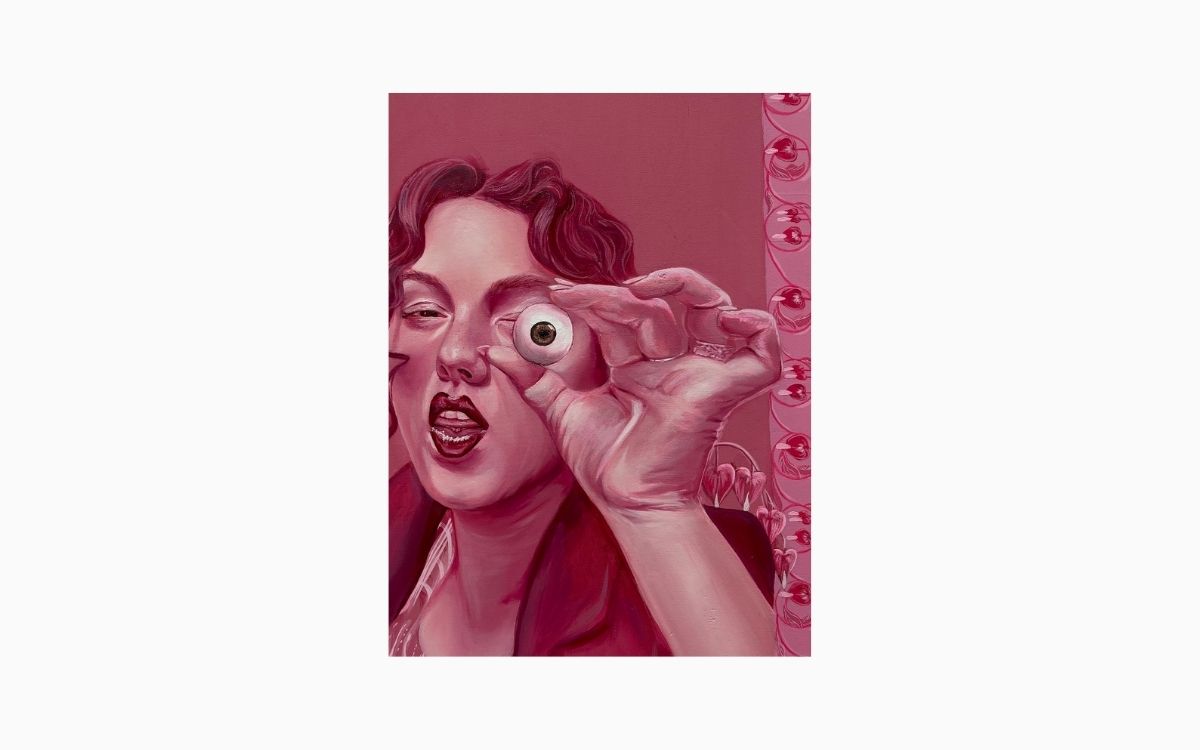
It’s a good question whether it’s important for viewers to understand the meaning of my pictures. I ask myself this question regularly. I think that my art has recently taken on a somewhat provocative and exaggerated quality, with a poster-like aesthetic. I’m currently working a lot with colours and motifs that carry strong connotations. Take the pink and the high heels, for example. But the titles of the pictures are also important to me. Because these then point to what I mean by them and probably also create a certain ‘aha’ moment from time to time. I believe that if you don’t read them, you might be tempted to simply see them as aesthetically pleasing, kitsch images. In a way, I’m also playing with viewers’ expectations. But in themselves, I think the meanings of my pictures are quickly grasped.
Have you ever struggled with the ethics of your art—such as who it represents or who it impacts?
Yes, that’s actually a question that’s been on my mind. I’m aware that I’m a white, young and privileged woman who has the good fortune and the time to express myself creatively. Yet it’s very difficult not to reproduce stereotypes. For example, I shy away from painting Black people, even though I’d love to, because I’m afraid of perpetuating racist stereotypes. At the moment, when I paint figuratively, I mostly paint people from my immediate circle and my family, which happens to be a lot of white, slim people. Of course, the question arises of how to deal with this, because it certainly creates a very selective perspective, and I’m aware of that. The same thing can become a problem even when working in monochrome. I noticed this, for example, with my painting mentioned above: ‘You don’t mess with women’ (mit Frauen spielt man nicht). To me, the meaning was absolutely clear, and then I was told that the use of pink—a colour with feminine connotations—along with the high heels and tights, made it seem rather stereotypical. I, on the other hand, saw in it a strong woman who is empowering herself and consciously defying the system. I was more considering that pink used to be the color of kings in the Middle Ages and in that time high heels were mostly worn by men.
Describe a piece you’ve created that has held the most emotional weight for you.What makes it significant?
I grew up on a four-sided farmstead and always lived next door to my grandmother. She inevitably had a huge influence on me and raised me, as I spent almost every day of my childhood with her. She was a constant presence in my life, and when she passed away in 2021 and I saw her lying there dead, it left a huge void. I found it very hard to accept that she was dead, and even today I sometimes think that I still need to tell her this or that. But unfortunately, that’s no longer possible. A painting I created in February 2023, two years after her death, deals with this pain and the shock. It’s called ‘Deathbed’. In fact, it took me a while before I was able to express how it felt to lose this person who was like a mother to me. Grandma still occupies my thoughts to this day. It was only in April that I painted a picture of her hands, as they were so essential to me, having done so much work and provided so much care for those around her. So I think these two paintings hold the greatest emotional value for me.
How has your artistic style transformed over the years? Are there specific influences, experiments, or moments that marked a turning point?
Well, my style has changed – or rather, evolved – a great deal over the years. This is due in no small part to the medium itself. When I was a child and teenager, I used to paint a lot with acrylics. Then, when I went to an art school in Wettin and was introduced to oil paints there, I didn’t paint with anything else for years. At the time, I didn’t know that oil paint could be thinned with solvents other than turpentine, so I practically always worked and slept in a room with an open container of turpentine. After I fainted several times and developed serious breathing problems, I stopped painting with oil paint and used acrylics for years. This definitely taught me a lot about mixing and colour theory, because to create transitions with acrylics, you have to mix many similar shades and place them side by side. It was only last year that I started painting with oil paints again, because I learnt from the internet that linseed oil can be used as a solvent. And since then I’ve been using both types of paint and making the most of their respective strengths: the affordability and quick-drying nature of acrylics, and the high quality, colour intensity and ease of blending of oil paints. And, of course, my style has also changed in terms of subject matter, and it’s still evolving. My best friend, for example, can pinpoint specific phases when I was painting in a particular style and then tried something different. Right now, for instance, she calls it my ‘pink phase’. I’m aware that having a distinct style is certainly important in the modern art market, but I see great potential in being able to develop further and experiment. Accordingly, I don’t believe I’m anywhere near finished, and I assume my style will continue to evolve.
How do you feel social media is shaping the way art is created, consumed, and valued today?
Social media has certainly changed the art market. But rather than demonising it, it actually offers a whole host of very practical opportunities. In the past, as an artist, you had to go out there, promote yourself and talk about yourself and your work. You needed galleries to represent and support you. Of course, that still exists and is certainly relevant. But it is simply no longer essential. Similarly, it is also possible to have an online shop and a website where you sell your art yourself, without having to pay commissions to a gallery. You can post videos and images about yourself and your art, thereby reaching a completely different audience and shaping how you might wish to be perceived. There are countless ways to find information online, take part in art competitions or be published in magazines. So you can take a much more active role yourself than was perhaps the case in the past.
What is certainly a problem, however, is the right to one’s own image and the protection of the creative concept behind the work you post online. As soon as you upload something, it is of course freely accessible, and whilst that is useful for seeing and being seen, the images and ideas can also be stolen.You can see this, for example, in the work of the artist Richard Prince. In 2014–2015, he took screenshots of other people’s Instagram accounts, printed them out in large format, exhibited them at the Gagosian Gallery in New York, and sold them for large sums of money as ‘New Portraits’. He has, of course, made this part of his artistic strategy and deliberately appropriated images. But in a way, we do nothing different when we study art. We are encouraged to copy and study the works of the old masters. The difference, of course, is that we don’t then put our name on them and claim they are our own work, but we do take inspiration from them. What I’m trying to say is: as long as the whole image isn’t copied, it’s relatively normal to draw inspiration from others. Sometimes you like the colour palette of another artist’s work, or the motif. And social media is, of course, a huge source of inspiration. But unfortunately, plagiarism happens time and again. I think social media has made art and the art market much more dynamic. Sometimes just as fast-paced as the apps themselves. Because as an artist, you sometimes get the impression that you have to be an influencer too in order to become known and recognised. It also seems that you have to produce work quickly, due to high demand and the pressure to stay current. But it can actually be an incentive to create.
Can art be truly therapeutic? Have you experienced its healing power personally, or seen it impact others?
Personally, I believe that art certainly has a therapeutic aspect. Seeing art in person and visiting a museum makes a huge difference. Studies show that viewing original artworks in a museum stimulates the brain up to ten times more than reproductions, particularly by activating the precuneus, a region associated with self-reflection and consciousness. According to scilogs.spektrum.de, physical contact promotes emotional responses, and according to univadis.de, it enhances visual processing.source
Art can touch upon our deepest wounds and needs. In fact, I have seen people in museums crying in front of paintings because they reminded them so strongly of something deeply felt from their own lives.
But it’s not just the act of experiencing art that’s essential. In my view, there’s also something therapeutic about creating art and the process involved. These days, we rarely have moments when we can simply sit down and reflect. That’s exactly what happens to me when I paint: the physical movement of my hand helps me wind down, and I reflect on my daily life and my experiences. I process it in a completely different, much more mature way. Personally, I experienced this following my grandmother’s death in 2021. I spent a large part of my childhood with this woman and was raised by her. When I then saw her lying there dead, it tore away an essential part of me and hurt deeply. I processed this by painting several pictures in which either my grandmother’s death, her presence, or the absence, the void she left behind, play a part. Painting these helped me incredibly and was really therapeutic in a way, as you spend so many hours sitting at the paintings, reflecting on the person depicted and the experiences, and are able to work through them somehow.
How do you approach criticism, whether from peers, critics, or audiences?
I try to take constructive criticism of my art on board and not take it too personally. It’s getting easier and easier. When I was 14, I did an internship at the theatre painting department at the Semperoper in Dresden. That’s where they paint the backdrops for operas, ballets and performances at the opera house in general. The criticism there was entirely justified; I can’t remember exactly what was said, but I do remember that I suffered from a creative block for two months afterwards because I thought I’d never be good enough anyway. Nowadays, I find it much easier to take criticism on board, but some comments naturally stick in your mind. For example, during my entrance exam at university, I was told that my art was a bit kitsch and lacked a certain edge. And that was true! At first it hurt, but I know full well that, in the end, the criticism helps me, which is why I’m actually always happy and grateful when I receive it these days.
Are there any upcoming projects or dreams that you’re particularly excited about?
I’m really looking forward to an exhibition of my paintings in Dresden this October and November. And in general, I’m excited about my artistic career, as I’ve got the feeling that it might actually go somewhere. And even if it doesn’t, I paint every day, it allows me to express myself, and it fills me with such a sense of fulfilment. That’s really what makes an artist, isn’t it?
Kimi Krauspe is not finished, and says so plainly. The style is still evolving, the ethical questions are still open, and an exhibition in Dresden this autumn is one step in a career that feels, for the first time, like it might actually go somewhere. But even that uncertainty is held lightly, because the painting happens regardless. It fills a void, processes a loss, responds to an injustice, and at the end of the day returns to the simple fact that making something every day is what makes an artist. That is not a modest claim. It is a precise one.